[🇧🇩] Textile & RMG Industry of Bangladesh

[🇧🇩] Textile & RMG Industry of Bangladesh
468
20K
More threads by Saif

G Bangladesh Defense

RMG’s reduced corporate tax won’t last long: NBR chairman

Star Business Report

1775435780613.webp


The current reduced corporate tax rates of 10 to 12 percent for the readymade garment (RMG) sector may not last much longer, said National Board of Revenue (NBR) Chairman Md Abdur Rahman Khan.

Speaking at a pre-budget meeting with stakeholders at the NBR headquarters in Agargaon today, Khan signalled a gradual return to the standard corporate tax rate of about 27.5 percent.

Export-oriented knitwear and woven garment manufacturers, along with green-certified factories, currently enjoy lower corporate tax rates of 10 percent and 12 percent, respectively. These incentives are designed to boost exports and encourage sustainable industrial practices.

However, Khan said these incentives are temporary and could be removed as part of wider tax reforms to ensure fairness.

“Such reduced rates won’t last long,” he said during a discussion at the meeting with the Women Entrepreneurs Network for Development Association (WEND) on corporate tax incentives for women-led businesses.

He added that exporters already enjoy a 50 percent income tax exemption on export earnings, which greatly lowers their actual tax burden. For example, with the standard corporate tax rate at 27.5 percent, the exemption reduces the effective rate to about 12 percent.

Nadia Binte Amin, president of WEND, suggested equalising corporate tax rates and reducing the 1 percent tax deducted at source (TDS) on export earnings for fully women-owned businesses.

She also proposed a 10 percent tax rebate for companies investing in research and development, innovation, training, and sustainable development.

AMCHAM PROPOSALS AHEAD OF BUDGET

The American Chamber of Commerce in Bangladesh (AmCham) shared its budget recommendations at the meeting. They proposed rationalising the current 1 percent minimum tax on annual turnover.

Khan responded that there is pressure to increase, not reduce, the minimum tax.

AmCham also suggested maintaining a level playing field in the banking sector by applying a uniform 37.5 percent tax rate to both foreign and local commercial banks.

Additionally, they recommended lower tax rates for Offshore Banking Units (OBUs), similar to other Asia-Pacific countries, where rates range from 0 to 20 percent.

“These measures would attract more foreign direct investment, improve exporters’ competitiveness, and increase overall investment and revenue,” said AmCham President Syed Ershad Ahmed.

Other proposals included reducing the supplementary duty on carbonated and sweetened beverages from 30 percent to 15 percent, simplifying procedures under Double Taxation Avoidance Agreements (DTAA), speeding up certification processes, introducing a standard foreign currency conversion method in line with international practices, and rationalising withholding tax rates.

AmCham also highlighted the need to promote digital financial inclusion and support sustainable industries. Their recommendations included lowering duties on smart cards and POS machines, offering incentives for digital payments, rationalising minimum tax rates, and creating a fully digital, time-bound tax refund system.

The meeting was attended by representatives from several business chambers, including EuroCham Bangladesh, Bangladesh-China Chamber of Commerce and Industries, and India-Bangladesh Chamber of Commerce and Industry, who shared their proposals ahead of the 2026-27 fiscal year budget.​
 

Chasing the American dream
Are we sacrificing European export stronghold

Mohammad Esha

Published :
Apr 08, 2026 23:47
Updated :
Apr 08, 2026 23:47

1775693613109.webp


The United States (US) is the primary destination for Bangladeshi exports, especially readymade garments (RMG), accounting for one-fifth of total apparel exports. On April 2 last year, the largest export market faced a setback due to President Donald Trump's reciprocal tariffs. Consequently, in the first six months of fiscal year 2025-2026 (FY26), exports declined every month except July. The growth rate was 12.84 per cent in FY25 but dropped by 2.19 per cent in the first half of FY26. December alone saw a sharp 14.25 per cent decline. Exports continued falling for eight months, with January down 0.50 per cent and February down 12.03 per cent.

The Trump administration's reciprocal tariff is not the sole reason for this negative trend. A more significant factor is that importers and buyers are waiting for a stable democratic environment, specifically an elected government and a peaceful political atmosphere.

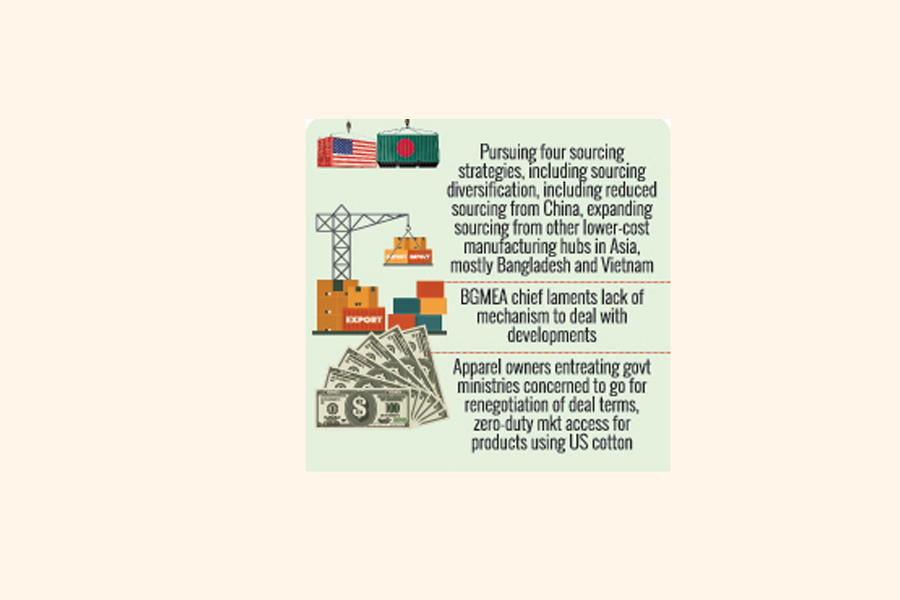
The good news is that on February 9, 2026, Bangladesh signed an Agreement on Reciprocal Tariff with the US. Under the agreement, the reciprocal tariff has been reduced to 19 per cent. A major achievement is zero tariff on exports of garments made using cotton and synthetic fibres imported from the US. The US produces the world's finest quality cotton. While we also import cotton from Brazil, Australia, Mali, Benin, Burkina Faso, and India, US cotton is slightly more expensive. The zero-tariff facility on finished products will make us more profitable. Since 54 per cent of Bangladesh exports are knitwear produced from natural cotton, using US cotton will unlock this zero-tariff advantage. The time has come to capitalise on this.

Europe remains a massive market for Bangladesh, accounting for half of our total garment exports. However, the recent India-EU Free Trade Agreement (FTA) has raised concerns about maintaining Bangladesh's position. This agreement between India and the 27 EU nations covers two billion people and about 25 per cent of global GDP. Under this deal, 144 Indian sub-sectors, including garments, textiles, leather, and footwear, will gain duty-free access to the EU. Bangladesh currently enjoys GSPEBA (Everything But Arms) facilities in the EU, which will continue until 2029 even after LDC graduation this November. We must prepare now for the GSP-Plus transition after 2029.

Even before the FTA with the EU, when the US imposed a 50 per cent reciprocal tariff on Indian goods, India took steps to boost exports to Europe. Indian government and textile representatives approached major European buyers such as Inditex Group (Zara), Polish LPP, German Aldi and Lidl, and French Auchan and C&A Netherlands, offering garments at lower prices. Similarly, China began supplying low-cost garments to the EU to offset shocks in the US market. As a result, the unit price of Bangladeshi garment products in the EU dropped by 3.84 per cent in 2025.

There has been long-standing talk about export diversification, but specific planning and development are lacking. Seventy per cent of our garment exports are cotton-based, while nearly 70 per cent of global apparel is made from MMF (Man-Made Fibre) or synthetic materials. Now is the time to leverage the zero-tariff facility by exporting MMF or synthetic garments to the US using American raw materials.

Beyond traditional European and American markets, we must expand exports to new destinations like the Gulf countries, Japan, Korea, Australia, New Zealand, and Latin America. The recently signed Bangladesh-Japan Economic Partnership Agreement (EPA) is a landmark deal that must be fully utilised. Under this agreement, 99.9 per cent of Bangladeshi products receive zero-duty access to Japan.

So, we remain optimistic that despite all adversities, Bangladesh will soon achieve its cherished goal of $100 billion in garment exports.

Mohammad Esha is Deputy Managing Director, Pubali Bank PLC​
 

BGMEA seeks uninterrupted energy supply
Staff Correspondent 13 April, 2026, 22:51

1776130335872.webp


The country’s readymade garment manufacturers on Monday sought the government’s support to ensure an uninterrupted energy supply for the RMG sector.

They sought support when a delegation of leaders from the Bangladesh Garment Manufacturers and Exporters Association met with the Minister for Power, Energy, and Mineral Resources, Iqbal Hassan Mahmood, and state minister Aninda Islam Amit at the ministry.Bangladesh travel

According to a press release, during the meeting, the BGMEA president Mahmud Hasan Khan Babu said that although buyer confidence has started to restore following the recent general election, the ongoing Middle East conflict has once again posed challenges to the global market.

He also said that neighbouring countries are ahead in energy security and that the current energy situation triggered by the conflict has put Bangladesh’s garment industry in a vulnerable position, according to a BGMEA press release here.

‘Due to insufficient gas and electricity supply, production capacity in factories has declined by 25–30 per cent,’ he added, placing several key proposals.

The trade body urged that a prompt diesel supply be ensured to garment factories from nearby filling stations under special arrangements.

It also urged the government to provide urgent gas connections, especially for small and medium industries (with boiler capacity of 300–500 kg), and ensure equitable gas distribution across industrial zones surrounding Dhaka.Maps

Installation of at least two additional Floating Storage Regasification Units at the earliest and simplification of the process for installing EVC meters at industries is a must, said BGMEA president.

The association also demanded the withdrawal of import duties and consumer-level taxes on imported fuel to reduce production costs and lessen the government’s subsidy burden.

The meeting also emphasised the importance of renewable energy.

BGMEA requested special tariff concessions on the import of solar PV system components to promote environmentally sustainable industrialization.

The association proposed reducing the existing high duties (ranging from 28.73 per cent to 61.80 per cent) on essential equipment such as solar panels, inverters, DC cables, and Battery Energy Storage Systems (BESS) to 1 percent.

The minister and the state minister listened attentively to the proposals and assured that necessary steps would be taken, considering the vital contribution of the RMG sector to the national economy, said the press release.

They also acknowledged BGMEA’s proposed format to facilitate emergency diesel supply from nearby filling stations.

BGMEA first vice-president Selim Rahman and vice-president (finance) Mizanur Rahman, and energy secretary Mohammad Saiful Islam were also present at the meeting.​
 

BGMEA demands policy support to sustain competitiveness of garment industry

FE ONLINE REPORT

Published :
Apr 15, 2026 20:54
Updated :
Apr 15, 2026 21:50

1776298397333.webp

A BGMEA team, led by its President Mahmud Hassan Khan, met with Commerce Minister Khandaker Abdul Muktadir at the secretariat in the capital. Photo: BGMEA

The apparel apex body, BGMEA, on Wednesday demanded policy support from the government to sustain the competitiveness of the country's garment industry amid mounting global economic challenges.

The organisation called for simplifying import and bonded warehouse policies, especially to facilitate raw material imports under Free of Cost (FOC) arrangements, and urged amendments to relevant provisions of the import policy, according to a statement.

A Bangladesh Garment Manufacturers and Exporters Association (BGMEA) delegation, led by its president Mahmud Hasan Khan, in a meeting with commerce minister Khandaker Abdul Muktadir, made the demands held at the secretariat office in the city.

They also demanded withdrawal of the existing 10 per cent income tax deduction on cash incentives to boost garment exports, while seeking steps to normalise trade relations with India and remove barriers to yarn imports and exports through land ports, it added.

They further proposed incorporating BGMEA recommendations into the amendments to the Import Policy (2024-2027) and called for automation of the criteria for granting Commercially Important Person (CIP) status to industry entrepreneurs.

During the meeting, the BGMEA leaders highlighted multiple challenges the industry is currently facing and stressed the need for policy support to ensure sustainable growth.

Quoting Mr Khan, the statement said global economic instability, the impact of the Middle East conflict, and local gas and power shortages are severely disrupting production in the apparel sector.

"Rising raw material prices and increasing production costs have further exacerbated the situation," he said, emphasising that strong policy support and a business-friendly environment are essential for the sector to remain competitive in the global markets.

The meeting also discussed the ongoing activities of the RMG Sustainability Council (RSC) and its role in addressing future industry challenges, said the BGMEA press release.

The BGMEA president clarified the association's position regarding the RSC's mandate, stating that the council was originally established to oversee occupational safety and health (OSH), including building, fire, and electrical safety.

"Social compliance or non-OSH issues like wages, leave, and trade unions are beyond the RSC's core jurisdiction,” he said, adding that expanding its scope into these areas would create unnecessary administrative and financial burdens on the industry, which is undesirable.

He further stressed that any decision in this regard must align with local laws and be taken in consultation with industry stakeholders.

The commerce minister paid a patient hearing to the concerns of the RMG sector and assured that the government would extend all necessary policy supports to help the sector overcome the current challenges and sustain Bangladesh's competitiveness in the global market.​
 

RMG exports brace for a gathering storm

Unsold inventories push Western buyers towards 10% order cuts while energy shortages disrupt apparel production

Refayet Ullah Mirdha

1776386842381.webp


Bangladesh’s garment sector is going through a period of sustained pressure as the war in the Middle East disrupts production and international retailers scale back orders.

Western retailers are expected to cut apparel orders by up to 10 percent next season, as higher clothing prices dampen demand and unsold stock piles up in stores.

The latest setback is another blow for local manufacturers, who are already dealing with frequent load shedding, rising transport costs and a deepening fuel crunch following the US-Israel war on Iran.

Exporters say the war has already driven up raw material import bills and freight charges for shipments abroad.

The readymade garment sector, which accounts for more than 80 percent of national export earnings, had only just begun to steady itself after reciprocal tariff turbulence.

But now, conditions are combining to create a perfect storm for the readymade garment sector. Many fear the combined effect could lead to a decline in future orders.

Preferring anonymity, a senior official of a leading European buyer said that overall, 8 percent to 10 percent of garment work orders will be cut for the next season as buyers begin placing orders.

He said retailers and brands across the West are still burdened with unsold winter merchandise, while goods for the current season have already arrived. As a result, orders for the next cycle have slowed.

Amid the fuel crisis, the official said freight costs inside Bangladesh have also climbed. The fare of goods-laden trucks plying between Dhaka and Chattogram has risen, despite no official increase in petroleum prices.

Truck operators, citing fuel rationing, have raised per-truck charges to Tk 50,000 from Tk 38,000. On average, he said fares have increased by around 20 percent since the outbreak of the war.

Moreover, factories that depend on diesel generators are facing mounting disruption. Many report delays in getting adequate supplies, while cotton prices have risen, pushing yarn costs up by 17 percent to 18 percent.

“But buyers are reluctant to absorb higher prices,” said the official. “The consumers will not pay higher prices during the bad times because of an increase in the cost of production. So, at the end of the year, the overall export growth in the garment sector may be much lower than last year.”

Another European buyer, also requesting anonymity, said that the war has slowed down the business and the recovery is still very uncertain.

He added that demand for outerwear in Europe could rise next season as higher energy prices prompt consumers to buy warmer clothing. However, inventories are still elevated.

Ramzul Seraj, managing director of Elite Garments Ltd, which exports to the United States, said demand for garment items in the US has weakened, while factory output in Bangladesh has been hit by diesel shortages.

Delays in production could force some exporters to use more expensive air shipments to meet delivery deadlines, he added.

Masud Kabir, managing director of Motex Fashion, a Gazipur-based sweater factory, said he receives diesel using a special card introduced by the Bangladesh Garment Manufacturers and Exporters Association (BGMEA). But the supply falls short of covering nearly eight hours of load-shedding.

He can run the factory with the diesel collected from a nearby petrol pump for three and a half hours, he said. As a result, production has suffered.

Anwar Ul Alam Chowdhury, chairman of Evince Group, said the government is supplying diesel, but factories require larger volumes to operate generators smoothly.

Md Fazlul Hoque, managing director of Plummy Fashions, said inadequate diesel supplies have also disrupted his operations. At the same time, freight charges for sea shipments have increased, along with prices of cotton, yarn and polyester.

The combined effect, Hoque said, is a likely decline in future orders.

Mohammad Hatem, president of the Bangladesh Knitwear Manufacturers and Exporters Association (BKMEA), said some competing countries such as Turkey are expanding exports despite the war, helped by their proximity to Europe and the United States and more reliable energy supplies.

He also expressed concern that recurring two-to-three-hour power cuts could lead to greater reliance on costly air freight.

BGMEA Director Faisal Samad said the association is in contact with buyers, urging them to take into account the exceptional circumstances created by the global oil crisis. Since April 13, member factories have been able to access diesel on a priority basis through a special card facility.

“Even so, overall productivity has declined because of insufficient fuel supplies,” he said.

BGMEA President Mahmud Hasan Khan said buyers also want factories to keep running as this is a global crisis.​
 

Latest Posts

Back