โ˜• Support Us โ˜•
[๐Ÿ‡ง๐Ÿ‡ฉ] - Those who have laid down their lives to free Bangladesh | Page 3 | PKDefense

[๐Ÿ‡ง๐Ÿ‡ฉ] Those who have laid down their lives to free Bangladesh

Reply (Scroll)
Press space to scroll through posts
G Bangladesh Defense
[๐Ÿ‡ง๐Ÿ‡ฉ] Those who have laid down their lives to free Bangladesh
82
3K
More threads by Saif


Deaths during student protest: 4 students' bodies exhumed in Feni for autopsies
Published :
Sep 12, 2024 00:01
Updated :
Sep 12, 2024 00:01


1726108649071.png


The bodies of students Ishtiaq Ahmed Shraban, Saidur Rahman Syed, Zakir Hossain Shakil and Md Sabuj, who were killed during the anti-discrimination studentโ€™s movement in Feni's Mohipal, have been exhumed for autopsies.

Of them, the bodies of Shraban and Syed of Fazilpur Kalatali area of Fulgazi Upazila were exhumed on Wednesday while the bodies of Shakil and Sabuj were exhumed on Tuesday on the orders of the court, reports UNB.

Later, the bodies were sent to Feni General Hospital for post-mortem.

On August 4, in support of the non-cooperation movement, the agitators were protesting in the Mohipal area of Feni on the Dhaka-Chattogram highway.

At the same time, the leaders and activists of Awami League and its allies took a stand on the trunk road of the city.

At around 2pm, when the leaders and activists of Awami League and allied organizations were moving towards Mohipal flyover, a clash broke out between the two groups.

At that moment, the surrounding became shaken by the explosion of shots, cocktails.

Sounds of firing were heard intermittently till 5pm.

At one stage of the clash, the police box of Mohipal was set on fire.

Nine people were killed in this incident and more than 150 people, including students, pedestrians and journalists, were injured by brickbats.​
 

Health ministry forms committee to confirm list of people martyred in popular uprising
bdnews24.com
Published :
Sep 13, 2024 23:25
Updated :
Sep 13, 2024 23:25

1726273351429.png


The health ministry has directed the field administration to authenticate the list of martyrs and injured victims from the civil uprising that toppled the Sheikh Hasina government.

An eight-strong committee has been formed to carry out this verification on the ground.

A letter signed by Umme Habiba, deputy secretary of the Health Service Division on Friday, outlined that a preliminary list was prepared based on data gathered from health institutions.

The letter said, โ€œA draft list has been created by the Management Information Department of the Directorate General of Health Services. It is crucial to verify this list on the ground.โ€

The committee will be chaired by the district commissioners and the district civil surgeon will serve as the member-secretary.

It will also include the superintendent of police, Upazila executive officer and two coordinators from the Anti-discrimination Student Movement.

The committee is tasked with verifying the list for accuracy, correcting any discrepancies and ensuring that no valid names are omitted.

They must submit the final, accurate list to the Health Service Division by Oct 14.

The letter specifies that only the names of martyrs and injured who supported the uprising should be included in the final list.

On Aug 15, the health ministry formed a committee to create a list of casualties.

The committee is led by former senior secretary of the Health Services Division Muhammad Humayun Kabir.

Under this committeeโ€™s supervision, the Health Directorate's MIS wing prepared the list, which has been submitted as a preliminary report.

According to ICT Advisor Nahid Islam, a total of 728 deaths and 20,263 injuries have been reported. In addition, a private source has provided a list of 800 martyrs, which is currently being verified.

District administrators have been instructed to submit a list from each district, with a final list expected by next Sunday, he added.

A state memorial event to honour the martyrs, scheduled for Saturday, has been postponed due to the list being incomplete.​
 

โ€˜At least 422 of the dead belong to the BNPโ€™
Fakhrul says govt should focus on 4 areas of reform, leave others for elected govt

1726442610624.png


BNP Secretary General Mirza Fakhrul Islam Alamgir yesterday said at least 422 of those killed in the July-August massacre were involved in party politics.

"According to various reports, 875 people were killed across Bangladesh until August 13, of whom at least 422 were involved in BNP politics," he said at a press conference at the BNP chairperson's Gulshan office.

"There is no scope for underestimating BNP's contribution [in the mass uprising]."

Reading out a statement, Fakhrul said, "It is not an isolated incident that the majority of the martyrs were BNP leaders and activists. It is a result of their long political struggle."

He said beside the student-led uprising, 1,551 BNP activists were killed during the Awami League regime until 2023, while 423 had been forcibly disappeared during the period.

"During this time, six lakh BNP leaders and activists were implicated in 1.5 lakh cases. This reflects the party's unwavering struggle and contribution towards the country's second liberation."

BNP sources said the party collected the names, identities, and addresses of the victims, and the list will be published on the party's official website.

Responding to journalists' questions, the BNP secretary general said preparing the report of Electoral System Reform Commission should not take more than two months. "Complete it within two monthsโ€ฆ"

In his televised address to the nation on Wednesday, Chief Adviser Prof Muhammad Yunus named Badiul Alam Majumdar as the head of the Electoral System Reform Commission, which is expected to finish its work within the next three months.

In this regard, Fakhrul said election-centric reforms should be given the highest priority.

"The reforms work should be completed quickly to move towards an election. The election will be held under a neutral government. The election will be free and fair. The people will elect their representatives by voting."

Fakhrul also identified the key areas requiring reforms, including the Election Commission, administration, law enforcement agencies, and the judiciary.

Other reforms will be carried out by the government that will come to power through polls, he added.

He said, "This interim government will implement reforms based on the opinions of all and then move forward to hold the election. The election will be free and fair, and power will be handed over to the people.

"We hear many responsible political parties saying things that are not very conducive to overall unity.​

"It is important to maintain unity. Be patient. Support all the work of this interim government and try to move forward."

The BNP will tomorrow hold a rally to mark International Democracy Day in front of its Nayapaltan central office at 3:00pm.

Party Standing Committee members Khandaker Mosharraf Hossain, Mirza Abbas, Nazrul Islam Khan, Abdul Moyeen Khan, and Salahuddin Ahmed were also present at the press conference.
 

Why did Abu Sayeed, fellows, sacrifice lives?
Mohammad Mozammel Haque 16 September, 2024, 00:00

1726533999721.png


THAT the Awami League had a master plan to capture power forever is discerned from some deplorable incidents that happened just after it assumed office in 2009. The party president, Sheikh Hasina, along with her leaders, did not hesitate even a little to kill our 57 patriotic army officers. Almost all the party leaders knew about what happened in the Border Guard Bangladesh (then Bangladesh Rifles) headquarters on February 25, 2009. This was the implementation of a pre-planned conspiracy against the army officers. Sheikh Hasina and her people knew well that if they could show off their strength to kill some selected army officers, they would be able to be in power for a long time. And unfortunately, we have seen the outcome of this plot for more than 15 years. From 2009 till the first half of 2024, our army could not play any role for the benefit of general people. This is because after the 57 senior army officers were cruelly murdered by the Awami League heinous gang, the army officers who supported the Awami League were posted into senior positions, and they did everything for keeping this party in power. Even during the July uprising, the army hardly played any positive role in favour of the students at the beginning of the movement. But when our patriotic students did not care about the so-called curfew and they came on the roads in the whole country on 4-5 August, they invited the army to shoot on them (the students); at that time most of the army officers lowered down their arms. Undoubtedly, there are a good number of officers in the Bangladesh Army who do not blindly support the Awami League; rather, they are very patriotic but could not stand against the Awami League for fear of losing their jobs. But this time their role is undoubtedly praiseworthy.

Furthermore, the Sheikh Hasina government displayed a ruthless approach towards suppressing any form of dissent or opposition. Ordinary citizens who attempted to mobilise for political or social causes faced severe repression. Supporters of opposition parties were frequently denied the right to assemble or express their demands. Even informal gatherings, such as marriage ceremonies or birthday parties, were not safe from harassment. Awami League supporters often targeted these events, leading to physical assaults or disruptions by calling the police. Countless incidents illustrate this climate of intimidation and violence. The police, under the Awami Leagueโ€™s influence, arrested opposition figures, sometimes resorting to extrajudicial killings. Many were shot in cold blood, while others were subjected to false and fabricated charges. As a result, opposition leaders and their supporters lived in constant fear, unable to sleep safely in their homes for days, months, or even years. The pervasive climate of fear and repression has severely impacted their ability to participate in political life and advocate for their causes. Moreover, the Awami League recruited thousands of police officers, army officers, and officers in other government and non-government fields only from the families who support this party. In this manner, the AL used the police, army, RAB, and BGB officers to foil any programmes organised by the opposition parties. The opposition parties were not allowed to organise any kind of programmes in the whole country. During their tenure, the AL-led government relied on legal and extralegal forms of repression to suppress its political opposition and dissenting voices. The attackers of Hindu temples, particularly during Durga puja, are often found to be linked with the AL.

In addition, the AL deprived the general people of our country of their voting rights. From 2014 to 2023, the people of Bangladesh could not exercise their right to vote for electing their future leaders. In every election, be it local or national, almost all the people were threatened and hindered from going to voting centres. If anybody has tried to visit the voting centre, s/he has been brutally punished by the supporters of AL although so many dead people have been shown to put their votes. If we go by the record, it appears that the AL is more engaged in violent acts, terrorism โ€” acts that are conventionally blamed the Islamist groups for. It is quite clear that the freedom as well as sovereignty of our beloved country was quite unsafe at the hands of the Awami League. They compromised our sovereign interest, as once stated by Sheikh Hasina, โ€˜India will never forget me for what I have given to her.โ€™

But, do we really know where our most beloved country is moving forward? Did Shaheed Abu Sayeed and other martyrs sacrifice their lives for a country where there will be corruption, discrimination, lawlessness, anarchy, extortion, exaction, extraction, blackmail, shakedown, and mayhem again? Just after the tragic downfall of an extortionist, coercer, and blackmailer, some other people of various political parties are doing the same as was done by their predecessor. This is undoubtedly a matter of great shock, tremor, and a matter of great shudder for the nation, which is still stained with the blood of thousands of innocent students, children, and general people. People injured during the July uprising are still fighting with death in the hospitals, and these criminals are trying to tarnish what great things have been achieved by these freedom fighters. Is it for seeing this kind of Bangladesh that our great martyrs sacrificed their lives? Of course not.

I think and firmly believe if the current situation persists, the spirit of our July uprsing โ€” whose wounds still remain unhealed โ€” along with students and ordinary citizens from all walks of life, regardless of their political, religious, or professional affiliations, will ignite a powerful revolt against any injustices in the future. The collective will of the people, including those from all communities, is likely to demand and fight for the countryโ€™s true independence, even if it means making the ultimate sacrifice. Therefore, it is crucial that we stay vigilant and alert to the conspiracies being hatched by those who seek to undermine our nationโ€™s values and freedom.​
 

Martyrsโ€™ families to get Tk 500,000 each, those of injured Tk 100,000
UNB
Updated: 18 Sep 2024, 23: 09

1726707630835.png

The first meeting of the executive committee of the July Shaheed Smriti Foundation was held at state guest house Jamuna on 18 September, 2024. UNB

The executive committee of the โ€œJuly Shaheed Smriti Foundationโ€ led by chief adviser Prof Muhammad Yunus has urged people from all sections of the society, the Bangladeshi diaspora and organisations and business firms to donate to the foundation.

Prof Yunus said donation of even a smallest amount of money should be documented and the list of the donors should also be preserved.

โ€œIf possible their names should be published on the website of the Foundation," he said, adding that โ€œThis foundation is an important milestone. We must strive hard to make it a success.โ€

The first meeting of the executive committee of the July Shaheed Smriti Foundation was held on Wednesday at state guest house Jamuna with Chief Adviser Prof Yunus in the chair.

The committee has decided that each family of the martyrs will primarily receive Tk 500,000 and each injured person will primarily get up to Tk 100,000.

The compensation for the injured persons will be made as soon as possible, while cheques for the families of the martyrs will be handed over at a commemorative event in the capital, according to the chief adviserโ€™s press wing.

The committee has also decided to find an office space and volunteers to run its operations. It will also preserve and archive all the video, images, oral history and other documents and memorabilia of the July-August mass uprising.

The chief adviser said the health ministry would pay for the treatment of the injured. The compensation that the Foundation will be giving to the injured will be in addition to the government's treatment expenses.

Advisers of the interim government Sharmeen Murshid, Nahid Islam and Asif Mahmud Shojib Bhuiyan, general secretary of the Foundation Mir Mahbubur Rahman Singdho and treasurer of the Foundation Kazi Waqar Ahmad were present in the meeting.​
 

708 in the draft list of martyrs of mass uprising
Special Correspondent
Dhaka
Published: 24 Sep 2024, 21: 25

The health ministry has published a draft list of martyrs of the people-student mass uprising that ousted the Awami League government. The draft list was published on the websites of the Health Services Division and Directorate General of Health Services Tuesday evening. There are names of 708 people on the list.

The health ministry disclosed the publication of the list in a public notification today. It said the draft list will be available on the websites of the Health Services division (www.hsd.gov.bd) and DGHS (www.dghs.gov.bd).

The list will be open to the public for corrections and additions till 6 October. The ministry has urged the families of the martyrs or their representatives to verify the relevant data on the list to complete the process.

The ministry also has requested the people who have any suggestion or any new information to add to the list to contact the hospitals concerned where the victim received treatment or any nearby government hospital.

The ministry has cited a few steps for making corrections. First, the family members of the martyrs or their representatives will have to register by submitting copies of their national ID cards, birth certificate or mobile number.

After registration, the person will have to download and print the data given on the list and fill up the blank options. After that the person will have to go to the nearby government hospitals where the person in charge will submit the form of newly added information and update those online. After that the person-in-charge of this at the hospital will check the website to verify whether the information was added properly or not.

Martyrsโ€™ families to get Tk 500,000 each, those of injured Tk 100,000

However, the ministry has requested the family members to contact the deputy commissioner (DC) or upazila nirbahi officer (UNO) concerned or the upazila health and family planning officer with proper evidence in case of any name missing from the list.​
 

Killings during uprising: Bangladesh can file complaint with ICC
Chief prosecutor of Hague-based court tells Yunus

1727482910588.png

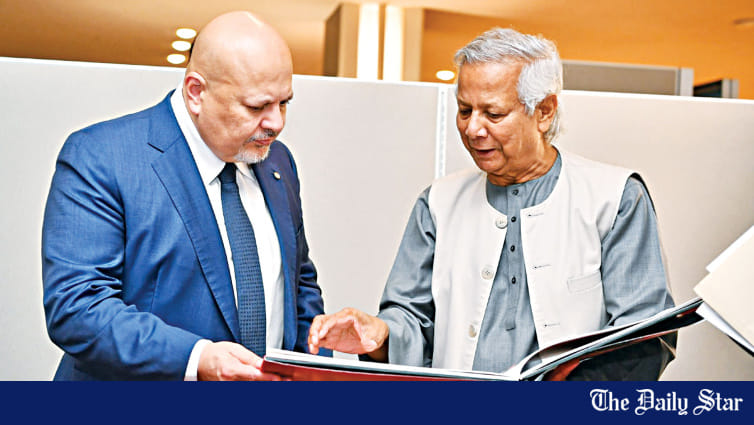
Chief Adviser Muhammad Yunus presents ICC Chief Prosecutor Karim AA Khan with a book titled โ€œArt of Triumphโ€ at the UN Headquarters in New York on Thursday. Photo: PID

ICC Chief Prosecutor Karim AA Khan has said Bangladesh can file a complaint at the International Criminal Court against those who committed a massacre during the July-August uprising.

He said this in response to a query from Chief Adviser Prof Muhammad Yunus regarding the process of filing a case at the ICC against the perpetrators of the massacre on charges of committing crimes against humanity.

The ICC chief prosecutor called on Yunus on the sidelines of the UN General Assembly in New York on Thursday.

The student-led mass uprising led to the ouster of Shiekh Hasina on August 5. Atrocities carried out by the law enforcers and activists of Hasina-led Awami League and its associate bodies left at least 700 people dead and more than 20,000 injured.

During the meeting, Karim apprised the chief adviser of the latest developments on the investigation, launched by the ICC in 2019, into the Rohingya crisis in Bangladesh and Myanmar.

Karim said he would visit Bangladesh by the end of this year. He also praised Yunus's three-point proposal to give a new momentum to resolve the Rohingya crisis.

The chief adviser put forward the proposals at a meeting at the UN Headquarters on Wednesday. The proposals included an urgent conference hosted by the UN chief to review the overall situation and suggest way outs, an energised joint response plan for the Rohingya humanitarian crisis and serious international efforts to support justice and accountability to address the genocidal crimes committed in Rakhine in 2017.

"The three points are perfect," Karim said.

EUROPEAN COMMISSION CHIEF MEETS YUNUS

European Commission President Ursula Von der Leyen has assured Chief Adviser Yunus that Bangladesh can count on Europe's support in its reform drive, reports UNB.

"We also remain your partner for steady growth and infrastructure development under Global Gateway," she said during a meeting with Yunus on the sidelines of the United Nations General Assembly on Thursday.

"Let's make the best out of our โ‚ฌ400 million Bangladesh Renewable Energy Facility," said the European Commission president.

Yunus also held meetings with the chiefs of the UN refugee agency and the International Labour Organisation at a New York hotel on the same day.

The high commissioner of the UN refugee agency, Filippo Grandi, discussed the Rohingya crisis with the chief adviser.

He called for a new approach to the crisis, saying that the international communities should do more to end the miseries of more than one million Rohingya in Bangladesh.

Grandi said the assumption of Professor Yunus as the new leader of Bangladesh has increased global interest in the Rohingya crisis. He hoped there will be more funding for the Rohingya humanitarian responses.

"The 700 million dollars from the World Bank is a good starting point," he said, adding that the UN stands ready to support more for the education of the Rohingya children.

Yunus stressed the need for finding a quick solution to the crisis and doing more for the future of hundreds of thousands of Rohingya children growing up in the camps in Bangladesh.

"We have to resolve this before it is too late. We have to find a solution," the chief adviser said.

Gilbert Houngbo, the director general of the International Labour Organisation, offered the UN labour agency's support for the interim government's move to implement ILO conventions in Bangladesh.

"We are at your disposal," he said, adding the ILO would respond to the chief adviser's call if and when he needed it.

Yunus said labour reforms are a top priority of his government as it sees the issue as a key to turning Bangladesh into a world class manufacturing hub.​
 

Rabbiโ€™s martyrdom yet to get recognition
Sisters struggle to get official acknowledgement for their 17-year-old brother

1727483859184.png


In the early hours of August 5, two young women were frantically searching for their 17-year-old brother, Ismail Hossen Rabbi, who had gone missing after leaving home the previous day to join the Anti-Discrimination student movement, breaking the lock on their tin-roofed house.

After hours of desperate searching, an Ansar member at the Dhaka Medical College Hospital morgue showed them several photographs. Among them, they found Rabbi -- lying lifeless on a stretcher, a single gunshot wound visible on his forehead, part of his brain exposed.

"Seeing the photo of my brother, my whole universe turned upside down," said Mim Akter, one of Rabbi's sisters.

The sisters requested the morgue authorities to release their brother's body but were told they first needed to prove their relationship.

When they asked how to do so, the authorities instructed them to bring police officers from the Jhigatola police box, who had reportedly left Rabbi at DMCH.

"However, when we sent our maternal uncles to the Jhigatola police box, they were chased away," Mim said.

"We begged the morgue authorities, explaining that the police wouldn't come, but they didn't listen," Mim added. "We were terrified they would disappear his body, just as we had heard happened to other students."

Later that afternoon, when protesting students arrived to retrieve the bodies of others, the sisters asked for their help. With the students' assistance, they managed to recover Rabbi's body from the morgue and, after pleading repeatedly, secured a death certificate from Ward 7.

However, the certificate only listed his name and date of death, without mentioning the cause, even though his forehead visibly bore a bullet wound.

Mim and her sister Mitu then hurriedly carried the body away, fearing the police might stop them.

"All my life, I thought my brother would carry our coffin one day. Never in my worst nightmare did I imagine that we would be carrying his," Mim said. "There are even videos of us, with the help of students, carrying my brother's body from the hospital," she added.

Despite possessing ample evidence -- including photographs of Rabbi's body, videos of their struggle to retrieve him, and a death certificate -- the sisters remain unable to secure their brother's martyr status.

Rabbi's name is absent from the martyr list, leaving them uncertain where to seek recognition for his sacrifice.

Furthermore, their attempts to file a case in court have been thwarted due to the lack of a postmortem report, a critical document they were never given.

After Rabby's burial in Madaripur, his sisters and student movement coordinators met with the DMCH director, who denied their request for a death certificate listing the cause of death, instructing them to get one from the local government instead.

"After getting the certificate from our Panchkhola Union Parishad chairman, we returned to submit it to the hospital authorities. However, the director said that he had been directed by the newly appointed health adviser to take more time, and the certificate would be provided eventually," said Mitu Akter, Rabby's sister.

"More than a month has passed, and that time has still not come. My brother still hasn't received official recognition as a martyr," she added.

In the meantime, the family spoke with several coordinators about where to go for the enlistment process, but they simply pointed to one another, and no one seemed to know the exact place to get this done.

"Is this our responsibility? If the government requires verification, they should direct us to a specific location. Many families of martyrs like us are in the same situation; they also don't know where to turn. Many bodies have disappeared or been burned to ashes. How will they be enlisted? This independence was earned at the cost of their lives -- do their lives hold no value? Will they receive no recognition?" asked Mim.

According to Mim, Rabby was a second-semester student at Shariatpur Polytechnic Institute.

Rabby's father, Md Miraz Talukder, a van driver by profession, lives hand to mouth. His mother, Asma Begum, teaches Arabic to students, while Mim manages daily expenses through private tutoring and sent money to Rabby to cover his living costs at the mess.

"When I found out he had joined the protest in Shariatpur, we brought him back to Sayedabad, where we live. He had even been hit by a rubber bullet on July 19 at Shahbagh," said Mim.

"By the end of July, when many students were losing their lives and social media was flooded with images and videos of injured or dead students and civilians, he refused to stay home, despite our pleas."

"On August 4, while we were at tuition, he somehow managed to unlock the door and leave. After that, I couldn't reach him by phone.

"In our last conversation on August 3, he said, 'You're worrying about me? What about Mugdha Bhai or Abu Sayed Bhai? They're already martyrs. If I die, I'll be one too.' He did become a martyr, but hasn't received that recognition yet."

On September 25, the sisters managed to meet with Information Adviser Md Nahid Islam alongside the family members of another victim -- Miraj Hossain.

The adviser assured all martyrs and injured individuals will be included in the official list.​
 

1,581 killed in mass uprising: students
DU Correspondent 28 September, 2024, 23:53

1727568677598.png


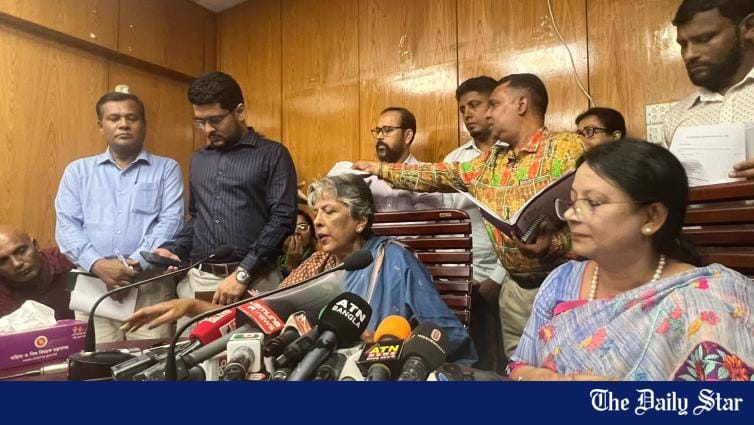
The health affairs sub-committee of the Student Movement against Discrimination at a press conference on Saturday said that they prepared a list of 1,581 people who were martyred in the July revolution.

The press conference was held at the TSC auditorium of Dhaka University, only seven days after the same committee revealed 1,423 deaths in the massacre.

Convener of the National Citizen Committee Muhammad Nasiruddin Patwari at the press conference said that they had listed a total of 1,581 martyrs.

โ€˜Itโ€™s not the final list. Finalisation of the list is still ongoing. We will provide the final list after some days. We will publish the martyrsโ€™ list according to international rules so that the families of martyrs donโ€™t get into any trouble,โ€™ he said.

Farhad Alam Bhuiyan, a member of the citizen committee, Tariqul Islam, member secretary of the subcommittee and convener Nahida Bushra, among others, were present at the conference.

Forhad Alam Bhuiyan said that As-Sunnah Foundation, Human Rights Support Society, Red July and other organisations assisted in the preparation of the primary list. The local people in different areas also helped them gather authentic information.

Tariqul Islam said that the preliminary list of deaths was forwarded to the committee headed by the deputy commissioners, which would submit the final list to the Ministry of Health after verifying the information.

The health ministry, the UN Office of the High Commissioner for Human Rights and different non-governmental organisations, meanwhile, are coming up with different death figures.

On September 24, the directorate general of health services published a list of 708 victims which was updated to 717 deaths on Thursday.

Health adviser to the interim government Nurjahan Begum after visiting central police hospital in the capitalโ€™s Rajarbagh on August 29 said that more than 1,000 people were killed, and over 400 were blinded during the student-led mass uprising.

Earlier, on August 21, non-governmental organisation Human Rights Support Society published a report putting the figure of deaths at 819 based on information collected through interviews with the victimsโ€™ families and from hospitals, witnesses and national dailies.

According to a primary report of the UN Office of the High Commissioner for Human Rights published on August 16, as many as 650 people were killed during the student-led mass uprising between July 16 and August 11.

Of these, nearly 400 deaths were reported from 16 July to 4 August, while around 250 people were reportedly killed following the new wave of protests between 5 and 6 August.

The UN office report also found that the security forces, including police and Border Guard Bangladesh, used unlawful lethal force and deliberately targeted unarmed people.​
 

'We want justice before we die'
Say families of victims at Nagorik Committee event

1728173967473.png


The government has failed to address its top priorities within the first two months of taking office, alleged family members of the martyrs of the July uprising.

They voiced frustration over the delay in starting the trial of those responsible for the massacre, completing the list of martyrs, and beginning the rehabilitation of the martyrs' families.

Speaking at a rally in front of the National Museum yesterday, Md Idris, father of Maruf Hossain, who was killed in clashes with police on July 19 in Rampura, questioned how the government would hold the perpetrators accountable, given that many top Awami League leaders have reportedly fled the country.

"If the leaders have run away, how will you [the government] bring them to justice?" he asked.

It breaks my heart that I cannot hear the word 'baba' [father] from my son anymore. But hundreds of students now call me baba.โ€” Saiful Islam Father of martyred Mominul Islam.

The rally, organised by the Jatiya Nagorik Committee, called for justice for the July massacre, rehabilitation for the martyrs' families, proper treatment for the injured, improvements in law enforcement, and measures to address price hike.

Idris recounted how, on July 26, detectives visited his house and interrogated him about his son's involvement with Jamaat-Shibir. He said the officers attempted to take him away but left after a lengthy argument with his family.

1728174028467.png

Saiful Islam weeps as he speaks about his son Mominul Islam, who was killed on July 19 during the quota reform movement, at the gathering held by the citizenโ€™s committee in front of the National Museum in the capitalโ€™s Shahbagh yesterday. Mominulโ€™s photos were held aloft next to Saiful as he spoke. Story on Page 3. PHOTO: PALASH KHAN

"If August 5 had not happened, I might have also ended up in Aynaghar [a notorious detention centre]," he said.

Denied support from the police, Idris lodged a case with the International Crimes Tribunal. He expressed frustration over the lack of progress and demanded to know when justice would be served.

Saiful Islam, father of Mominul Islam, who was martyred on July 19 in Mirpur, shared similar concerns. "We want justice before we die. All those responsible for the massacre should be punished," he said.

"It breaks my heart that I cannot hear the word 'baba' [father] from my son anymore. But hundreds of students now call me baba," he added.

Family members of other martyrs, including Raihan Hossain's brother, echoed these sentiments.

"Two months have passed, and the government has not even started the procedures for justice," he said.

Nasiruddin Patwary, convener of the committee, criticised the government for its lack of progress in rehabilitating the martyrs' families and treating the injured.

"Many of the injured are still suffering in hospitals. The government must ensure proper treatment," he urged.

He said the revolution had been driven by the financial desperation of the marginalised, yet their economic situation remains unchanged.

"Egg prices have skyrocketed, and market syndicates are still active. The government must act immediately to curb this," he said.

Patwary also warned political parties not to exploit the martyrs for their own agenda. "Understand the pulse of the people, especially the youth and students," he added.

Akhter Hossain, the committee's member secretary, emphasised that the government must bring to justice all those responsible for the massacre, including those who gave the orders and those who carried out the violence.

He said the previous government had been subservient to India, but the current administration, born of revolution, should show courage in handling these challenges.

The rally, conducted by Nagorik Committee member Ariful Islam Adeeb, was attended by the families of martyrs Shahriar Hassan Alvi, Khalid Saifullah, Nahidul Islam, Mosharraf Hossain, and Matiur Rahman.

Other speakers included Pritam Das, Sanjida Islam Tuli, Abdul Ahad, and Moshiur Rahman.​
 

Members Online

Latest Posts

Latest Posts