 Indian Defense
Krishna with Flute
Senior Member
- Jan 26, 2024
- 5,689
- 3,036
- Axis Group

After iPhones, India eyes to add missiles, helicopters and battleships to its export basket with cheap loan offer
Story by Firstpost• 1d•
6 min read
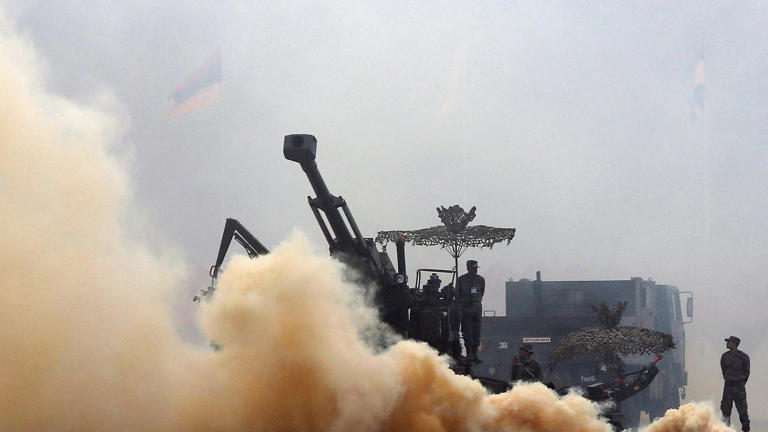
Indian Army soldiers participate in a mock drill exercise during the Army Day parade in New Delhi, India. File image/ Reuters© Copyright (C) https://firstpost.com. All Rights Reserved.
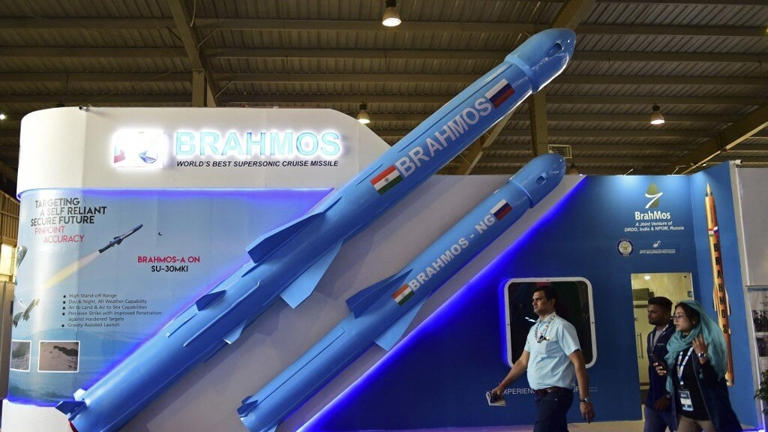
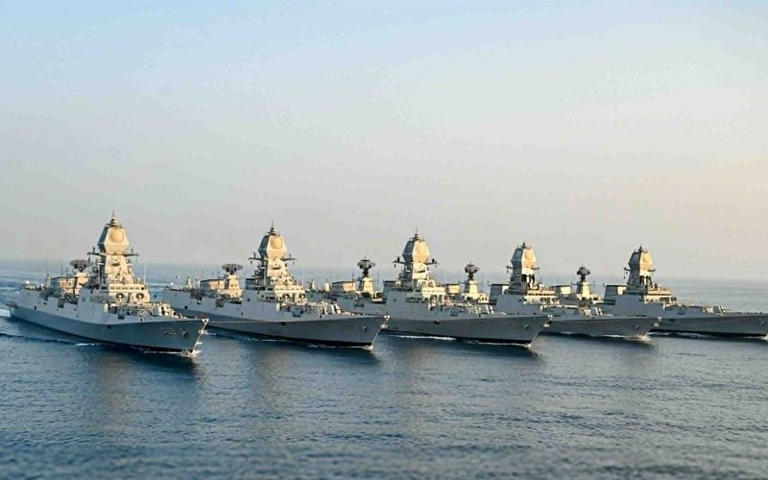
Prime Minister Narendra Modi's bid to transform India into a global factory floor has produced billions of dollars of low-cost iPhones and pharmaceuticals. Now he hopes to add missiles, helicopters and battleships to the shopping carts of foreign governments.
The world's largest importer of weapons after Ukraine is expanding the ability of the state-owned Export-Import Bank (EXIM) to offer long-term, low-cost loans to clients, including those whose political or credit risk profiles may limit their access to conventional financing, according to two Indian officials and three industry sources.
FirstCry IndiaSTABILO Flow Fountain Pen - Active Black
Ad
New Delhi will also sharply increase the number of defense attachés in its foreign missions as part of a new program that will see the government directly negotiate some arms deals, four Indian officials said. India is particularly targeting governments which have long relied on Russia for arms, two of the people said.
India's plans, which were detailed to Reuters by 15 people and have not been previously reported, mark an unprecedented effort by the government to inject itself into the recruitment and financing of foreign buyers as the world is rearming and longstanding geopolitical relationships are being recast.
Indian bureaucrats have long focused more on buying fighter aircraft from Russia's Sukhoi and howitzers from the United States to ward off China and Pakistan, Delhi's two nuclear-armed neighbors. While India has long had a small-arms production sector, its private firms have only recently started to make higher-end munitions and equipment.
 Related video: India builds its electronics edge despite tariff threats (WION)
All right, India is quietly emerging as a global electronics
Loaded: 13.20%
The Indian defense and external affairs ministries, as well as Modi's office, did not respond to requests for comment. EXIM declined to comment.
“India is marching towards achieving the target of increasing defence exports,” defense minister Rajnath Singh wrote on X this month.
One turning point was Russia's invasion of Ukraine in February 2022, according to an Indian official tasked with growing arms exports. Like most of the people interviewed by Reuters for this story, the official spoke on condition of anonymity to discuss sensitive government matters.
Spare Western arsenals were shipped to Kyiv while Russia's factories churned out munitions almost exclusively for its war effort. That left other nations that had historically relied on Washington and Moscow - the world's two largest arms exporters - scrambling for alternatives.
With its history of buying and absorbing arms technology from both the West and Russia, Delhi started to get more inquiries, the official said.
In response to Reuters' questions, Russian state arms exporter Rosoboronexport referred to previously issued statements that said it was in talks with India about jointly producing and promoting equipment to third-party states that are "friendly to Russia."
The Pentagon had no comment.
India produced $14.8 billion of arms in 2023-2024 fiscal year, up 62% since 2020, government data show. Some Indian-made artillery shells were found on the frontline in Ukraine in support of Kyiv's defense, Reuters previously reported.
Delhi has started brokering meetings between visiting delegations and domestic arms contractors, as well as demonstrating more sophisticated equipment like combat helicopters during military exercises, four officials said.
Viraj Solanki, a research fellow at London's International Institute for Strategic Studies think-tank, said India faced challenges selling its newer and more high-end wares.
"Unless it starts using its indigenous equipment more frequently and demonstrating its effectiveness, it is likely to struggle to convince potential buyers," he said.
Fast and cheap
Modi's government has set a target of doubling arms-and-equipment exports to $6 billion by 2029. It hopes sales will go beyond the ammunition, small arms and defense-equipment components that currently compose much of its military exports.
Delhi missed its target of $3.5 billion in arms sales for the latest fiscal year by about a third, but that still marks a significant increase from the $230 million in weapons and defense components it exported a decade ago.
At a time of stretched global budgets and burgeoning defense demand, India is pitching itself partially as a relatively low-cost producer.
India can produce 155 mm artillery ammunition for about $300 to $400 a piece, two Indian sources said, while European equivalents sell for upwards of $3,000.
Indian firms have also sold howitzers for about $3 million each, one of them said, or roughly half what a European-made version costs.
While Western nations that reduced artillery and other defense production after the Cold War are rushing to restart factories, state-owned Munitions India was among the Indian firms that kept such capacity.
Delhi - which has in recent years faced off with Pakistan and China in combat - had a different strategic scenario, said retired naval Cdr. Gautam Nanda, who leads KPMG's Indian aerospace and defense consulting practice. "There were no cuts on our production capacity."
Private manufacturers like Adani Defence and Aerospace and armor-and-ammunition maker SMPP are beginning to produce 155 mm artillery shells, which they said had already been ordered by foreign governments.
"With this changing scenario, definitely we see a huge, massive demand for artillery ammunition," said SMPP chief executive Ashish Kansal, whose company is setting up a plant to manufacture large caliber 155 mm artillery ammunition.
Higher-end weapons
India plans to use increased financing of arms exports via EXIM, which had a loan portfolio of $18.32 billion in the 2023-24 fiscal year, to move its products up the value chain.
Such financing will largely be conducted by EXIM's commercial business, which has the state as a backstop but doesn't draw solely from the national budget. Indian arms makers lobbied heavily for the move, an industry source said.
Most banks in India have been unwilling to offer commercial loans for arms exports because they don't want to deal with countries that may have higher credit and political risks, one Indian diplomat told Reuters.
That has long hampered India from competing on big deals with countries like France, Turkey and China, whose packages come with financing or credit guarantees, the diplomat said.
One market India is hoping to expand in is Brazil, where EXIM opened an office in January.
Delhi is in talks to sell Akash missiles to Brasília, according to two industry sources and two Brazilian officials. Even as India faces shortfalls in its own shipbuilding capacity, it is also pursuing a deal to build battleships for Brazil, according to the two Brazilian officials and an Indian official.
India's Bharat Electronics, which develops components for the Akash missile system, opened a marketing office in São Paulo this year, two Indian industry sources said.
EXIM was expected to help finance some of the deals in Brazil, they added.
Brazil's army said in an email to Reuters that the developers of Akash had responded to a request for information and that it had not made a decision on the purchase.
Bharat Electronics did not respond to requests for comment.
Strategic autonomy
Delhi is focusing its arms-export strategy on countries in Africa, South America and Southeast Asia.
India plans to dispatch at least 20 new defense attachés to foreign embassies by March 2026, three Indian defense officials said. Their host nations include Algeria, Morocco, Guyana, Tanzania, Argentina, Ethiopia, and Cambodia, they said, adding that Delhi believed it had the ability to significantly expand arms exports to those governments.
One of the officials said this would be accompanied by a reduction in the number of defense attachés posted to Western embassies, who would be sent elsewhere.
The attachés have been tasked with promoting Indian weapons and were given resources to analyze the arms requirements of their host governments, the officials said.
Like India, many of these nations have a history of buying military equipment from the Soviet Union and Russia, which differs from the NATO standards adopted by many Western producers.
One early success story is Armenia, where India posted a defense attaché for the first time last year.
India has already eroded Russia's monopoly over arming Armenia, which was part of the Soviet Union but has since said that it cannot rely on Moscow.
It sold 43% of the arms Armenia imported between 2022 and 2024, according to data from the Stockholm International Peace Research Institute, up from almost nothing between 2016 and 2018.
Rosoboronexport said in March that SIPRI, which relies on open-source information, does not have comprehensive data.