Bangladesh Defense
Saif
Senior Member
- Jan 24, 2024
- 19,004
- 8,834
- Nation

- Residence
- Axis Group


Govt officials should have mentality to work in all positions: PM
Stating that every position in public administration is important for the government, Prime Minister Tarique Rahman today, Sunday, said that it is essential for government officials to have the mentality to work in all positions. “If professionalism is compromised only for promotion or posting...
 en.prothomalo.com
Govt officials should have mentality to work in all positions: PM
The Prime Minister said that the current government had to start its journey amid the most fragile economy, weak and divided public administration and deteriorating law and order situation in the country’s history.
BSS
Dhaka
Published: 03 May 2026, 22: 26
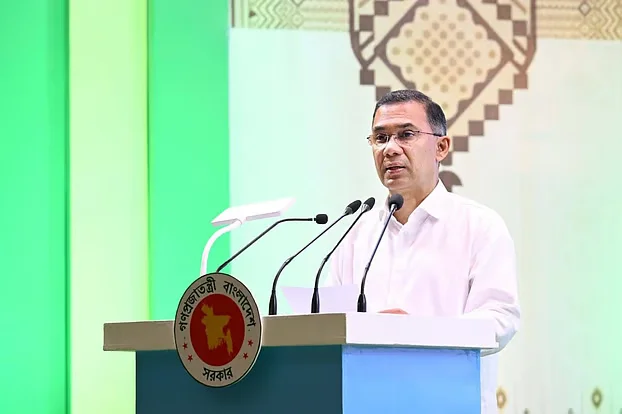
Prime Minister Tarique Rahman addresses the four-day DCs Conference 2026 at the Osmani Memorial Auditorium in Dhaka on 3 May 2026 BSS.
Stating that every position in public administration is important for the government, Prime Minister Tarique Rahman today, Sunday, said that it is essential for government officials to have the mentality to work in all positions.
“If professionalism is compromised only for promotion or posting in one’s preferred place, you may benefit temporarily, but it negatively affects the efficiency and neutrality of public administration as a whole,” he said while addressing the Deputy Commissioners’ (DCs) Conference this morning.
Earlier, the Prime Minister formally opened the four-day DCs Conference-2026 around 10:30 am at the Osmani Memorial Auditorium in the city, which will continue till 6 May.
Tarique Rahman, also chairman of the ruling BNP (Bangladesh Nationalist Party), said the mentality of always wanting appointment or posting in preferred positions is one of the main reasons for making the government officials corrupt and unprofessional.
“Therefore, my special request to you is to consider every path in public administration as important and inevitable. Keep you mentally prepared to perform duties in any position of public administration, at any place in the country, at any time,” he said.
Noting that honesty, merit and efficiency are the main principles in recruitment, transfer or promotion in public administration, the premier said that the government is firmly committed to ensuring accountability in the effectiveness of the administrative structure everywhere, including quick recruitment of manpower in vacant posts with transparency, formation of a strong Public Service Commission (PSC) and formulation of private service rules.
Cabinet members, advisers, the cabinet secretary, chiefs of three services, other senior officials and divisional commissioners were present at the inaugural ceremony.
The Prime Minister earlier walked from his office at the Bangladesh Secretariat to the Osmani Memorial Auditorium to join the programme around 10:20 am.
At that time, people standing on both sides of the road greeted the Prime Minister, who responded by waving back at them.
Noting that the present government is the reflection of the aspirations of general people, who have long expected an accountable, justice-based and welfare-oriented governance system, the Prime Minister said it is normal that the people would want to see a real reflection of their aspirations through every work of the government.
“Divisional commissioners and deputy commissioners are the main bridge between the government and the people. The success of the activities undertaken by the government depends entirely on your (DCs) honesty, efficiency and sense of responsibility,” he added.
At the beginning of the event, the Prime Minister thanked the government officials, who demonstrated their professionalism and performed national duty in the last national election.
“You have proved in the 12 (February) election that if public administration works properly, the people’s verdict is definitely reflected. On the other hand, we have also seen in 14, 18 or 2024 what can happen if you are not allowed to work,” he said.
“Yesterday afternoon you saw a sports event for children. You saw with what spirit the children want to move forward. I think the main spirit or motto of today’s deputy commissioners’ conference should be that motto of those children. That is, moving forward—let that be the spirit of today’s event,” Tarique Rahman added.
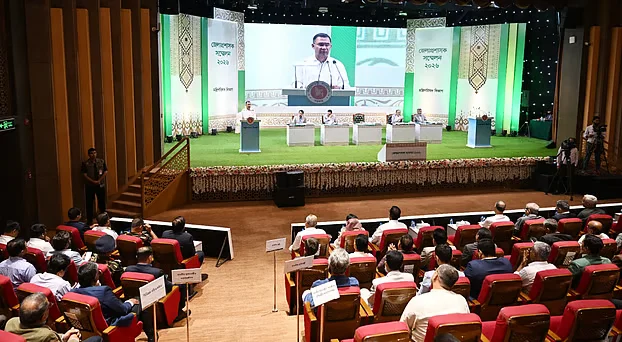
Prime Minister Tarique Rahman addresses the four-day DCs Conference 2026 at the Osmani Memorial Auditorium in Dhaka on 3 May 2026 BSS.
Prime Minister’s Adviser for Public Administration Ministry Md Ismail Zabihullah, State Minister Md Abdul Bari and Prime Minister’s Principal Secretary ABM Abdus Sattar also spoke at the event, among others.
This is the first DC Conference since the BNP formed the government in February this year.
The Prime Minister said that the current government had to start its journey amid the most fragile economy, weak and divided public administration and deteriorating law and order situation in the country’s history.
“(However) with your cooperation, we have been able to change much of that situation in these two and a half months.
During fascist rule, corruption and looting had burdened the state and the people with debt. On the other hand, the current war situation has emerged as a challenge for the new government,” he added.
Tarique Rahman said, perhaps no country in the world has been spared from the war situation at this moment while Bangladesh has also been affected.
“However, our effort is how we can all together face the situation without increasing the suffering of the people. With your cooperation, we have continued that effort,” he added.
“While facing this very situation, the current government wants to establish a justice-based welfare state in the light of the country’s eternal religious and social values,” the Prime Minister said, adding, to achieve this goal, the government has started implementing various initiatives to improve the living standards of the people from every profession and class in the country.
“On the basis of a policy, through public administration- that is, through you- we have already introduced Family Card, Farmer Card, Sports-related initiatives, and monthly honorariums for imams, muezzins and other religious leaders in the country. These activities have started through you,” he said.
“We want to gradually implement our election manifesto and every point and every commitment we made in the July charter. We are committed in this regard. I hope you will be able to play a role in efficiently implementing every promise made by the government to the people with your talent and qualifications, InShAllah,” the head of the government said.
Advising deputy commissioners not to use excessive laws and regulations and complications as excuses, the Prime Minister said, “Let’s try to develop the mentality of taking realistic, effective and public-interest-related decisions at all levels of administration so that people can receive the expected benefits of every government programme on time”.
Mentioning that the world has entered the age of Artificial Intelligence (AI), Tarique Rahman said, “We are all aware of this. To survive in global competition, public administration officials must also keep themselves prepared to face the times”.
Stressing that this conference should not be just a place for formal exchange of views, he said rather, it should be a platform where the real experiences, limitations, needs and innovative thinking of field administration can be directly reflected in the national-level decision-making process.
Terming the DCs as the government’s administrative ambassadors at the field level, the Prime Minister said controlling commodity prices, maintaining market discipline and ensuring fair prices for farmers are extremely important.
He stressed the need for making mobile court operations effective, regular and visible.
Besides, the Prime Minister instructed DCs to keep strict watch so that service seekers do not face unnecessary harassment, delay or irregularities while visiting government offices.
“You should seriously address any legitimate complaint of the people. Strict measures must be taken to maintain law and order, control drug abuse and maintain communal harmony, and prevent child marriage, violence against women and children- the matters that are within your capacity,” he said.
Stating that national unity is “our greatest strength”, Tarique Rahman said, “Differences of opinion may exist among us. But in the interest of the country, personally as a political worker, I believe ‘Bangladesh First’.”
A total of 34 sessions will be held during this four-day DC Conference. Among these, 30 will be working sessions, and the number of participating ministries or divisions is 56.
A total of 1,729 proposals were submitted by the DCs to the government on different issues related to governance. Out of those proposals 498 have been included in the working papers. The highest 44 proposals came related to the Health Services Division.
Ministers and state ministers of 56 ministries and divisions will provide necessary instructions to the deputy commissioners regarding their respective ministries at the conference.
The Prime Minister said that the current government had to start its journey amid the most fragile economy, weak and divided public administration and deteriorating law and order situation in the country’s history.
BSS
Dhaka
Published: 03 May 2026, 22: 26
Prime Minister Tarique Rahman addresses the four-day DCs Conference 2026 at the Osmani Memorial Auditorium in Dhaka on 3 May 2026 BSS.
Stating that every position in public administration is important for the government, Prime Minister Tarique Rahman today, Sunday, said that it is essential for government officials to have the mentality to work in all positions.
“If professionalism is compromised only for promotion or posting in one’s preferred place, you may benefit temporarily, but it negatively affects the efficiency and neutrality of public administration as a whole,” he said while addressing the Deputy Commissioners’ (DCs) Conference this morning.
Earlier, the Prime Minister formally opened the four-day DCs Conference-2026 around 10:30 am at the Osmani Memorial Auditorium in the city, which will continue till 6 May.
Tarique Rahman, also chairman of the ruling BNP (Bangladesh Nationalist Party), said the mentality of always wanting appointment or posting in preferred positions is one of the main reasons for making the government officials corrupt and unprofessional.
“Therefore, my special request to you is to consider every path in public administration as important and inevitable. Keep you mentally prepared to perform duties in any position of public administration, at any place in the country, at any time,” he said.
Noting that honesty, merit and efficiency are the main principles in recruitment, transfer or promotion in public administration, the premier said that the government is firmly committed to ensuring accountability in the effectiveness of the administrative structure everywhere, including quick recruitment of manpower in vacant posts with transparency, formation of a strong Public Service Commission (PSC) and formulation of private service rules.
Cabinet members, advisers, the cabinet secretary, chiefs of three services, other senior officials and divisional commissioners were present at the inaugural ceremony.
The Prime Minister earlier walked from his office at the Bangladesh Secretariat to the Osmani Memorial Auditorium to join the programme around 10:20 am.
At that time, people standing on both sides of the road greeted the Prime Minister, who responded by waving back at them.
Noting that the present government is the reflection of the aspirations of general people, who have long expected an accountable, justice-based and welfare-oriented governance system, the Prime Minister said it is normal that the people would want to see a real reflection of their aspirations through every work of the government.
“Divisional commissioners and deputy commissioners are the main bridge between the government and the people. The success of the activities undertaken by the government depends entirely on your (DCs) honesty, efficiency and sense of responsibility,” he added.
At the beginning of the event, the Prime Minister thanked the government officials, who demonstrated their professionalism and performed national duty in the last national election.
“You have proved in the 12 (February) election that if public administration works properly, the people’s verdict is definitely reflected. On the other hand, we have also seen in 14, 18 or 2024 what can happen if you are not allowed to work,” he said.
“Yesterday afternoon you saw a sports event for children. You saw with what spirit the children want to move forward. I think the main spirit or motto of today’s deputy commissioners’ conference should be that motto of those children. That is, moving forward—let that be the spirit of today’s event,” Tarique Rahman added.
Prime Minister Tarique Rahman addresses the four-day DCs Conference 2026 at the Osmani Memorial Auditorium in Dhaka on 3 May 2026 BSS.
Prime Minister’s Adviser for Public Administration Ministry Md Ismail Zabihullah, State Minister Md Abdul Bari and Prime Minister’s Principal Secretary ABM Abdus Sattar also spoke at the event, among others.
This is the first DC Conference since the BNP formed the government in February this year.
The Prime Minister said that the current government had to start its journey amid the most fragile economy, weak and divided public administration and deteriorating law and order situation in the country’s history.
“(However) with your cooperation, we have been able to change much of that situation in these two and a half months.
During fascist rule, corruption and looting had burdened the state and the people with debt. On the other hand, the current war situation has emerged as a challenge for the new government,” he added.
Tarique Rahman said, perhaps no country in the world has been spared from the war situation at this moment while Bangladesh has also been affected.
“However, our effort is how we can all together face the situation without increasing the suffering of the people. With your cooperation, we have continued that effort,” he added.
“While facing this very situation, the current government wants to establish a justice-based welfare state in the light of the country’s eternal religious and social values,” the Prime Minister said, adding, to achieve this goal, the government has started implementing various initiatives to improve the living standards of the people from every profession and class in the country.
“On the basis of a policy, through public administration- that is, through you- we have already introduced Family Card, Farmer Card, Sports-related initiatives, and monthly honorariums for imams, muezzins and other religious leaders in the country. These activities have started through you,” he said.
“We want to gradually implement our election manifesto and every point and every commitment we made in the July charter. We are committed in this regard. I hope you will be able to play a role in efficiently implementing every promise made by the government to the people with your talent and qualifications, InShAllah,” the head of the government said.
Advising deputy commissioners not to use excessive laws and regulations and complications as excuses, the Prime Minister said, “Let’s try to develop the mentality of taking realistic, effective and public-interest-related decisions at all levels of administration so that people can receive the expected benefits of every government programme on time”.
Mentioning that the world has entered the age of Artificial Intelligence (AI), Tarique Rahman said, “We are all aware of this. To survive in global competition, public administration officials must also keep themselves prepared to face the times”.
Stressing that this conference should not be just a place for formal exchange of views, he said rather, it should be a platform where the real experiences, limitations, needs and innovative thinking of field administration can be directly reflected in the national-level decision-making process.
Terming the DCs as the government’s administrative ambassadors at the field level, the Prime Minister said controlling commodity prices, maintaining market discipline and ensuring fair prices for farmers are extremely important.
He stressed the need for making mobile court operations effective, regular and visible.
Besides, the Prime Minister instructed DCs to keep strict watch so that service seekers do not face unnecessary harassment, delay or irregularities while visiting government offices.
“You should seriously address any legitimate complaint of the people. Strict measures must be taken to maintain law and order, control drug abuse and maintain communal harmony, and prevent child marriage, violence against women and children- the matters that are within your capacity,” he said.
Stating that national unity is “our greatest strength”, Tarique Rahman said, “Differences of opinion may exist among us. But in the interest of the country, personally as a political worker, I believe ‘Bangladesh First’.”
A total of 34 sessions will be held during this four-day DC Conference. Among these, 30 will be working sessions, and the number of participating ministries or divisions is 56.
A total of 1,729 proposals were submitted by the DCs to the government on different issues related to governance. Out of those proposals 498 have been included in the working papers. The highest 44 proposals came related to the Health Services Division.
Ministers and state ministers of 56 ministries and divisions will provide necessary instructions to the deputy commissioners regarding their respective ministries at the conference.