Bangladesh Defense
Saif
Senior Member
- Joined
- Jan 24, 2024
- Messages
- 21,818
- Likes
- 9,805
- Nation

- Residence
- Axis Group

Non-leather footwear exports stall, miss global boom
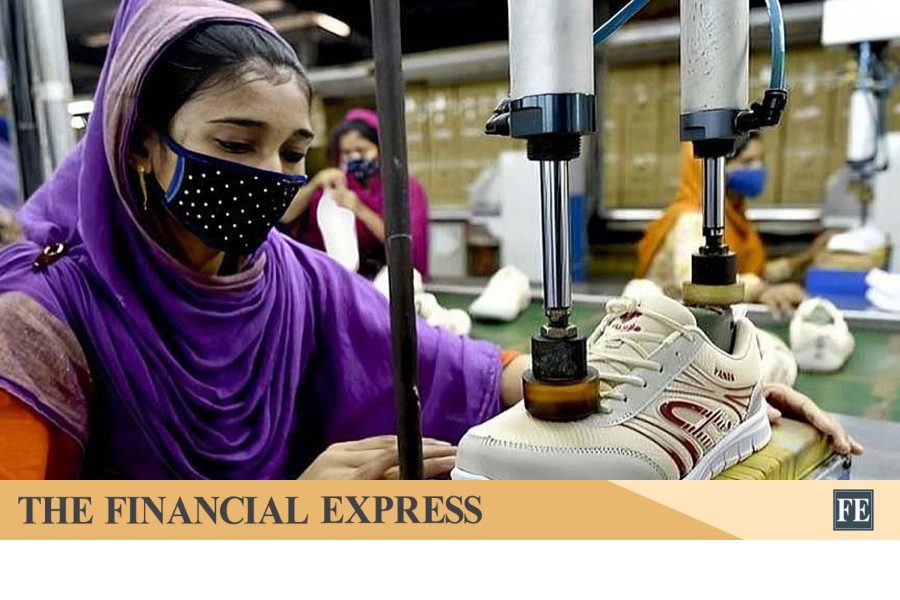
After rebounding strongly over two years, the non-leather footwear exports lost momentum in the last fiscal year, logging only 1.6 percent growth as manufacturers grappled with high borrowing costs, capacity constraints and lingering political uncertainty.
Non-leather footwear exports stall, miss global boom
Jagaran Chakma
After rebounding strongly over two years, the non-leather footwear exports lost momentum in the last fiscal year, logging only 1.6 percent growth as manufacturers grappled with high borrowing costs, capacity constraints and lingering political uncertainty.
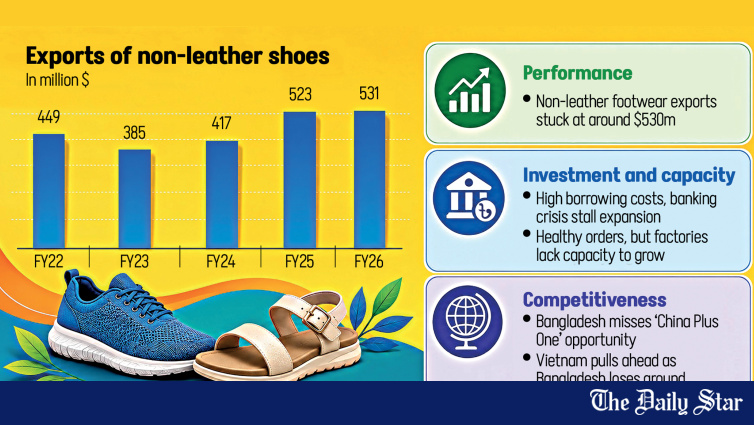
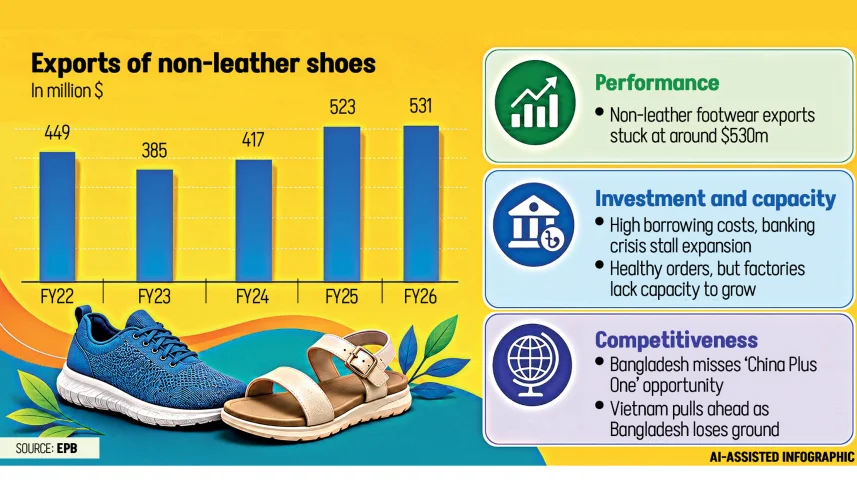
Exports under the “Other Footwear” category -- covering synthetic, rubber, plastic and textile footwear -- rose to $531 million in FY2025-26 from $522 million a year earlier, according to the Export Promotion Bureau (EPB).
The five-year trend reflects both recovery and stagnation. Exports fell from $449 million in FY22 to $385 million in FY23 amid weak demand in the US and Europe, before rebounding to $417 million in FY24.
The slowdown in FY26 comes despite the “China Plus One” strategy, under which global brands are diversifying production beyond China.
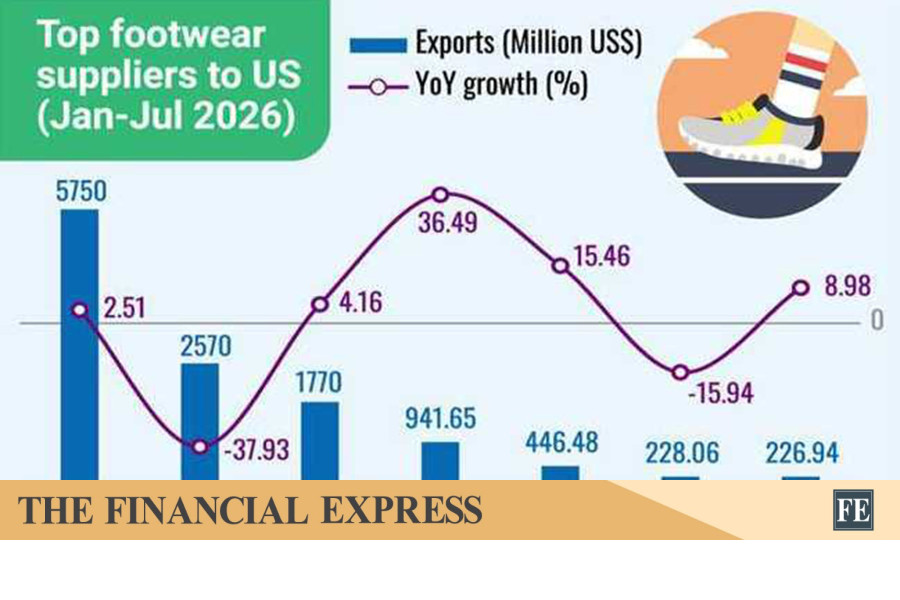
Combined with leather footwear exports of $691 million, Bangladesh’s footwear exports totalled only $1.22 billion in FY26, far lower than regional competitors. For instance, Vietnam exports more than $25 billion worth of footwear annually and Indonesia more than $6 billion.
The sector’s modest export growth reflects weak investment rather than weak demand, said Riad Mahmud, managing director of Shoeniverse Footwear.
“Most manufacturers are already operating at or near full capacity. Without new factories or capacity expansion, export growth will inevitably remain limited,” he said.
Mahmud blamed the prolonged banking sector liquidity crunch, saying manufacturers are struggling to secure financing for expansion.
“Our factory is running at full capacity and orders remain healthy. The question is why we are not expanding,” he said. “The simple answer is that bank financing is no longer available.”
He said Shoeniverse now plans to raise funds through the capital market by listing its footwear unit, Sunipun Footwear Ltd, and is preparing its prospectus.
“We have already announced our intention to go public. If the regulatory process becomes faster, as the authorities have indicated, it could provide an alternative source of financing for manufacturers,” he said.
He added that the stagnation in capital machinery imports also reflects slowing industrial investment. “The orders are there, but production capacity is not increasing because investment has slowed. That is the real bottleneck.”
Hasanuzzaman Hassan, chairman of BLING Leather Products Ltd, said inadequate banking support cost his company a major export opportunity last year.
He said the company spent nearly two months trying to open a letter of credit (LC) for a $2.2 million export order from buyers in the United States and Europe. However, the process stalled because the bank did not provide the required support, prompting the buyers to cancel the order.
“As the LC issue remained unresolved, the buyers had already moved elsewhere,” Hassan said.
He also linked the sector’s slow growth in the last FY to economic and political uncertainty during the interim government’s tenure, which disrupted business operations and weakened buyers’ confidence.
“When buyers see uncertainty, they become cautious. Some delayed orders, while others shifted sourcing to competing countries,” he said.
Hassan expects conditions to improve under the elected government as a more stable political atmosphere is likely to boost buyers’ confidence. “If the policy environment remains stable and banks become more supportive, many of those buyers are likely to return.”
Md Nasrullah, general manager and head of international business at Apex Footwear, attributed the slowdown to rising production costs, political uncertainty and weaker buyer confidence, particularly in the European market.
“Running a factory has become much more expensive,” he said, citing higher gas and electricity tariffs, annual wage increases and lending rates of 12-13 percent.
He estimated gas-related production costs alone have risen by more than 40 percent.
Md Nasir Khan, chairman of Jennys Shoes, said the industry has already invested heavily in expanding capacity but cannot fully utilise it because of supply-side bottlenecks.
“The industry has brought in machinery worth billions of dollars and built the capacity to grow. But many factories are producing only a fraction of what they are capable of because raw materials are not reaching them on time,” he said.
Delays in importing raw materials, unreliable electricity supply and cumbersome regulations are disrupting production and raising costs, Khan said. Frequent power outages also make it harder to meet delivery schedules.
“When shipments are delayed, buyers lose confidence. Instead of expanding by 20 to 30 percent a year, the industry risks slipping into negative growth,” he warned.
Jagaran Chakma
After rebounding strongly over two years, the non-leather footwear exports lost momentum in the last fiscal year, logging only 1.6 percent growth as manufacturers grappled with high borrowing costs, capacity constraints and lingering political uncertainty.
Exports under the “Other Footwear” category -- covering synthetic, rubber, plastic and textile footwear -- rose to $531 million in FY2025-26 from $522 million a year earlier, according to the Export Promotion Bureau (EPB).
The five-year trend reflects both recovery and stagnation. Exports fell from $449 million in FY22 to $385 million in FY23 amid weak demand in the US and Europe, before rebounding to $417 million in FY24.
The slowdown in FY26 comes despite the “China Plus One” strategy, under which global brands are diversifying production beyond China.
Combined with leather footwear exports of $691 million, Bangladesh’s footwear exports totalled only $1.22 billion in FY26, far lower than regional competitors. For instance, Vietnam exports more than $25 billion worth of footwear annually and Indonesia more than $6 billion.
The sector’s modest export growth reflects weak investment rather than weak demand, said Riad Mahmud, managing director of Shoeniverse Footwear.
“Most manufacturers are already operating at or near full capacity. Without new factories or capacity expansion, export growth will inevitably remain limited,” he said.
Mahmud blamed the prolonged banking sector liquidity crunch, saying manufacturers are struggling to secure financing for expansion.
“Our factory is running at full capacity and orders remain healthy. The question is why we are not expanding,” he said. “The simple answer is that bank financing is no longer available.”
He said Shoeniverse now plans to raise funds through the capital market by listing its footwear unit, Sunipun Footwear Ltd, and is preparing its prospectus.
“We have already announced our intention to go public. If the regulatory process becomes faster, as the authorities have indicated, it could provide an alternative source of financing for manufacturers,” he said.
He added that the stagnation in capital machinery imports also reflects slowing industrial investment. “The orders are there, but production capacity is not increasing because investment has slowed. That is the real bottleneck.”
Hasanuzzaman Hassan, chairman of BLING Leather Products Ltd, said inadequate banking support cost his company a major export opportunity last year.
He said the company spent nearly two months trying to open a letter of credit (LC) for a $2.2 million export order from buyers in the United States and Europe. However, the process stalled because the bank did not provide the required support, prompting the buyers to cancel the order.
“As the LC issue remained unresolved, the buyers had already moved elsewhere,” Hassan said.
He also linked the sector’s slow growth in the last FY to economic and political uncertainty during the interim government’s tenure, which disrupted business operations and weakened buyers’ confidence.
“When buyers see uncertainty, they become cautious. Some delayed orders, while others shifted sourcing to competing countries,” he said.
Hassan expects conditions to improve under the elected government as a more stable political atmosphere is likely to boost buyers’ confidence. “If the policy environment remains stable and banks become more supportive, many of those buyers are likely to return.”
Md Nasrullah, general manager and head of international business at Apex Footwear, attributed the slowdown to rising production costs, political uncertainty and weaker buyer confidence, particularly in the European market.
“Running a factory has become much more expensive,” he said, citing higher gas and electricity tariffs, annual wage increases and lending rates of 12-13 percent.
He estimated gas-related production costs alone have risen by more than 40 percent.
Md Nasir Khan, chairman of Jennys Shoes, said the industry has already invested heavily in expanding capacity but cannot fully utilise it because of supply-side bottlenecks.
“The industry has brought in machinery worth billions of dollars and built the capacity to grow. But many factories are producing only a fraction of what they are capable of because raw materials are not reaching them on time,” he said.
Delays in importing raw materials, unreliable electricity supply and cumbersome regulations are disrupting production and raising costs, Khan said. Frequent power outages also make it harder to meet delivery schedules.
“When shipments are delayed, buyers lose confidence. Instead of expanding by 20 to 30 percent a year, the industry risks slipping into negative growth,” he warned.