[🇧🇩] Monitoring the political activities of BNP

[🇧🇩] Monitoring the political activities of BNP
451
20K
More threads by Saif

G Bangladesh Defense

Three BNP-affiliated committees dissolved, 14 expelled

1790810449011.webp


The BNP’s Dhaka North city unit, Dhaka North Jubo Dal and Dhaka West Chhatra Dal committees have been dissolved, while 14 leaders and activists of the BNP and its affiliated organisations have been expelled.

The decisions were announced in separate press releases issued by the organisations on Wednesday.

The moves came amid allegations that some local BNP activists were involved in an attack and vandalism at Radda MCH-FP Centre, a mother and child healthcare facility in Mirpur.

However, the party’s statements did not mention the incident.

The BNP said three leaders -- Shah Ali thana joint convener Khalil Chowdhury, C-Block unit general secretary Anwar Hossain and Dhaka North city unit member Hafizur Rahman Shukku -- were expelled over allegations of “immoral and anti-organisational activities”.

The 51-member Dhaka North city BNP convening committee, led by Aminul Islam as convener and Mostafa Zaman as member secretary, was dissolved.

No reason was given for the decision, with the party saying a new committee would be announced soon.

The Dhaka North Jubo Dal and Dhaka West Chhatra Dal committees were also dissolved as their terms had expired.

Five Chhatra Dal leaders, two Jubo Dal-linked activists and six leaders of the Swechchhasebak Dal and Sramik Dal were also expelled for alleged disciplinary violations and anti-organisational activities.​
 

BNP in power, BNP in crisis
Ahammad Foyez 01 October, 2026, 00:00


1790813374764.webp

New Age/Mehedi Haque

IT IS not a typical political outcome for a party that swept to power with a massive majority to face such intense criticism within just seven months. Yet, this is the reality for the ruling Bangladesh Nationalist Party. Although the party’s government is still in its infancy, questions are already being raised across almost every sphere — governance, party discipline, the conduct of leaders and activists, allegations of extortion and land grabbing, partisan influence within the administration and the relationship with the youth.

The question arises: what would the situation have been had the BNP lost the election and an opposition alliance formed the government? There is no definitive answer to this. While one can speculate based on Bangladesh’s recent political history, there is no tangible evidence of an alternative history; consequently, one cannot interpret the current reality through the lens of that hypothetical scenario.

The reality is that the BNP is currently in power. Therefore, the political responsibility for the country’s present situation rests primarily with the incumbent government.

Perhaps the BNP’s greatest challenge lies in its political preparedness. It is not unusual for a party that has spent a long time in opposition to make mistakes during its first few months in power. However, if — even after seven months — the boundaries of responsibility between the government and the party remain blurred, the conduct of grassroots activists remains unchecked and the gap between public expectations and government performance continues to widen, then the issue can no longer be dismissed simply by saying ‘time is needed.’

A major asset for the BNP was the broad political opposition that had emerged during the Awami League’s long tenure. Many individuals — intellectuals, professionals and ordinary citizens — who opposed the Awami League were sympathetic to the BNP. While not all of them were staunch BNP supporters, many were mentally prepared to accept the BNP as an alternative to the Awami League.

Retaining that base of public goodwill was crucial for the BNP after assuming power. Yet, a shift is now evident. Many who were once sympathetic to the BNP are now criticising the party’s actions. Some are openly opposing it, others are expressing disappointment and some argue that the current reality falls far short of the expectations they held for the BNP as an alternative to the Awami League.

In this context, the most vital step for the BNP should have been to view criticism as a political asset. When even supporters of the government raise questions, viewing those questions merely as ‘opposition’ causes the government to shrink its own social base.

One of the most uncomfortable issues for the BNP is the allegations of extortion and land grabbing levelled against its leaders and activists.

A report published in New Age on September 28 revealed data from a list compiled by the Dhaka Metropolitan Police. The report stated that the list contained the names of 1,530 individuals involved in extortion and the seizure of land and property in the capital. Among them, 278 were identified as patrons of crime; the list showed that 230 of these individuals were current or former leaders and activists of the BNP and its affiliated organisations. The report further indicated that at least 350 of the 1,252 individuals active on the ground were linked to the BNP or its affiliates.

This information certainly carries political significance. The BNP has not accepted collective responsibility for such allegations. On September 28, Nazrul Islam Khan, the prime minister’s political adviser, asserted that genuine BNP leaders and activists are not involved in extortion, land grabbing or violence.

Yet, this is where the crucial question arises. If similar allegations are repeatedly raised against a segment of the party’s leaders and activists, is merely expelling a few individuals sufficient? Or is it necessary to establish mechanisms within the party’s organisational structure to ensure that political power cannot be used as a tool for personal financial gain at the local level?

A practical challenge facing the BNP must also be considered here. During the Awami League’s long tenure in power, many BNP leaders and activists faced lawsuits, arrests, imprisonment, persecution and political harassment or were forced to go into hiding. Many of them remained cut off from normal economic activities.

How to integrate this vast workforce into legitimate economic activities after assuming power should have been a crucial policy question for the party.

This certainly does not mean directly paying leaders and activists from party funds. Instead, encouragement could be given to initiatives such as supporting micro-entrepreneurship, cooperatives, local production, transport, agriculture, services, technology or small businesses

However, no such major or visible programme has yet been put forward by the BNP.

On the contrary, allegations of converting political influence into economic benefits at the grassroots level are becoming increasingly apparent. This is not merely a law-and-order issue; it is also a matter of a political party’s organisational failure.

There are several leaders within the BNP’s national executive committee responsible for employment-related matters. It is only natural that their duties would include formulating employment programmes for both party activists and the general public.

The question remains: what programmes have they undertaken in the last two years that have yielded tangible results for people at the grassroots level? The answer to this question is not particularly clear to the public.

If a major political party utilises hundreds of thousands of leaders and activists solely for political rallies, meetings or election activities — without planning to enhance their social and economic capabilities — it is unsurprising that a segment of those activists would attempt to exploit informal avenues of power once the party takes office.

Another major issue is the relationship between the party and the government.

After the BNP assumed power, many key party leaders simultaneously took on government responsibilities. This raised a fundamental question: who would run the party?

Running a government and running a political party are not the same thing. A minister must implement state policies, whereas a party leader must manage the organisation, maintain contact with activists, resolve local disputes, cultivate new leadership and disseminate the party’s political philosophy within society.

When both responsibilities are concentrated in a single individual, the party risks becoming weakened.

Reports of internal disputes, factionalism and leadership conflicts in various districts and metropolitan areas are already surfacing. The BNP should view these disputes not merely as local issues, but as central organisational problems. A long-standing issue in Bangladeshi politics is the tendency for political parties to gradually become centred on members of parliament and local power brokers.

If a party becomes overly dependent on elected representatives, the roles of ordinary activists, professionals, researchers, youth and grassroots organisers diminish.

The BNP now has the opportunity to avoid this risk.

If the party and the government are not kept distinct, the BNP’s organisational character could also become centred on individuals in the future. This is not merely an issue concerning a specific person; it is a problem for the political institution itself.

Perhaps the greatest political test lies in engaging the youth.

A significant portion of the young generation that was active in the July 2024 mass uprising carved out its own space in politics outside the realm of established political parties. They expect a new kind of political culture, accountability and participation.

The BNP had a major opportunity to forge a new political relationship with this generation. However, so far, no clear, long-term political programme to establish such a relationship has been evident.

While it is possible to navigate a new reality with old leadership, it is difficult to engage the new generation for long using outdated political thinking.

What the BNP needs most right now is introspection.

There may well be allegations of conspiracy against the government. It is also natural for the opposition to conduct political campaigns against the government; BNP leaders, too, have made such allegations.

However, if every problem faced by a government is attributed to opposition conspiracies, the opportunity to identify one’s own mistakes is lost.

Instead, the BNP should view every major criticism through the lens of three questions: Is the allegation true? If true, what is the cause? And what institutional measures can be taken to prevent this in the future?

If one merely expels the accused individual without seeking answers to these three questions, the likelihood of the problem recurring remains high.

The BNP government has been in power for seven months. This period cannot be considered sufficient for a definitive evaluation of any government. Yet, seven months is not an insignificant amount of time to understand a government’s political character, priorities and approach to handling crises.

The BNP still has the opportunity to make course corrections. If the party so desires, it can separate the government from the organisation, revitalise the grassroots structure, establish preventive — rather than merely punitive — mechanisms against extortion and land grabbing, create political space for the youth and prioritise competence and expertise over party affiliation in government decision-making.

Coming to power was a significant political achievement for the BNP. However, retaining power is not the sole yardstick of success for a ruling political party. A party’s long-term political capability is determined by its ability to build institutions, instil discipline among its cadres, accommodate dissenting views and maintain a clear distinction between the state and the party.

The primary challenge facing the BNP now is not confronting the opposition, but effectively managing its own government and party. The experience of the past seven months has made at least one thing clear: preparing to assume power and preparing to govern are not the same thing.

Ahammad Foyez is managing editor at New Age.​
 

BNP MP Ferdousi Ahmed Misti resigns, seat declared vacant

Staff Correspondent
Dhaka


1790897238734.webp

BNP MP Ferdousi Ahmed Misti Prothom Alo

Ferdousi Ahmed Mishti, a BNP lawmaker elected to a reserved seat for women, has resigned from Parliament.

She met Speaker Hafiz Uddin Ahmed at around 1:45pm today and submitted her resignation. The Parliament Secretariat has already issued a gazette notification declaring her seat vacant.

Ferdousi Ahmed Mishti was elected as a reserved-seat lawmaker on a BNP nomination. There are 50 reserved seats for women in Parliament. Under the Constitution, these seats are distributed among political parties in proportion to the number of directly elected members they have in Parliament. This time, 36 women were elected to reserved seats on BNP nominations. The gazette notification for the reserved-seat lawmakers was published on 30 April, and they took oath on 3 May. Ferdousi Ahmed Mishti has therefore resigned as an MP after serving for about five months.

A senior source at the Prime Minister’s Office said Prime Minister and BNP Chairman Tarique Rahman instructed Ferdousi to resign on Wednesday night. She was also told that stricter action would be taken against her if she did not resign as soon as possible.

Ferdousi met Speaker Hafiz Uddin Ahmed at around 1:45pm today. It was then reported that she had resigned.

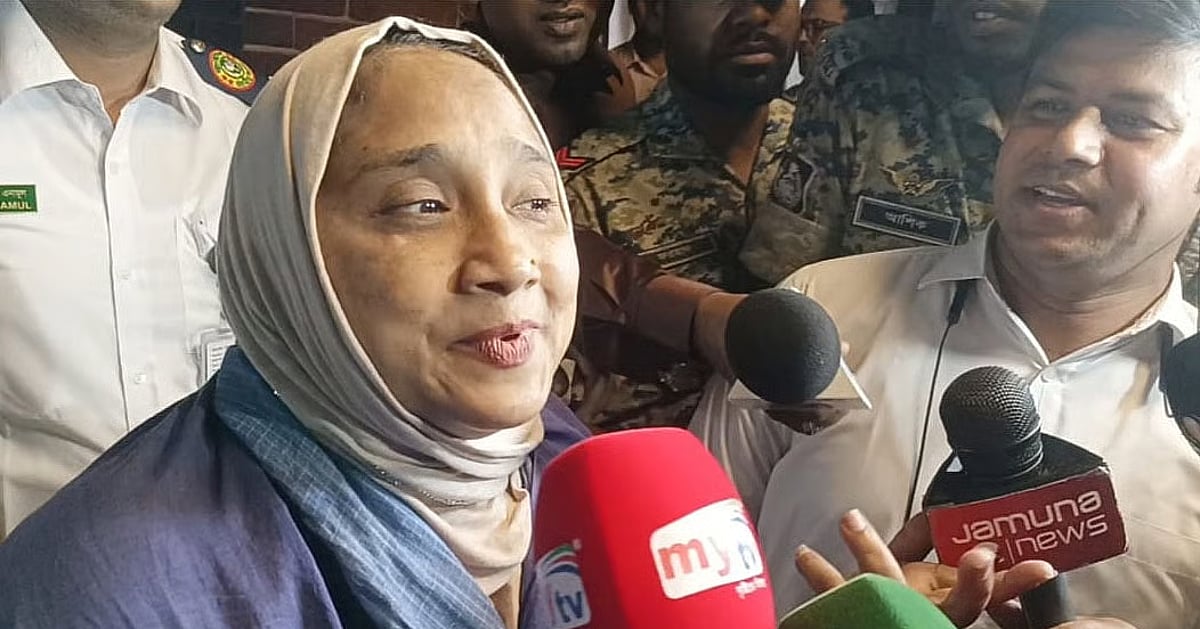
However, after leaving the meeting with the Speaker, Ferdousi told reporters, “The Speaker called me, and I met him.” Asked about her resignation, she said, “Let there be an investigation.” When asked whether she had submitted her resignation letter, she replied, “Whatever decision the BNP takes will be followed.”

The Speaker’s office later said Hafiz Uddin Ahmed would speak to reporters in the afternoon.

According to sources in the BNP and the government, the government is also taking a tough stance over the Radda incident. The Prime Minister has been gathering information about the incident for the past two days, including who was involved in the attack and vandalism, their political affiliations and who was behind the incident. Sources familiar with the matter said information had also emerged about the involvement of several people known to be close to Ferdousi Ahmed.

A source at the BNP policymaking level told Prothom Alo that the party’s top leadership is taking the Radda incident seriously. The government is embarrassed by allegations involving party leaders and activists in the destruction and looting of a healthcare facility and an alleged attempt to grab its land. After information emerged about the involvement of people known to be close to Ferdousi Ahmed, her role and political responsibility have also come under discussion. In such circumstances, a tough decision could also be taken regarding the lawmaker based on the findings of the investigation.

Names of people close to the MP

Prothom Alo’s investigation found information about the involvement of several people associated with local BNP politics in the attack and vandalism at the Radda healthcare centre. Among them are former member of the Dhaka North City BNP, Mohammad Hanif Mia, and former member secretary of the Dhaka North unit of Jubo Dal, Mostafa Jaglul Pasha. Sources familiar with the matter said they are known locally as people close to Ferdousi Ahmed.

More than 200 masked people armed with locally made weapons looted and then demolished the Radda MCH-FP Centre in Mirpur, Dhaka, on 25 September 2026.

People associated with local BNP politics were also reportedly involved in the activities of the “Sammona Dokandar Samabaya Samity Limited”, which came under discussion after the Radda Centre was demolished.

Ferdousi Ahmed was the president of the association in 2006, when she was a commissioner representing Ward No. 8 of Shah Ali police station. At the time, she signed as the association’s president an application submitted to the Housing and Public Works authorities seeking allocation of the land where the Radda Centre was located in the name of the association.​
 

BNP goes hard on unruly party members
Staff Correspondent . Dhaka 02 October, 2026, 01:01

1790898068751.webp


The ruling Bangladesh Nationalist Party has taken a hardline against its leaders and activists accused of criminal activities amid growing public criticism over a series of incidents, including the attack on RADDA MCH-FP Centre at Mirpur in the city and allegations of land grabbing and extortion across the country.

The party has already dissolved several committees of its main organisation and affiliated bodies.

A BNP reserved-seat lawmaker has also resigned as a Member of Parliament on the prime minister’s directive after allegations of her involvement in the Mirpur attack emerged.

The Dhaka Metropolitan North BNP, Jatiyatabadi Juba Dal and Dhaka Metropolitan West Chhatra Dal committees have already been dissolved, while 14 leaders and activists of the BNP, Juba Dal, Chhatra Dal, Swechchhasebak Dal and Sramik Dal have been expelled from the organisations.

The party said it would not take responsibility for any misconduct by the expelled individuals and instructed its leaders and activists not to maintain organisational ties with them.

BNP senior leaders said the party was implementing its chairman Tarique Rahman’s directive to take actions against anyone involved in criminal or unethical activities, irrespective of political affiliations.

They said the party had not only taken organisational action but had also filed cases against some of its members and handed them over to law enforcement agencies.

They said that further organisational and legal actions against those involved in criminal activities would become visible within a couple of days.

Meanwhile, BNP reserved-seat lawmaker Ferdousi Ahmed Mishti resigned as an MP on Thursday following a directive from the prime minister over allegations of her involvement in the attack and demolition of the health facility in the city.

A senior official at the prime minister’s office said Tarique Rahman, also BNP chairman, on Wednesday night had instructed Ferdousi to resign and warned of tougher party action if she failed to do so promptly.

The development came a week after an overnight attack on the nearly 50-year-old RADDA MCH-FP Centre at Mirpur, on September 25.

The attackers demolished the facility and, after occupying the property, put up a signboard reading ‘Somomona Dokandar Samity Ltd’ in front of the premises.

Home minister Salahuddin Ahmed said on Wednesday that an investigation was under way against a local lawmaker over the demolition.

Juba Dal leaders, speaking to New Age on condition of anonymity, said allegations had emerged against several members of the party over extortion, land grabbing and attempts to control cable television and internet businesses.

They said reports prepared by law enforcement agencies had also contained allegations against several committee members.

According to a Dhaka Metropolitan Police list, 1,530 people have been identified as allegedly involved in extortion and land and property grabbing across the capital.

Of them, 278 were identified as alleged patrons, including 230 current or former BNP leaders and activists or members of its affiliated organisations.

At least 350 of the remaining 1,252 people identified as active at the field level were also linked to the BNP or its affiliated bodies, according to the list.

Prime minister’s office spokesperson Mahdi Amin on Wednesday said the government was working to restore law and order and ensure the arrest of offenders without delay.

He said the government would take action under the law against anyone attempting to create instability, adding that investigations and arrests were being pursued as quickly as possible.

Earlier, the BNP lawmakers raised growing concerns over the security situation at a parliamentary party meeting on June 6.

The meeting, chaired by prime minister Tarique Rahman at the Jatiya Sangsad, discussed deteriorating law and order and increasing violent crimes.​
 

Latest Posts

Back