| Global Defense, OSINT & Geopolitics Wire

Wars 2023 10/08 Monitoring the Israel and Lebanon War

Wars 2023 10/08 Monitoring the Israel and Lebanon War
271
16K
More threads by Saif

G War Archive

Bangladesh to initiate safe return of citizens from Lebanon

The government has taken an initiative to ensure the safe return of Bangladeshis in phases, who got stuck in troubled Lebanon, with the first batch's likely arrival on October 21.

The first batch may consist of at least 50 Bangladeshis, including injured, women, and children, an official told UNB, adding that they may come to Dhaka via Jeddah, the Kingdom of Saudi Arabia.

Around 1,800 Bangladeshis have already shown interest to return and got enrolled with the Bangladesh Embassy.

The Ministry of Foreign Affairs, Ministry of Expatriates' Welfare and Overseas Employment are working together for the return of Bangladeshis trapped in war-torn Lebanon.

The government is working closely with all concerned to bring back all the Bangladeshis who wish to return from Lebanon safely, said the foreign ministry.

Earlier, an inter-ministerial meeting was held with the participation of Foreign Secretary Md Jashim Uddin, Expatriates' Welfare Secretary Md Ruhul Amin and Managing Director and CEO of Biman Bangladesh Airlines Limited Dr Md Shafiqur Rahman.

Bangladesh mission heads assigned to the Middle East joined the meeting on the Zoom platform.

The foreign secretary has issued necessary instructions to the Bangladeshi ambassador in Lebanon to take necessary measures for the safe return of the stranded Bangladeshis.

He also gave necessary instructions to ensure the safety of all the expatriate Bangladeshis staying there who do not wish to return to the country.

A notification was issued to enroll Bangladeshis who wish to return from the embassy and initially about a thousand migrant workers are said to be willing to return home.​
 

Netanyahu vows ‘no ceasefire’ in Lebanon after Hezbollah threats
AFP
Jerusalem
Published: 16 Oct 2024, 09: 35

1729127587485.webp


People gather outside a collapsed building as they attempt to extricate a man from underneath the rubble following Israeli bombardment in the Saftawi district in Jabalia in the northern Gaza Strip on 15 October 2024 amid the ongoing war in the Palestinian territory between Israel and Hamas AFP

Israeli prime minister Benjamin Netanyahu rejected Tuesday the idea of a ceasefire in Lebanon that would leave Hezbollah close to his country’s northern border, as the militant group threatened to widen its attacks.

Netanyahu’s comments came as the United States ramped up pressure over Israel’s conduct of the wars in Lebanon and Gaza, criticising the recent bombing of Beirut and demanding that more aid reach the Palestinian territory.

In a call with French president Emmanuel Macron, Netanyahu said he was “opposed to a unilateral ceasefire, which does not change the security situation in Lebanon, and which will only return it to the way it was”, according to a statement from his office.

Netanyahu and the Israeli military have insisted there must be a buffer zone along Israel’s border with Lebanon where there is no presence of Hezbollah fighters.

“Prime minister Netanyahu clarified that Israel would not agree to any arrangement that does not provide this (a buffer zone) and which does not stop Hezbollah from rearming and regrouping,” the statement said.

In a defiant televised speech, Hezbollah’s deputy leader Naim Qassem said the only solution was a ceasefire while threatening to expand the scope of its missile strikes across Israel.

“Since the Israeli enemy targeted all of Lebanon, we have the right from a defensive position to target any place” in Israel, he said.

Early Wednesday Israel’s military reported around 50 projectiles were fired from Lebanon at the country’s north, without any reports of casualties.

Iran-backed Hezbollah said it launched “a large salvo of missiles” at the town of Safed.

Israel’s military bombed several areas in southern and eastern Lebanon on Tuesday, including in the Bekaa Valley where a hospital in Baalbek city was put out of service, Lebanon’s official National News Agency reported.

It also said it had captured three Hezbollah fighters in south Lebanon.

Lebanon’s health ministry said nine people were killed Tuesday evening in strikes on the country’s south, and five others in the east, including three children.

Asked about Israeli air strikes in Lebanon in which residential buildings in central Beirut were hit on 10 October, the US State Department voiced open criticism.

“We have made clear that we are opposed to the campaign the way we’ve seen it conducted over the past weeks” in Beirut, State Department spokesman Matthew Miller told reporters.

In a letter sent to the Israeli government on Sunday, Secretary of State Antony Blinken and Defense Secretary Lloyd Austin also warned that the United States could withhold weapons deliveries unless more humanitarian aid was delivered to Palestinians in Gaza.

The letter made “clear to the government of Israel that there are changes that they need to make again to see that the level of assistance making it into Gaza comes back up from the very, very low levels that it is at today,” Miller said.

‘Worst restrictions’

Despite the need for food, medical supplies and shelter in hunger-ravaged Gaza, a spokesman for the UN’s children’s agency UNICEF said Tuesday that aid was facing the tightest restrictions since the start of Israel’s offensive in October last year.

“We see now what is probably the worst restrictions we’ve seen on humanitarian aid, ever,” spokesman James Elder said in Geneva, adding that there were “several days in the last week (where) no commercial trucks whatsoever were allowed to come in”.

For more than a week, Israeli forces have engaged in a sweeping air and ground assault targeting northern Gaza and the area around Jabalia amid claims that Hamas militants were regrouping there.

“The whole area has been reduced to ashes,” said Rana Abdel Majid, 38, from the Al-Faluja area of northern Gaza.

Majid said entire blocks had been levelled by “the indiscriminate, merciless bombing”.

At a school-turned-shelter hit by an Israeli strike in the central Nuseirat camp, Fatima al-Azab said “there is no safety anywhere” in Gaza.

“They are all children, sleeping in the covers, all burned and cut up,” she said.

Israel launched a military campaign in Gaza after the 7 October 2023 attack by Hamas that resulted in the deaths of 1,206 people, mostly civilians, according to an AFP tally of official Israeli figures, including hostages killed in captivity.

The Israeli campaign has killed 42,344 people, the majority civilians, according to figures from the health ministry in the Hamas-run territory which the UN considers reliable.

Lebanon strikes

Israel escalated its air campaign against Hezbollah in Lebanon from September 23 and then launched a ground offensive a week later intended to push the group back from its northern border.

Hezbollah has been firing thousands of projectiles into Israel over the last year in support of Hamas, displacing tens of thousands of Israelis.

At least 1,356 people have been killed in Lebanon since Israel escalated its bombing last month, according to an AFP tally of Lebanese health ministry figures, though the real toll is likely higher.

The war in Lebanon, which has suffered years of economic crisis, has displaced at least 690,000 people, according to figures from the International Organization for Migration.

Israel is also weighing how to respond to Iran’s decision to launch around 200 missiles at the country on 1 October.

Netanyahu’s office said that Israel -- and not its top ally the United States -- would decide how to strike back.

“We listen to the opinions of the United States, but we will make our final decisions based on our national interest,” it said Tuesday.

The Iranian barrage was in retaliation for an Israeli strike in Lebanon’s Beirut that killed Hezbollah leader Hassan Nasrallah, and another that killed Iranian general Abbas Nilforoushan on 27 September.

US President Joe Biden, whose government is Israel’s top arms supplier, has warned Israel against striking Iran’s nuclear or oil facilities.

According to a Washington Post report on Monday citing unnamed US officials, Netanyahu reassured the White House that Israel was contemplating targeting only military sites.​
 

Hezbollah says launching new 'escalatory phase' in Israel war

1729297021985.webp

A man uses his crutches to walk amid the destruction a day after Israeli airstrikes that targeted the southern Lebanese city of Nabatieh on October 17, 2024. Photo: AFP

Lebanon's Hezbollah on Thursday said it was launching a new phase in its war against Israel, saying it has used precision-guided missiles against troops for the first time.

Israel has been pounding south and east Lebanon, areas where Hezbollah holds sway, since all-out war erupted on September 23.

In Lebanese border villages, the rivals have engaged in close-range combat after Israel launched a ground invasion last month.

Hezbollah "announces a transition to a new and escalatory phase in the confrontation with the Israeli enemy, which will be reflected in the developments and events of the coming days," the group said in a statement.

The announcement came after the Israeli military on Thursday said its forces killed Yahya Sinwar, the leader of Hamas, which is a Hezbollah ally.

The statement, however, made no mention of the Hamas chief.

It said "hundreds of fighters...are fully prepared to counter any Israeli ground incursion into southern Lebanese villages," noting that attacks against Israel have increased in recent days.

It said its rocket strikes continue "to escalate day by day," with "precision-guided ones...being deployed for the first time".

Israel killed Hezbollah's leader Hassan Nasrallah in a Beirut air strike On September 27. It has has repeatedly called for Hezbollah to be pushed away from the border to ensure its citizens could return to their homes in northern Israel.

Earlier on Thursday, Hezbollah lawmaker Hassan Fadlallah said that the Israeli army was not fully in control of any village in south Lebanon.​
 

A city silenced by war

1729467645247.webp

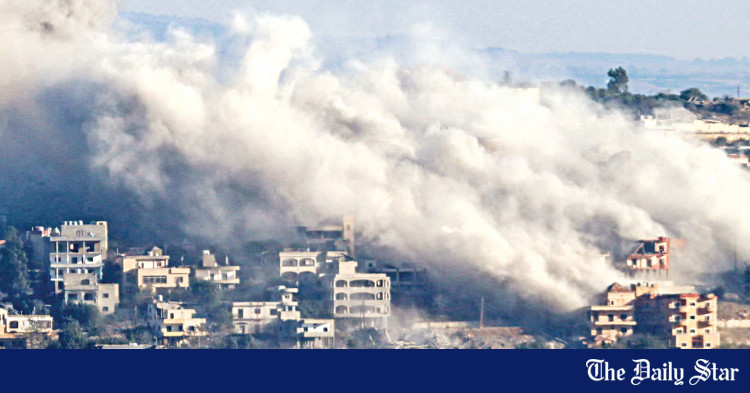
Smoke rises from the site of an Israeli airstrike that targeted the southern Lebanese border village of Khiam, where the Lebanese official media reported 14 strikes within minutes yesterday. Photo: AFP

Just a month ago, south Beirut's bustling streets were packed with traffic, families strolling about and youths in cafes, but now silence dominates the abandoned Hezbollah bastion, interrupted only by the sound of Israeli bombs.

Escalating Israeli attacks since late September, after nearly a year of low-intensity cross-border exchanges, have reduced much of the Lebanese capital's once densely-packed southern suburbs to rubble and sent many of its residents fleeing.

Braving the smell of rotting flesh that reeks from razed buildings, a few young men stood guard, dressed in black civilian clothes and occasionally driving around the ruins on their motorbikes.

They observed the odd car and the handful of displaced residents who come on foot, hastily checking on their apartment or collecting some belongings before heading back to safety.

"The young people told me not to stay too long because drones were constantly flying over and could strike at any time," said 32-year-old Mohammed, on a brief visit home to get more clothes.

Giving his first name only for security concerns, he said he first left on September 27, days into Israel's intense air campaign on Lebanon.

That day, massive Israeli strikes killed Hezbollah's elusive leader Hassan Nasrallah in the heart of the Iran-backed group's south Beirut stronghold, toppling several apartment buildings and spreading fear of even greater violence.

"We left in a hurry and thought we would never see our house again," said Mohammed, adding that his neighbours had also fled.

The building was still standing, but many others have been damaged or destroyed.

ATTACKS ON INFRASTRUCTURE

Cracks snaked down nearby buildings as torn-off asphalt and burst pipes leaked sewage and tap water.

Generators that long made up for daily power cuts after five years of economic crisis had also been blown to bits.

"About 320 buildings were destroyed in Beirut and its suburbs" in less than a month of war, Mona Fawaz of the Beirut Urban Lab told AFP.

The devastation has surpassed the damage caused by Israel's last war with Hezbollah in 2006, said Fawaz, who records cases of "urbicide", the destruction of cities in conflict, focusing now on Lebanon and the Gaza Strip.

She accused Israel of "deliberate targeting of what allows life to continue," including vital infrastructure unrelated to Hezbollah.

Hezbollah had completely rebuilt Beirut's south based on the existing urban plans from before the 2006 war, which had displaced about 100,000 people from the area.

During that 33-day war, "surveys list 1,332 severely damaged multi-storey apartment buildings, of which 281 were completely razed to the ground" in an area of about 20 square kilometres (eight square miles), said Fawaz.

The Burj al-Barajneh neighbourhood, unscathed in 2006, has been heavily damaged in the bombardment this time around.

CHILDHOOD MEMORIES

Once again, families from south Beirut are forced to seek refuge elsewhere in the country or abroad.

Many live in rented apartments or with relatives, while others are crammed in schools-turned-shelters.

Hassan, 37, grew up in the Mraijeh district of Beirut's south, where Israeli jets targeted Hashem Safieddine, widely seen as Nasrallah's most likely successor.

Despite the bloodshed, he said Mraijeh will always remind him of his "friends, the games we used to play as children, the smell of freshly-baked bread in the morning, neighbours chatting and Ramadan festivities".

The supermarket he used to shop at is in ruins, with nearby shops, schools and buildings also reduced to rubble.

Hassan, who also asked to be identified by first name only, was told his favourite record store was no more.

As the war shows no signs of abating, greater losses are all but certain.

"We are afraid to return after the war only to discover how many of our friends have died, like in 2006," said Hassan with a sigh.​
 

US, Iran in ‘tug of war’ over Lebanon, analysts say
Agence France-Presse . Beirut, Lebanon 20 October, 2024, 18:22

1729468966457.webp

A fire rages on a hill after rockets were fired from southern Lebanon, on the outskirts of Rosh Pinna in the Upper Galilee on October 20, 2024, amid the ongoing war between Israel and Hezbollah. | AFP photo

With Iran-backed Hezbollah on the defensive after a series of heavy Israeli blows, the United States and Iran are locked in a showdown over Lebanon’s future, analysts said.

Hezbollah, the most powerful regional force backed by Iran, which arms and finances it, has long held sway in Lebanon.

But the group’s influence is now in question after Israel’s assassination of its leader, Hassan Nasrallah, in a significant setback.

Hezbollah’s losses have left Lebanon in a ‘tug of war between Iran and the United States’, said Michael Young of the Carnegie Middle East Center think tank.

‘The Israelis with the Americans... are trying to use military force to try to transform the balance of power in Lebanon to their advantage,’ he told AFP.

‘There are no signs that the Iranians are going to accept this without a fight.’

Hezbollah is considered better armed than Lebanon’s national military and remains the only group that did not put down its weapons after the 1975-90 civil war.

Last year, it opened a new front with Israel over the conflict in Gaza, in support of its ally Hamas.

It carefully calibrated attacks to avoid a full-blown conflict, which eventually came on September 23 when Israel stepped up bombing of Hezbollah strongholds, including south Beirut.

The United States has pushed for ceasefire, but has also expressed support for Israeli attempts to ‘degrade Hezbollah’s infrastructure’.

US Secretary of State Antony Blinken said this month that ‘it’s clear that the people of Lebanon have an interest -- a strong interest -- in the state asserting itself and taking responsibility for the country and its future.’

Kim Ghattas, the author of ‘Black Wave’, a book on the Saudi-Iran rivalry, said: ‘Lebanon is caught between Iran and Hezbollah on the one hand, and Israel and the US on the other.’

But ‘Washington’s vision doesn’t necessarily align with Israel’s in terms of war goals and tactics’, she said.

‘The US would certainly like to see a weakening of Hezbollah, maybe even the disarming of the group, but it is wary of Israel going too far with the military campaign.’


Israeli Prime Minister Benjamin Netanyahu warned Lebanon it could face destruction ‘like Gaza’ as Israel vowed to keep fighting Hezbollah until it secures its northern border.

‘I say to you, the people of Lebanon: Free your country from Hezbollah so that this war can end,’ Netanyahu said on October 8.

Iran, for its part, ‘wants to preserve what’s left of its assets in Lebanon and ensure the survival of the regime’, Ghattas said, referring to the Islamic republic.

‘It needs to walk a fine line between continuing to support Hezbollah... while signalling it is ready for diplomacy.’

Iran’s meddling drew a rare rebuke from Lebanon last week, as Prime Minister Najib Mikati accused it of ‘blatant interference’ over remarks attributed to a Tehran official regarding ceasefire terms.

Mikati charged that Iran had attempted ‘to establish an unacceptable guardianship over Lebanon’, after Iran’s parliament speaker Mohammad Bagher Ghalibaf reportedly told France’s Le Figaro newspaper that his government was ready to negotiate on the implementation of a 2006 UN resolution that calls for only the Lebanese army and UN peacekeepers to be deployed in southern Lebanon.

As the Israel-Hezbollah war nears its one-month mark, calls have mounted for Lebanon to elect a president after a two-year void due to political deadlock.

The last president, Michel Aoun, was a Hezbollah ally, making the vote a test for the country’s political trends.

In an interview with AFP, Mikati said serious efforts were underway to elect a president, in line with calls from the United States and other Western allies.

Political leaders in Lebanon too have made careful appeals for a new president, trying to avoid impressions they were leveraging Hezbollah’s setbacks for political gain.

‘The Lebanese parties hostile to Hezbollah understand that the situation is very delicate,’ said Young.

‘They don’t want to provoke the Shiite community, which already feels humiliated and angry and isolated and let’s remember, is armed,’ he added.

While suspicion between sects has grown since the Israeli-Hezbollah war forced displaced Shiite communities into Christian-majority areas, many are wary of a repeat of the country’s 15-year war.

The Israeli invasion of Lebanon in 1982 also recalls bitter memories for Lebanese and ultimately led to the creation of Hezbollah, one of Israel’s most formidable foes.

‘It seems that politicians in Lebanon have learned lessons of the past, but the longer this current limbo and war lasts, the harder it will be to keep tensions under control,’ said Ghattas.​