Home Watch Videos Wars Movies Login

[🇧🇩] Trump's Victory/Tariff/ Bangladesh

[🇧🇩] Trump's Victory/Tariff/ Bangladesh
218
6K
More threads by Saif

G Bangladesh Defense

Bangladesh, US sign reciprocal tariff agreement, cut duty to 19pc

bdnews24.com
Published :
Feb 10, 2026 00:15
Updated :
Feb 10, 2026 00:15

1770683338442.webp


Bangladesh has signed a tariff agreement with the United States after nine months of negotiations, reducing the supplementary duty by one percentage point.

The Chief Advisor’s Office announced on Monday night that under the new deal, Bangladeshi exports to the US market will face a 19 percent supplementary duty, bringing the overall tariff down from 35 percent to 34 percent.

The government had been optimistic about securing concessions, having already taken steps to improve trade relations, including purchasing Boeing aircraft and increasing imports of wheat, cotton and other goods.

Despite these measures, officials acknowledged that the Trump administration was not persuaded to cut tariffs further.

“Although the duty has not fallen significantly, we expect Bangladeshi products will gain additional benefits in the US market,” the interim government said.

The agreement was signed online by Commerce Advisor Sheikh Bashir Uddin, National Security Advisor Khalilur Rahman and US Trade Representative Ambassador Jamieson Greer.

President Donald Trump, in his second term, announced steep tariffs on more than 100 countries on Apr 2, 2025, imposing an additional 37 percent duty on Bangladeshi goods.

Following negotiations, the rate was reduced to 20 percent and took effect on Aug 1, adding to the existing 15 percent tariff.

Since then, Bangladesh has sought to lower the burden, leading to Monday’s deal.​
 
Analyze

Analyze Post

Add your ideas here:
Highlight Cite Respond

AmCham welcomes Bangladesh-US reciprocal tariff agreement

FE ONLINE REPORT
Published :
Feb 10, 2026 20:58
Updated :
Feb 10, 2026 20:58

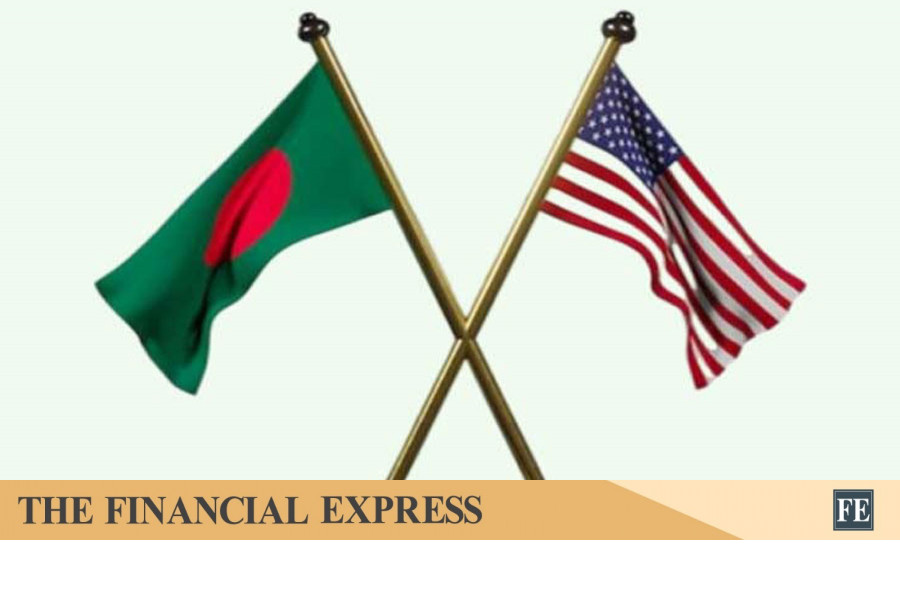
1770770926024.webp


American Chamber of Commerce in Bangladesh (AmCham) on Tuesday welcomed the recently announced trade understanding between Bangladesh and the United States, which sets tariffs at 19 per cent and introduces important facilitative provisions for selected exports.

From AmCham’s perspective, this development reflects constructive engagement between two longstanding economic partners and sends a positive signal to global investors amid heightened uncertainty in international trade, according to a statement.

The United States remains one of Bangladesh’s most important export destinations, particularly for ready-made garments, and this outcome provides greater predictability for exporters while preserving Bangladesh’s competitiveness in a key market.

Equally important is the provision that allows zero-tariff access for certain products manufactured with US inputs, it said in the statement, adding that this has the potential to encourage deeper supply-chain integration, promote value addition, and strengthen backward linkages between US producers and Bangladeshi manufacturers.

“We also view Bangladesh’s commitments to improving market access, regulatory transparency, and standards alignment as steps in the right direction,” Amcham president Syed Ershad Ahmed said in the statement.

Over the long term, such reforms enhance efficiency, reduce the cost of doing business, and benefit consumers and industries alike, he said, adding trade agreements are not only about tariffs; they are also about confidence, rules, and trust—and this framework contributes to all three.

From AmCham’s standpoint, this agreement underscores the importance of continued dialogue between the government and the private sector.

As the only chamber representing US companies in Bangladesh, he said AmCham remains committed to supporting policy reforms that foster trade, investment, and sustainable economic growth.

“We believe this outcome can serve as a platform for deeper economic cooperation, increased US investment, and diversification beyond traditional sectors.”

Looking ahead, consistent implementation, clear communication of rules, and ongoing stakeholder engagement will be critical, he said, adding AmCham stands ready to work with both governments and our members to translate this opportunity into tangible gains for businesses, workers, and the broader economy of Bangladesh.​
 
Analyze

Analyze Post

Add your ideas here:
Highlight Cite Respond

DUTY-FREE FACILITY UNDER TRUMP TRADE DEAL

Dhaka gives access to 6,710 US goods, gets relief on 1,638 items


Saddam Hossain 11 February, 2026, 22:11

1770860704401.webp

A file photo shows a crane arranging containers at the Kamalapur Inland Container Depot in the capital. | New Age photo

Bangladesh would have to extend tariff concessions on 6,710 categories of United States products once the recently signed Agreement of Reciprocal Trade comes into force.

Moreover, Bangladesh would get reciprocal benefits for 1,638 categories of its exports to the US market.

Under the agreement, Bangladesh agreed to provide significant preferential market access for US industrial and agricultural goods, including energy products, chemicals, machinery, motor vehicles and parts, medical devices, ICT equipment, soy, dairy, beef, poultry, and fruits and nuts.

Commerce adviser Sk Bashir Uddin and United States Trade Representative ambassador Jamison Greer signed the ART virtually on Monday, reducing the reciprocal tariff on Bangladeshi products exported to the US to 19 per cent.Bangladesh cultural tours

The agreement stated that RMG items manufactured using cotton sourced from the US would be eligible for zero reciprocal duty under a specific mechanism and volume threshold.

The USTR published a review of the ART, along with specific HS codes, on Tuesday, indicating that Bangladesh would immediately reduce customs duties on approximately 4,500 categories of US products effective the day the agreement takes effect.

However, according to the ART, in Bangladesh, customs duty comprises supplementary and regulatory duties.

For another 2,210 product categories, duties would be phased out gradually, the ART said. Under the agreement, Bangladesh has committed to providing tariff concessions to the US products in four phases.

Firstly, Bangladesh would reduce customs duties entirely on 4,500 products originating from the US, which would be effective on the date of entry into force of this agreement.

Secondly, across 1,538 categories, tariffs would be cut by 50 per cent from the first day of implementation, with the remaining 50 per cent reduced equally over four years, reaching zero from January 1 of the fifth year.

Thirdly, tariffs on 672 categories would be halved on the first day and gradually reduced to zero over nine years, reaching full elimination on January 1 of the tenth year.

Fourth, 422 product categories already subject to zero customs duty would continue to enjoy that status.

Finally, Bangladesh would retain the right to impose duties on the remaining 326 categories in accordance with its tariff schedule under the MFN customs.

Against nearly 7,000 products, Bangladesh will enjoy zero reciprocal tariff on 1,638 products, including pharmaceuticals, aircraft-related products, cane-made baskets and bags, iron and steel products, graphite, minerals, chemicals, plastic goods, and wooden products.

Under the agreement, Bangladesh would not impose quotas on imports of US goods.

Bangladesh would allow US goods complying with applicable US or international standards, US technical regulations, or US or international conformity assessment procedures to enter without additional conformity assessment requirements.

The agreement also stated that Bangladesh would provide non-discriminatory or preferential market access for US agricultural goods, ensure that its sanitary and phytosanitary measures are science and risk-based and do not operate as disguised restrictions on bilateral trade, and remove unjustified SPS barriers in areas that undermine reciprocity.

Bangladesh would not enter into agreements or understandings with third countries that include non-scientific, discriminatory, or preferential technical standards; include third-country SPS measures that are incompatible with US or international standards; or otherwise disadvantage US exports to such third countries.

Bangladesh shall ensure transparency and fairness in the protection or recognition of geographical indications, including under an international agreement.

Moreover, Bangladesh would provide robust protection for intellectual property.

The agreement also stated that Bangladesh would adopt and implement a prohibition on the importation of goods mined, produced, or manufactured wholly or in part by convict labour, forced or compulsory labour, and child labor.

Bangladesh would protect internationally recognised labour rights, the agreement stated, and ensure that workers in export processing zones (EPZs) could fully exercise their rights to freedom of association and collective bargaining.

Moreover, the country would adopt and maintain environmental protections, effectively enforce its environmental laws, uphold or, as necessary, institute strong environmental governance structures, and address environmental issues that contribute to non-reciprocal trade.

If the US adopts a border measure to combat regulatory arbitrage that would disadvantage US workers and businesses, Bangladesh shall coordinate and endeavor to align its border measures to address the issue, the ART said.

By 2030, Bangladesh will implement and maintain technology solutions that enable full pre-arrival processing, paperless trade, and digitized procedures for the movement of goods into and out of the United States, including facilitating digital trade with the US.

If Bangladesh requires a Halal certification, the country would allow any US Halal certifier meeting Bangladesh’s Halal requirements to certify products.

Bangladesh would remove mandatory reinsurance cession requirements, including the obligation for US insurers to reinsure at least 50 per cent of their business with Sadharan Bima Corporation, according to the agreement.

The agreement stated that Bangladesh would endeavor to facilitate increased purchases of US civilian aircraft, parts, and services, as Biman Bangladesh Airlines intends to purchase 14 Boeing aircraft, with an option to purchase additional aircraft.

Moreover, Bangladesh would purchase US energy and liquefied natural gas worth $15 billion over 15 years, along with US agricultural products including wheat (at least 700,000 metric tons per year for five years), soy and soy products (at least $1.25 billion or 2.6 million metric tons over one year), and cotton, with an estimated total value of $3.5 billion.

The agreement also stated that Bangladesh would endeavor to increase purchases of US military equipment and limit such purchases from certain countries.Bangladesh cultural tours

Moreover, Bangladesh will submit a complete notification to the WTO of all subsidies it provides within six months of this Agreement›s entry into force.

Regarding the agreement, Mustafizur Rahman, a distinguished fellow at the Centre for Policy Dialogue, said it does not qualify as a free trade agreement under WTO rules.

If it is not recognised as such, similar tariff concessions may need to be extended to other countries, potentially putting significant pressure on revenue collection at the import stage, he warned.

The US is Bangladesh’s largest export destination.

In 2024, Bangladesh exported to the US goods worth about $8.4 billion, of which $7.34 billion accounted for readymade garments. In the year, the country imported US goods worth $2.2 billion.​
 
Analyze

Analyze Post

Add your ideas here:
Highlight Cite Respond

Members Online

Latest Posts

Back
 
G
O
 
H
O
M
E