New Tweets

Wars 2024+ Iran VS Israel

G War Archive
Wars 2024+ Iran VS Israel
3K
118K
More threads by Saif

Status
Not open for further replies.
These fools do not realise that its their nation that is being attacked.

Not just the regime they hate.

Its like me sitting in LA cheering China bombing New Delhi, because somewhere in the bombing BJP leadership will also get taken out.

Iranian Diaspora are foolish. Often called the Indian diaspora, but worse.
 
Analyze

Analyze Post

Add your ideas here:
Highlight Cite

Iran, Israel trade missile strikes amid escalating tensions
Agence France-Presse. Tehran, Iran 15 June, 2025, 04:55

1749946133904.webp

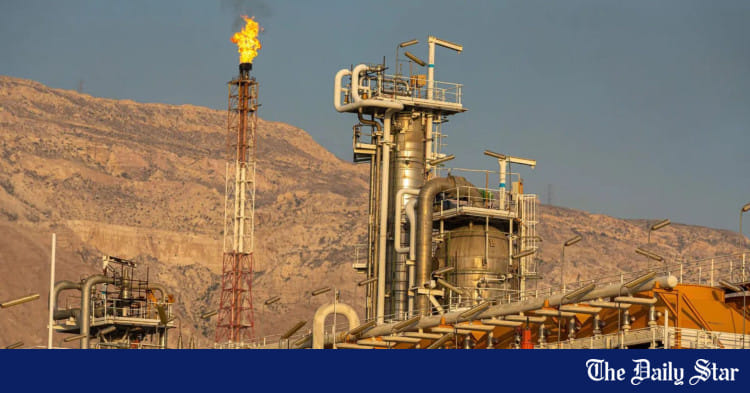
Vehicles jam a highway as a fire blazes nearby in the oil depots of Shahran, northwest of Tehran, on June 15, 2025. Israel and Iran exchanged fire on June 14, a day after Israel unleashed an unprecedented aerial bombing campaign that Iran said hit its nuclear facilities, ‘martyred’ top commanders and killed dozens of civilians. | AFP Photo

Iran launched a new wave of missiles at Israel on Saturday, wounding several people in residential buildings, while Israel said it was striking Tehran.

The fresh attacks came after Israeli Prime Minister Benjamin Netanyahu vowed to hit ‘every target of the ayatollah regime’, and Iranian President Masoud Pezeshkian warned further strikes would draw ‘a more severe and powerful response’.

As calls for de-escalation grew, a new round of nuclear talks between the United States and Iran scheduled for Sunday was cancelled, with Iran saying it could not negotiate while under attack from Israel.

Israel's operation, which began early Friday, has targeted Iran's air defences and hit key nuclear and military sites, killing dozens of people including top army commanders and atomic scientists, according to Tehran.

On Saturday night Israel said it was simultaneously working to intercept a new salvo of missiles fired from Iran, while also carrying out strikes on ‘military targets in Tehran’.

Iranian news agency Tasnim reported that an Israeli strike had targeted the country's defence ministry headquarters in Tehran and damaged one of its buildings. The ministry did not comment.

Iran, meanwhile, announced a ‘new wave’ of attacks targeting Israel.

Israel's emergency services said an Iranian missile hit a home in the Haifa region, leaving 14 people injured, including one in critical condition.

Israeli strikes meanwhile hit two fuel depots in Tehran, the Iranian oil ministry said Sunday.

According to the oil ministry, the oil depots at Shahran northwest of Tehran and another reservoir south of the city were hit.

An AFP journalist saw the depot at Shahran on fire.

Every site, every target

Iran's UN ambassador said 78 people were killed and 320 wounded in Friday's first wave of Israeli strikes.

Israel on Saturday said three people were killed and 76 wounded by Iran's drone and missile barrage the night before.

Netanyahu has vowed to keep up Israel's campaign.

‘We will hit every site, every target of the ayatollah regime,’ he said in a video statement, threatening greater action ‘in the coming days’.

He added that the Israeli campaign had dealt a ‘real blow’ to Iran's nuclear programme and maintained it had the "clear support" of US President Donald Trump.

Trump said he and Russian President Vladimir Putin had agreed in a phone call on Saturday that the conflict between Iran and Israel ‘should end’.

Pezeshkian said meanwhile that ‘the continuation of the Zionist aggression will be met with a more severe and powerful response from the Iranian armed forces’.

According to a statement from his office, Pezeshkian also condemned Washington's ‘dishonesty’ for supporting Israel while engaged in nuclear talks with Iran -- which mediator Oman said would no longer take place on Sunday.

Western governments have repeatedly accused Iran of seeking a nuclear weapon, which it denies.

Iran's top nuclear negotiator, Foreign Minister Abbas Araghchi, said the Israeli attacks undermined negotiations and were pushing the region into a ‘dangerous cycle of violence’.

Foreign concern

After decades of enmity and conflict by proxy, it is the first time the arch-enemies have traded fire with such intensity, triggering fears of a prolonged conflict that could engulf the Middle East.

Highlighting the unease, Turkish President Recep Tayyip Erdogan warned against a ‘devastating war’ with regional consequences, in a call with Saudi Crown Prince Mohammed bin Salman, Ankara said.

Israeli strikes have hit Iran's Natanz uranium enrichment plant and killed its highest-ranking military officer, Mohammad Bagheri, as well as the head of the powerful Islamic Revolutionary Guard Corps, Hossein Salami.

The Israeli military said its strikes had killed more than 20 Iranian commanders.

Iranian media reported five Guards killed Saturday in Israeli strikes, while authorities in one northwestern province said 30 military personnel had been killed there since Friday.

Iran's Red Crescent said an ambulance was hit Saturday in Urmia city, killing two.

Iran called on its citizens to unite in the country's defence, while Netanyahu urged them to rise up against against the government.

Iran's Mehr news agency said Tehran had warned Britain, France and the United States it could retaliate if they came to Israel's defence.

Everything was shaking

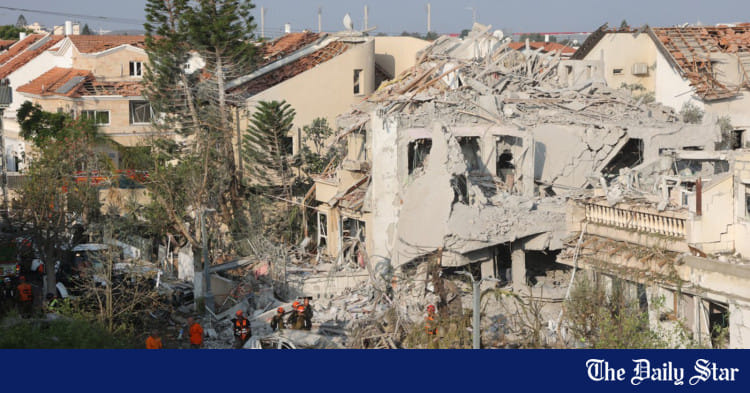
AFP images from the city of Ramat Gan near Tel Aviv showed blown-out buildings, destroyed vehicles and streets strewn with debris after Iran's first wave of attacks.

Iran's Revolutionary Guards said they had struck dozens of targets in Israel. One Iranian missile wounded seven Israeli soldiers, the military said.

Firefighters had worked for hours to free people trapped in a Tel Aviv high-rise building on Friday.

Chen Gabizon, a resident, said he ran to an underground shelter after receiving an alert.

‘We just heard a very big explosion, everything was shaking, smoke, dust, everything was all over the place,’ he said.

In Tehran, fire and heavy smoke billowed over Mehrabad airport on Saturday, an AFP journalist said.

The Israeli army said it had struck an underground military facility Saturday in western Iran's Khorramabad that contained surface-to-surface and cruise missiles.

Iranian media also reported a ‘massive explosion’ following an Israeli drone strike on an oil refinery in the southern city of Kangan.

The attacks prompted several countries to temporarily ground air traffic, with Jordan again shutting its airspace late Saturday after it had briefly reopened it.​
 
Analyze

Analyze Post

Add your ideas here:
Highlight Cite
 
Analyze

Analyze Post

Add your ideas here:
Highlight Cite

The illegal attack on Iran
Vijay Prashad 15 June, 2025, 00:00

1749947146220.webp

Smoke from Israeli airstrike on Iran. | Counter Punch

ISRAEL’S consistent attacks on Iran since 2023 have all been illegal, violations of the United Nations Charter (1945). Iran is a member state of the United Nations and is therefore a sovereign state in the international order. If Israel had a problem with Iran, there are many mechanisms mandated by international law that permit Israel to bring complaints against Iran.

Thus far, Israel has avoided these international forums because it is clear that it has no case against Iran. Allegations that Iran is building a nuclear weapon, which are constantly raised by the United States, the European Union, and Israel, have been fully investigated by the International Atomic Energy Agency and found to be unfounded. It is certainly true that Iran has a nuclear energy programme that is within the rules in place through the IAEA, and it is also true that Iran’s clerical establishment has a fatwa (religious edict) in place against the production of nuclear weapons. Despite the IAEA findings and the existence of this fatwa, the west — egged on by Israel — has accepted this irrational idea that Iran is building a nuclear weapon and that Iran is therefore a threat to the international order. Indeed, by its punctual and illegal attacks on Iran, it is Israel that is a threat to the international order.

Over the past decades, Iran has called for the establishment of a Middle East Nuclear Free Zone, a strange idea coming from a country accused of wanting to build a nuclear weapon. But this idea of the nuclear free zone has been rejected by the West, largely to protect Israel, which has an illegal nuclear weapons programme. Israel is the only country in the Middle East with a nuclear weapon, although it has never tested it openly nor acknowledged its existence. If Israel was so keen on eliminating any nuclear threat, it should have taken the offer for the creation of a nuclear-free zone heartily.

Neither the Europeans, who so often posture as defenders of international law, nor the United Nations leadership have publicly pushed Israel to adopt this idea because both recognise that this would require Israel, not Iran, to denuclearise. That this is an improbable situation has meant that there has been no movement from the West or from the international institutions to take this idea forward and build an international consensus to develop a nuclear-free zone in the Middle East.

Israel does not want to build a nuclear-free zone in the region. What Israel wants is to be the sole nuclear power in the region, and therefore to be exactly what it is — namely, the largest United States military base in the world that happens to be the home to a large civilian population. Iran has no ambition to be a nuclear power. But it has an ambition to be a sovereign state that remains committed to justice for the Palestinians. Israel has no problem with the idea of sovereignty per se, but has a problem with any state in the region that commits itself to Palestinian emancipation. If Iran normalised relations with Israel and ceased its opposition to US dominion in the region, then it is likely that Israel would end its opposition to Iran.

Israel and US prepared the way

IN JANUARY 2020, the United States conducted an illegal assassination at Iraq’s Baghdad Airport to kill General Qassim Soleimani, the leader of the Quds Force of the Islamic Revolutionary Guards Corps. Soleimani, through the Quds Force, had produced for Iran an insurance policy against further Israeli attacks on the country. The Quds Force is responsible for Iranian military operations outside the boundaries of the country, including building what is called the ‘Axis of Resistance’ that includes the various pro-Iranian governments and non-governmental military forces. These included: Hezbollah in Lebanon, various IRGC groups in Syria that worked with Syrian militia groups, the government of Bashar al-Assad in Syria, several Palestinian factions in Occupied Palestine, and the Ansar Allah government in Yemen. Without its own nuclear deterrent, Iran required some way to balance the military superiority of Israel and the United States. This deterrence was created by the ‘Axis of Resistance’, an insurance policy that allowed Iran to let Israel know that if Israel fired at Iran, these groups would rain missiles on Tel Aviv in retaliation.

The assassination of Soleimani began a determined new political and military campaign by the United States, Israel, and their European allies to weaken Iran. Israel and the United States began to punctually strike Iranian logistical bases in Syria and Iraq to weaken Iran’s forward posture and to demoralise the Syrian and Iraqi militia groups that operated against Israeli interests. Israel began to assassinate IRGC military officers in Syria, Iran, and Iraq, a campaign of murder that began to have an impact on the IRGC and the Quds Force.

Taking advantage of its genocidal war against the Palestinians in Gaza, Israel, with full support from the United States and Europe, began to damage the ‘Axis of Resistance’, Iran’s insurance policy. Israel took its war into Lebanon, with a ruthless bombing campaign that included the assassination of the Hezbollah leader Sayyid Hassan Nasrallah on September 27, 2024. This campaign, while it has not totally demolished Hezbollah, has certainly weakened it. Meanwhile, Israel began a regular bombing campaign against the Syrian military positions around Damascus and along the road to Idlib in the north. This bombing campaign, coordinated with the US military and with the US intelligence services, was designed to open the roadway for the entry of the former al-Qaeda fighters into Damascus and to overthrow the government of al-Assad on 8 December 2024. The fall of the al-Assad government dented Iran’s strength across the Levant region (from the Turkish border to the Occupied Palestinian Territory) as well as along the plains from southern Syria to the Iranian border. The consistent campaign by the United States to bomb Yemeni positions further resulted in the loss of Ansar Allah’s heavy equipment (including long-range missiles) that fundamentally threatened Israel.

What this meant was that by early 2025, the Iranian insurance policy against Israel had collapsed. Israel began its march to war, suggesting an attack on Iran was imminent. Such an attack, Israel’s Prime Minister Benjamin Netanyahu knows, would help him in a domestic political fight with the ultra-orthodox parties over the question of a military exemption for their communities; this will prevent his government from falling. Cynical Netanyahu is using genocide and the possibility of a horrendous war with Iran for narrow political ends. But that is not what is motivating this attack. What is motivating this attack is that Israel smells an opportunity to try to overthrow the Iranian government by force.

Iran returned to the negotiations brokered by the IAEA to prevent such an attack. Its leadership knew full well that nothing would stop a scofflaw such as Israel from bombing Iran. And nothing did. Not even the fact that Iran is still at the negotiation table. Israel has taken advantage of Iran’s momentary weakness to strike. And that strike might escalate further.

CounterPunch.org, June 13. Vijay Prashad’s most recent book (with Noam Chomsky) is The Withdrawal: Iraq, Libya, Afghanistan and the Fragility of US Power (New Press, August 2022).​
 
Analyze

Analyze Post

Add your ideas here:
Highlight Cite

Live Updates
Israel army says struck underground missile facility in western Iran


1749947590532.webp

Israeli emergency responders inspect a site hit by a missile fired from Iran near Tel Aviv on June 14, 2025. Iran struck Israel early June 14, with barrages of missiles after a massive onslaught targeted the Islamic republic's nuclear and military facilities, and killed several top generals. Photo: AFP

Key updates-
  1. Tehran launches dozens of missiles early on Saturday​
  2. Air raid sirens in Tel Aviv, Jerusalem​
  3. Israel says some missiles intercepted​
  4. Tahran's Mehrabad airport hit, Fars new agency reports​
  5. Around 60 people, including 20 children, killed in Israeli attack on Tehran, Iran's state media reports​
  6. Iran airspace closed 'until further notice': state media​
  7. Iran says still undecided on joining US in nuclear talks​

Iran and Israel traded missiles and airstrikes on Saturday, the day after Israel launched a sweeping air offensive against its old enemy, killing commanders and scientists and bombing nuclear sites in a stated bid to stop it building an atomic weapon.

In Tehran, Iranian state TV reported that around 60 people, including 20 children, had been killed in an attack on a housing complex, with more strikes reported across the country. Israel said it had attacked more than 150 targets.

In Israel, air raid sirens sent residents into shelters as waves of missiles streaked across the sky and interceptors rose to meet them. At least three people were killed overnight. An Israeli official said Iran had fired around 200 ballistic missiles in four waves.​
 
Analyze

Analyze Post

Add your ideas here:
Highlight Cite

Iran says production at world's largest gas field partly suspended after Israeli attack

1749947728369.webp

The South Pars Gas-Condensate field in Asalouyeh, Iran, in 2021. Photo: AFP/Saeid Arabzadeh

Iran has partially suspended gas production at the world's biggest gas field after an Israeli strike caused a fire there on Saturday, the semi-official Tasnim news agency reported, in what would be the first Israeli strike on Iran's oil and gas sector.

Iran shares the South Pars gas field with Qatar. Striking it would mark a major escalation in the conflict, which had already pushed oil prices up 9% on Friday even though Israel spared Iran's oil and gas on the first day of its attacks.

Israel launched an air offensive against Iran on Friday, killing commanders and scientists and bombing nuclear sites in a stated bid to stop Tehran building an atomic weapon.

The South Pars field is located offshore in Iran's southern Bushehr province and is responsible for the lion's share of gas production in Iran, the world's third largest gas producer after the United States and Russia.

The strike caused a fire, which has been extinguished, the Iranian oil ministry said. The fire broke out in one of the four units of Phase 14 of South Pars, halting production of 12 million cubic metres of gas, Tasnim said.

Iran produces around 275 billion cubic meters (bcm) of gas per year or some 6.5% of global gas output, and consumes it domestically as it cannot export gas due to sanctions.

Iran shares the field with Qatar, which calls the field North Field. Qatar produces 77 million tonnes of liquefied gas from the field with the help of global majors such as Exxon and Shell and supplies the gas to Europe and Asia.​
 
Analyze

Analyze Post

Add your ideas here:
Highlight Cite
  • Sad (0)
Reactions: Bilal9
 
Analyze

Analyze Post

Add your ideas here:
Highlight Cite
  • Khamenei (+4)
Reactions: Sharma Ji
Iranian Diaspora are foolish. Often called the Indian diaspora, but worse.
Stop your crap.

We have our chtyas. But no Indian would cheer his country getting attacked.
 
Analyze

Analyze Post

Add your ideas here:
Highlight Cite
Status
Not open for further replies.

Members Online

No members online now.

Latest Posts

Back
PKDefense - Recommended Toggle