| Global Defense, OSINT & Geopolitics Wire

[🇧🇩] Agriculture in Bangladesh

[🇧🇩] Agriculture in Bangladesh
284
17K
More threads by Saif

G Bangladesh Defense

Saif

Senior Member
Joined
Jan 24, 2024
Messages
22,367
Likes
9,875
Nation

Axis Group

Agriculture Sectors
Last published date:
2022-07-20

Overview​

A rising middle class (estimated at over 30 million) has fueled demand for high-quality agricultural products. According to the Bangladesh Bureau of Statistics for FY 2020-21, crops, livestock, fisheries, and forest products accounted for about 12.5 percent of Bangladesh’s total GDP and employed approximately 40 percent of the total population. Most agricultural production in Bangladesh is characterized as traditional subsistence farming. Bangladesh produces a variety of agricultural products such as rice, wheat, corn, legumes, fruits, vegetables, meat, fish, seafood, and dairy products. Rice is the main staple in the Bangladeshi diet. Lack of arable land and limited natural resources increase the importance of developing new agricultural technologies, such as salt tolerant or submergence tolerant seed varieties, to help increase productivity and meet future demand. Floods, cyclones, and biotic-abiotic stress can also affect agricultural productivity levels and incomes.

Although Bangladesh imports bulk commodities such as wheat, soybeans, and pulses, there are niche segment opportunities for high-value agricultural product imports, particularly in more affluent urban centers such as Dhaka and Chittagong. Strong consumer demand exists for imported fresh fruits, tree nuts, and dairy products, as well as processed food products.
Total Market Size for Agricultural Products: 2016-2021

201620172018201920202021
Total Local Production$30,424$33,374$35,882$38,095$37,568$38,801
Total Exports$1,488$1,625$1,418$1,600$1,343$1,586
Total Imports$5,991$9,470$5,952$8,000$8,442$10,334
Imports from the U.S.$496$889$1,087$1,300$966$1,031
Total Market Size$34,927$41,219$40,417$44,495$44,667$47,549
Exchange Rates798182848585

total market size = (total local production + imports) - exports)
Units: $ millions

Leading Sub-Sectors​

The processed food industry accounts for approximately 13 percent of all manufacturing production value and employs 6.5 percent of the manufacturing labor force. The industry employs 1.4 percent of the country’s total labor force, and the sector is dominated by small- and medium-sized enterprises strongly linked to local production. There are nearly 292 medium-sized food manufacturing enterprises in the country processing baked goods, confectionery items, fruits and vegetables, cereals, dairy goods, fruit juices, and other foods and beverages.

Opportunities​

Agricultural equipment and technology; agriculture inputs, including feed, seeds, pesticides, and fertilizer; dairy processing equipment; fish processing equipment; packaging and canning equipment and technology; agriculture infrastructure consulting services and solutions, including silos and cold chain/cold storage facilities.

Resources​

  • Ministry of Agriculture
  • Bangladesh Agricultural Research Council
  • Food and Agriculture Organization
  • Ministry of Food
  • Ministry of Livestock and Fisheries
  • Ministry of Textile and Jute
  • Ministry of Commerce
 

More attention needed for the agriculture sector​

1707036249301.webp


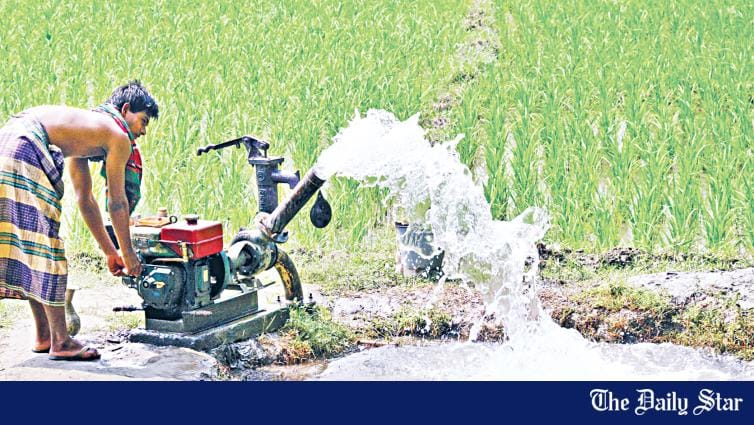
More emphasis should be given on agricultural mechanisation and the use of ICT in farming. PHOTO: STAR

The agriculture sector is one of the key economic pillars of Bangladesh. Just after liberation in 1971, its contribution to GDP was around 60 percent. It is the most important sector in Bangladesh that helps with peoples' livelihoods, employment, and contributes to GDP, we all know that. But its share of GDP has decreased over the last decade, going from 17 percent in 2010 to 12.6 percent in 2020.

Countries around the world are now facing serious inflationary challenges mainly due to the Russia-Ukraine war, which is greatly harming the global economy. The global commodity market is facing considerable instability due to supply chain disruptions. Bangladesh has also been affected by all these, and is struggling to cope with the situation. The country was already experiencing significant inflationary pressure, and the added price hike has made the situation almost unbearable for the general people.

On the other hand, its foreign currency reserves have been going down. The impact of the three Cs – climate change, Covid-19, and conflict (Russia-Ukraine war) – has given birth to another "C" which is quite evidently, the cost. However, these could be tackled with three As – agriculture, austerity and assistance – which could save all of us.

Over the years, Bangladesh has written a remarkable story of poverty reduction and development, especially during the past decade. After its independence in 1971, it was one of the poorest countries in the world. But Bangladesh successfully reached the lower-middle-income status in 2015 and is now on track to graduate from the UN's Least Developed Countries (LDC) category by 2026.

However, compared to many other countries of the world, we are still lagging behind in terms of technology, education, economy, farming, and in numerous other sectors. Bangladesh is now an important part of the global village. And it will not always be easy for Bangladesh to overcome different global shocks. It is because we currently have so many issues to cope with that the government announced a measured budget for the fiscal year 2022-2023.

In his budget speech for the fiscal year 2022-2023, Finance Minister AHM Mustafa Kamal emphasised on boosting food production to ensure food security amid the Russia-Ukraine war and global food price hike. He proposed an allocation of Tk 33,698 crore for food, fisheries, and agriculture for the coming fiscal year, which is only 6.2 percent of the total budget. He talked about increasing fertiliser subsidies from Tk 12,000 crore (2021-2022) to Tk 16,000 crore.

The significance of farming as a whole, including the sub-sectors, service and industry sectors, has increased manifold. The cultivation of high-value fruit orchards and vegetables also played a significant role in boosting the economy. Not only the farms, but the value addition of these agricultural products provided a much-needed boost for the agricultural service sector. Bangladesh Rice Research Institute (BRRI) must be credited for the grain production and they have been quite remarkable, I must say. Alongside the production, the research didn't stop for a day and with responsibility, it moved ahead with the support of Bangladeshi Agricultural Research Institute (BARI). Bangladesh Institute of Nuclear Agriculture (BINA) also deserves credit for their advanced techniques in boosting agricultural production and for developing technologies that are environmentally friendly and sustainable.

The farming sector has individually employed more than 40.6 percent people, either directly or indirectly. Previously, farmers in our country were really poor, but today, they have changed their fates with their persistent labour and certainly with quality seed support. And that has also led to farmers' buying capacity increasing. They can now feed themselves and their family and also send their children to school.
1707036383890.webp

Over the years, Bangladesh has written a remarkable story of poverty reduction and development. PHOTO: HABIBUR RAHMAN

If we look at the three main driving forces of our economy – i.e., farming, RMG, and remittances – we will see the sons and the daughters of farmers working in all three sectors. Oftentimes, they send their earnings back to their parents in their villages. And this money is used to invest in farming – both in small- and large-scale initiatives. This has not only strengthened our economy, but has empowered the youth, especially women, and has also helped raise the voice of the impoverished. Moreover, agricultural tourism has opened a new door for us. I have seen in many European countries and in the US the concept of the family farm. Many young entrepreneurs in Bangladesh have started a number of wonderful eco-resorts across the country and people from around Bangladesh are visiting these beautiful places to get close to nature and farming.

Climate change is a big challenge, which we are facing and will have to face with the use of new agricultural technologies and adaptability. We must closely follow global adaptation technologies and concentrate more on new examples of climate adaptability which is best suited for us. More emphasis should be given on agricultural mechanisation and the use of ICT in farming, as this will help us greatly in fighting back against climate change. In the same way, we should also focus on the weather-based index and crop insurance which will ensure real empowerment of farmers and will make them more resilient. Artificial intelligence will play a key role and I don't think family farms will remain, but the pattern of farming will change entirely. Overall, the system will change and we will go through a global paradigm shift. Ultimately, we will have to face the challenge of hidden carbon emission and we will need technologies to overcome it. After 50 years, farming will become more expensive, but there will be a global export market where Bangladesh will hopefully be at the forefront.

Despite the high population, decreasing arable land, and frequent natural disasters, Bangladesh has made significant progress in achieving self-sufficiency in producing cereal crops and reducing poverty. Almost half of the population is now employed in the farming sector. Therefore, our state policies must be aligned with the interest of this sector, especially at a time when we are facing numerous challenges as a nation. I believe that, if we could safeguard the marginal farmers, bring in modern technologies, properly execute the Delta Plan, and strengthen inter-ministerial coordination, the country will keep moving forward and the farming sector will continue to flourish.
 

Cultivation of colorful cauliflower is increasing in Bangladesh - price is double and is rich in Beta-Carotene, tastes better too.​


Nahar Agro seeks to lead egg market with Tk150 crore new investment​

It aims to sell 10 lakh eggs per day for the consumers by 2025​


Nahar Agro seeks to lead egg market with Tk150 crore new investment


Nahar Agro, a Chattogram-based agro farm, plans to make a Tk150 crore new investment to expand its poultry business to enter the egg market with around 10 lakh daily supply by 2025.

The new investment plan is expected to transform the farm, which is heavily concentrated on hatching egg production, into a major player in the egg market in the Chattogram region, company officials say.

"There is a daily demand for 50 lakh eggs in the Chattogram region, but there are not enough poultry farms in the area to meet the demand. We are planning to fill the gap in production to ease the crisis in the market while also reducing the price," Rakibur Rahman, managing director of the company, told The Business Standard.

Currently, the company produces nearly 2.5 lakh hatching eggs a day, apart from some consumable ones with double yolks. It also has businesses in areas ranging from poultry and fish feed to dairy and horticulture products.

The move comes at a time when Bangladesh is grappling with price volatility in the egg market, forcing it to allow imports from neighbouring India as a tool for stabilising the situation.

Initially, Nahar Agro aims to supply two lakh eggs per day by this year, which will eventually increase to 10 lakh by the next year, according to company officials.

With the massive business expansion plan, it hopes to create around 1,000 new jobs alongside producing 50-60 tonnes of environmentally friendly bio-fertiliser per day.

The company says it has already taken initiatives to import modern machinery and establish new farms in different parts of the district in phases.

In the first phase, the company plans to set up a shed to produce two lakh eggs per day by 2024. By the end of 2025, the company will set up all seven sheds containing 1.2 million hens to produce one million eggs.

"We hope to set up all the sheds in phases to produce 10 lakh eggs by 2025 and then we have plans to double the production in the next two years," Rakibur said.

The company aims to incorporate modern technologies in its egg production, such as an automatic system for brooding, egg collection, drinking, and feeding facilities, alongside installing an automatic ventilation system and automatic heating and cooling equipment in the new layer industry.

"There will also be an automatic litter collection system to turn the litter into biofertiliser. We are working on that, particularly to make our new industry more effective," Rakibur told TBS, adding that the industry will produce 50-60 tonnes of biofertiliser every day.

In a span of 37 years since starting business as a livestock venture in 1989, Nahar Agro has become one of the country's largest and most successful agro-business entities with an annual turnover of around Tk1,000 crore. It employs more than 2,500 people directly and another 10,000 indirectly.

The company has maintained a sustainable growth with top-quality day-old chicks, poultry and fish feed, along with dairy and horticulture products.

It has 12 lakh parent-stock (broiler and layer) chickens in its poultry farms. From the eggs laid by the parent-stock chickens, 22 lakh to 24 lakh chicks are produced every week in its hatcheries.

Besides, its dairy farm has 1,700 breeding and milking cows, producing about 5,500 to 6,000 litres of milk daily.
Nahar Agro operates four poultry and fish feed mills in Mirsharai, Sirajganj, and Jashore, with a production capacity of 60,000 tonnes per month. Currently, these mills produce 30,000 tonnes of feed a month, with 20% used by the company's own farms and the remaining 80% marketed.

Additionally, the agro company provides chicks, feed, and other technical support to around 10,000 poultry farmers across approximately 5,000 poultry farms nationwide.
 
Growing Roselle buds in Bangladesh which is consumed (after drying) as a tea (and is an organic superfood). One KG sells for Tk. 4000 and many times that amount overseas.