Bangladesh Defense

Saif
Senior Member
- Joined
- Jan 24, 2024
- Messages
- 22,336
- Likes
- 9,875
- Nation

- Axis Group

Rapid development of AI: Crisis or opportunity for Bangladeshi Youth?
Porimol Palma 15 September, 2026, 11:31
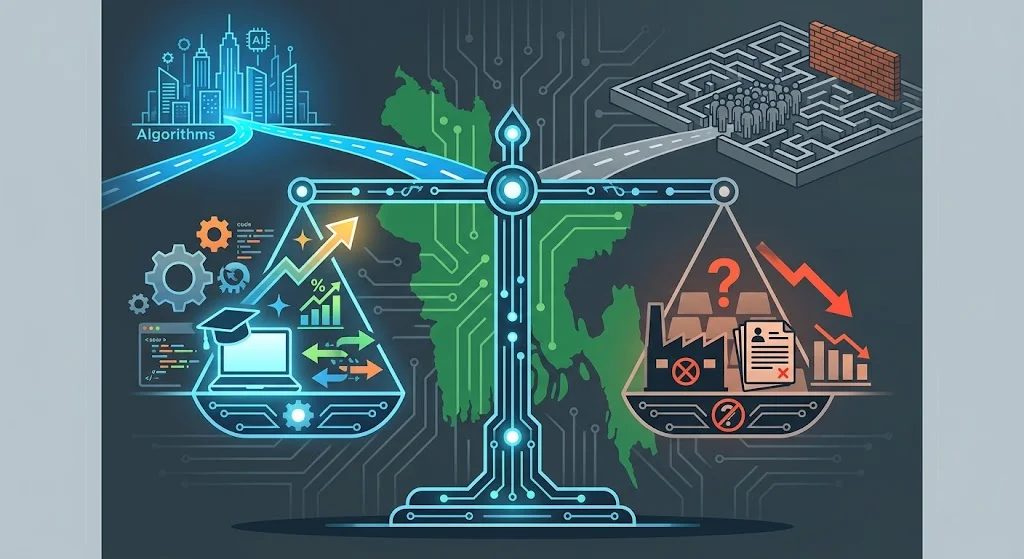
Artificial intelligence is rapidly changing the way people work, from writing and translation to coding, data analysis, graphic design and software development.
For Bangladesh, however, the transformation is arriving at a difficult time: millions of young people are already struggling to find work.
The Bangladesh Bureau of Statistics Labour Force Survey put the country's overall unemployment rate at 3.66 per cent in 2024. But unemployment among people aged 15–29 was 8.07 per cent.
The rapid spread of AI therefore raises a critical question for Bangladesh – if whether it will create new opportunities or make an already difficult job market even harder to enter.
For Achia Nila, founder of software development company Women in Digital, AI is both a challenge and a major opportunity.
AI, she said, is no longer relevant only to IT professionals. People in almost every sector can use it to improve productivity.
She herself has seen the change in her business.
‘I used to employ ten developers before the advent of AI. Now, I can do much of my primary work, including project analysis, myself as I have an IT background,’ she said.
‘So, I might have cut some employees, but the efficiency and speed of my work has have been enhanced.’
That experience captures one of the central dilemmas posed by AI. The technology can make an individual worker significantly more productive, but the same productivity gain can mean that companies need fewer people to perform certain tasks.
For Bangladesh's large pool of freelancers, particularly those providing services such as data entry, graphic design and basic software development to overseas clients, the implications could be significant.
‘There is a common perception that the Bangladeshi freelancers engaged in providing IT products and services to the developed world will be hardest hit by the advent of AI,’ Nila said.
‘This is a partial truth. If you update yourself with the required expertise, you would be able to work more efficiently and earn even better.’
The bigger danger is for workers who do not update their skills.
Continuous learning and adaptation is are increasingly important as technology changes both the nature of work and what employers expect from workers.
‘AI cannot work without humans behind them. It needs to prompt and it is the humans who can be prompters,’ Nila said.
Even AI-generated content, she added, requires human supervision and verification.
People are already seeing large numbers of AI-generated images and videos on social media, but the novelty of such content is beginning to wear off.
‘People want unique, human-touched contents content. Even if you take AI assistance, it has to have unique features, and that’s not possible without humans working behind them,’ she said.
Entry-level jobs under pressure
Professor Rifat Shahriyar of the Department of Computer Science and Engineering at BUET has observed a more immediate impact on the country's IT job market.
‘The demand for the fresher CSE graduates has come down because of the industries’ more use increased use of AI,’ he said.
Starting salaries for newly recruited graduates have also declined, he said.
Companies are increasingly using AI to enable mid-level engineers to perform software development and other tasks that previously required larger numbers of entry-level workers.
‘In the developed world too, the expert-level jobs on the subject are increasing,’ Shahriyar said.
That has implications beyond the technology industry because entry-level employment traditionally provides young graduates with their first opportunity to gain professional experience.
If those first rungs of the career ladder disappear or become fewer, young people may find it harder to enter the professions in the first place.
The same pressure could eventually affect freelancers working in routine areas such as graphic design and data entry.
But workers who learn to use AI effectively could find new opportunities, Shahriyar said.
A warning for Bangladesh's education system
A recent study of university students in Bangladesh suggests that young people are aware of the transformation but are not uniformly prepared for it.
The study, published on September 10 in Discover Global Society, surveyed 450 students at Dhaka University, Rajshahi University and Pabna University of Science and Technology.
The students generally believed that AI could create new employment opportunities, although they also expressed concerns about job losses and skill gaps.
The researchers called for greater integration of AI-related education into university curricula and closer alignment between what students learn and what industries require.
That challenge comes when, as per BBS Labour Force Survey 2024, there are according to the BBS Labour Force Survey 2024, there were about 2.62 million unemployed people in Bangladesh. Around 885,000 of them were university graduates, while unemployment among people with tertiary education was 13.54 per cent.
Bangladesh as AI consumer
Professor Shahriyar said the problem in Bangladesh is that it is basically the consumers a consumer of AI tools, not producers a producer. Also, the country does not have its infrastructure ready.
‘We are now only buying the applications or using free ones. We will be spending huge foreign currency amounts of foreign currency if we continue to do this.’
The country needs stronger domestic capacity to develop AI applications and supporting infrastructure, including data centres, he said.
‘We have talents talent and if we can develop our own applications, our government and industries can use them at competitive cost.’
Developing domestic capacity would also help Bangladesh address data protection and cybersecurity concerns, he added.
The issue is becoming increasingly important as AI spreads beyond technology companies into government, education, finance, healthcare, manufacturing and other sectors, the academic added.
Training the whole workforce
Both experts argue that AI training cannot be restricted to computer science students or software professionals.
‘The most important thing now for our government is to expand AI training to anyone eligible and have laws so that we cannot abuse AI and protect the data,’ Shahriyar said.
‘AI is not about the IT professionals only but for all sectors. It affects all and benefits all. What is needed is the right policy and regulations.’
The technology could also become an important learning tool.
People can use AI to learn foreign languages, mathematics and other skills, provided they know how to use the technology properly and verify the information it provides.
Nila similarly believes that Bangladesh needs to move much faster.
‘You can have your AI agents that can work for you if you train them properly. These are also paid AI services. You don’t have much of them many of them being used in Bangladesh,’ she said.
That points to a potentially important divide in the future labour market: not simply between people who have jobs and those who do not, but between workers who know how to use AI and those who do not.
The opportunity behind the disruption
Globally, AI companies are developing increasingly powerful systems at extraordinary speed.
Some technology leaders and researchers have warned that the development of advanced AI needs stronger safeguards because of the potential economic, cybersecurity and social risks.
But the technology also has the potential to dramatically increase productivity.
For Bangladesh, the challenge is therefore not whether AI can be stopped. It cannot.
The real challenge is whether the country can prepare its young population quickly enough.
‘We need strong regulations for data collection and incentives for people and industries to learn the required skills and develop local applications and infrastructure,’ said Professor Rifat Shahriyar.
Porimol Palma 15 September, 2026, 11:31
Artificial intelligence is rapidly changing the way people work, from writing and translation to coding, data analysis, graphic design and software development.
For Bangladesh, however, the transformation is arriving at a difficult time: millions of young people are already struggling to find work.
The Bangladesh Bureau of Statistics Labour Force Survey put the country's overall unemployment rate at 3.66 per cent in 2024. But unemployment among people aged 15–29 was 8.07 per cent.
The rapid spread of AI therefore raises a critical question for Bangladesh – if whether it will create new opportunities or make an already difficult job market even harder to enter.
For Achia Nila, founder of software development company Women in Digital, AI is both a challenge and a major opportunity.
AI, she said, is no longer relevant only to IT professionals. People in almost every sector can use it to improve productivity.
She herself has seen the change in her business.
‘I used to employ ten developers before the advent of AI. Now, I can do much of my primary work, including project analysis, myself as I have an IT background,’ she said.
‘So, I might have cut some employees, but the efficiency and speed of my work has have been enhanced.’
That experience captures one of the central dilemmas posed by AI. The technology can make an individual worker significantly more productive, but the same productivity gain can mean that companies need fewer people to perform certain tasks.
For Bangladesh's large pool of freelancers, particularly those providing services such as data entry, graphic design and basic software development to overseas clients, the implications could be significant.
‘There is a common perception that the Bangladeshi freelancers engaged in providing IT products and services to the developed world will be hardest hit by the advent of AI,’ Nila said.
‘This is a partial truth. If you update yourself with the required expertise, you would be able to work more efficiently and earn even better.’
The bigger danger is for workers who do not update their skills.
Continuous learning and adaptation is are increasingly important as technology changes both the nature of work and what employers expect from workers.
‘AI cannot work without humans behind them. It needs to prompt and it is the humans who can be prompters,’ Nila said.
Even AI-generated content, she added, requires human supervision and verification.
People are already seeing large numbers of AI-generated images and videos on social media, but the novelty of such content is beginning to wear off.
‘People want unique, human-touched contents content. Even if you take AI assistance, it has to have unique features, and that’s not possible without humans working behind them,’ she said.
Entry-level jobs under pressure
Professor Rifat Shahriyar of the Department of Computer Science and Engineering at BUET has observed a more immediate impact on the country's IT job market.
‘The demand for the fresher CSE graduates has come down because of the industries’ more use increased use of AI,’ he said.
Starting salaries for newly recruited graduates have also declined, he said.
Companies are increasingly using AI to enable mid-level engineers to perform software development and other tasks that previously required larger numbers of entry-level workers.
‘In the developed world too, the expert-level jobs on the subject are increasing,’ Shahriyar said.
That has implications beyond the technology industry because entry-level employment traditionally provides young graduates with their first opportunity to gain professional experience.
If those first rungs of the career ladder disappear or become fewer, young people may find it harder to enter the professions in the first place.
The same pressure could eventually affect freelancers working in routine areas such as graphic design and data entry.
But workers who learn to use AI effectively could find new opportunities, Shahriyar said.
A warning for Bangladesh's education system
A recent study of university students in Bangladesh suggests that young people are aware of the transformation but are not uniformly prepared for it.
The study, published on September 10 in Discover Global Society, surveyed 450 students at Dhaka University, Rajshahi University and Pabna University of Science and Technology.
The students generally believed that AI could create new employment opportunities, although they also expressed concerns about job losses and skill gaps.
The researchers called for greater integration of AI-related education into university curricula and closer alignment between what students learn and what industries require.
That challenge comes when, as per BBS Labour Force Survey 2024, there are according to the BBS Labour Force Survey 2024, there were about 2.62 million unemployed people in Bangladesh. Around 885,000 of them were university graduates, while unemployment among people with tertiary education was 13.54 per cent.
Bangladesh as AI consumer
Professor Shahriyar said the problem in Bangladesh is that it is basically the consumers a consumer of AI tools, not producers a producer. Also, the country does not have its infrastructure ready.
‘We are now only buying the applications or using free ones. We will be spending huge foreign currency amounts of foreign currency if we continue to do this.’
The country needs stronger domestic capacity to develop AI applications and supporting infrastructure, including data centres, he said.
‘We have talents talent and if we can develop our own applications, our government and industries can use them at competitive cost.’
Developing domestic capacity would also help Bangladesh address data protection and cybersecurity concerns, he added.
The issue is becoming increasingly important as AI spreads beyond technology companies into government, education, finance, healthcare, manufacturing and other sectors, the academic added.
Training the whole workforce
Both experts argue that AI training cannot be restricted to computer science students or software professionals.
‘The most important thing now for our government is to expand AI training to anyone eligible and have laws so that we cannot abuse AI and protect the data,’ Shahriyar said.
‘AI is not about the IT professionals only but for all sectors. It affects all and benefits all. What is needed is the right policy and regulations.’
The technology could also become an important learning tool.
People can use AI to learn foreign languages, mathematics and other skills, provided they know how to use the technology properly and verify the information it provides.
Nila similarly believes that Bangladesh needs to move much faster.
‘You can have your AI agents that can work for you if you train them properly. These are also paid AI services. You don’t have much of them many of them being used in Bangladesh,’ she said.
That points to a potentially important divide in the future labour market: not simply between people who have jobs and those who do not, but between workers who know how to use AI and those who do not.
The opportunity behind the disruption
Globally, AI companies are developing increasingly powerful systems at extraordinary speed.
Some technology leaders and researchers have warned that the development of advanced AI needs stronger safeguards because of the potential economic, cybersecurity and social risks.
But the technology also has the potential to dramatically increase productivity.
For Bangladesh, the challenge is therefore not whether AI can be stopped. It cannot.
The real challenge is whether the country can prepare its young population quickly enough.
‘We need strong regulations for data collection and incentives for people and industries to learn the required skills and develop local applications and infrastructure,’ said Professor Rifat Shahriyar.