Bangladesh Defense

Saif
Senior Member
- Joined
- Jan 24, 2024
- Messages
- 22,335
- Likes
- 9,875
- Nation

- Axis Group

https://www.newagebd.net/post/banking/317409/experts-for-building-ai-ready-banking-fintech-ecosystem
Experts for building AI-ready banking, fintech ecosystem
Staff Correspondent . Dhaka
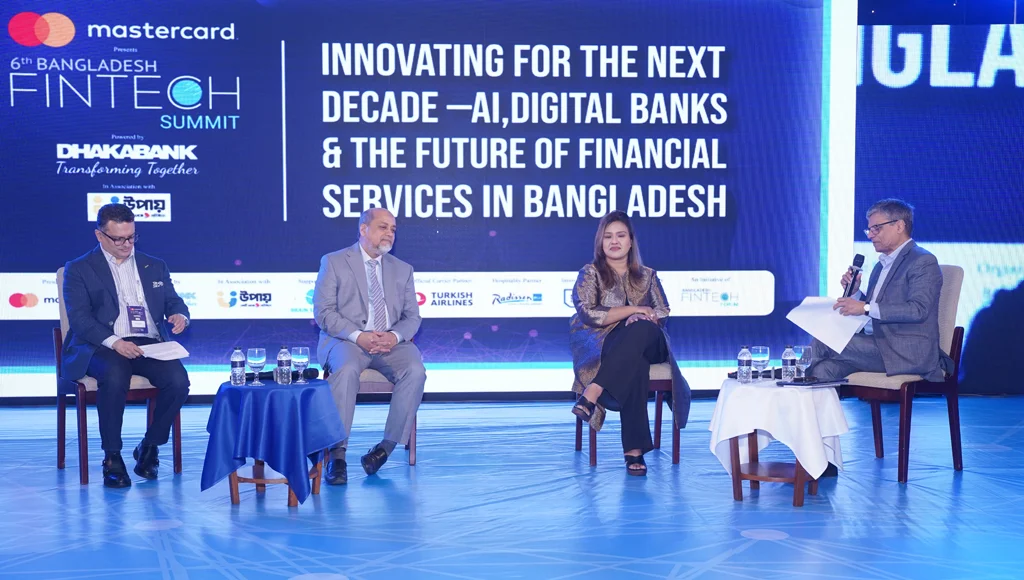
A panel discussion titled ‘Innovating for the Next Decade – AI, Digital Banks & the Future of Financial Services in Bangladesh’ is held as part of the 6th Bangladesh Fintech Summit in the capital on Saturday. | Press release photo
Banks and financial technology companies in Bangladesh need to embrace artificial intelligence, build practical AI skills, and strengthen collaboration to create a more efficient, secure, and inclusive digital financial ecosystem, experts said on Saturday.
They said that AI could improve banking operations, automate routine tasks, strengthen fraud detection and expand access to financial services.
Universities and financial institutions should also work together to prepare a workforce capable of applying the technology in practice, they added.
They made the remarks at a panel discussion titled ‘Innovating for the Next Decade – AI, Digital Banks & the Future of Financial Services in Bangladesh’ at the 6th Bangladesh Fintech Summit, organised by the Bangladesh Brand Forum in the capital.
Pubali Bank managing director and chief executive officer Mohammad Ali said that banks should integrate AI into account opening, identity verification, anti-money laundering compliance, loan processing and portfolio analysis.
AI-based systems could speed up account opening and help banks make faster decisions on personal, car and home loans, he said.
The technology could also help bank executives analyse corporate and small- and medium-enterprise portfolios and improve risk management, he added.
Mohammad Ali suggested setting up AI laboratories within individual departments to encourage practical applications across banking operations.
AI could eventually handle most routine, straight-through processing, leaving human employees to interpret complex cases and make decisions requiring judgement, he said.
He also called on universities to focus on practical AI applications in banking, including balance-sheet and cash-flow analysis, credit assessment, risk mitigation and regulatory compliance, rather than concentrating mainly on prototype development.
Shyamol B Das, managing director and chief executive officer of UCB Fintech Company Limited, which operates mobile financial service upay, said that banks and fintech companies should work together by combining fintech innovation with banks’ established services and customer trust.
He highlighted the potential of digital platforms and agent networks to reach underserved customers, while banks could provide credit and other financial products.
He said that better interoperability and cooperation among financial institutions could also help them use transaction histories to assess customers’ creditworthiness and expand financial inclusion.
Zakia Sultana Laboni, country manager of Mastercard Bangladesh, said that institutions should integrate AI into financial systems from the design stage to identify and prevent fraud and other risks, rather than responding only after problems occur.
She also stressed the importance of cybersecurity in digital banking, saying that security should be built into systems from the outset.
She called for continuous learning and stronger collaboration among technology companies, financial institutions and universities to develop AI-ready skills.
The speakers also highlighted embedded finance, digital wallets and agent networks as ways to make financial services more accessible, particularly to underserved customers.
They said that practical training and lifelong learning would be essential as AI reshaped banking and financial services.
In his welcome address, Sajid Mahbub, group chief executive officer and executive editor of the Bangladesh Brand Forum, said the next chapter of Bangladesh’s fintech journey would depend on how effectively the country turned digital adoption into lasting financial capability.
‘Innovation must make financial services more useful and accessible, while strengthening the trust people place in them. This requires institutions, entrepreneurs, and policymakers to work together on the infrastructure and standards that will support our financial future,’ he said.
Representatives from domestic and international banks, fintech companies, technology firms, financial institutions, and academia took part in three panel discussions, keynote sessions, and other sessions at the event.
Staff Correspondent . Dhaka
A panel discussion titled ‘Innovating for the Next Decade – AI, Digital Banks & the Future of Financial Services in Bangladesh’ is held as part of the 6th Bangladesh Fintech Summit in the capital on Saturday. | Press release photo
Banks and financial technology companies in Bangladesh need to embrace artificial intelligence, build practical AI skills, and strengthen collaboration to create a more efficient, secure, and inclusive digital financial ecosystem, experts said on Saturday.
They said that AI could improve banking operations, automate routine tasks, strengthen fraud detection and expand access to financial services.
Universities and financial institutions should also work together to prepare a workforce capable of applying the technology in practice, they added.
They made the remarks at a panel discussion titled ‘Innovating for the Next Decade – AI, Digital Banks & the Future of Financial Services in Bangladesh’ at the 6th Bangladesh Fintech Summit, organised by the Bangladesh Brand Forum in the capital.
Pubali Bank managing director and chief executive officer Mohammad Ali said that banks should integrate AI into account opening, identity verification, anti-money laundering compliance, loan processing and portfolio analysis.
AI-based systems could speed up account opening and help banks make faster decisions on personal, car and home loans, he said.
The technology could also help bank executives analyse corporate and small- and medium-enterprise portfolios and improve risk management, he added.
Mohammad Ali suggested setting up AI laboratories within individual departments to encourage practical applications across banking operations.
AI could eventually handle most routine, straight-through processing, leaving human employees to interpret complex cases and make decisions requiring judgement, he said.
He also called on universities to focus on practical AI applications in banking, including balance-sheet and cash-flow analysis, credit assessment, risk mitigation and regulatory compliance, rather than concentrating mainly on prototype development.
Shyamol B Das, managing director and chief executive officer of UCB Fintech Company Limited, which operates mobile financial service upay, said that banks and fintech companies should work together by combining fintech innovation with banks’ established services and customer trust.
He highlighted the potential of digital platforms and agent networks to reach underserved customers, while banks could provide credit and other financial products.
He said that better interoperability and cooperation among financial institutions could also help them use transaction histories to assess customers’ creditworthiness and expand financial inclusion.
Zakia Sultana Laboni, country manager of Mastercard Bangladesh, said that institutions should integrate AI into financial systems from the design stage to identify and prevent fraud and other risks, rather than responding only after problems occur.
She also stressed the importance of cybersecurity in digital banking, saying that security should be built into systems from the outset.
She called for continuous learning and stronger collaboration among technology companies, financial institutions and universities to develop AI-ready skills.
The speakers also highlighted embedded finance, digital wallets and agent networks as ways to make financial services more accessible, particularly to underserved customers.
They said that practical training and lifelong learning would be essential as AI reshaped banking and financial services.
In his welcome address, Sajid Mahbub, group chief executive officer and executive editor of the Bangladesh Brand Forum, said the next chapter of Bangladesh’s fintech journey would depend on how effectively the country turned digital adoption into lasting financial capability.
‘Innovation must make financial services more useful and accessible, while strengthening the trust people place in them. This requires institutions, entrepreneurs, and policymakers to work together on the infrastructure and standards that will support our financial future,’ he said.
Representatives from domestic and international banks, fintech companies, technology firms, financial institutions, and academia took part in three panel discussions, keynote sessions, and other sessions at the event.