The Blue Economy offers a suite of opportunities for sustainable, environment friendly, equitable growth in both traditional and emerging sectors of Bangladesh, which is one of the maritime nations of South Asia. This can be capitalised by devising an Exclusive Economic Zone (EEZ) targeting th
thefinancialexpress.com.bd
Devising a blue economic zone for Bangladesh
Mir Shariful Bashar
Published :
Apr 09, 2025 00:07
Updated :
Apr 09, 2025 00:07
The Blue Economy offers a suite of opportunities for sustainable, environment friendly, equitable growth in both traditional and emerging sectors of Bangladesh, which is one of the maritime nations of South Asia. This can be capitalised by devising an Exclusive Economic Zone (EEZ) targeting the ocean resources. There is huge potential for attracting investment from the global business community who are pursuing sea-based investment portfolios.
Context of the Blue Economic Zones: With its extensive coastline and access to the Bay of Bengal, Bangladesh has a great potential for a thriving blue economy that emphasises modern technology-based deep-sea fishing, marine transportation, sustainable energy production, bio-prospecting and conservation, sustainable use of living ocean resources.
It is estimated that Bangladesh has achieved 118,813 square kilometers of the Bay of Bengal (Mostofa et al., 2018). The areas of resources include 200 nautical miles of exclusive economic zone and more than 354 nautical miles of resources on seabed (continental shelf). It is estimated that the resources from the sea of Bangladesh constitute 81 per cent of the resources existing in its land territory. An oft-mentioned asset is the more than 120 million square kilometers of marine territory, continental shelf, and inshore waters as well as the long brackish water resources for aquaculture.
Rationale for the Proposed Project Idea: It supports all of the United Nations’ Sustainable Development Goals (SDGs), especially SDG 14 ‘life below water’, and recognises that this will require ambitious, coordinated actions to sustainably manage, protect and preserve our ocean. Bangladesh can catch fish from up to 660 kilometers from the Bay of Bengal but its trawlers now tap fisheries from only up to 60 kilometers owing to lack of capacity as well as facilitation (Year Book Of Fisheries Statistics of Bangladesh 2022-2023). For instance, in 2023 the country caught only 95,000 tons of fish in contrast to 8 million tons by India, Myanmar, Sri Lanka and Thailand from the Bay of Bengal. And Bangladeshi trawlers accounted for 11 per cent of the total catch in the region last year. Some 69,000 mechanised and non-mechanised boats and about 200 industrial steel body trawlers are engaged in fishing in up to 60 kilometers from the coastline. And yet, there is hardly any capability of catching demurral fishes below 50 meter depth of water. Logline fishing is totally absent in deep sea waters of our territory. There is tremendous scope for increasing marine resource extraction (not only fishing) by introducing technology, long line and incentives for bigger ocean-based facilities. Other marine sub-sectors also hold immense economic promise for the nation.
Goals and Objectives of developing a Blue Economic Zone: The goal of devising a Blue Economic Zone in Bangladesh through the mainstreaming and institutionalisation of the blue economy is to improve sectoral performance in coastal and offshore marine fisheries, aquaculture, and other marine-based sub-sectors in order to meet the sustainable development goals (SDGs) associated with the blue economy and leverage wider opportunities for Bangladesh. Moreover, operationalising the blue economy by enhancing existing value chains and creating new value chains with sustainability through a multi-sectoral strategy would help bridge the gap between the public and private sectors, as well attract more foreign direct investment into these unexplored sectors for exporting to the untapped markets.
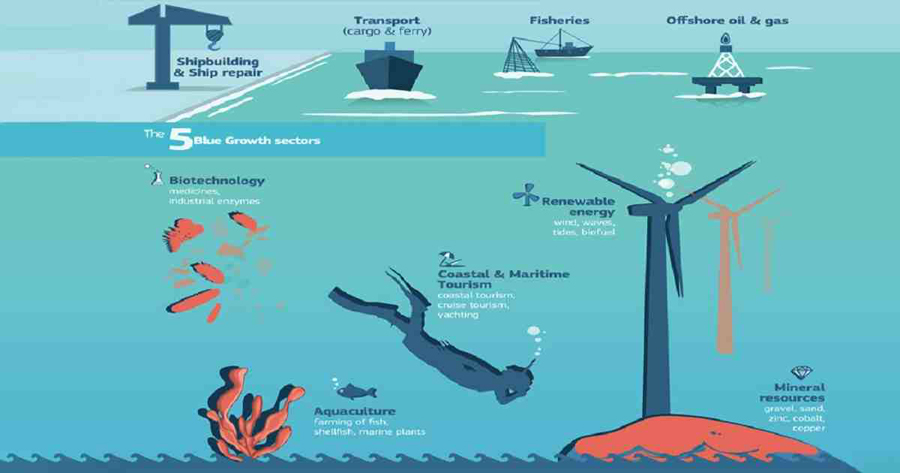
Recommendations on the Potential Sectors for the Exclusive Economic Zone: The blue horizon of the Bay of Bengal has a great potential for the following sub-sectors to be operated under an Exclusive Economic Zone (EEZ) through PPP model – which can be served as a multi-sectoral economic hub. Some key target sectors include:
Deep-sea fishing using modern technology
As a key component - a multinational / transnational PPP model of engagements can be commissioned with the Deep Sea Fishing model, which is supported by all-in-one ship-mounted fish processing facilities for instant export linking with the deep sea ports using the technical facilities of the “Bangladesh Satellite-1 (BS-1)” & AI / data analytics. A package deal under PPP programme can cover all the support needed for fishing data intelligence, loan provision for fishing equipment and facilities, subsidised fuel, and operating costs.
Fish processing & export hubs in onshore facilities.
Extracting pharmaceutical components from marine organisms.
Offshore oil and gas extraction (controlled exploration).
Production of marine food & food supplements
Sea SALT production (Modern Technology based SALT production & processing)
Algae-based food & biofuel production (e.g., Spirulina, Omega-3 oils).
Scalable Marine Food & Biotechnology components Production facilities with a specific focus in Health & Nutation (Medication, Cosmeceuticals and food supplements like:SPIRULINA )
Energy/ Ocean renewable energy generation units
PPP based Power Generation using the Wind (Offshore wind mills), Tidal & Sea waves energy – which is Greenenergy power plants & environment responsive.
Maritime Trade routes & transits (PPP based Port activities &facilities for the FTZs, EZs & SEZs)
Ship building , repair, maintenance & scrap ship breaking hub
Exclusive & value added Water leisure (Zone for scuba diving), coastal tourism, Multi-country Sea Cruise (Marine Tourism, Eco-tourism, Cruise & recreation, regional integrated tourism etc.)
Promote the totally GREEN & environment friendly Economic Zone concept as the Natural Climate Buffer for whole the Universe.
It is the high time for Bangladesh to take advantage of unemployed youth by creating more jobs opportunities for them. Bangladesh government should go ahead with government and non-government joint investments (particularly by FDI) through well-timed actions enacting exhaustive rules and regulations to ensure proper use of marine resources at the blue economic zones. If Bangladesh can utilise her marine resources efficiently, it is quite easily possible for her to be a middle-income country within a short period of time.
Expected Results of the Blue Economic Zone Projects: The outcome of the development is an inclusive, equitable, self-reliant and sustainable Economy. It will include but not be limited to the following outcomes:
Creating scopes for attracting FDI in multifarious business opportunities.
Generating employment opportunities for the coastal population.
Skill based employment Generation for the country.
Creating more formal economic sectors in national business portfolios.
Creating PPP based EZ success cases in Bangladesh
Combating protein deficiency of the mass population as a sideline initiative
The benefits and impacts of this project include boosting the national economy, fostering a marine resources-based business community, attracting sector-specific investors especially the large Investors, and ultimately benefiting marginal Fishermen and Costal people.
A Proposal on the territory & scale of the zone by practicable phases: Bangladesh has got a significant maritime area of 118,813 sq. km (including the designated areas of BBEZ and the continental shelf). Having such vast maritime area of the Bay of Bengal doesn’t mean Bangladesh should use it all at once. We may develop the area in phases. It is more practical and effective to use a selective approach, identifying the most appropriate zones first, rather than distributing resources throughout the whole marine domain. It would be preferable to carry out a phase-based implementation rather than operating throughout the Bay of Bengal as proposed below:
Phase 1: Use contemporary technologies to map marine resources.
Phase 2: Choose areas according to depth, seabed resources, fish stocks, and economic potentials.
Phase 3: Establish a pilot economic zone close to Moheshkhali and progressively expand it in response to the findings.
Bangladesh can identify high-yield regions for economic activity by using satellite data, maritime surveys, GIS mapping, and professional data analysis.
Strategies recommended for ensuring security: It is crucial to protect the Exclusive EZ’s security and sovereignty. Here are a few key strategic recommendations:
Robust policy support with EEZ laws & regulations for resource management.
Exclusive marine economic laws to govern trade and investment (FDI).
Military-backed surveillance for enforcement.
Naval & Coast Guard presence to monitor foreign activities.
Satellite surveillance & radar systems for tracking navigations.
Automated tracking (tech based) of fishing fleets & cargo ships.
Defining clear maritime boundaries with neighboring countries (India, Myanmar etc).
Engaging in regional security partnerships (BIMSTEC etc).
On shore /off shore Support Team & Support Centers; and regular R&D.
Consultation with successful countries & accessing Regional Cooperation by International Treaties.
Challenges ahead & way forward: There are several challenges to overcome while establishing this EZ. These are:
Depletion of marine resources due to overfishing.
Marine pollution from industrial activities.
Devastation of ecosystems as a result of energy extraction and mining.
Conflicts with neighboring countries (India, Myanmar etc)
Illegal fishing by foreign/ unregistered vessels.
Smuggling & piracy threats.
High cost of infrastructure development led investment.
Need for large-scale foreign direct investment (FDI) and good ROI to support it.
Lack of sophisticated maritime technologies in Bangladesh.
Shortage of skilled manpower in marine industries (huge training program needed).
Huge Dependency on foreign expertise & machinery and target markets.
The engagements should be focused on various action based elements such as:
Marine fisheries and coastal land based aquaculture and mariculture.
Synergies with fisheries and mariculture.
Designate Marine Protected Areas for Conservation Purpose.
Bonded fishing licence based operation
Value added marine tourism (especially eco and recreational tourism)
Renewable as well as fossil-based energy exploration
Transport and related logistics
Mining and exploration of energy resources (Gas, petroleum).
Developing marine related education institutes and diversifying culture.
Facility building for offshore EZ support
County branding to attract FDI in blue economy-based initiatives
The success of this initiative critically depends on:
Strategic and data-driven site selection for phase based development (rather than considering the entire sea area).
Result based planning (feedback from Piloting) & stake holder engagements (Marine Business Associations, Security Agencies, Govt. agencies etc)
Diversified use of the BBEZ for multiple industries (fisheries, energy, tourism, biotech, marine logistics etc).
Addressing environmental, geopolitical, social (coastal livelihood), economic, and technological challenges properly.
Following a long-term Master Plan (for 50 years++).
Concluding Remarks: The distinct selling point of the idea of ‘Blue Economic Zone’ is that it represents an unexplored economic sector for the country where planned investment can yield higher return in a shorter period of time, with the potential to add more innovative components. A “Blue Economic Zone” has great prospects to draw Foreign Direct Investment, boost value-added Exports, and generate employment in underdeveloped areas of the country. By establishing Exclusive Blue Economic Zones, Bangladesh may leverage the opportunities of Ocean Economy to diversify its economy, enhance environmental resilience and reduce poverty. However, this calls for sustainable attitude, strategic investments through FDI, and powerful leadership. Bangladesh might serve as a global model for a prosperous Blue Economic Zones if the Bay of Bengal’s resources are used efficiently.
Several years have passed since Bangladesh successfully resolved its long-standing maritime boundary disputes with Myanmar and India -- an achievement widely hailed as historic. Yet, with the passage of time, a quiet unease has set in. The verdicts of the international tribunals were not merely abo
thefinancialexpress.com.bd
Blue economy: Rich in promise, poor in practice
Published :
Jan 08, 2026 23:25
Updated :
Jan 08, 2026 23:25
Several years have passed since Bangladesh successfully resolved its long-standing maritime boundary disputes with Myanmar and India -- an achievement widely hailed as historic. Yet, with the passage of time, a quiet unease has set in. The verdicts of the international tribunals were not merely about drawing lines on nautical charts; they symbolised the opening of a vast horizon of opportunity. That horizon, often described as the promise of the "blue economy," still remains unexplored. Following the rulings, there were animated discussions among relevant quarters about the urgency of unlocking the ocean's economic potential through coherent policies and institutional readiness. Those discussions, however, have not translated into meaningful action. Apart from the establishment of a small "cell" under the Energy Division, little substantial has been done to develop a structured programme for marine exploration and sustainable utilisation. The result of this prolonged inaction has been two-fold: while the country has failed to harness its marine wealth, the seas have increasingly borne the cost of neglect.
A recent multinational marine fisheries and ecosystem survey brings this reality into sharp focus. Presented to the Chief Adviser, the findings reflect both promise and peril. Conducted over a month between August 21 and September 21 last year, the survey involved 25 scientists from eight countries, including 13 Bangladeshi researchers. It confirms the vast aquatic potential of Bangladesh's deep-sea waters and identifies a critical fish nursery beneath the Sundarbans mangrove forest. Yet the same study warns of mounting pressure from overfishing, aggressive industrial practices and the reckless spread of plastic pollution. The evidence is alarming. Plastic waste has been detected at depths of up to 2,000 metres, a stark reminder that marine pollution knows no bounds. Comparisons with a 2018 study reveal a sharp decline in large fish species in deep waters, while stocks in shallow coastal areas are dwindling at an alarming rate. Officials point out that between 270 and 280 large trawlers currently operate in deep-sea fishing, with around 70 employing targeted fishing-an aggressive method that boosts profits for large operators but devastates ecosystems and marginalises small-scale fishers who depend on coastal waters.
Now, it is worth recalling the scale of what Bangladesh secured through international arbitration. From the disputed area in the Bay of Bengal claimed by India, Bangladesh gained 19,467 square kilometres out of 25,602. Against Myanmar, it upheld its claim to a 200-nautical-mile exclusive economic zone and territorial rights. These were not symbolic victories; but strategic gains. Yet, preparation and planning have lagged far behind required actions. A domain that demands specialised knowledge and long-term vision has not been entrusted adequately to experts.
The case for a well-empowered, dedicated authority to oversee the blue economy is therefore compelling. Such a body could provide a coherent framework for exploration, implementation and monitoring, while also designing viable and responsible business models for investors. Without decisive institutional leadership the blue economy risks its consignment to a mere evocative phrase -- rich in promise, poor in practice.

 Bangladesh Defense