New Tweets

[๐Ÿ‡ง๐Ÿ‡ฉ] Earthquake in Myanmar----Lessons for Bangladesh

G Bangladesh Defense
[๐Ÿ‡ง๐Ÿ‡ฉ] Earthquake in Myanmar----Lessons for Bangladesh
37
884
More threads by Saif


Dhaka jolted by early morning earthquake

1764812002404.webp


An earthquake shook Dhaka and surrounding areas at 6.15am this morning.

According to Indian Center for Seismology, the tremor had a 4.1 magnitude on Richter Scale. The epicenter of the quake was Narsingdi. USGS was yet to report on it.

Bangladesh faces a high risk of major earthquakes due to its location along three active tectonic plate faults, experts warned recently following major tremors, stressing that preparedness, public awareness and modern technology are crucial to reducing casualties and damage.​
 
Analyze

Analyze Post

Add your ideas here:
Highlight Cite Respond

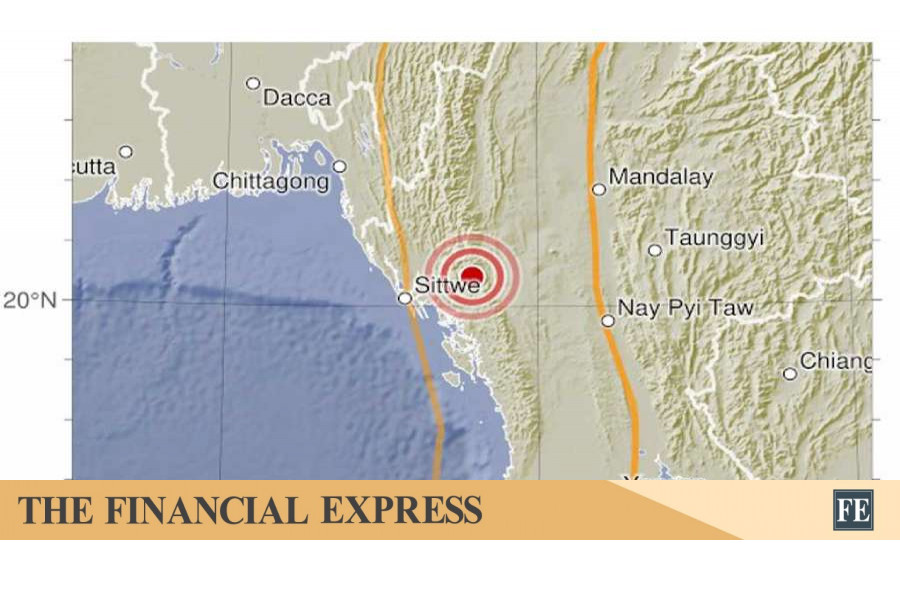
Bangladesh shaken again as 5.9 magnitude quake hits near Myanmar border

bdnews24.com
Published :
Feb 03, 2026 22:45
Updated :
Feb 03, 2026 22:45

1770165880306.webp


Bangladesh has experienced its second earthquake in a single day, this time originating near the Myanmar border.

According to GFZ Earthquake Explorer, the tremor struck at 9:34pm Bangladesh time with a magnitude of 5.9 on the Richter scale.

No immediate reports of casualties or damage have emerged.

This follows an earlier tremor in the day.​
 
Analyze

Analyze Post

Add your ideas here:
Highlight Cite Respond

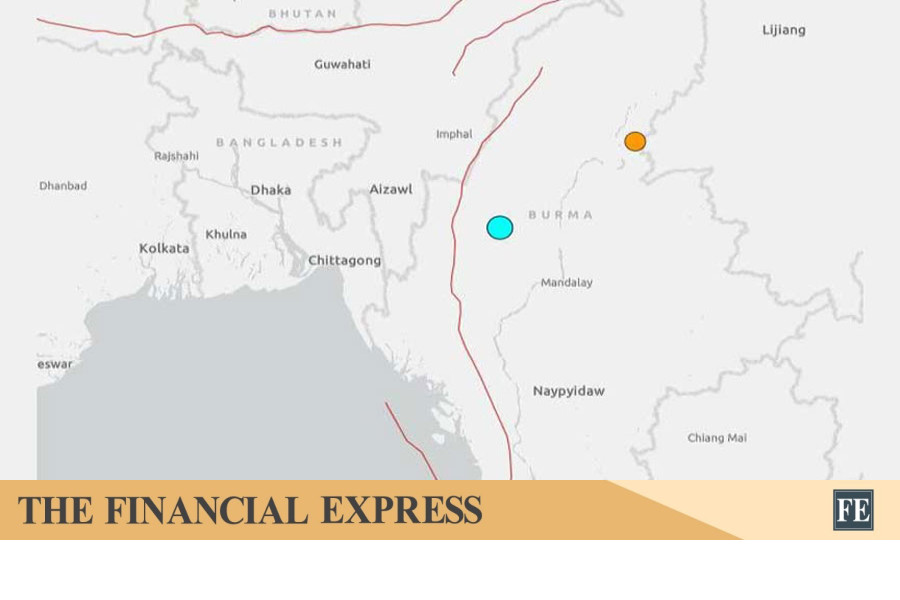
Magnitude 5.1 earthquake in Myanmar shakes Bangladesh

bdnews24.com
Published :
Feb 26, 2026 00:20
Updated :
Feb 26, 2026 00:20

1772065770296.webp


A magnitude 5.1 earthquake in Myanmar have shaken Dhaka and several other parts of Bangladesh.

The tremor struck at 10:51pm on Wednesday, according to the Bangladesh Meteorological Departmentโ€™s earthquake monitoring centre.

Assistant Meteorologist Farzana Sultana said the epicentre was in Myanmar, 462 kilometres from the Agargaon Met Office in Dhaka.

The US Geological Survey (USGS) also recorded the quake at magnitude 5.1, with its origin 129 kilometres below the surface.

No immediate reports of damage or casualties were available.​
 
Analyze

Analyze Post

Add your ideas here:
Highlight Cite Respond

Earthquake: Satkhira resident says building โ€˜swayed like a tree branchโ€™

Staff Correspondent
Dhaka
Published: 27 Feb 2026, 16: 43

1772240022320.webp

Bangladesh Meteorological Department (BMD) reported Asshashuni Upazila of Satkhira to be the epicentre. USGS

Mrityunjoy Roy, a resident of Satkhira Sadar upazila, has described his frightening experience during the earthquake that was felt in different parts of the country including Dhaka at 1:52:29 pm today, Friday.

According to the Bangladesh Meteorological Department (BMD), the epicentre of the earthquake was in Ashashuni Upazila of Satkhira. The earthquake measured 5.4 on the Richter scale and was of moderate intensity.

Speaking to Prothom Alo over the phone, Mrityunjoy Roy, who is a journalist by profession, said he was lying on his bed when the quake struck. Suddenly, he felt the entire bed shaking.

โ€œI wondered what was happening. Then I rushed outside shouting,โ€ he said.

Mrityunjoy added that it felt as though the five-storey building was swaying from side to side. The strong tremor made it seem as if the building was moving the way tree branches sway back and forth during a storm.

According to a report by media outlet Anandabazar Online, tremors were also felt in Kolkata and other districts of West Bengal in India, where the magnitude was recorded at 5 on the Richter scale.​
 
Analyze

Analyze Post

Add your ideas here:
Highlight Cite Respond

Earthquake contingency plans must be foolproof

RECURRING earthquakes of varying magnitudes require the government to revisit its preparedness and mitigation plans. A 5.4-magnitude earthquake, originating in Satkhira, was felt on February 27. With the latest event, there were nine earthquakes in February, two of which had the epicentre in Satkhira. The Department of Meteorology says that 32 earthquakes have occurred in the country and in neighbouring areas since mid-February 2025. In November 2025, at least 10 people, including two children, died and several hundred became injured after a 5.7-magnitude earthquake struck Dhaka and surrounding districts. The worrying issue is that the frequency of earthquakes has recently increased. Earthquakes have, in particular, risen in Bangladeshโ€™s south-west, traditionally considered a low-risk area. Experts have differing views on the cause of the earthquake. While some believe that the earthquake in Satkhira was an aftershock of the Narsingdi earthquake, others think that it resulted from the south-west, being subjected to opposing tensile forces between the two tectonic plates at the eastern and western edges of Bangladesh. At this time of heightened risk, the government should urgently focus on strengthening earthquake resilience.

Bangladesh, with major seismic activities in the region, is considered an earthquake-prone region because of its location at the junction of the Indian, Eurasian and Burmese plates. An earlier survey of Rajdhani Unnayan Kartripakkha estimated that around 865,000 buildings could collapse in an earthquake of a magnitude of 6.9 originating in the fault line in Tangail. In March 2025, the Fire Service and Civil Defence issued an official alert identifying Dhaka, Chattogram, Mymensingh and Sylhet as high-risk regions and urged all concerned to take a nine-point measure that included constructing earthquake-resistant buildings, strengthening vulnerable buildings, ensuring proper maintenance of gas, water and electric lines and improving public awareness and skills in earthquake prevention and response. Bangladesh has an earthquake contingency plan, but its implementation is uncertain. The awareness programmes are irregular. Efforts to reduce long-term risks through measures such as strengthening building codes and improving land-use planning barely exist. The governmentโ€™s plan also appears ineffective given the way it has responded to recent injuries and fatalities from the earthquake, especially the one in Narsingdi.

It is almost impossible to predict when a major earthquake will occur. This means that the government must have a system that is ready to respond any time. The primary emphasis should be given to extensive awareness and practical training. This includes regular drills in all public and private establishments, retrofitting risky buildings, enforcing earthquake safety technologies in new buildings and implementing the governmentโ€™s guidelines on how to deal with the aftermath of an earthquake. The government must build capacity for prompt response, rescue and evacuation operations and treatment facilities in hospitals.​
 
Analyze

Analyze Post

Add your ideas here:
Highlight Cite Respond

32 earthquakes in 13 months in country, origins in low-risk regions too

Partha Shankar Saha & Mostafa Yusuf
Dhaka
Published: 28 Feb 2026, 08: 11

1772499144486.webp

Roof tiles of a mud house collapse at Uttarpara village in Tala upazila of Satkhira after an earthquake jolted the country on 27 February 2026. Prothom Alo

Bangladesh is located at the junction of three earthquake-prone tectonic plates. So experts consider it natural that earthquakes will occur from time to time in the country. However, the worrying matter is that recently the tendency of earthquakes originating within the country has increased. In particular, earthquakes have increased in the countryโ€™s south-western region, which is known as a low-risk zone for earthquakes.

Experts think that this south-western region has come under tensional forces (opposing pulls) between two plates located on the countryโ€™s eastern and western edges. As a result, earthquake proneness in this region may have increased. They also think that a new fault may have formed in the south-western region, or an old fault may have become active again.

Experts believe that these earthquakes in the south-western region are not frightening. However, in their opinion, the increase in the number of earthquakes inside the country and in surrounding areas indicates a large earthquake. And proper preparation is needed to face such an earthquake. According to them the country lacks this considerably.

Yesterday, Friday afternoon, an earthquake shook various regions of the country including Dhaka. After that, the fear of earthquakes and ways to deal with them came up again for discussion. Yesterdayโ€™s earthquake originated in Ashashuni upazila of Satkhira. Its magnitude at the epicentre was 5.4 on the Richter scale, which is called a moderate earthquake.

Earthquake felt across Bangladesh, magnitude 5.4, epicentre in Satkhira

Although tremors were felt in different parts of the country including the capital, naturally they were felt much more strongly at the epicentre in Satkhira. There, people came out on the streets leaving their houses and shops in panic. Many of them said they felt a strong jolt. The earthquake, which lasted a few seconds at 1:52 pm, spread panic in the district.

Abdul Ali, a resident of Ashashuni Sadar, told Prothom Alo, โ€œSuddenly my two-storey house started shaking. Everyone in the family quickly came down.โ€ Purbopod Mallik, a resident of Harinagar village adjacent to the Sundarbans, said that suddenly around noon his two-storey house shook in the earthquake.

Why are earthquakes increasing in the southwest

Considering earthquake risk, the country has been divided into highly risky, moderately risky, and low-risk areas. Among these, the area from Lalmonirhat district in the north to Khagrachhari in the south-east is highly risky; the north-central region including Dhaka is moderately risky; and the southern and south-western regions of Barishal and Khulna divisions are considered low-risk areas.

In this low-risk area, a moderate earthquake originated yesterday in Satkhira. But not only yesterdayโ€”on Thursday a 3.2-magnitude earthquake originated in Kaliganj of Jhenaidah in the southwest. Also, on 3 February early morning, an earthquake originated in Kalaroa of Satkhira with a magnitude of 4.1. On 27 September last year, an earthquake of magnitude 3.5 occurred in Monirampur of Jashore.

The three earthquake-prone regions among which Bangladesh is located are the subduction zone in the east, the Dauki Fault in the north, and the Himalayan Frontal Thrust zone at the foothills of the Himalayas (stretching from Nepal to Arunachal).

Small earthquakes donโ€™t reduce risk of a major earthquake

Earthquake expert and former professor of the Geology Department at University of Dhaka, Humayun Akhter, told Prothom Alo that the Indian Plate is going under the Burma Plate to the east, which is called subduction. At the eastern edge the plate is sinking downward. But to the west, a large part of the same plate is relatively stable and resisting the pull toward the east.

Humayun Akhter compared this situation to stretching a rubber band. He said, when pulled from two sides, pressure and tension are created in the middle. If the tension exceeds the limit of elasticity, the rubber band snaps. Similarly, tension accumulating in the middle of a plate can reactivate an old fault at a weak point or create a new fracture. Then the accumulated energy is suddenly releasedโ€”that is an earthquake.

He thinks that in this Satkhira incident an old fault may have been reactivated or a new fault may have formed. He believes that if focal mechanism analysis (which indicates the type of displacement of rocks along a fault or fracture of a plate) is obtained in the future, it will be understood whether it is a normal fault or a newly activated one.

However, Humayun Akhter reassured that there is no major active tectonic plate boundary in that area. So moderate earthquakes may occur there, but the risk of a very large earthquake is low.

Akhtarul Ahsan, deputy director of the Geological Survey Department who is doing a PhD on earthquakes at Auburn University in the United States, thinks the Satkhira earthquake was an aftershock of the 5.7-magnitude earthquake on 21 November last year.

Earthquake: Another active fault line discovered in Bangladesh
Akhtarul Ahsan told Prothom Alo that the origin of the Satkhira earthquake was from a newly discovered 400-kilometre-long fault line extending from Kolkata to Jamalpur to Mymensingh. The Satkhira and Narsingdi regions fall within the hinge line (30-kilometre areas on both sides of the fault line) of this fault.

In Akhtarul Ahsanโ€™s research, a new 400-kilometre-long fault line has recently been found from Kolkata through Jamalpur in Bangladesh to Mymensingh.

Earthquake origins increasing inside the country

Data on earthquakes from 2016 to now have been obtained from the earthquake observation centre of the Bangladesh Meteorological Department (BMD). It shows that from mid-February 2025 to yesterday, 32 earthquakes originated inside the country and in border-adjacent areas. Among these, the highest numberโ€”10 earthquakesโ€”originated in the greater Sylhet area. These earthquakes originated near the Dauki Fault.

Rubaiyat Kabir, officer-in-charge of the earthquake observation centre of the BMD, told Prothom Alo yesterday that since 2016 there has been no record of 32 earthquakes originating inside the country in just 13 months. The increase of earthquakes inside the country and in border areas is the manifestation of the huge amount of energy accumulated beneath the earth. It indicates a large earthquake, which has been said for a long time.

Although agreeing about the possibility of a big earthquake, professor Humayun Akhter has a different explanation regarding the increase of earthquakes in and around the country.

He said, โ€œCompared to before, the effort to collect earthquake data in our country and neighbouring areas has increased. Earlier those were not there. Technology has also improved. So perhaps now we are getting more and more accurate earthquake-related information.โ€​
 
Analyze

Analyze Post

Add your ideas here:
Highlight Cite Respond

Members Online

Latest Posts

Back
PKDefense - Recommended Toggle