[🇧🇩] Bangladesh Tourism

[🇧🇩] Bangladesh Tourism
100
6K
More threads by Saif

G Bangladesh Defense

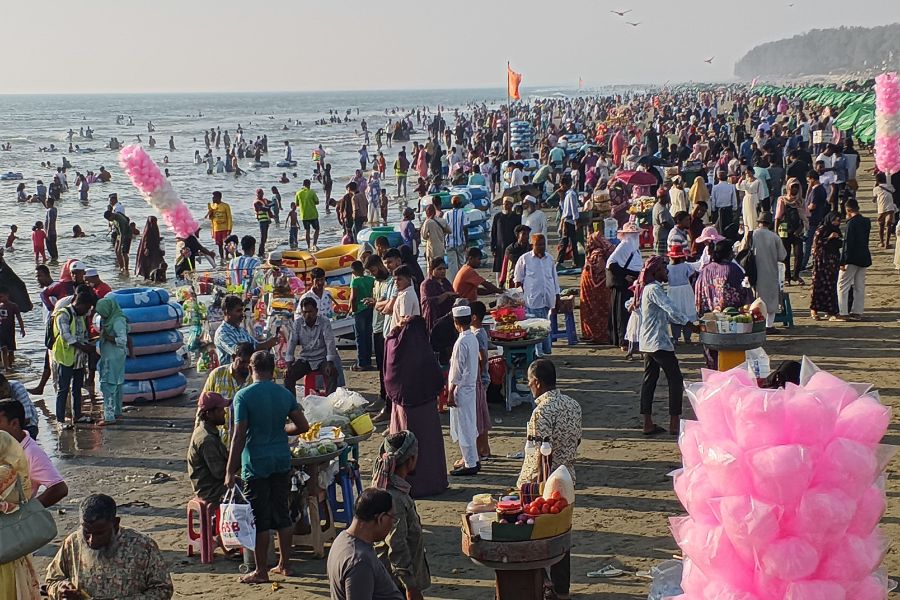
Cox's Bazar bustling with tourists during Durga Puja holidays


Cox's Bazar is witnessing a surge in tourist arrivals during the Durga Puja holidays, with concerns following a deadly resort fire easing and hotels reporting increased bookings.

Tourism-related businesses expect at least 1 million tourists to visit the beach town during the 10-day holiday period through October 25, generating Tk 9 billion to Tk 10 billion in business, reports BSS.

Concerns over tourist arrivals arose after a fire broke out at TupTup Resort in Inani on October 17, leaving 10 people dead.

However, hotel owners said tourist numbers had increased over the past two days.

Abul Kashem Sikder, president of the Cox's Bazar Hotel and Guesthouse Owners Association, said about 95 percent of rooms at more than 20 star-category hotels and 80 percent at medium-sized hotels, guesthouses and cottages had been booked in advance.

At least three lakh tourists visited the beach during the three consecutive holidays on Thursday, Friday and Saturday, according to local businesspeople.

Beaches at Laboni, Sugandha and Kalatoli were crowded on Tuesday, with visitors enjoying the sea and various beach activities.

Deputy Commissioner Md A. Mannan said the administration had taken necessary measures to ensure tourists' safety, prevent harassment and excessive charges, and maintain order during the holidays.

Durga Puja is being celebrated at 324 mandaps across the district. Following Vijaya Dashami rituals on October 21, at least 400 idols will be immersed in the sea at the beach. Organisers expect 250,000 to 300,000 people to attend the event.

Uday Shankar Pal Mithu, acting president of the Cox's Bazar District Puja Celebration Council, said preparations were underway to hold the immersion festival peacefully, with support from the administration, law enforcement agencies and political parties.​
 

Unlocking tourism sector's potential


1792626341226.webp


As Bangladesh aspires to graduate from the United Nations' Least Developed Country (LDC) category and become a middle-income economy, diversifying its sources of economic growth has become imperative. Tourism, a major driver of economic growth worldwide, has helped countries such as Sri Lanka, Nepal, Thailand and the Maldives strengthen their economies by capitalising on their natural and cultural attractions. However, despite its abundant natural beauty and rich cultural heritage, Bangladesh has failed to unlock the full potential of its tourism sector. The World Economic Forum's recently published Travel and Tourism Development Index (TTDI), which places Bangladesh at 98th position among 110 economies, highlights the challenges facing the country's tourism industry. There is no dearth of tourist attractions in Bangladesh, and its people are known for their hospitality. What the country lacks is a well-planned approach to developing tourist sites, improving infrastructure and strengthening the tour-operating industry.

The recent fire at a resort in the Marine Drive area of Cox's Bazar, which claimed 10 lives, exposes gaping holes in tourist safety and security regime. The resort reportedly had neither a fire safety certificate nor adequate fire safety measures and continued operating defying warnings from regulatory bodies. Such instances of flagrant violation of safety standards, however, are not isolated ones. A recent report suggests that a majority of about 600 hotels, motels and resorts in Cox's Bazar lack mandatory fire safety licences, environmental clearances and construction approvals. This indicates that rules and regulations exist largely on paper, and are hardly enforced, giving rise to haphazard development of tourist sites. Moreover, incidents of robbery and snatching, tourists drowning in the sea and women facing harassment further undermine visitors' sense of insecurity. Besides, touts offering various services have also become a major nuisance at tourist destinations. The government has introduced tourist police to ensure visitors' safety and security, but recurrence of such incidents raises questions about security mechanism at tourist sites.

These safety and management failures also bring into focus the shortcomings of the government institutions responsible for developing and promoting tourism. In this context, lacklustre performance of the Bangladesh Parjatan Corporation (BPC), the state agency entrusted to promote tourism and facilitate travel, is particularly concerning. The BPC operates hotels, motels, resorts and restaurants in prime locations across the country's major tourist destinations. However, the corporation is reportedly running at a loss, suggesting that its resources are not being utilised to their full potential. The root cause of the BPC's poor performance lies in its operators' traditional bureaucratic mindset. Rather than adopting a business-oriented approach, the agency operates like any other government agency, with little emphasis on marketing or innovative ideas to cater to the tourists' needs.

In an increasingly competitive market, such bureaucratic inertia is counter-productive. Bangladesh needs a tourism authority that actively promotes its attractions, improves service standards, develops attractive travel packages and responds to changing market demands. Reform must begin with a shift in institutional mindset, replacing bureaucratic inertia with professionalism and innovation. Bangladesh cannot expect its tourism industry to flourish without a dynamic and effective institution to drive its growth.​
 

Two-day tourism carnival kicks off at Kuakata


1792798357011.webp


A two-day tourism carnival kicked off at Kuakata, a popular coastal tourist destination in Patuakhali, on Friday with a beach football competition.

ABM Mosharraf Hossain, lawmaker from Patuakhali-4 constituency, formally inaugurated the competition by releasing balloons and pigeons at the zero point of the beach adjacent to DC Park, reports BSS.

Sultana Jesmin Jui, a lawmaker from the reserved women's seat for Pirojpur-1, and Bangladesh Parjatan Corporation Chairman Md Shamimuzzaman attended the inauguration as special guests, along with officials from different government departments.

The first day of the carnival also features a kite festival and drawing competition at Lembur Bon in the afternoon, followed by a concert featuring popular artistes in the evening.

Different programmes will also be held tomorrow (Saturday).

The carnival has drawn a large number of visitors to Kuakata, with the gathering of tourists estimated at over one lakh on the occasion.

Inspector Nazmul Hasan of the Tourist Police said around 700 members of the Tourist Police, River Police, regular police and plainclothes law enforcement agencies have been deployed to ensure the safety of tourists.​
 

Saint Martin’s Island travel guide 2026–27: Dates, fees, and tourist restrictions

Sozib Mia


1792971654538.webp

Saint Martin’s Island Abul Hasnat

After a long wait, Saint Martin’s Island is set to reopen to tourists. Visitors will be allowed to travel to the coral island from 1 November to 15 March next year. However, overnight stays will be permitted only in December and January. Tourists will also need a travel pass to visit the island.

The information was announced in a directive issued by the Ministry of Environment, Forest and Climate Change on 25 October. Under the directive, tourist vessels will continue to depart for Saint Martin’s Island from the Inland Water Transport Authority (BIWTA) jetty at Nuniyachhara in Cox’s Bazar town, as before.


1792971678147.webp

Saint Martin's Island BSS

However, the daily cap on tourist arrivals has been increased this year. A maximum of 3,500 tourists will be allowed to visit Saint Martin’s Island each day. Each visitor will have to pay an environmental conservation fee of Tk 100.

An interministerial meeting on tourist access to Saint Martin’s Island was held at the Ministry of Environment, Forest and Climate Change on 12 October. On 25 October, the ministry’s Environment-2 wing issued directives to the relevant ministries and departments to implement the decisions taken at the meeting. The directives retain the provisions of a notification issued by the ministry on 22 October 2025.


1792971727274.webp

A tourist ship on its way to Saint Martin's island. Prothom Alo

Under the 2025 notification, tourists will be allowed to visit Saint Martin’s Island only during the daytime in November and must return on the same day. Overnight stays will be permitted in December and January.

Sabreena Rahman, senior assistant secretary at the ministry, told Prothom Alo, “The provisions of the previous notification will be followed.”

This means that although the period during which tourists can visit Saint Martin’s Island has been extended this year, the rules governing overnight stays will remain unchanged from last year.

Meanwhile, tourists will again need a travel pass to visit Saint Martin’s Island. An official of the Bangladesh Tourism Board told Prothom Alo that visitors would need to obtain a travel pass, as they did last year. Technical preparations are underway in this regard.

Last year’s notification also imposed several restrictions to protect the island’s environment and biodiversity. These include:

No lights may be switched on at night on the beach or in adjoining areas.

Activities that generate noise and the organisation of barbecue parties are prohibited.

Entry into the keya forests, as well as the collection, purchase and sale of keya fruit, is prohibited.

Activities that harm the island’s biodiversity—including sea turtles, birds, corals, snails, mussels, starfish, horseshoe crabs, seagrass and algae—are prohibited.

Motorcycles, jet skis and similar vehicles are prohibited on the beach.​
 

Making tourists' dollars count


1793060603951.webp


Bangladesh Bank (BB) through a circular on Sunday (October 25), has allowed hotels, resorts, restaurants, shopping malls, retail outlets and other establishments to retain up to 15 per cent of their foreign currency receipts from foreign visitors paying through internationally issued cards or other approved instruments. The remaining 85 per cent must be encashed in taka. This appears to be a routine adjustment to the central bank's foreign exchange regulations. But in an economy where every dollar earned or spent is a matter of concern, this decision deserves closer attention. For its implications extend beyond the balance sheets of the establishments concerned.

Notably, these are not exporters shipping goods abroad. They earn foreign currency by providing services or selling goods to visitors. A hotel accommodating a guest, for instance, may receive payment by international card. Earlier, those receipts had to be encashed in local currency. Now, part of the proceeds may remain in the hotel's foreign currency (FC) account with an authorized dealer (AD) bank. The retained money, however, cannot be spent at will. Its use is limited to legitimate foreign exchange obligations arising from current account transactions. What practical difference will that make? Consider a resort paying an overseas booking service or a hotel settling permissible expenses through its international card. It would be rather cumbersome if the establishment converted all its foreign currency earnings into taka and then had to purchase dollars afresh from a bank for those expenses. Repeated conversion may entail costs. In that case, allowing merchants to retain a portion of their earnings in hard currency is a sensible move. It gives them operational flexibility without permitting their earnings to escape the banking system.

However, one should not mistake this arrangement for a measure that will immediately increase dollar supply in the domestic foreign exchange market. In fact, the opposite may happen initially. Since up to 15 per cent of eligible receipts can remain in FC accounts instead of being encashed, that portion is not immediately liquidated. The rest, or 85 per cent, will be converted into taka. So, how does the economy benefit? The answer lies less in dollars sold today than in how much can be attracted to the formal banking system over time.The real benefit of this relaxation will be in encouraging businesses to bring more foreign currency earnings into the formal banking system rather than looking for easier options outside it. For when banking is inconvenient, some businesses may be tempted to use the kerb market or informal hundi channels. Such transactions deprive banks of foreign exchange and evade scrutiny. By incentivizing international card payments, BB is trying to make formal transactions more attractive.

There is also the question of developing the country's tourism economy. Going by Bangladesh Tourism Board figures, foreign visitor arrivals, including business travellers, dropped to 585,145 in 2025 from 633,094 in the preceding year. Easier foreign currency transactions may encourage local businesses to welcome more international visitors. But should anyone expect a banking circular alone to draw tourists in droves? Certainly not. Poor visitor facilities cannot be remedied by relaxing banking rules. However, this facility must not turn into another loophole for misuse. The AD banks have been asked to ensure deduction and payment of applicable taxes and value-added tax (VAT), proper overseas card acceptance facilities and compliance with Know Your Customer (KYC), anti-money laundering and countering financing of terrorism (AML/CFT) rules. These safeguards are necessary. But that should not mean creating bureaucratic hurdles that defeat the purpose of the relaxation. Banks need to be able to distinguish genuine international transactions from regulatory evasions.

BB's decision is a welcome departure from restrictive foreign exchange management. Similar practical relaxations should be considered for businesses in international trade, hospitality and entertainment, subject to oversight. The government, too, needs to improve tourism infrastructure and visitor services. For foreign currency cannot be earned simply by changing the rules for keeping it. There must first be more foreign visitors willing to come here and spend their dollars.​
 
Back
Top