New Tweets

[๐Ÿ‡ง๐Ÿ‡ฉ] Banking System in Bangladesh

G Bangladesh Defense
[๐Ÿ‡ง๐Ÿ‡ฉ] Banking System in Bangladesh
307
10K
More threads by Saif


Fixing boards of ailing banks is first step for good governance
BB governor says in interview

1724974628448.webp


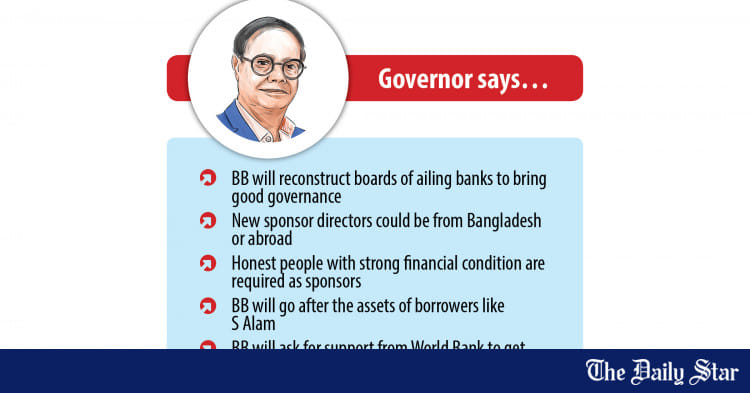
Reconstituting the board of directors of ailing banks is the first step towards bringing good governance and discipline to the banking sector, according to Bangladesh Bank Governor Ahsan H Mansur.

The country's central bank has already reconstituted the board of some banks in which S Alam Group held a majority stake, Mansur said in a recent interview with The Daily Star.

The eminent economist was appointed as governor of the Bangladesh Bank on August 14. He replaced Abdur Rouf Talukder, who stepped down from the post following the ousting of the Sheikh Hasina-led Awami League government on August 5.

Of the banks with reconstituted boards, S Alam Group held a roughly 80 percent stake in Islami Bank Bangladesh, Social Islami Bank, Global Islami Bank and Union Bank.

The central bank governor said they will take over the shares of S Alam Group against its liabilities to these banks in order to sell them and return depositors' funds.

The boards of two other lenders -- National Bank and United Commercial Bank -- were also reformed.

Mansur informed that, in most cases, they are reconstituting the preliminary board of ailing banks. Regarding the selling of S Alam's shares, he said this would allow new sponsor directors to come to the boards.

"The new sponsor directors could be from home or abroad. Shares will be available for all investors," Mansur added.

However, the central bank governor also said they will ensure that only fit and proper people assume the post.

"Honest people with strong financial condition are needed as sponsor directors for ailing banks," he said. "We will go after the assets of borrowers or directors like S Alam if needed."

Regarding the recovery of laundered money, Mansur said the Bangladesh Bank and other related authorities will speak with counterparts abroad to bring back the funds.

"We will also seek support from the World Bank," he added, informing that the US government was interested in helping in this regard.

"We will not give up anything we can recover."

Furthermore, Bangladesh is already in talks with the International Monetary Fund (IMF) and other multilateral agencies for additional loans.

"We are thinking about foreign loans to create some breathing space and have discussed with the IMF to access their funds," Mansur said.

Bangladesh is also holding discussions with the World Bank for additional budget support, sectoral support lending or programme lending.

"Additionally, we have started talking with the Asian Development Bank (ADB) and are hopeful that the multilateral lenders will allow funds to help rebuild our forex reserves," Mansur added.

The country's foreign exchange reserves stood at $20.48 billion as per the IMF calculation on August 21, showed central bank data.

The forex reserves have been falling for the last three years as the outflow of foreign currencies exceeded inflow.

Regarding the country's economic situation, the Bangladesh Bank governor said the first problem is cost disruption while the second is flooding across the country.

"The country is facing lots of supply chain disruptions that we cannot control. We can only try to control the demand side. And the new government is trying to do that."

Mansur also said bank interest rates have been market-driven since May as prescribed by the IMF and various economic experts.

The former government was forced to remove the single-digit ceiling on interest rates and allow them to be market-driven while also doing the same for foreign exchange rates.

The forex market has become more stable since then, he said. "I am hopeful that exchange rate stability will prolong as global commodity price shocks are not there."

Regarding remittances, Mansur said the inflow is positive and they will see if it sustains in coming days.

"Remittance inflow in the first 20 days of this month is much higher compared to the same period last year," he added.​
 
Analyze

Analyze Post

Add your ideas here:
Highlight Cite Respond
  • Love (+3)
Reactions: Bilal9

Banking sector reform hinges on resolving political issues: experts
Staff Correspondent 30 August, 2024, 22:07

1725063233393.webp


Economists and experts on Friday said that current problems of the financial sector could not be resolved without addressing the underlying political problems, as economic outcomes were connected to the countryโ€™s political settlement.

At a webinar titled โ€˜Eviction of Influence in the Banking Sector: Will It Alleviate the Misery?โ€™ organised by Forum for Bangladesh Studies, experts blamed bad politics and poor governance as the root cause for severe crimes and corruption within the countryโ€™s banking sector.

Abdul Mannan, former managing director of Islami Bank, said that on January 5, 2017, he was taken by intelligence officials and coerced into signing his resignation letter.

He alleged that the resignation letter, signed under pressure, was written on an unused pad from Islami Bank, which had not been used since the bankโ€™s establishment in 1983 up to the present year, 2024.

The controversial S Alam Group forcibly took over Islami Bank on January 5, 2017.

He said that officials from the Bangladesh Bank worked late into the night to expedite the change of ownership of Islami Bank on that very same day.

He questioned how such practices could be tolerated in a countryโ€™s banking sector, which was crucial to the economy.

Mannan also noted that in the following years, the Bangladesh Bank overturned many decisions over phone with the influential business group.

He called for actions to prevent such occurrences in the future, emphasising the need for stringent measures and supervision to ensure that similar coercive and irregular practices do not happen again.

Mannan said that independence of the Bangladesh bank was crucial to overcome the crises of the banking sector.

โ€˜I am optimistic that if the central bank remains independent and if managing directors of banks are freed from control of board of directors, the sector could reach new heights within a year,โ€™ he added.

Mannan, who lived seven and a half years abroad and recently returned to the country after the fall of the Awami League government on August 5, said that he was fearful whether or not he would be able to breathe freely upon his return to Bangladesh.

โ€˜I now feel that I have the freedom to speak, but overcoming that fear will take time. I need more time to truly breathe freely,โ€™ he said.

Mamun Rashid, chairman of Financial Excellence, said that the S Alam model had thrived in the banking sector due to deficiencies in good governance and the existing financial sector problems would not be solved without addressing the political problems

Good governance in the banking sector cannot be achieved without ensuring overall accountability throughout the country, he said.

Mamun stated that there were instances where a large amount of loans was disbursed to the S Alam Group in the morning, and by evening, the money had been siphoned out of the country through hundi.

The economist said that there were numerous allegations of large cash withdrawals from banks under S Alamโ€™s control after banking hours, but none of these allegations were investigated.

He also alleged that a former deputy governor of the Bangladesh Bank, SK Sur Chowdhury, was responsible for facilitating influential figures in siphoning cash out of the country from the banks.

Rashed Al Mahmud Titumir, development studies department professor at the University of Dhaka, said that transparency of institutions and organisations largely depended on political settlement of the country.

He said that it was widely known that there was a huge amount of bad loans in the country but there was no scope to know the real figure due to manipulation exercised by regulatory authorities.

Titumir demanded that a forensic audit be conducted in the banking sector to know the real picture of bad loans and who were involved with the process.

Describing the state of the banking sector โ€˜worse than a severely ill patient,โ€™ he said that protecting the interests of depositors and small and medium entrepreneurs should be central to the sectorโ€™s reforms and reconstruction.

โ€˜It is crucial to establish the principle that depositors are the owners of banks. Otherwise, the aspirations of martyrs of the student-led mass uprising will not be realised,โ€™ Titumir said.

He also emphasised the need for implementing financial sector reforms with consideration of Bangladeshโ€™s specific context.

Titumir recommended establishing an Islamic banking wing within the Bangladesh Bank, which should operate in accordance with international standards.

Badiul Alam Majumder, secretary of Shushashoner Jonno Nagorik, held unethical politics responsible for the fraud and corruption in the banking and financial sectors.

Political motives and directives were behind the takeover of Islami Bank, as politics was serving the interests of specific groups rather than the well-being of the public, he said.

Badiul Alam mentioned that the ousted government faced a legitimacy crisis due to holding controversial elections.

Due to the legitimacy crisis, the outgoing government created crony groups, which have since taken over financial institutions, he said.

Badiul Alam mentioned that the situation would not improve unless the right leadership was elected through proper elections.​
 
Analyze

Analyze Post

Add your ideas here:
Highlight Cite Respond
  • Like (+1)
Reactions: Bilal9

The renaissance of Bangladesh Bank and some expectations
We hope that the BB governor will continue the momentum and spirit to bring order and promote the economy

1725493870290.webp

ILLUSTRATION: BIPLOB CHAKROBORTY

The newly appointed Bangladesh Bank (BB) governor, Dr Ahsan H Mansur, has effectively started the reformation of the country's banking sector without delay. This is most hopeful as it has long been overdue. The new governor, being a strong proponent of macroeconomic governance, started his day with the bitterest task of swooping down on the top financial hooligans who simply emptied the banking sector through a wholehearted pairing with corrupt politicians in power. An objective assessment of what is happening at the central bank heralds the advent of a dark chapter for the oligarchs who plundered both the capital market and numerous banks simultaneously under the interest of the past rulers.

What the governor has kicked off is no less than a renaissance since his actions have begun to storm the castles and forts of the economic mafia who never thought of being caught red-handed because they governed the government. His prime actions endorse the importance of correcting institutions before talking about theoretical aspects. Dr Mansur is a sound pro-market economist who has equal respect for Smithian ethical doctrines, and he has not deviated from that: his market-based rules for exchange and interest rates are a testimony to that. He has remained different from his predecessors by signalling to the market that he will go after the money launderers and bank looters before fixing theoretical macro irregularities.

The revival of Bangladesh Financial Intelligence Unit (BFIU) is also a significant move. BFIU was like a cat without teeth under the two previous governors, while the Anti-Corruption Commission (ACC) was like an anaemic tiger without claws. Both the institutions are prerequisites for the well-functioning of Bangladesh Bank. The political domestication of both BFIU and ACC impeded BB's desired actions in many regulatory aspects. The judicial tardiness of default litigations at higher courts eventually made BB dysfunctional as a financial regulator. That is why many economists advocated for BB to have some magisterial powers to punish the wrongdoers at its own discretion.

The political domestication of both BFIU and ACC impeded BB's desired actions in many regulatory aspects. The judicial tardiness of default litigations at higher courts eventually made BB dysfunctional as a financial regulator. That is why many economists advocated for BB to have some magisterial powers to punish the wrongdoers at its own discretion.

Although the new BB governor has infused blood into the BFIU, pairing with the ACC or higher courts remains beyond his capacity. And that bureaucratic labyrinth will again give refuge to the wrongdoers when the next elected regime begins. The time has come to make some reform so BB can complete the task of judgement and punishment within the financial regulatory framework. Going to the ACC or courts for straightforward financial verdicts is just a waste of time and energyโ€”a rigmarole which eventually helps the culprits. This injustice induces new entrepreneurs to default wilfully since dishonesty pays better. People want an end to this culture to make the banking system fair and self-propelled. We believe the banking commission, which is presumably under construction, will figure out what to do in this respect to remove the trap of judicial bureaucracy.

The institutional damage done by the immediate past BB governor, who was forced to resign after the collapse of the Awami League regime, may be vast quantitatively, but qualitatively it is perverted and infectious. The lax rules he endorsed for the loan delinquentsโ€”such as getting rid of the stigma as a defaulter by only adjusting 5-10 percent of defaulted loanโ€”are hard to reverse. The past governor, a retired bureaucrat with no background in economic scholarship but noted as a lobbyist, endorsed a Chattogram-based business group to engulf a couple of banks, as the BB has recently revealed.

The new governor's day dawns with the fight against that vicious conglomerate, which syphoned off millions of dollars from their possessed banks through terrible malpractice and the judicial impunity of the past government. This crusade will give the Bangladesh Bank a tough time. Economists who believe in ethics and politicians who respect minimum fairness must stand beside the new governor so he can bring some semblance of order in the country's banking system and punish the culprits by seizing their assets to adjust for their thefts. He wants to treat the cancer first before giving vitamins to the patient. And that makes him different from other policymakers.

We hope that the BB governor will continue the momentum and spirit to bring order and promote the economy. The prime objective of the central bank is to maximise employment and growth subject to maintaining a moderate level of inflation. The governor should require the banks to report their internal employment figures as well as annual profit figures. The banking administration will remain half-broken if the Financial Institutions Division (FID) at the finance ministry is not eliminated. The pay structure at banks is highly hierarchical and unfair. That must be addressed too. The interim government should appoint a competent leader at the competition commission, which is another example of a domesticated species with a retired bureaucrat at its helm. Institutional leadership must be merit-based, not just qualified for clerical work with unquestionable obedience.

Finally, Economic Adviser Dr Salehuddin Ahmed and BB Governor Dr Ahsan H Mansur must step in a highly measured way to form the banking commission, which will delink political clout from banking affairs for the sake of establishing a corporate culture so the financial sector can see some light at the end of the tunnel. To make it happen, the governor's position must be made constitutionally powerful to strike the final note of the renaissance.

Dr Birupaksha Paul is a professor of economics at the State University of New York at Cortland in the US.​
 
Analyze

Analyze Post

Add your ideas here:
Highlight Cite Respond
  • Like (+1)
Reactions: Bilal9

Fixing our banks, building a more robust banking system
Tawhid Ali
Published: 06 Sep 2024, 09: 42

1725606256516.webp

The Bangladesh BankFile photo

When asked why he robbed banks, the famous American bank robber, Willie Sutton, famously quipped โ€œbecause thatโ€™s where the money is.โ€ It seems that many of our leading business leaders have adopted a similar mindset over the past fifteen years. Regrettably for our nation, they have become alarmingly adept at robbing banks.

The Bangladeshi banking system is in a precarious situation. The causes of this predicament are well-documented by various analysts (Centre for Policy Dialogue has produced several well-researched presentations). There is a consensus on how we arrived at this juncture and the magnitude of the issues we face. There is also an agreement that reforming our banks and regulatory framework is crucial since banks are the primary source of credit in our economy, and without an effective credit system, our economy cannot function.

As a Bangladeshi citizen with significant experience in financial markets in New York and London, I wish to share my perspective. We should not panic. Fortunately, the problems faced by Bangladeshi banks are not unprecedented and compare favourably to crises I have witnessed elsewhere. We will need an audit to get a true picture, however various sources put the countryโ€™s NPL ratio at around 10-15% of total loans outstanding. So even if we were off and NPL were to double to 30%, that would be lower than situations I have faced (for example, Ukraine banksโ€™ NPL ratio reached over 50% in 2018, Greeceโ€™s NPL ratio also exceeded 50% in 2015, Turkey peaked at 30% in 2000). There are multiple solutions to this mess. My confidence stems from my two-decade career in finance, during which I observed numerous global banking crises.

Young people today may not recall that our global financial system nearly collapsed fifteen years ago. During that time, developed economies like the US, UK, Germany, Ireland, Spain, Portugal, Greece, and Iceland had to bail out their banks and reassess their banking regulations. Each country had similar options but chose different paths based on political feasibility and philosophical leanings. Some took longer than others. Some solutions worked better than others.

In all situations, banks were adequately recapitalized, bad assets disposed of, and regulations changed. In some cases (like the US, UK, Ireland, Germany, and Iceland), economic growth returned, and the size of the economy today is larger than it was pre-banking crises. But in other situations (Italy, Spain, and Greece), the economy remains much smaller than it was before the problems. I believe with the right solution mix and proper political resolve, Bangladesh can come out of this predicament with a far better foundation for future growth.

We will need to create a robust independent bank regulator to prevent politically connected individuals from securing excessive loans

Here are some lessons Iโ€™ve learned that could be particularly relevant for Bangladesh:

1. Government intervention is necessary but can be โ€œlight-touchโ€ with multilateral agency assistance. Some countries even profited from intervening in troubled banks (although that sounds pretty optimistic in Bangladeshโ€™s case right now).

2. Fixing the banks' capital structure is crucial. A thorough audit of each bank will help understand their true state and how much capital is needed. To the extent feasible, banks should be given the opportunity to raise this capital in private markets. The Government can come in as a provider of last resort and its terms need to reflect that.

3. Weak banks should be wound up. Their productive assets can be taken over by relatively stronger banks, leading to increased concentration initially but solvable later with the granting of new licenses.

4. We should establish an asset management company (AMC) to handle troubled assets independently. The government can provide the equity needed for the AMC and can provide guarantees; however, the AMC needs to be able to act independently and within the current judicial system to work out the troubled assets. AMCs are not guaranteed to succeed when systems have high levels of troubled assets; however, in the right circumstances, they can help solve much of the problem without significantly burdening public finances.

5. We will need to create a robust independent bank regulator to prevent politically connected individuals from securing excessive loans. We need to remember that our banks did not get into trouble because they were being greedy or acting imprudently. Our solution space needs to acknowledge that as an emerging economy, our banks will always face political pressure to lend, so our regulatory framework needs to develop with an eye towards curtailing that. We also need to tread carefully here as there can be many unintended consequences for poor regulations. If we come down too hard on the banks, they will not lend, and our economy will suffer.

Finally, while its outside my immediate area of expertise, I believe we will need to enhance Bangladeshโ€™s legal framework to facilitate a distressed asset market. Banks will always extend and pretend if the regulators allow them. Creating an effective mechanism for private parties to come in and take the troubled assets off the banks' balance sheets will be essential going forward.

Defaulters have gotten away in Bangladesh for decades. We need to put a stop to that. I am optimistic that we can.

* Tawhid Ali is a global public markets equity portfolio manager with over two decades of investing experience. He was Chief Investment Officer at Alliance Bernstein (AB) and a management consultant with McKinsey & Company.​
 
Analyze

Analyze Post

Add your ideas here:
Highlight Cite Respond
  • Love (+3)
Reactions: Bilal9

Global lenders to finance banking reforms

The Asian Development Bank (ADB) and the World Bank are expected to provide funds to Bangladesh for banking sector reforms, including strengthening and modernising the central bank.

The decision came following two separate meetings at the Bangladesh Bank (BB) headquarters on Monday between central bank officials and delegations of the ADB and World Bank.

The ADB is likely to disburse $1.3 billion towards Bangladesh's efforts to reform the banking sector and modernise the BB, central bank officials who attended the meetings told The Daily Star.

They added that the fund is likely to be distributed across three years, with $500 million coming in the first year, $500 million in the second year and $300 million in the third year.

They further said the World Bank is likely to disburse $400 million for banking reforms, including modernisation and capacity-building of the central bank.

The World Bank delegation wanted to know more about the planned banking reforms, so central bank Governor Ahsan H Mansur described the initiatives to them, according to the officials.

The ADB delegation met with the central bank's Financial Sector Support and Strategic Planning Department, but other senior officials were also present at the meeting.

On the other hand, the World Bank delegation met with the central bank governor while senior officials from the Banking Regulation and Policy Department, and the Department of Offsite Supervision were present.

Contacted, Md Habibur Rahman, deputy governor of the central bank, told The Daily Star that the ADB and World Bank would provide technical and other required support to reform the banking sector.

After joining as central bank governor, Mansur, a prominent economist, has moved swiftly to reform the banking sector, which became plagued by irregularities and scams during the previous government's rule.

The central bank has already reconstituted the board of directors of 11 banks.

When the Awami League won the first of four consecutive elections in 2008, non-performing loans in the banking sector stood at Tk 22,480 crore.

By the end of June this year, the amount had soared to over Tk 200,00 crore, accounting for over 12 percent of total disbursed loans in the banking system, as per Bangladesh Bank data.​
 
Analyze

Analyze Post

Add your ideas here:
Highlight Cite Respond
  • Like (+1)
Reactions: Bilal9
เฆซเง‡เฆฐเฆพเฆจเง‹ เฆนเงŸเง‡เฆ›เง‡ เฆฌเงเฆฏเฆพเฆ‚เฆ• เฆ–เฆพเฆคเง‡เฆฐ เฆฌเฆพเฆนเฆฟเฆฐเง‡ เฆฏเฆพเฆ“เงŸเฆพ เงฉเงฆ เฆนเฆพเฆœเฆพเฆฐ เฆ•เง‹เฆŸเฆฟ เฆŸเฆพเฆ•เฆพ |

 
Analyze

Analyze Post

Add your ideas here:
Highlight Cite Respond

Banking sector issues that the new governor should address
Good governance and adequate legal infrastructure need to be established

1726102570516.webp

According to the Basel Accords, banks in Bangladesh need to maintain a minimum capital of 12.5 percent of risk-weighted assets. PHOTO: STAR

The economy of Bangladesh is heavily dependent on the banking sector as 86 percent of financial intermediation is conducted through banks. But this reliance has led to many problems for the economy in general and the banking sector in particular. Commercial banks typically provide small and short-term loans to a wide range of borrowers. By offering small loans to many borrowers, banks can build a well-diversified portfolio, which is crucial for minimising risk. A short-term loan with high turnover rate can be issued multiple times a year, increasing profit. However, instead of granting small loans, our banks tend to prioritise large loans, which they are able to do within the legal framework.

A large loan is defined as one that constitutes at least 10 percent of a bank's capital. A bank can sanction a loan of up to 25 percent of its capital to finance power sector projects. Within this framework, just four such borrowers could take up all of the bank's capital. If these borrowers default, the bank would become insolvent.

A bank can grant a borrower 15 percent of its capital as funded loans, which require immediate disbursement, and 20 percent as non-funded loans, which require delayed disbursement. As such, a borrower can get a loan of up to 35 percent of the bank's capital. In such a scenario, only three borrowers can deplete the bank's entire capital. In case of export financing, a borrower can receive a loan of up to 50 percent of the bank's capital, with the funded exposure not exceeding 15 percent of the bank's capital. In this case, only two borrowers could consume the bank's capital. When banks issue large loans, they fail to build a diversified investment portfolio, leading to an imbalance between risk and return.

The availability of large loans hinders the growth of our stock market. Banks are involved in indirect finance, where they collect funds from depositors and lend them to borrowers. Borrowing from banks is easier because borrowers are accountable to banks, not to the depositors. In contrast, stock markets are involved in direct finance where borrowers have to obtain funds directly from the suppliers of capital. Here, borrowing firms have to win over suppliers of funds through their performance, ultimately reflected in their share prices. In an efficient market, it is very difficult for less creditworthy borrowers to raise funds. However, due to our banking sector being plagued by ill-governance, less creditworthy borrowersโ€”with political connectionsโ€”can easily convince banks to grant loans.

When banks provide long-term loans from their short-term deposits, it imposes major risks on their depositors. Granting large loans goes against the basic principle of bank lending, as it creates maturity mismatch wherein depositors' claims to the bank mature earlier than banks' claims to borrowers. This can lead to liquidity problems, making it difficult for banks to honour customers' cheques. Large loans are also more likely to default. In contrast, small loans contribute significantly to the economy by reducing income inequality between the rich and the poor, and the default rate for small loans is low. Therefore, every bank should allocate a certain percentage of its funds for small loans.

Restrictions should be placed on single-borrower exposure and large loans from banks. As a result, large borrowers will turn to the stock marketโ€”and policymakers will be more diligent in developing this market from its precarious condition.

Bangladesh Bank (BB) regularly discloses non-performing loans (NPLs)โ€”the latest reported amount is Tk 1,82,295 crore, compared to just Tk 22,481 crore in 2009. However, there is always doubt about the accuracy of its reported NPL figures. A true picture of distressed assets should include not only NPLs but also write-off loans, rescheduled loans, and loans stuck in courts. This would provide a more accurate assessment of the banking sector's asset quality. The NPL rate of 10.11 percent in 2023, as reported by BB, would increase to roughly 30 percent if all distressed assets were considered. In an attempt to reduce the ever-growing NPLs, the central bank has frequently changed loan classification rules, deviating from international standards. Despite these efforts, the usual growth of NPLs has not been curbed.

When a loan becomes non-performing, BB permits loan rescheduling where a loan is renewed or extended under circumstances that are beyond the control of the borrower. The rescheduling is allowed a maximum of three times, examining the causes for the loan's non-performance. The down payment for rescheduling ranges between 10 and 30 percent of the outstanding loan and the time limit never exceeds three years.

Despite the large number of banks in our country, many people are still outside the banking network. This is a contradiction. The rural poor are less interested in maintaining bank accounts, while the urban poor keep their money in semi-formal and informal repositories. So, should we reduce the number of banks through merger and acquisition?

For the past decade, loan rescheduling has been permitted by breaking existing rules. Moreover, in 2015, a loan restructuring facility was provided to 15 large borrowers with loans of Tk 500 crore and above, upon receiving a down payment of only 2 percent of the outstanding loan amount. The loan terms were extended to 10 years.

There are huge political repercussions when NPLs rise. While there is less fuss about write-off loans, a write-off loan represents the worst state of NPLs. The amount of write-off loans stood at Tk 51,560 crore in 2023, up from Tk 15,300 crore in 2009. BB also relaxed the rules for loan write-off. Earlier, to write a loan off, it needed to remain unpaid for five years, a 100-percent provision needed to be maintained, and a case was required to be filed against the borrower. Later, the unpaid period of an NPL was reduced from five to three years, allowing banks to quickly remove their worst loans from the balance sheet.

If BB wants to reduce NPLs, the nexus between business and politics must be broken so that politically connected individuals cannot intentionally default on loans. Good governance and adequate legal infrastructureโ€”relevant laws, courts and impartial judgesโ€”need to be established. Borrowers have to be evaluated properly before loan sanctioning. Rules for loan rescheduling, restructuring and write-off must be strictly enforced.

According to the Basel Accords, banks in Bangladesh need to maintain a minimum capital of 12.5 percent of risk-weighted assets. Some banks consistently face capital deficit. Data shows that the capital shortfall of 10 private and public banks in the country reached Tk 39,655 crore in 2023.The capital base of our banks is also relatively low because of high NPLs and low reinvestment of profits. Bank owners are more interested in taking profits as dividends rather than reinvesting them as retained earnings.

There is also continuous capital flight from rural to urban areas. Data shows that even though rural areas supplied nearly 13 percent of deposits in 2010, they obtained only 8 percent of advances. The supply of deposits by rural people increased to 21 percent in 2023, but they received only 12 percent of advancesโ€”a capital flight of 9 percentage points to urban areas. The misuse of loans by wilful defaulters in urban areas poses a threat to rural depositors. To address this, more opportunities for using loans in rural areas should be created.

The overall expenditure management of banks is still not efficient. Data indicates that the expenditure-income ratio was around 99 percent on average between 1991 and 2000. It declined considerably to 73 percent in 2010 before increasing to 81 percent in 2023. These high ratios may be attributed to high staff salaries, provision for default loans, and high corporate tax rates. The elevated expenditure should be controlled as it is offset mainly against low pay to depositors.

Despite the large number of banks in our country, many people are still outside the banking network. This is a contradiction. The rural poor are less interested in maintaining bank accounts, while the urban poor keep their money in semi-formal and informal repositories. So, should we reduce the number of banks through merger and acquisition? Once the number of banks is reduced, it might be beneficial to increase their branches to spread services to remote areas and take advantage of economies of scale. These decisions should be made prudently.

Md Main Uddin, PhD is professor, Department of Banking and Insurance, University of Dhaka.​
 
Analyze

Analyze Post

Add your ideas here:
Highlight Cite Respond

Restoring trust in the banking sector

1726358478443.webp


Lately, I have been receiving calls from friends and family asking which banks are safe or if they should withdraw their deposits from a particular bank. There were reportedly some bank branches, which couldn't encash small cheques from their clients and even clearing cheques were returned by a few banks for a shortage of funds.

The situation has worsened with Bangladesh Bank Governor Ahsan H Mansur listing 10 commercial banks as bankrupt. Of course, depositors even with some good banks are panicked, apprehending a dent in the overall banking sector. Newspapers have reported of huge cash being held in the family vaults and beneath the pillow i.e. outside banking. An adviser to the interim government was also heard to be in problems with their very large government deposits being stuck with much scandalised Padma bank.

The extent of scur left on the banking sector during the past regime is truly shocking. Despite frequent media coverage of irregularities, civil society's voice raised, and more transparency emerging after the mass uprising that brought down the regime, the true scale of corruption in the banking sector during the previous regime seems unfathomable. This just shows how daunting the challenge will be for the interim government as it sets its sights on reforms, restructuring and recovery.

The new administration has already taken some positive steps. The decision to form a taskforce to undertake reforms is a move in the right direction, though we are yet to see much visibility about their laundry lists. According to media reports, the Bangladesh Bank has also decided to rescue struggling banks, including some Shariah-based banks formerly controlled by a particular group, by injecting liquidity or merging a few.

The old regime had also promised similar objectives. However, instead of working towards that, it gave preferential treatment to corrupt, politically linked bank owners and stakeholders, which further compromised the health of these banks and put depositors' funds at risk.

Though Mansur in his past incarnation was heard to be not subscribing to the idea of providing liquidity to ailing banks (it usually happens to many while you are on other side of the table), the present authorities are heard to be supporting these banks for three main reasons: to safeguard the country's economy, protect depositors, and facilitate business continuity.

We strongly support these measures as these are the real issues that should drive all reform decisions. Though many of the banks were mired in corruption, their bankruptcy would cause significant harm to both depositors and the economy. The central bank is therefore obligated to try the "rescue path". But it must do so in the right way and for the right reasons.

However, the central bank has now decided to avoid providing liquidity support by printing money, as was done before, and instead allow lenders to access support through inter-bank money supply, with it acting as the guarantor. Additionally, the central bank must ensure that these banks take every possible measure to recover default loans in order to lessen their liquidity crisis.

Reportedly, out of the Tk 70,000 crore that went outside the banking channel, Tk 30,000 crore has been recovered. This, along with the government's decision to insure up to Tk 2 lakh for each depositor, should help restore some confidence in the sector. While we appreciate the overall direction of the banking sector under the interim government, coordinated efforts involving various agencies are essential to recover or bring back the remaining funds into the coffer. Besides, we should be expecting closure of the few investigations into large wrong doings in the banking sector.

The author is chairman of Financial Excellence Ltd​
 
Analyze

Analyze Post

Add your ideas here:
Highlight Cite Respond

Latest Posts

Back
PKDefense - Recommended Toggle