New Tweets

[🇧🇩] BIMSTEC for Regional Prosperity

G Bangladesh Defense
[🇧🇩] BIMSTEC for Regional Prosperity
31
2K
More threads by Saif


Is BIMSTEC failing?
Mir Mostafizur Rahaman
Published :
Sep 04, 2024 21:37
Updated :
Sep 04, 2024 21:37

1725517234067.webp


Is the Bay of Bengal Initiative for Multi-Sectoral Technical and Economic Cooperation (BIMSTEC) destined to die before making any notable progress in meeting its avowed objectives?

The way things have been going on one has reasons to foresee such a possibility. The postponement of the forum's 6th summit, scheduled to be held in Bangkok from September 2-4, could only strengthen such a pessimistic notion. Since its inception 26 years ago, the only 5 BIMSTEC summits have been held. Some people in the region, however, tend to believe that it is not yet a lost case.

This lack of continuity and infrequent meetings undermine the momentum necessary for any sustained regional cooperation.

Established in 1997 with the goal of enhancing economic cooperation and regional integration among its seven member states-Bangladesh, Bhutan, India, Myanmar, Nepal, Sri Lanka, and Thailand-BIMSTEC represents a unique bridge between South and Southeast Asia. Despite its potential, however, the organisation has often been criticised for its sluggish progress and lack of visibility.

BIMSTEC was created with high hopes, envisioned as a platform to promote regional cooperation, peace, and prosperity in the Bay of Bengal region. The member states, which collectively account for nearly 22 per cent of the world's population, are located in one of the least integrated regions globally. The organisation aims to address this by fostering connectivity, economic collaboration, and socio-cultural ties. In theory, BIMSTEC's ambitions are commendable; in practice, however, its achievements have been very limited.

Moreover, while member states have committed to various initiatives, including a Free Trade Agreement signed in 2004, these agreements have yet to be fully implemented. The delay in executing these projects reflects a deeper issue: BIMSTEC's lack of institutional capacity and political will.

BIMSTEC has often been seen as an alternative to the South Asian Association for Regional Cooperation (SAARC), which has been largely paralysed by the long-standing rivalry between India and Pakistan. BIMSTEC was expected to fill the void. However, BIMSTEC's performance has not lived up to these expectations. Much like SAARC, BIMSTEC has struggled to maintain regular dialogue and cooperation among its members.

The reasons for this are manifold. BIMSTEC, like SAARC, operates on the principle of non-interference in bilateral disputes, which is viewed as both strength and weaknesses. While this principle prevents the organisation from being bogged down by individual-level conflicts, it also limits its ability to address critical security and political issues that affect regional stability. The organisation's slow progress in areas like public health and climate change further illustrates its operational challenges. Despite identifying these areas as priorities, BIMSTEC has yet to develop concrete mechanisms for cooperation.

Despite these challenges, some people are still pinning hopes on the BIMSTEC. Recent developments suggest a renewed commitment among member states to revitalize the organization. The frequency of meetings has increased, and the adoption of the BIMSTEC Charter in 2022, after 23 years of deliberation, marks a significant step toward institutional strengthening. This new charter, along with the Kathmandu Declaration from the 2018 summit, outlines a clearer vision for the organization's future, including reforms to enhance its effectiveness.

Furthermore, BIMSTEC has made strides in specific areas, particularly in promoting connectivity. Projects aimed at improving transportation links, such as road, rail, and port development, are underway, reflecting a growing recognition of the importance of physical connectivity for economic growth.

For BIMSTEC to succeed, however, much more needs to be done. The organisation's Secretariat, currently headed by a Secretary General with limited authority, must be empowered to play a more proactive role in coordinating and implementing regional initiatives.

Additionally, member states must develop a minimum consensus on key economic, political, and security issues. National interests should be aligned with regional priorities, and a collective commitment to overcome narrow, self-serving agendas is essential. Without such consensus, BIMSTEC risks becoming another ineffective regional organisation, unable to meet the expectations of its members or deliver tangible benefits to its people.​
 
Analyze

Analyze Post

Add your ideas here:
Highlight Cite Respond
  • Like (+1)
Reactions: Bilal9

Yunus-Modi meeting likely on BIMSTEC sidelines in November
FE Online Report
Published :
Oct 01, 2024 20:33
Updated :
Oct 01, 2024 20:33

1727830659306.webp


A bilateral meeting between Chief Adviser Dr Muhammad Yunus and Indian Prime Minister Narendra Modi is likely to take place on the sidelines of the BIMSTEC summit, scheduled for November.

Foreign Adviser Md Touhid Hossain made the comment on Tuesday during a press conference regarding Bangladesh’s participation in the UN General Assembly and other contemporary issues.

He added that he met with India’s External Affairs Minister S Jaishankar in New York but was unable to arrange a meeting at the highest level, as Prime Minister Modi left New York the day before Dr Yunus arrived.

Modi will not attend the Commonwealth Summit scheduled for October 21-26 in Apia, Samoa, as he will be attending the BRICS summit instead, which is of greater importance to India.

Additionally, Dr Yunus will not attend the Commonwealth Summit.

Touhid Hossain indicated that a possible meeting might take place next month during the BIMSTEC summit. Although the date has not been finalised, it is expected to be in November, when bilateral meetings could occur.

He also mentioned that they will seek to address mutual concerns through various levels of communication.

The BIMSTEC summit was initially scheduled for September.

BIMSTEC, or the Bay of Bengal Initiative for Multi-Sectoral Technical and Economic Cooperation, includes Bangladesh, Bhutan, India, Myanmar, Nepal, Sri Lanka, and Thailand as member states.

Established on June 6, 1997, with the signing of the Bangkok Declaration, BIMSTEC is the only organisation that brings together five countries from South Asia and two from Southeast Asia. Collectively, they account for 22 per cent of the world's population, with a combined GDP of $4.5 trillion.

Following a decision at the Third BIMSTEC Summit in 2014, the BIMSTEC Secretariat was established in Dhaka, providing an institutionalised framework for deepening and enhancing cooperation.

Seven countries lead seven sectors: Bangladesh leads trade, investment, and development, including the blue economy; Bhutan leads environment and climate change, including the mountain economy; India leads security, including energy and disaster management; Myanmar leads agriculture and food security, including fisheries and livestock; Nepal leads people-to-people contact, including poverty alleviation; Sri Lanka leads science, technology, and innovation, including health and human resource development; and Thailand leads connectivity.

After the summit, Bangladesh will assume the chairmanship of BIMSTEC.

Responding to a question, the Foreign Adviser said the issue of Sheikh Hasina’s extradition was not discussed during his meeting with Indian counterpart S Jaishankar on the sidelines of the UNGA.

He also expressed optimism that the Indian visa centre would resume normal operations soon.

Responding to another question, the Foreign Adviser said that if Pakistan found the courage to apologise for its actions in Bangladesh in 1971, relations with them could be normalised.

However, he said that this issue has not been an obstacle to restoring normal bilateral ties, as evidenced by the past 52 years.

"But whenever we hold bilateral meetings, the issue of seeking an apology will be raised by Bangladesh," he added.​
 
Analyze

Analyze Post

Add your ideas here:
Highlight Cite Respond

BIMSTEC Energy Centre in Bengaluru to promote energy security in region
FE ONLINE DESK
Published :
Nov 10, 2024 23:35
Updated :
Nov 10, 2024 23:35

1731288848558.webp


The Bay of Bengal Initiative for Multi-Sectoral Technical and Economic Cooperation (BIMSTEC) has said BIMSTEC Energy Centre (BEC) in Bengaluru will promote energy security through grid interconnections, renewable energy development and realization of energy efficiency.

The establishment of BIMSTEC Energy Centre (BEC) in Bengaluru has been seen as a step towards promoting regional cooperation in energy sector within BIMSTEC framework, which is led by India.

The BEC will manage a regional energy database, conduct feasibility studies for intra-BIMSTEC projects and enhance cooperation by preparing a framework for networking among national agencies of BIMSTEC member States, said the regional organisation on Sunday, reports UNB.

Moreover, the Centre will foster capacity building, cross-border investments and infrastructure development for training in energy sector.

The host country agreement between the government of India and the BIMSTEC Secretariat for establishing BIMSTEC Energy Centre (BEC) in Bengaluru was signed in New Delhi on November 8.

BIMSTEC Secretary General Indra Mani Pandey signed it on behalf of the Secretariat while Secretary (East), Ministry of External Affairs Jaideep Mazumder signed on behalf of the government of India.

India also leads the Security and Disaster Management sectors.

A Plan of Action for Energy Cooperation was adopted by the BIMSTEC Energy Ministers’ Conference in 2005.

The MoU for establishing the BIMSTEC Grid Interconnection has been force since April 2019.

The BIMSTEC policies for Transmission of Electricity and for Trade, Exchange of Electricity and Tariff Mechanism are being finalized. A BIMSTEC Grid Interconnection Master Plan is also under discussion.

BIMSTEC Energy Cooperation has focused on promoting renewable energy, improving energy efficiency, developing cross-border energy trade and undertaking grid interconnections, which aim to ensure energy security, transition to green energy and sustainable development in Bay of Bengal region.

BIMSTEC comprises seven countries of the Bay of Bengal region: Bangladesh, Bhutan, India, Myanmar, Nepal, Sri Lanka and Thailand. It pursues regional cooperation in seven broad sectors: Agriculture and Food Security; Connectivity; Environment and Climate Change; People to People Contact; Science, Technology and Innovation; Security; and Trade, Investment and Development.

The cooperation also covers 8 sub-sectors: Blue Economy, Mountain Economy, Energy, Disaster Management, Fisheries and Livestock, Poverty Alleviation, Health and Human Resource Development.​
 
Analyze

Analyze Post

Add your ideas here:
Highlight Cite Respond

BIMSTEC urged to boost trade
Bangladesh Sangbad Sangstha . Dhaka 06 January, 2025, 22:11

1736213800300.webp


Commerce adviser Sk Bashir Uddin on Monday urged the Bay of Bengal Initiative for Multi-Sectoral Technical and Economic Cooperation to prepare a roadmap to double regional trade.

‘Increasing trade among partner countries, especially mutual understanding among businessmen in the region, can play a vital role in making the organisation more effective,’ he said when he had a meeting with BIMSTEC secretary general Indra Mani Pandey at Bangladesh secretariat in the city.

During the meeting, they discussed in detail what can be done to make BIMSTEC more effective, said a press release.

In his speech, Bashir said that the organisation, formed to work on trade, investment and economic cooperation, was working to protect the interests of partner countries.

Indra Mani said that the ministerial meetings would help make BIMSTEC more effective.

He sought Bangladesh’s cooperation to make the ministerial meetings fruitful for increasing exports, imports and investments in the region.

Secretary (routine responsibilities) of the Ministry of Commerce Md Abdur Rahim Khan was present at the meeting.​
 
Analyze

Analyze Post

Add your ideas here:
Highlight Cite Respond

Political will key to unlocking Bimstec’s potential
Economists say Bimstec’s intra-regional trade remains at 7% compared to Asean’s 25%

1741826496319.webp


In spite of bridging South Asia and Southeast Asia, the seven-member Bay of Bengal Initiative for Multi-Sectoral Technical and Economic Cooperation (Bimstec) has failed to emerge as a powerful economic bloc due to a lack of political will and trade barriers, economists say.

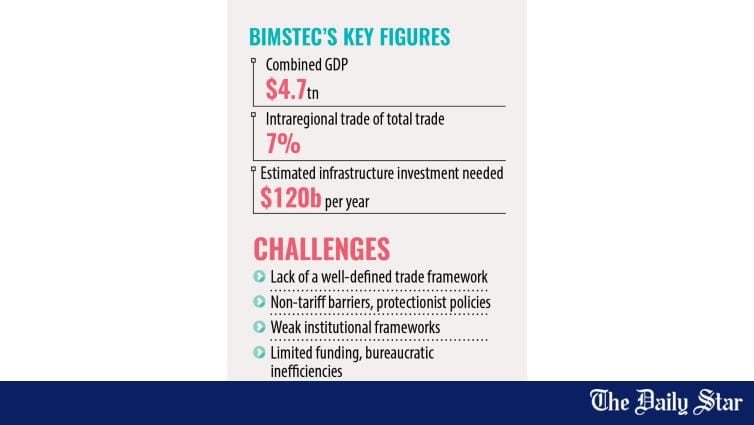
The combined economic size of Bimstec members stands at around $4.7 trillion, highlighting the bloc's vast potential for boosting intra-regional trade.

However, referring to the Association of Southeast Asian Nations (Asean), analysts said Bimstec's intra-regional trade accounts for just 7 percent of its total trade, compared to 25 percent for Asean.

"The absence of a well-defined trade framework is keeping Bimstec from realising its full potential," said Selim Raihan, a professor of economics at the University of Dhaka, at a policy dialogue in Dhaka yesterday.

Speakers at the event, titled Regional Cooperation and Development: Curtain Raiser to the Sixth BIMSTEC Summit, said that unlike Asean, which has established free trade policies and value chain integration, Bimstec struggles with fragmented trade arrangements and weak institutional frameworks.

They urged Bimstec members to learn from Asean's success in fostering regional trade and economic integration.

Bimstec was established in 1997 to promote economic and technical cooperation. Its members are Bangladesh, India, Myanmar, Sri Lanka, Thailand, Bhutan and Nepal.

Raihan, also the executive director of the South Asian Network on Economic Modeling (Sanem), said, "While an FTA framework was signed in 2004, there has been little tangible progress due to reluctance among member states and prolonged negotiations over tariff reductions and sensitive lists."

Sanem and the Bimstec Secretariat jointly organised the event at Sanem's Dhaka office.

The economist said that the lack of a comprehensive FTA, along with non-tariff barriers and protectionist policies, continues to hinder regional economic integration.

Globalisation is slowing and regionalism remains a viable strategy—yet South Asia has not fully capitalised on it, said Zaidi Sattar, chairman of Policy Research Institute (PRI).

"Bimstec must embrace strategic regionalism, where countries within the bloc work together to offset global trade uncertainties," he said.

However, the economist said, differences in political will have long delayed trade integration, with member states prioritising nationalistic economic policies over collective growth.

Sattar said delays in implementing a Bimstec charter, which took 25 years to finalise, reflect the lack of urgency among the members.

Limited funding and bureaucratic inefficiencies within Bimstec Secretariat have further stymied progress, he pointed out.

Another critical challenge is a lack of infrastructure to facilitate smooth trade, he said.

Mustafizur Rahman, distinguished fellow at the Centre for Policy Dialogue (CPD), stressed on improving transport, logistics, and digital connectivity.

"Bimstec requires an estimated $120 billion annually in infrastructure investment to bridge existing gaps. Without seamless transport and logistics networks, trade efficiency remains low," Rahman said.

A Bimstec master plan for transport connectivity, if fully implemented, could significantly facilitate trade, he said.

However, he said financial constraints and slow project implementation have hampered progress.

Indra Mani Pandey, secretary general of Bimstec, acknowledged these challenges but remained optimistic about future engagements.

"Despite political differences, member states continue to negotiate and explore economic collaboration. Bangladesh, as the current chair, is playing a crucial role in advancing discussions," he said.

M Masrur Reaz, chairman and chief executive officer of Policy Exchange Bangladesh, pointed out that foreign direct investment (FDI) trends were shifting and Bimstec needed to establish a stronger investment framework.

"While Asia is the leading recipient of global FDI, South Asia lags behind East Asia. Protectionist policies, regulatory hurdles, and a lack of investment facilitation make it difficult for Bimstec countries to attract meaningful FDI," he said.

He emphasised the need for investment-driven cooperation, particularly in sustainable sectors such as agriculture, water, and sanitation.

"Bimstec needs to focus on a well-structured economic corridor, boosting supply chain integration and implementing digital solutions to streamline trade," said Prabir De, a professor at the Research and Information System for Developing Countries.

The upcoming 6th Bimstec Summit is expected to address some of these concerns, particularly trade liberalisation, connectivity, and institutional strengthening.

However, the experts warned that without concrete commitments from member states, the bloc risks remaining stagnant.

"Political will is key to unlocking Bimstec's true potential. Without strong leadership and a commitment to collective growth, the region will continue to lag behind in the global economic race," said Mustafizur Rahman.​
 
Analyze

Analyze Post

Add your ideas here:
Highlight Cite Respond

BIMSTEC: Bangladesh approaches India for Yunus-Modi talks on sidelines

1742512332019.webp

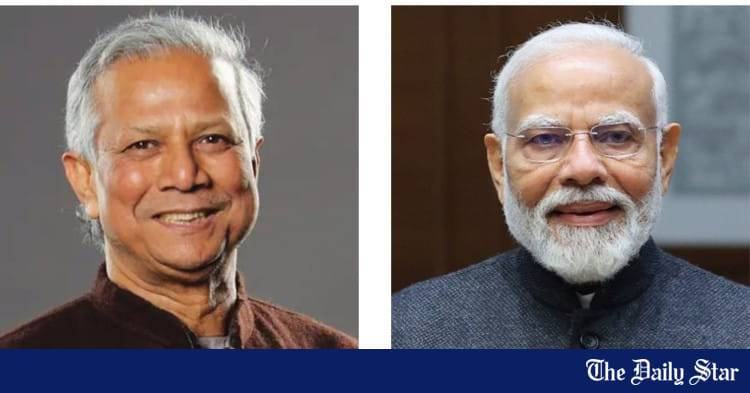
Muhammad Yunus, left, Narendra Modi

Bangladesh has approached India to arrange a meeting between Chief Adviser Professor Muhammad Yunus and Prime Minister Narendra Modi in Bangkok in the first week of April, reports ANI.

The two leaders are likely to visit Thailand from April 2-4 to attend the sixth BIMSTEC Summit in Bangkok.

Speaking to ANI, Foreign Adviser Touhid Hossain said, "We have made a diplomatic approach to India to hold a bilateral meeting between our two leaders at the sidelines of BIMSTEC Summit."

Yunus is expected to meet Chinese President Xi Jinping on March 28.

Earlier in February, Indian External Affairs Minister S Jaishankar held a meeting with Touhid on the sidelines of the Indian Ocean Conference in Oman.

Informing about his meeting, Jaishankar said the talks were focussed on the bilateral relationship between two countries and Bay of Bengal Initiative for Multi-Sectoral Technical and Economic Cooperation (BIMSTEC).

"Met Foreign Affairs Adviser Md. Touhid Hossain of the Interim Government of Bangladesh. Conversation was focused on our bilateral relationship, as also on (BIMSTEC)," Jaishankar wrote on X.

Bangladesh foreign ministry too had issued a statement, where it stated that two sides discussed on various bilateral issues of mutual concerns and interests.​
 
Analyze

Analyze Post

Add your ideas here:
Highlight Cite Respond
  • Like (+1)
Reactions: Bilal9

BIMSTEC 2025: Yunus-Modi bilateral meeting unlikely

1742601921908.webp

Muhammad Yunus, left, Narendra Modi

Chief Adviser Muhammad Yunus and Indian Prime Minister Narendra Modi are unlikely to hold a meeting on the sidelines of the BIMSTEC summit on April 2-4, putting a damper on the possibility of a thaw in the currently icy bilateral relationship between the two neighbouring countries.

Dhaka and New Delhi were working positively for such a meeting in Bangkok but the latter has yet to tell anything definitely on Dhaka's diplomatic approach, The Daily Star has learnt from people with knowledge of the matter.

"I don't have any update to share at this point in time," said Randhir Jaiswal, spokesman for India's external affairs ministry, during the weekly media briefing when asked about the possibility of Modi-Yunus bilateral meeting in Bangkok, reports our correspondent in New Delhi.

Given the acrimonious bilateral relationship at present, it is unlikely that there will be a meeting between the two countries' heads of government, according to people informed with the proceedings in Delhi's South Block.

A diplomatic source in Dhaka too made a similar comment.

They, however, did not rule out the exchange of pleasantries between the two leaders as all the leaders attending the summit will be around each other on more than one occasion.

"But nothing more than that is expected," said an Indian government official.

Earlier, there was another possibility of a bilateral meeting between Yunus and Modi on the sidelines of the UN General Assembly in New York in September last year. However, that did not happen as Modi had left New York before Yunus arrived.

Bangladesh's Foreign Adviser Touhid Hossain and Indian External Affairs Minister S Jaishankar, however, held meetings on two occasions: once on the sidelines of UNGA on September 23 last year and then on the sidelines of the 8th Indian Ocean Conference 2025 in Oman on February 16.

The two countries also held a Foreign Office Consultation on December 9 last year.

"There might be statements from political figures but our leadership is all for a good relationship with India -- we have interdependence on many aspects," said a foreign ministry official.

Relations between the two countries soured after the ouster of former Prime Minister Sheikh Hasina on August 5 last year and her eventual fleeing to India the same day.

Since then, the Indian government drastically reduced the number of visa seekers in Bangladesh. It also did not respond to Dhaka's official request for Hasina's extradition.

New Delhi repeatedly expressed concerns over the repression of minorities in Bangladesh, and Dhaka responded by saying that those statements were akin to interfering in the internal issues of Bangladesh.

Bangladesh also accused sections of the Indian media and political figures of exaggerating reports of minority attacks and making provocative remarks.

Chief Adviser's Office repeatedly said that the majority of the attacks on minorities, mostly Hindus, were not religious in nature but political.​
 
Analyze

Analyze Post

Add your ideas here:
Highlight Cite Respond
  • Angry (-3)
Reactions: Bilal9

Myanmar junta chief to join BIMSTEC leaders' summit in rare trip abroad
REUTERS
Published :
Mar 28, 2025 21:24
Updated :
Mar 28, 2025 21:24

1743212477827.webp

Myanmar's junta chief Senior General Min Aung Hlaing, who ousted the elected government in a coup, presides at an army parade on Armed Forces Day in Naypyitaw, Myanmar, March 27, 2021. Photo : REUTERS/Stringer/Files

Myanmar's junta chief Min Aung Hlaing will join a regional leaders' summit in Thailand next week where he is seeking high-level bilateral meetings, three sources with direct knowledge told Reuters, in a rare visit to a Southeast Asian country since seizing power in coup that led to a civil war.

Min Aung Hlaing is the subject of widespread western sanctions and is barred from attending summits of the Southeast Asian bloc ASEAN due to the Myanmar military's failure to implement an agreed peace plan with the bloc.

He will join the April 3-4 summit in Bangkok of the BIMSTEC grouping of mostly South Asian countries, where the Myanmar delegation is seeking bilateral meetings with leaders and top officials, according to the sources, who declined to be identified because they were not authorised to speak to media.

The meetings being sought include ones with Indian Prime Minister Narendra Modi and the chief adviser of Bangladesh’s interim government, Muhammed Yunus, the sources said.

"They have been reaching out asking for meetings," one of the sources said, referring to Myanmar officials.

An Indian government source said Myanmar officials had made "overtures" to New Delhi seeking a bilateral meeting between the junta chief and Modi, but added that India had not taken a decision so far.

India's foreign ministry did not respond to a request for comment. A spokesperson for Myanmar's military government could not immediately be reached for comment.

Asked by Reuters if the Myanmar general was attending, Thailand's foreign ministry said all leaders of BIMSTEC member countries have confirmed their attendance.

ESCALATING CRISIS

Myanmar has been in crisis since the military overthrew the elected government of Nobel laureate Aung San Suu Kyi, sparking mass protests that escalated into an armed rebellion against the junta. More than a third of the population is in need of humanitarian assistance, according to the United Nations.

The trip to Thailand to join other leaders would be significant for Min Aung Hlaing, who has sought to gain legitimacy at home and abroad for his plans to return the country to democracy via an election that has been derided by critics as a sham to perpetuate army rule.

The junta chief on Thursday said the election would be held in December, promising a free and fair vote and to transfer state power to the winning party.

Min Aung Hlaing is regarded by many countries as a pariah as head of a military accused of committing widespread atrocities as it battles to hold power and contain a widening rebellion. The military denies wrongdoing.

His trips overseas have been rare, mostly to Russia, which he visited this month, and to China late last year for a sub-regional summit.

His travel could be limited further following an announcement in November by the prosecutor of the International Criminal Court that a warrant for his arrest would be sought for crimes against humanity in the alleged persecution of the Rohingya, a mainly Muslim minority. Myanmar has denied the allegations.

BIMSTEC, or the Bay of Bengal initiative for Multi-Sectoral Technical and Economic Cooperation, includes Thailand, Myanmar, India, Bangladesh, Nepal, Sri Lanka and Bhutan.​
 
Analyze

Analyze Post

Add your ideas here:
Highlight Cite Respond
  • Like (+1)
Reactions: Bilal9

Latest Posts

Back
PKDefense - Recommended Toggle