Bangladesh Defense
Saif
Senior Member
- Jan 24, 2024
- 20,472
- 9,566
- Nation

- Residence
- Axis Group


RMG products fetch higher prices in EU than US
Bangladeshi-made major garment items get higher prices in the European Union (EU) market compared to the US due to different pricing and margin strategies based on preferential market access, according to a RAPID study. "On average, firms foroprop ten apparel products obtain 5.0 per cent t
RMG products fetch higher prices in EU than US
FE ONLINE REPORT
Published :
Mar 14, 2026 16:30
Updated :
Mar 14, 2026 16:30

Bangladeshi-made major garment items get higher prices in the European Union (EU) market compared to the US due to different pricing and margin strategies based on preferential market access, according to a RAPID study.
"On average, firms foroprop ten apparel products obtain 5.0 per cent to 18 per cent higher prices in the EU than in the US market," said Jillur Rahman, lecturer of the Department of Development Studies at Dhaka University.
Citing an example, he, also deputy director of Research and Policy Integration for Development (RAPID), said exporters receive about 20 per cent to 27 per cent higher prices for T-shirts in Germany than in the US, while trousers command a 9.0 per cent to 15 per cent price premium in the German market.
He attributed a systematic price differential between preferential (EU) and non-preferential (US) markets, consistent with destination-specific pricing behaviour.
Mr Rahman was presenting the findings at a consultation event held on Saturday at the conference room of the Department of Development Studies at the DU in the city.
Moderated by RAPID executive director Dr Muhammad Abu Eusuf, Commerce Additional Secretary Abdur Rahim Khan, DU faculty of social sciences Dean Dr Taiabur Rahman and Economic Reporters' Forum president Doulot Akter Mala, spoke, among others.
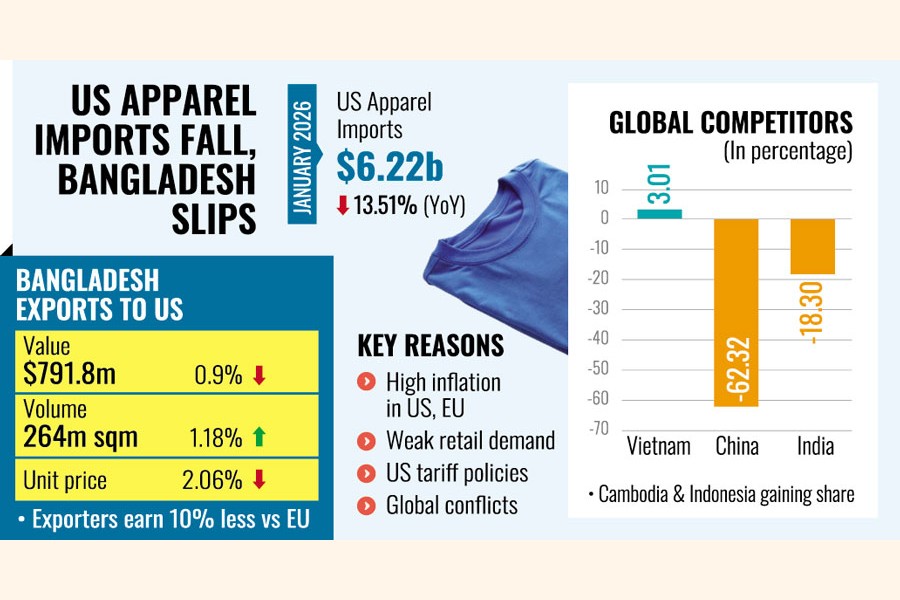
Bangladeshi apparel exporters pursue markedly different pricing strategies across preferential and non-preferential markets, Mr Jillur Rahman said, adding that on average, firms charge more than 10 per cent lower prices in the US market than in the EU.
"High US tariffs compel exporters to absorb a significant share of the tax burden within their own margins in order to remain price-competitive at the border," he explained.
The results also reveal incomplete exchange rate pass-through, with exporters absorbing about 55 per cent of currency depreciation when exporting to the US, compared with around 40per cent for the EU, suggesting that firms operating in the non-preferential US market have stronger incentives to retain exchange rate gains in local-currency margins rather than fully transmit them into lower export prices.
FE ONLINE REPORT
Published :
Mar 14, 2026 16:30
Updated :
Mar 14, 2026 16:30
Bangladeshi-made major garment items get higher prices in the European Union (EU) market compared to the US due to different pricing and margin strategies based on preferential market access, according to a RAPID study.
"On average, firms foroprop ten apparel products obtain 5.0 per cent to 18 per cent higher prices in the EU than in the US market," said Jillur Rahman, lecturer of the Department of Development Studies at Dhaka University.
Citing an example, he, also deputy director of Research and Policy Integration for Development (RAPID), said exporters receive about 20 per cent to 27 per cent higher prices for T-shirts in Germany than in the US, while trousers command a 9.0 per cent to 15 per cent price premium in the German market.
He attributed a systematic price differential between preferential (EU) and non-preferential (US) markets, consistent with destination-specific pricing behaviour.
Mr Rahman was presenting the findings at a consultation event held on Saturday at the conference room of the Department of Development Studies at the DU in the city.
Moderated by RAPID executive director Dr Muhammad Abu Eusuf, Commerce Additional Secretary Abdur Rahim Khan, DU faculty of social sciences Dean Dr Taiabur Rahman and Economic Reporters' Forum president Doulot Akter Mala, spoke, among others.
Bangladeshi apparel exporters pursue markedly different pricing strategies across preferential and non-preferential markets, Mr Jillur Rahman said, adding that on average, firms charge more than 10 per cent lower prices in the US market than in the EU.
"High US tariffs compel exporters to absorb a significant share of the tax burden within their own margins in order to remain price-competitive at the border," he explained.
The results also reveal incomplete exchange rate pass-through, with exporters absorbing about 55 per cent of currency depreciation when exporting to the US, compared with around 40per cent for the EU, suggesting that firms operating in the non-preferential US market have stronger incentives to retain exchange rate gains in local-currency margins rather than fully transmit them into lower export prices.