What attacks on Saudi Arabia mean for Bangladesh’s economy
Jagaran Chakma
The country’s remittances, energy and fertiliser imports, and exports face fresh risks as Yemen’s Iran-backed Houthis fire ballistic missiles and drones at Saudi Arabia.
Trade leaders, manpower exporters and economists say the escalation, which comes as the US-Israeli war on Iran widens amid stalled diplomacy, exposes the economy to the risk of a fresh external shock.
Since fiscal year 2014-15, the Kingdom of Saudi Arabia has employed around half of the 96 lakh Bangladeshis who went abroad for work. So, the attacks put Saudi jobs at risk and, in time, the country’s overall remittance inflow.
Ali Haider Chowdhury, former secretary-general of the Bangladesh Association of International Recruiting Agencies (BAIRA), said that a prolonged conflict centred on Saudi Arabia could delay recruitment, raise migration costs and weaken demand for workers.
“At least 800,000 Bangladeshis travel to Saudi Arabia for work each year, and any slowdown would hit prospective migrants and the families who depend on their earnings,” he said.
Of the 969,000 workers who went abroad in fiscal year 2025-26, Saudi Arabia hired more than 600,000, over 60 percent of the total. Remittances provide the foreign exchange the country needs to meet external payments, including for imports, and Saudi Arabia accounted for the largest share last year, at 16 percent.
In the July-September period this year, Bangladeshi workers in Saudi Arabia sent home nearly $2 billion, almost one-fifth of the total, according to the Bangladesh Bank.
After the latest Houthi attacks on the Kingdom, Ali Haider said that they were yet to see any impact on remittances. “It would take a few months to assess the consequences,” he said.
The Gulf and the wider Middle East employ more than three-quarters of the country’s migrant workers. The Iran war and its spillover across the Gulf have already left millions of Bangladeshi workers in the region uncertain about their future.
Fewer Bangladeshis have been leaving for work in the region since the war broke out in February this year.
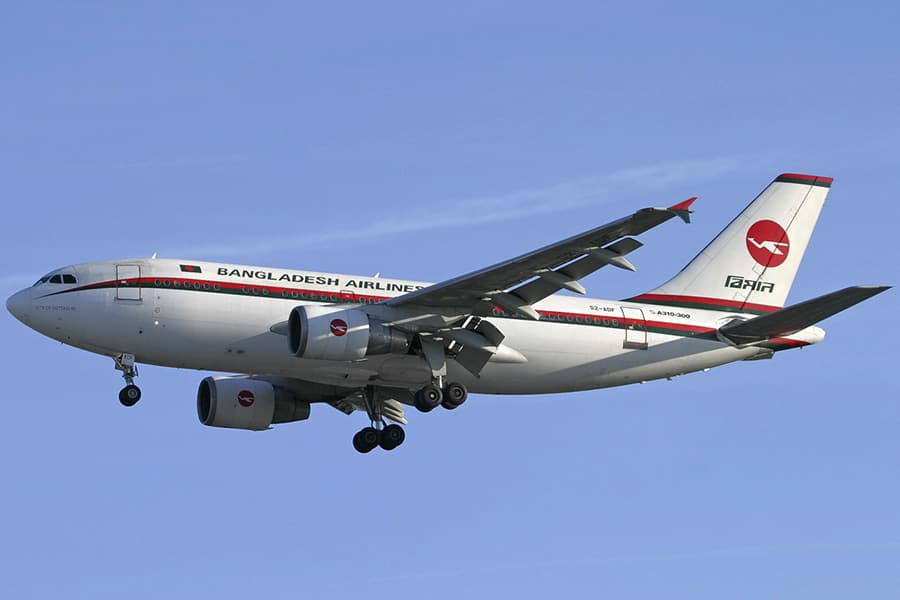
This week the Houthi attacks disrupted at least 61 flights from Dhaka airport to the Kingdom, affecting at least 8,381 passengers, according to the Civil Aviation Authority of Bangladesh (CCAB). Two Bangladeshis were killed, and 27 were injured in an attack on Riyadh airport reported on October 10.
As the Houthis escalate their attacks and threaten shipping in the Red Sea and the Bab el-Mandeb Strait, energy and fertiliser shipments to Bangladesh face long reroutes amid the Iran war choking maritime traffic through the Strait of Hormuz, a major artery for global energy and fertiliser shipments.
Disruptions in the Strait of Hormuz have already hampered trade and pushed up oil and fertiliser prices globally. The International Monetary Fund (IMF) forecasts that oil will average around $96 a barrel throughout 2026, compared with $68 in 2025.
Bangladesh, a net petroleum importer, is facing spiralling bills for oil, gas and fertiliser. To pay the higher energy costs and cushion the economy against the conflict, the government plans to seek about $4 billion in budget support from multilateral and bilateral lenders in the current fiscal year.
Meanwhile, fertiliser supplies appear to have remained unaffected so far by the escalation.
Preferring anonymity, a senior official of Bangladesh Agricultural Development Corporation (BADC) said fertiliser supplies from Saudi Arabia are uninterrupted so far, with four lots already received and no indication of a suspension of the fifth consignment.
The Saudi supplier has assured BADC that, if any disruption occurs there, fertiliser could be shipped through Duqm Port in Oman, the official said.
Riaz Uddin Ahmed, executive secretary of Bangladesh Fertilizer Association, said imports have not been affected by the recent attacks on Saudi Arabia, and suppliers have provided no negative updates regarding existing orders.
He said that ships are taking detours due to the situation around the Bab el-Mandeb Strait, but that he does not expect the recent attacks to disrupt fertiliser supplies.
He added that suppliers have not raised any concerns about the orders already booked.
Apart from manpower, Saudi Arabia is also a major market for Bangladeshi apparel and processed food. The Kingdom imported $340 million worth of Bangladeshi goods in fiscal year 2025-26, according to the Export Promotion Bureau (EPB).
Ahsan Khan Chowdhury, chairman and chief executive of PRAN-RFL Group, the country’s largest agro-processed food exporter, said the company has found alternative routes to keep deliveries going to Middle Eastern markets.
“Previously, we transported our products through the Strait of Hormuz. Now, we are using alternative shipping routes involving containers, despite the sharp increase in shipping costs to $5,000 per container from $1,500 previously,” he said.
The higher costs have cut margins by nearly two percentage points. PRAN-RFL has also moved its plastic-resin sourcing from the Middle East to China, and orders from Middle Eastern markets have fallen by about 40 percent from pre-war levels, said Ahsan.
Taskeen Ahmed, president of the Dhaka Chamber of Commerce and Industry (DCCI), said the Middle East conflict is raising import costs, fuelling inflation and weakening export competitiveness.
M Masrur Reaz, chairman and chief executive of Policy Exchange Bangladesh, identified four potential risks arising from the Houthi attacks.
Those are disruption to Saudi employment and remittances, higher oil prices, weaker global demand because of inflation, and shipping delays and higher freight costs if attacks spread near the Bab el-Mandeb Strait.
Asif Ibrahim, former president of the Business Initiative Leading Development (BUILD), urged the government to set up a crisis task force, secure alternative fuel supplies, maintain reserves and dollar liquidity, support exporters and small businesses, ease port and customs bottlenecks, protect migrant workers and speed up renewable energy projects under a time-bound plan.
[The Daily Star Staff Correspondent Sukanta Halder contributed to this report.]
 Bangladesh Defense