| Global Defense, OSINT & Geopolitics Wire

[🇧🇩] China is a Time Tested Friend and a Strategic Partner of Bangladesh

[🇧🇩] China is a Time Tested Friend and a Strategic Partner of Bangladesh
369
19K
More threads by Saif

G Bangladesh Defense

Bangladesh, China agree on education cooperation in nine areas


1792195298822.webp


Bangladesh and China agreed on nine key areas of educational cooperation, said a press release issued by the ministry of education on Friday.

The areas of cooperation include- establishing Chinese standard diploma vocational institutes, setting up smart classrooms and expanding Chinese language learning opportunities across the country.

The agreement was reached at a high-level meeting between Bangladesh’s Ministry of Education and Primary and Mass Education and China’s Ministry of Education to upgrade Bangladesh’s Technical and Vocational Education and Training (TVET) system to international standards, create sustainable employment opportunities for technical students and expand quality technology-based education nationwide, reports BSS.

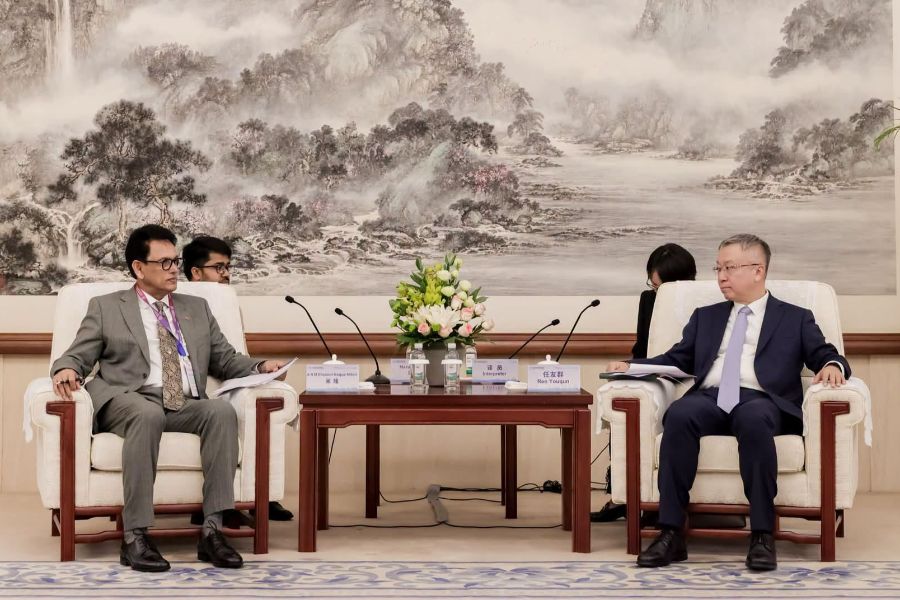
The meeting was held last night on the sidelines of the World Vocational and Technical Education Development Conference 2026 in Tianjin, China.

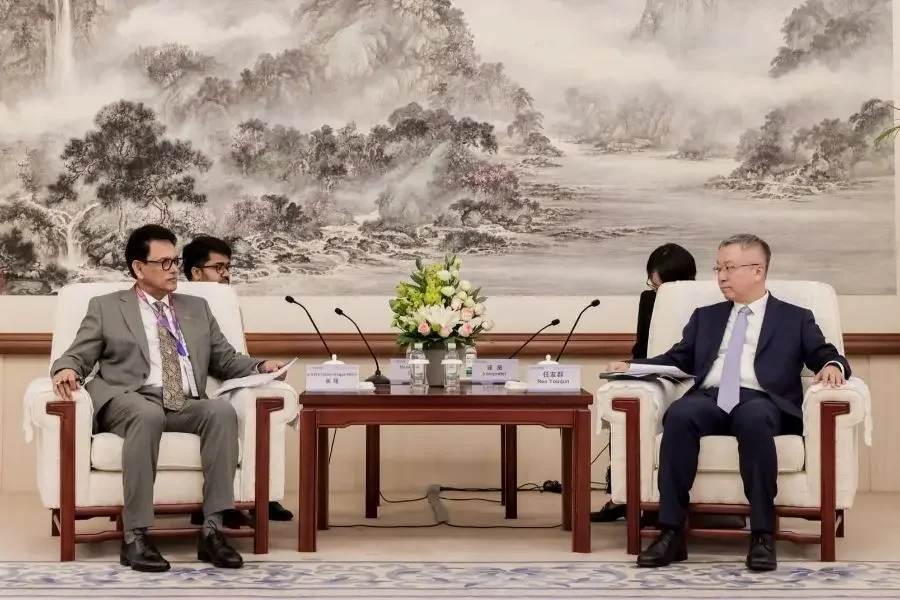
Minister for Education and Primary and Mass Education Dr. A N M Ehsanul Hoque Milon led the Bangladesh delegation while Chinese Vice Minister of Education Ren Youqun led the Chinese side.

During the meeting, Milon stressed the urgent need to strengthen Bangladesh’s technical education system and create international-standard employment opportunities for students.

He called for technical and infrastructural assistance from Chinese educational institutions to establish Chinese-standard diploma vocational institutes across the country.

Chinese Vice Minister for Education Ren Youqun expressed full support for the proposals and pledged China’s all-out cooperation in the overall development of Bangladesh’s education system.

He reiterated that the Chinese government would provide full support for TVET reforms in Bangladesh, the construction of smart classrooms, the modernisation of technical institutions and the expansion of Chinese language education nationwide.

Both sides expressed their firm commitment to implement the agreed bilateral initiatives in a timely manner.​
 

Chinese banks urged to start operations in Bangladesh
Bangladesh Sangbad Sangstha . Dhaka
​
1792541942495.webp

​
Bangladesh has urged leading Chinese banks to establish operations in the country to strengthen financial connectivity, facilitate trade financing and support Chinese investment in Bangladesh.

The call was made at a ‘Bangladesh Day’ event held at the headquarters of the Export-Import Bank of China in Beijing on Tuesday, jointly organised by the bank and Invest Bangladesh, said a press release here.

Eleven Chinese financial institutions participated in the event, including three of the world’s four largest banks by assets — the Industrial and Commercial Bank of China, Agricultural Bank of China and Bank of China.

Twenty-six leading Chinese companies from infrastructure and engineering, power and renewable energy, information technology, green technology, electronics and agricultural technology sectors also attended the event.

Invest Bangladesh Chairman Ashik Chowdhury attended as the chief guest, while China Exim Bank Vice President Wang Kang and Bangladesh Ambassador to China Md Nazmul Islam were present as guests of honour.

Bangladesh Bank and Invest Bangladesh jointly presented a paper titled ‘The Next Frontier: Bangladesh-China Financial Connectivity’.

According to the presentation, bilateral trade between Bangladesh and China reached $19 billion in the fiscal year 2024-25. Despite the substantial trade volume, no Chinese bank has yet established direct operations in Bangladesh.

The presentation noted that Chinese banks are already operating successfully in countries such as Cambodia, Sri Lanka and Myanmar, although their trade volumes with China are lower than that of Bangladesh.

The event highlighted Bangladesh’s priority investment sectors, the Chinese Economic and Industrial Zone in Chattogram and investment opportunities in the Mongla Economic Zone.

Discussions focused on how Chinese companies and their financing institutions could participate in these opportunities.

‘Financial connectivity is the next phase of Bangladesh-China cooperation,’ Ashik Chowdhury said.

He said the presence of Chinese banks in Bangladesh was essential to provide trade financing, equipment procurement facilities, working capital and long-term investment support to Chinese companies investing in the country.

Bangladeshi companies, he added, need technology and partnerships that can help expand their businesses and production capacity.

‘An increased presence of Chinese financial institutions in Bangladesh can benefit both sides and make it easier to turn investment decisions into reality,’ he said.

Wang Kang said China Exim Bank, as a policy bank, was currently involved in around 40 projects in Bangladesh across sectors including infrastructure, energy, agriculture and manufacturing.

He said the bank would encourage leading Chinese companies to invest directly in Bangladesh’s priority sectors, including textiles and healthcare, in the coming days.

Such investments would play an important role in Bangladesh’s overall economic development, he added.

The event concluded with a networking session, during which Chinese business leaders and bank representatives held direct discussions with the Bangladesh delegation on foreign direct investment, easier financing arrangements and potential partnerships.​
 

Ten years of BRI: Infrastructure ambitions to economic transformation


1792711545972.webp


Ten years after joining China’s Belt and Road Initiative, Bangladesh stands at a defining moment. Chinese financing has helped reshape its transport networks, energy infrastructure and investment landscape. The next phase of cooperation must therefore move beyond building infrastructure and toward strengthening industrial capacity, expanding exports and securing sustainable economic growth.

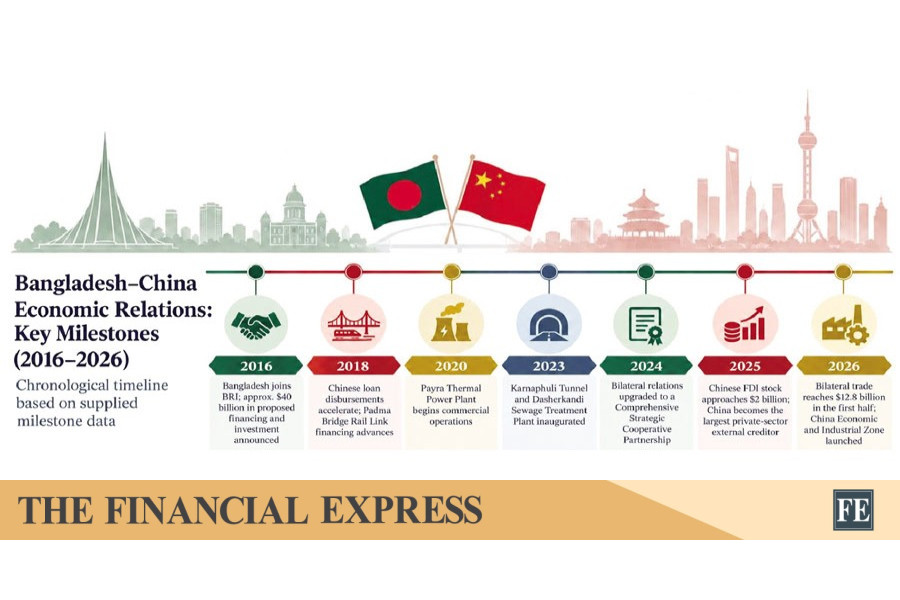
A decade ago, Bangladesh embarked on one of its most consequential development partnerships, opening a new chapter in its economic relationship with China. When Chinese President Xi Jinping visited Dhaka on October 14, 2016, Bangladesh formally joined the Belt and Road Initiative (BRI), positioning itself among South Asia’s earliest participants in China’s ambitious connectivity framework. The visit elevated bilateral relations to a strategic partnership of cooperation and generated approximately $40 billion in proposed financing and investment commitments.

Ten years later, the most important question is not simply how much China has invested, but how effectively that cooperation has strengthened Bangladesh’s economic foundations.

The BRI’s first decade has delivered substantial progress in physical connectivity and energy infrastructure, while exposing critical gaps between financial pledges and implementation, rising trade imbalances, and the need for greater investment efficiency. These achievements and limitations deserve equal consideration as Bangladesh plans its next decade of cooperation, shaping the priorities ahead.

The economic ambition underpinning Bangladesh’s BRI participation was considerable. The 2016 commitments included approximately $26 billion for infrastructure and development projects and another $14 billion for joint ventures. Transport, electricity, telecommunications and industrial connectivity dominated the proposed investment portfolio.

However, financial commitments should not be confused with actual disbursements. According to an assessment published by a news outlet, outgoing Chinese Ambassador Yao Wen reported that $4.45 billion had been disbursed for 35 BRI projects by 2023. The assessment noted that comprehensive and updated BRI-specific disbursement figures remained unavailable, limiting independent evaluation of implementation progress.

The central challenge not merely mobilising additional financing, but ensuring timely implementation, transparent procurement and manageable repayment obligations. These policy choices will determine whether cooperation strengthens Bangladesh’s economic foundations. This challenge also sets the stage for the shift from funding to trade and investment.

Trade and investment have become central pillars of Bangladesh–China cooperation. China has remained Bangladesh’s largest trading partner for 16 consecutive years, from 2010 through 2025. According to figures published by the Chinese Embassy in September 2026, bilateral trade reached $12.8 billion in the first half of 2026, up 10.6 percent year on year.

Chinese machinery, industrial equipment, raw materials and intermediate goods support Bangladesh’s manufacturing industries, particularly ready-made garments, leather and electronics. However, the persistent imbalance between imports and exports highlights the need to strengthen Bangladesh’s export capacity. Rather than restricting productive imports, Bangladesh should work with Chinese investors and buyers to expand exports of agricultural products, processed food, seafood, leather goods, pharmaceuticals, home textiles, light engineering products and digital services.

Realising this potential requires more than market access. Bangladesh must improve logistics, product quality, international certification, technology transfer and industrial linkages to diversify beyond its heavy reliance on ready-made garments. China’s zero-tariff market access for eligible Bangladeshi products and the prospect of a bilateral free-trade agreement offer opportunities to advance this agenda.

The priority for the next decade should therefore be to transform the trading relationship into a more balanced and mutually beneficial partnership — one that strengthens domestic industries, creates employment and expands competitive, higher-value exports while gradually narrowing the bilateral trade gap.

Investment trends are particularly noteworthy. China’s foreign direct investment stock reportedly increased from $241 million in 2016 to nearly $2 billion by the end of 2025, representing approximately 700 per cent growth. China became Bangladesh’s third-largest source of FDI stock and its second-largest source of annual net FDI inflows in 2025, contributing $321.15 million.

China has also emerged as Bangladesh’s largest private-sector external creditor. Its share of private-sector long-term external debt reached 34.2 percent in 2025, equivalent to $3.37 billion, compared with $422 million in 2020. This reflects growing financial integration, but also strengthens the case for prudent debt management.

A promising development is the China Economic and Industrial Zone in Anwara, Chattogram, formally launched in July 2026. The zone aims to attract manufacturing investment in textiles, machinery, electronics, and green industries. Such initiatives could transform Chinese engagement from predominantly infrastructure construction into long-term industrial production, employment generation and technology transfer.

Infrastructure remains the most tangible outcome of BRI cooperation. Chinese companies have participated in landmark projects including the Padma Bridge Rail Link, Karnaphuli Tunnel, Chattogram-Cox’s Bazar railway, Chattogram Elevated Expressway, and Dasherkandi Sewage Treatment Plant.

The Padma Bridge Rail Link has strengthened railway connectivity between Dhaka and southwestern Bangladesh, opening opportunities for trade, transportation and regional development. The Karnaphuli Tunnel, inaugurated in 2023, represents another engineering milestone, creating an underwater road connection intended to support Chattogram’s industrial and logistics expansion.

The Padma Multipurpose Bridge, constructed by a Chinese contractor but financed by Bangladesh itself, also demonstrates the wider role of Chinese engineering expertise.

Energy cooperation has similarly contributed to expanding electricity-generation capacity. The 1,320-megawatt Payra Thermal Power Plant, developed through a Bangladesh-China joint venture, stands among the most significant examples. Chinese financing and technical expertise have also supported electricity transmission and other energy projects. However, growing generation capacity must be accompanied by reliable fuel supplies, efficient transmission networks and greater investment in renewable energy.

The achievements of the past decade are significant, but infrastructure alone cannot guarantee sustainable development. The next phase of Bangladesh–China Belt and Road cooperation must focus on converting connectivity into productivity, investment into industrial capacity, and economic partnerships into tangible benefits for businesses and citizens.

Bangladesh should prioritise commercially viable investments, transparent procurement, prudent debt management and stronger domestic industrial participation. Infrastructure projects must be linked to export-oriented manufacturing, renewable energy, technology transfer and skills development to generate quality employment, strengthen local supply chains and increase domestic value addition.

Equally important is establishing clear mechanisms for accountability. A public dashboard tracking project financing, implementation progress and economic outcomes, complemented by independent assessments of value for money, would help ensure that investments deliver measurable benefits.

Bangladesh must also maintain diversified international partnerships, ensuring that cooperation with China complements its relationships with India, Japan, the European Union and multilateral development institutions. Such an approach would preserve policy flexibility while enabling Bangladesh to pursue mutually beneficial investment and trade opportunities.

The central objective for 2027–2036 should be to build stronger domestic industries, diversify exports, develop a skilled workforce and improve Bangladesh’s position in regional and global value chains. Ultimately, the success of the next decade will depend not on how much infrastructure is built, but on how effectively it supports competitive businesses, sustainable growth and inclusive economic prosperity.

The first decade strengthened connectivity; the next must deliver competitiveness. Bangladesh’s greatest achievement will be measured by what it can produce, export and sustain—not simply by what it builds.

Mohammad Saiyedul Islam, PhD, is a Senior Lecturer and Researcher in the School of Overseas Education at Sanming University in China’s Fujian Province.

Professor Mohammed Masum Iqbal, PhD, is a Pro-Vice Chancellor at Daffodil International University.​
 

China’s proposed economic corridor: What it means for Bangladesh

Raheed Ejaz

1794872168786.webp

Possible route of the China-proposed economic corridor Prothom Alo Graphics

China has proposed an economic corridor linking Kunming, the capital of its southwestern Yunnan province, with Bangladesh via Myanmar's coastal port of Kyaukphyu. Under the proposed arrangement, goods would travel overland from Kunming to Kyaukphyu and then by sea to Bangladesh.

Chinese President Xi Jinping proposed the corridor connecting China, Myanmar and Bangladesh during a meeting with Prime Minister Tarique Rahman in Beijing on 26 June. The proposal was mentioned in an official statement issued by China's foreign ministry after the meeting.

However, the precise route of the corridor has yet to be determined. Questions such as how goods will be transported, which Bangladeshi port will be used and how land and sea routes will be integrated remain under discussion.

Several Bangladeshi diplomats who accompanied Prime Minister Tarique Rahman on his visit to China said the initial plan envisages an overland connection between Kunming and Kyaukphyu. From there, small feeder vessels would carry goods to Bangladesh across the Bay of Bengal.

Tarique Rahman visited Beijing in late June. Earlier that month, then foreign secretary Asad Alam Siam had also visited the Chinese capital. Foreign Minister Khalilur Rahman had travelled to Beijing in May. Chinese officials had outlined the initial concept of the proposed corridor during discussions with the two officials.


1794872214745.webp

Prime Minister Tarique Rahman meets Chinese President Xi Jinping at the Great Hall of the People in Beijing, China. PID

China's preliminary plan is to extend the land-based transport network from Kunming through Ruili, Muse and Mandalay in Myanmar to Kyaukphyu in Rakhine State. The connection between Kyaukphyu and Bangladesh would primarily be maritime.

Concept of a three-country corridor

The idea of establishing economic connectivity among Bangladesh, China and Myanmar is not entirely new. It has links to an earlier proposal for the Bangladesh-China-India-Myanmar (BCIM) Economic Corridor.

The initiative aimed to establish a regional connectivity network linking Kunming with Kolkata in India through Myanmar and Bangladesh.

Formal discussions among the four countries on the BCIM initiative began in 2013. Representatives from the four countries met in Kunming that year, and discussions on the initiative gained momentum in Bangladesh in 2014.

However, deteriorating relations between Beijing and New Delhi over border disputes, along with India's objections to China's Belt and Road Initiative (BRI), ultimately prevented the BCIM corridor from taking shape.

Notably, the BCIM initiative has never been formally abandoned. During the visit of Bangladesh's then prime minister to China in July 2024, a joint statement by the two countries acknowledged the importance of the BCIM initiative and called for greater coordination, including on connectivity, to advance it.

Regional connectivity and the BRI were also discussed during the March 2025 visit to China by Professor Muhammad Yunus, then chief adviser to Bangladesh's interim government.

An important aspect of Beijing's latest proposal is the plan to establish an economic connectivity framework among the three countries, leaving India outside the arrangement.

Questions over the future

Kyaukphyu is an important location for China. Work is under way there to develop a deep-sea port and a special economic zone.

Existing oil and gas pipelines between China and Myanmar are also connected to Kyaukphyu port. China has now raised the possibility of linking Bangladesh to this network.

Initially, Beijing wants to develop a maritime transport connection between Kyaukphyu and a port in Bangladesh. However, no final decision has been made on which Bangladeshi port will be used, how frequently vessels will operate or how much cargo will be transported. The economic viability of the proposed arrangement also remains unclear.

Two separate aspects of the proposal need to be considered. The first is making the land-based connection between Kunming and Kyaukphyu fully operational. The second is transporting goods between Kyaukphyu and Bangladesh by sea.

The future of the second component will depend much more heavily on Myanmar's political and security situation. The ongoing conflict in Rakhine State and the Arakan Army's control over most of the region have raised questions about the prospects of establishing connectivity among China, Myanmar and Bangladesh.

The biggest challenge

The situation in Myanmar's Rakhine State is the biggest challenge facing the proposed three-country corridor.

Myanmar experienced a military coup in 2021. The conflict that followed has had a profound impact on the region.

The Arakan Army has taken control of most areas in Rakhine. However, the situation surrounding Chinese projects, including the strategically important port at Kyaukphyu, is somewhat different. Taking China's investments into account, the Arakan Army has so far refrained from directly disrupting the main Chinese port project in Kyaukphyu. But that does not mean the area is entirely safe for a trilateral connectivity initiative.

Kyaukphyu is important to China for two main reasons. First, Beijing has made substantial economic and infrastructure investments there. Second, China plans to use the port to establish an alternative route connecting Yunnan with the Bay of Bengal.

As a result, China needs to maintain relations with Myanmar's military government while also preserving an understanding with the Arakan Army, which currently controls much of Rakhine.

During a recent visit to Kunming, the capital of Yunnan province, this correspondent spoke with a senior official of the provincial foreign affairs office. The discussion highlighted both Beijing's interest in the proposed new corridor and its concerns over the security situation in Rakhine.

Wen Shixiang, deputy director-general of Yunnan's Foreign Affairs Office, told Prothom Alo that the proposed Bangladesh-China-Myanmar (BCM) Economic Corridor was a political decision involving the three countries. It remained at an early stage, and Beijing was working to implement the decision. All parties would benefit if the economic corridor materialised, he said.

China itself understands that building infrastructure alone will not be enough to make the corridor operational. Political stability and security are essential.

Asked about the challenges to implementing the corridor, particularly the situation in Rakhine, Wen Shixiang said the Bangladesh-China-Myanmar Economic Corridor had considerable potential but also faced several obstacles, especially the prevailing security situation in Rakhine.

Political stability and security were indispensable to the project's implementation, he said. Establishing such a partnership would first require agreement on policy positions. All parties would also need to take effective and meaningful initiatives to make it a reality.

Geopolitics

China's proposal is not merely about economic connectivity between Bangladesh and Myanmar. It is also intertwined with the geopolitics of the Bay of Bengal and the wider Indian Ocean region.

India is closely monitoring the expansion of China's economic and infrastructure links with Bangladesh. On 3 July, Indian foreign ministry spokesperson Randhir Jaiswal said New Delhi was closely watching developments in neighbouring countries.

China, however, has said India would have the opportunity to join the corridor if it wished.

Japan, meanwhile, has significant economic interests in the Bay of Bengal region. It has investments in the Matarbari deep-sea port project and the Bay of Bengal Industrial Growth Belt (BIG-B) initiative.

Greater regional connectivity and trade could bring economic benefits to Japan. At the same time, an expanding Chinese presence in the Bay of Bengal would factor into Tokyo's strategic considerations.

The United States is particularly concerned about China's growing presence in the Indo-Pacific region.

What should Bangladesh do?

Bangladesh is still assessing China's proposal. Since Chinese President Xi Jinping put forward the idea in June, officials from the two countries have held discussions at various levels.

In July, China's then ambassador to Bangladesh, Yao Wen, described the initiative as being at an early stage. The proposal was subsequently discussed during visits by Chinese delegations to Dhaka and at various bilateral meetings.

Most recently, the issue came up during the 4 November visit to Dhaka by Liu Haixing, minister of the International Department of the Communist Party of China.

However, no final route, construction agreement or implementation timeline for the corridor has been announced so far.

Experts say Bangladesh's immediate priority should be to conduct a comprehensive assessment of the proposal's economic and strategic viability.

The government needs to calculate which Bangladeshi port would offer the most cost-effective route for transporting goods from Kyaukphyu, the likely transportation costs, and the charges for feeder vessels and port services.

It must also ensure that the corridor does not merely facilitate the transportation of Chinese goods but provides Bangladeshi export products with equal access to the proposed connectivity network.

Bangladesh should also take into account the conflict in Rakhine and the Rohingya crisis. It may be worth considering whether the new initiative could create opportunities for diplomatic engagement with different stakeholders in Rakhine.

Overall, China's proposal presents Bangladesh with a new opportunity for regional connectivity. But an economic corridor cannot be established simply by drawing a route on a map. It requires political stability, security, economic viability and cooperation among the countries concerned.

Bangladesh's immediate task is to assess the feasibility of the proposal while safeguarding its own economic and diplomatic interests. Ultimately, the benefits Bangladesh derives from the initiative will depend on how Dhaka chooses to engage with it.​