| Global Defense, OSINT & Geopolitics Wire

[đŸ‡§đŸ‡©] Israel and Hamas war in Gaza-----Can Bangladesh be a peace broker?

[đŸ‡§đŸ‡©] Israel and Hamas war in Gaza-----Can Bangladesh be a peace broker?
1K
47K
More threads by Saif

G Bangladesh Defense

Heavy rain floods tents housing Gaza displaced people, aid shortages hamper response

1794095396500.webp

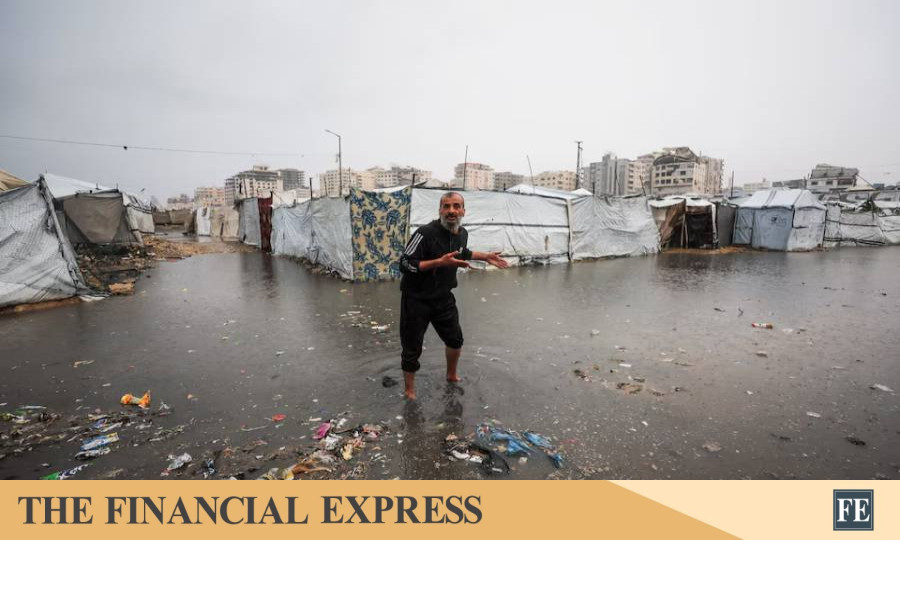
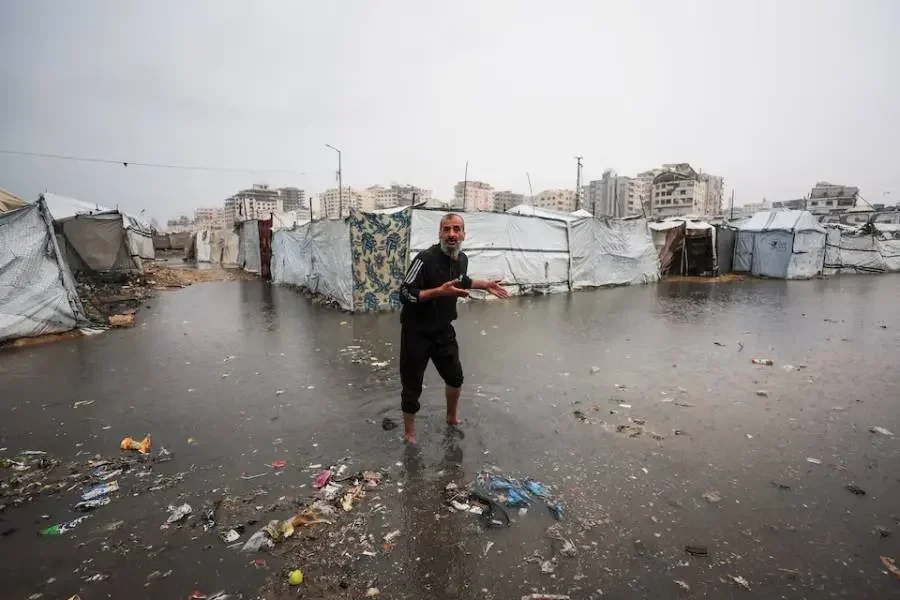
A displaced Palestinian man stands in a partially flooded tent camp during a rainy day in Gaza City, November 7, 2026. REUTERS/Dawoud Abu Alkas TPX IMAGES OF THE DAY

Heavy rains have flooded tens of thousands of tents housing displaced Palestinians crammed into encampments across the Gaza Strip, washing away shelters and soaking blankets and mattresses, local authorities said on Saturday.

The ‌Hamas-run Gaza government media office said at least 70,000 tents had been flooded in the past 12 hours, affecting tens of thousands of displaced people and causing injuries although no fatalities had been reported.

The territory's civil defence service said it had received 1,500 distress calls from displaced residents. Three abandoned houses collapsed without causing injuries, it added.

At a tent encampment in Gaza City, some people tried to repair their tents, while others used sand to reinforce them and prevent water from entering. Some were busy getting their children out ⁠of flooded tents.

Olfat Magdoub, a Gaza resident, tried in vain to sweep water away from her tent.

"This is the first day of rain, and of course we are already flooded. What will happen if it rains again the next day? This is only the first day and we're already overwhelmed," said the woman.

"Two weeks ago when it rained, I swear to God, I spent four days sleeping on blankets spread on the floor because the rainwater had flooded the bedding. Same now, the mattresses are wet so we sleep on the ground.”

Municipal and civil defence officials said they were unable to cope with the storm because of fuel shortages and damage to equipment.

They said Israel had destroyed hundreds of vehicles, including bulldozers and others used to pump water, during its war against Hamas, which had displaced most of the territory's more than 2 million ‌residents and ⁠left much of Gaza in ruins. Most of the population now lives in tent camps.

Hamas blamed Israel for not allowing shelters and construction materials into Gaza.

COGAT, the Israeli military agency that coordinates aid, did not immediately comment on the accusations by Hamas. It said in a statement on Friday that it had stepped up efforts to improve sanitary conditions across Gaza before the heavy rain, which had been expected, in coordination with international organisations.

LITTLE PROGRESS ON RECONSTRUCTION

The agency said ⁠four additional vacuum trucks entered Gaza this week through the International Committee of the Red Cross (ICRC), joining eight others brought in over the past month to support sewage pumping, weekly waste removal and repairs to water and sewage infrastructure.

A US-brokered ceasefire last year called for the eventual reconstruction of Gaza, but little progress ⁠has been made. Negotiators have failed to agree on terms for Hamas to disarm or for Israel to withdraw its troops, which control about two-thirds of the territory and from which residents have been ordered to leave.

"We have no resources, no tarpaulins, no tents and no one is ⁠checking on us," said displaced Gaza resident Rafiq Ghattas, standing barefoot in the middle of a large pool of rainwater.

Palestinian authorities say more than 74,000 people have been killed in Gaza since Israel began its assault on the territory after Hamas-led fighters killed about 1,200 people in southern Israel on attacks on October 7, 2023.​
 

UNICEF says Israel blocks Gaza basin repairs, warns of flood risk


1794356255790.webp

A picture taken Aug 4, 2026 shows Palestinians attending the funeral of 112 members of the Hassayna and Abu Sharia clan, who were killed in an Israeli strike in 2023 and whose remains were recovered from beneath the rubble, according to Gaza’s Civil Defense, in Gaza City, Aug 4, 2026. REUTERS/Dawoud Abu Alkas

The UN children’s agency said Israel had rejected the import of equipment needed to repair a water basin in Gaza, warning that the facility could overflow and endanger nearby residents through flooding and disease.

Local authorities say Israel destroyed water infrastructure and vehicles used to pump water during its military campaign in Gaza, which displaced most of the territory’s more than 2 million residents and left much of the enclave in ruins. Most of the population now lives in tent camps.

One damaged facility is the Sheikh Radwan stormwater basin in Gaza City, which is contaminated with sewage and at risk of overflowing after heavy rainfall, according to UNICEF’s James Elder.

He told reporters the agency had been working with Israeli authorities and US President Donald Trump’s Board of Peace for a year on a $3 million plan to repair it. But COGAT, the Israeli military agency overseeing humanitarian affairs in Gaza, rejected the project in the past few days.

“Toxic sewage could flow into the streets and tents of Gaza City, forcing children and families from their makeshift homes once more, and grossly increasing the threat of disease. So we’re a bit baffled,” he told a press briefing in Geneva.

“Let’s do the rehabilitation before this becomes another entirely preventable killer of girls and boys in Gaza,” he said.

COGAT did not immediately respond to a request for comment.

Elder said the agency had cited security grounds, in an apparent reference to strict Israeli rules regulating the entry of items that could be used for either civilian or military purposes by Hamas.

This week, heavy rain has already flooded tens of thousands of tents housing displaced Palestinians in encampments across the Gaza Strip.

Four people, including three small children, were killed when a sand embankment collapsed on their tents, highlighting the risks ahead of the rainy winter season.

A US-brokered ceasefire last year called for the eventual reconstruction of Gaza, but little progress has been made as negotiators have failed to agree on terms for Hamas to disarm or for Israel to withdraw its troops.

World Health Organization spokesperson Christian Lindmeier said at the same briefing that flooding, poor sanitation and insufficient health and water services posed significant risks of communicable diseases in Gaza.

Nearly one million displaced people across Gaza now face medium or high flood risk, he said.​
 

Humanitarian situation in Gaza worsens amid political deadlock
​
  • Floods killed at least six people and affected 200,000 others​
  • Around 70,000 displacement tents were flooded during torrential weekend rainfall​

1794620081003.webp

Displaced Palestinian people wade through water puddles between the tents amid heavy rainfall in Gaza City on November 7, 2026. Photo: AFP

This autumn’s heavy rain and falling temperatures are exacerbating the humanitarian situation for civilians in Gaza. Torrential rainfall over the weekend killed at least six people, including children, according to Unicef. Local authorities said at least 70,000 tents were flooded and more than 200,000 people affected.

“Over the past two days, we have been trying to stabilize our tent with sand and rubble to keep water from seeping inside,” Rawan Al-Omari, a mother of two, told DW on the phone.

She and her children share a tent west of Jabalia in northern Gaza. “The entire area around us has turned into mud, so even leaving the tent has become difficult,” the 33-year-old said. “Everything is exhausting.”

The rain also soaked the tent and everything 45-year-old Radi Amin and his three children own.

“For three consecutive days, we have been trying to dry our clothes while my children were shivering in the cold,” he told DW. “Only on Wednesday, with the sun finally out and warm enough, our belongings started to dry.”

Amin said that “the heavy rain served as a stark reminder of our truly dire state.”

Aid teams meanwhile have started to clear blocked sewer lines and stormwater basins at 60 locations, benefiting an estimated 30,000 families, the UN Office for the Coordination of Humanitarian Affairs (Ocha) reported on Wednesday.

However, Ocha’s humanitarian partners also warned that there is not enough space to relocate people living in flooded areas or war-damaged buildings. “Israeli authorities are restricting Palestinian access anywhere behind the so-called ‘Yellow Line,’ which means that most of Gaza’s land remains off limit,” Ocha said.

Following the Hamas resistance campaign against Israel on October 7, 2023, the ensuing war in Gaza has destroyed most of Gaza’s infrastructure and housing. More than 74,600 people were killed in the Gaza Strip, according to figures from Gaza’s Health Ministry. Israel controls about two-thirds of the territory, which is marked by a military demarcation line, the so-called Yellow Line.

Hamas continues to exercise governing authority in much of the remaining territory close to the Mediterranean Sea, where most of Gaza’s roughly 2 million residents live. Most of them have been displaced several times and live in tents, camps for displaced people or in houses that are deemed unsafe.

As part of the US-brokered ceasefire in October 2025, US President Donald Trump established the Board of Peace (BoP) committee to oversee the ceasefire’s implementation as well as Gaza’s postwar governance and reconstruction. According to a joint assessment by the World Bank, United Nations and European Union published in April 2026, Gaza’s recovery and reconstruction will require an estimated $71.4 billion (€64.2 billion) over the next decade.

However, little progress has been made as negotiators have been failing to agree on terms for Hamas to disarm and for Israel to withdraw its troops from the territory. Despite the ceasefire, Israel continues to carry out airstrikes on Gaza. On Thursday, Israel carried out a strike on Nasser Hospital in Khan Younis against alleged Hamas members.

For Nathan Brown, a professor of political science and international affairs at George Washington University in the US, the current rainfall exemplifies the deadlock of Trump’s peace plan for Gaza.

“The failure of the Board of Peace to advance reconstruction, or even secure reliable relief, is fundamentally due to Israeli objections based on the insistence that Hamas has to completely disarm first,” he told DW.

Until the recent elections in Israel, the Board of Peace showed little interest in challenging that view, Brown added: “Now it is willing to go public, though not in very confrontational terms.”

On Monday, the Board of Peace issued a statement saying that Israel’s steps to improve the humanitarian situation ahead of the coming winter remain insufficient. “We call on the leadership of the current Government of Israel to act immediately to authorize and facilitate the entry of all necessary winterization and humanitarian supplies.”

Israel’s Coordinator of Government Activities in the Territories (Cogat) said the same day that among other equipment, 12 sewage vacuum trucks for the International Committee of the Red Cross arrived in Gaza and that 91,000 tents and more than 8,200 trucks carrying tarpaulins, blankets and winter clothing had entered Gaza in recent months.

In its statement, the Board of Peace also called on Hamas to abide by commitments under the ceasefire, including laying down its weapons and transferring governing authority. Hamas promptly rejected the criticism in a statement and accused Israel of obstructing implementation of the peace plan and withholding urgently needed humanitarian supplies.

The United Nations as well as numerous international agencies have accused Israel of systematically preventing the import of prefabricated shelters into Gaza. The UN said around 150,000 tents were outside Gaza and ready to be dispatched, pending the necessary approvals, a claim Israel rejects.

Israeli Prime Minister Benjamin Netanyahu, who is serving as caretaker prime minister while a new government is being formed following the October 27 elections, denied that Israel was responsible for the worsening conditions and blamed Hamas instead.

He warned that “as long as Hamas remains in power, it will use every dual-use item entering Gaza to entrench its terror regime and expand its military arsenal.”

For Gaza’s population, this deadlock amid the approaching winter spells ongoing hardship.

“Children and families are facing devastating conditions, with around 1.2 million people, including more than 560,000 children, living in critical or catastrophic shelter conditions,” Ahmad Alhendawi, regional director of the aid organization Save the Children, told DW.

The amount of available winter clothing remains critically insufficient in Gaza, he added.

“As available supplies cover less than 1% of needs, hundreds of thousands of children face the winter without adequate clothing, blankets or heating, leaving them exposed to hypothermia and respiratory illnesses,” Alhendawi said.

Furthermore, Nestor Owomuhangi, the UN Population Fund’s (Unfpa) representative to Palestine, told DW that around 400,000 people in Gaza continue to live in areas at high risk of flooding, including an estimated 10,000 pregnant women.

“For women and girls already enduring displacement and hunger, the rain threatens their health, safety and dignity,” he told DW, adding that “with around 180 babies born every day, mothers and newborns urgently need dry, warm shelter.”​


Top UN court ruling on Myanmar genocide to be watched for clues on Gaza


1794959367487.webp

An exhausted Rohingya refugee woman touches the shore after crossing the Bangladesh-Myanmar border by boat through the Bay of Bengal, in Shah Porir Dwip, Bangladesh Sept 11, 2017. REUTERS/Danish Siddiqui

The United Nations’ highest court is set to rule on Thursday on whether Myanmar’s 2017 military campaign against the minority Rohingya amounted to genocide, in a closely watched case that could shape how courts assess state responsibility for the gravest crime under international law.

The decision by the International Court of Justice (ICJ), also known as the World Court, will be its first substantive ruling in more than a decade on alleged violations of the 1948 Genocide Convention.

For the Rohingya, the judgment represents a rare moment of hope that the world will formally recognise their suffering and take a step toward accountability.

“The military took my husband and other men from the village. We saw it happen with our own eyes,” said Hasina Khatun, 34, who lost her husband and brother in the Inn Din massacre, one of several mass killings in Myanmar’s northern Rakhine State.

“My husband was gone, my children were crying from hunger, and I was pregnant,” she said. “There was no one to help me. Somehow we survived and reached Bangladesh,” where they now live in a nine-by-12-foot (three-by-four metre) shelter made of bamboo and plastic sheeting.

Khatun is raising her sons, aged 14, 12 and nine, among about 1.2 million Rohingya refugees in Cox’s Bazar, the world’s largest refugee settlement.

“We have been waiting for a long time for the verdict,” she said. “We hope it will bring us justice and pave the way for our return home. We want to return to Myanmar with dignity, security, citizenship, and our full rights,” she said.

Myanmar’s military-backed government did not respond to requests for comment.

GENOCIDAL INTENT

Legal scholars will be scrutinising the ruling for guidance that could resonate beyond Myanmar, including in South Africa’s 2023 case accusing Israel of genocide in Gaza, an allegation Israel rejects.

Gambia brought the Rohingya case in 2019, arguing that Myanmar bears state responsibility for genocide after a military offensive drove at least 730,000 Muslim Rohingya from Buddhist-majority Myanmar into neighbouring Bangladesh.

Refugees recounted killings, mass rape and the burning of villages. A UN fact-finding mission concluded the campaign included “genocidal acts”. Myanmar denies genocide and says its forces were carrying out a legitimate counter-insurgency operation.

Genocide has rarely been established in international courts, largely because prosecutors must prove the specific intent to destroy, in whole or in part, a national, ethnic, racial or religious group.

The Myanmar case has echoes of the proceedings against Israel, particularly over arguments that military operations were legitimate responses to attacks by armed groups, said Melanie O’Brien, a professor of international law at the University of Western Australia.

Lawyers will be watching how much weight the panel of UN judges gives to UN inquiries - which found genocidal intent in Gaza and Myanmar - and whether the court looks beyond mass killings to crimes against women and children to establish genocidal intent.

“This case will certainly impact other genocide cases,” Priya Pillai, an international lawyer who heads the Asia Justice Coalition, said.

International courts have recognised genocide in only a handful of cases since the Holocaust, including the 1994 Rwanda genocide, the 1995 Srebrenica massacre in Bosnia, and crimes committed by Cambodia’s Khmer Rouge in the late 1970s.

As part of its case, Gambia has also asked the court to order Myanmar to pay reparations and ensure the safe return of Rohingya refugees.

The ICJ settles disputes between states and rules on alleged breaches of international treaties. It should not be confused with the International Criminal Court, which prosecutes individuals for crimes including war crimes, crimes against humanity and genocide. ICJ rulings are final.​