 Chinese Defense
Saif
Senior Member
- Jan 24, 2024
- 21,724
- 9,794
- Nation

- Residence
- Axis Group


China widening area denial
Discover the significant expansion of China's naval capabilities and its impact on regional and global dynamics, including the modernization of its fleet, development of aircraft carriers, and strategic partnerships in the Asia-Pacific region.
 en.prothomalo.com
China widening area denial
Mohammad Abdur Razzak
Updated: 15 May 2024, 16: 16

A nuclear-powered Type 094A Jin-class ballistic missile submarine of the Chinese People's Liberation Army (PLA) Navy is seen during a military display in the South China Sea April 12, 2018Reuters
People's Liberation Army Navy (PLAN), the naval branch of Chinese military celebrated its 75th founding anniversary on 23 April 2024. Since its establishment on 24 April 1949 till the 1980s, PLAN was an offshore territorial defence navy built on quantitative force. A forward looking development of the navy simmered only in the early 1990s.
Taiwan's first presidential election in 1996 accelerated the navy's modernisation. China was perturbed by the political move across the Taiwan Strait. China viewed the first ever election as prelude to Taiwan declaring independence. To stop Taiwan crossing the red line, China conducted massive naval maneuver in the Taiwan Strait including live fire missiles landing close to Taiwan's coast. China's naval maneuver prompted the US administration to dispatched two carrier task groups to offset China's naval threat.
PLAN leadership got the ground to strongly persuade political leadership for renewed attention toward the long neglected maritime frontiers. Pre-election naval diplomatic engagements brought to the fore China's naval weaknesses over the reunification of Taiwan and in defending its disputed maritime claims over the nine-dash line, Spratly and Paracel Island Groups in the South China Sea, disputed Senkaku/Diaoyu island, first and second island chain and importantly, protecting the Sea Lines of Communication transporting China's ever increasing maritime trade.
Chinese Communist Party (CCP) leadership was convinced to prioritize the modernization of the navy to widen sea denial capacity from brown water into blue waters beyond the horizon, below it and above it with a mix bag of offensive and defensive capacity. PLAN since 1990s saw rapid and consistent quantitative and qualitative growth in ships, submarines, and naval aviation including their training and operations.
Traditionally PLAN is subordinate to People's Liberation Army (PLA). PLA had the leadership of Chinese armed forces. In 2023 the CCP leadership appointed Admiral Dong Jun, the former Chief of PLAN as the first ever Minister of Defence to lead Chinese armed forces. Appointment of Admiral Dong was in appreciation of navy's importance to China in the context of geo-political reality and transforming the navy further as the new great power maritime competition is increasing.
China's fast economic growth and progress in civilian and military technology since 1980s were key drivers to navy's modernization. Despite slow economic growth at the beginning of 2020s, China did not alter the course of naval programs.
It is interesting to note that, Admiral Dong's appointment also followed the political blow with Nancy Pelosi's Taiwan visit in August 2022. "The CCP has handed over the leadership of the PLA to a man who views the world through the lens of war at sea …. Admiral Dong's various appointments should be a reminder of the importance the CCP places on the PLAN and the PLA's overall capability to take Taiwan by kinetic means should other efforts fail."
Since the naval diplomatic confrontation in 1996, PLAN's command structure has been broadened with operational flexibility. With a strength of 240,000 personnel including 15,000 marines and 26,000 naval aviation personnel PLAN today is the second largest navy in the world per tonnage - two million tonnage in 2022, only behind the US Navy. It has the largest number of war ships globally with an overall order of battle approximately 390 ships and submarines compared with the US naval force having approximately 300 ships and submarines in naval inventory.
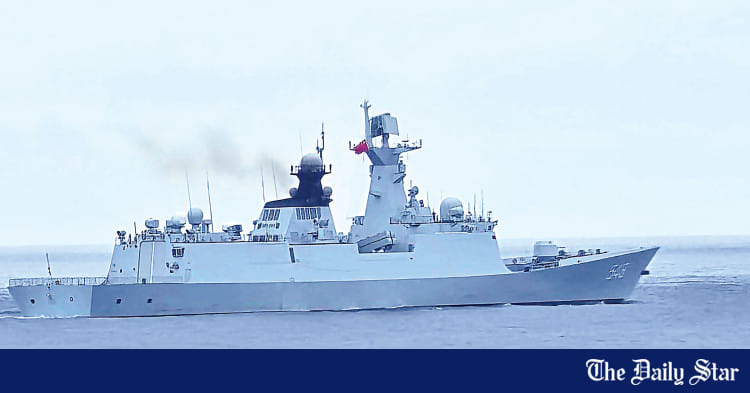
China's fast economic growth and progress in civilian and military technology since 1980s were key drivers to navy's modernization. Despite slow economic growth at the beginning of 2020s, China did not alter the course of naval programs. During 2022 and 2023, the PLAN commissioned its "eighth Type 055/Renhai-class cruiser, eight more Type 054A/Jiangkai II frigates, and one comprehensive submarine rescue ship.
In addition, the PLAN launched one Type 075/Yushen-class amphibious assault ship, five cruisers and destroyers, two newer Type 054B frigates, and three nuclear-powered submarines." "The total tonnage launched and commissioned in 2023 was about 170,000 tons, compared with 110,000 tons in 2022, although still somewhat lower than the 200,000-ton annual average prior to the COVID-19 pandemic." Naval analysts assessed that the decrease in tonnage production is likely have covered by advanced technologies in new platforms. The PLAN surface fleet strength is projected to be 430 by 2030.
The most significant development since 1996 has been the aircraft carrier program and modernisation of the nuclear submarine fleet. PLAN has two operational aircraft carriers Liaoning (Type 001) and Shandong (Type 002) as of 2024. The third, Fujian (Type 003), completed eight day long first sea trial in May 2024. The fourth (Type 004), possibly with nuclear propulsion, reportedly is under construction. Liaoning and Shandong had their first operational deployment during the 'targeted military operations' that PLAN conducted around Taiwan ahead of the US House Speaker Nancy Pelosi's visit in August 2022.
Liaoning was built on the hull of 67,500 ton ex-Soviet aircraft carrier Varyag (Kuznetsov Class). China purchased the hull without machinery and equipment through a Macau based private tourist venture project in 1998. But upon arrival in 2000, the ship was docked in Dalian naval shipyard. Liaoning was commissioned in 2011. Shandong, the second aircraft carrier was built on own design and constructed domestically. It was commissioned in 2019.
The third 80,000 ton Fujian is also designed and built domestically. It is likely to join the PLAN end of 2025 or early 2026. China's aircraft carrier fleet is not of the same capability like its immediate rival USA which has 11 aircraft carriers all powered by nuclear technology. Its submarine fleet is all nuclear.
USA has battle hardened experience over a hundred years in carrier operations in different parts of oceans including the Second World War and other major wars. China has plan to have a fleet around six aircraft carriers by 2030/2035. Next three carriers could be built with nuclear propulsion technology.
While modernising its fleet in quick march, China has limitations in building international network of naval infrastructure. China's growth in alliance building has not been as successful as it is expanding the fleet. China has established its first overseas military support base in 2017 in the Horn of Africa in Djibouti overlooking the global choke points at Bab-el-Mandeb and the Suez Canal. China invested USD 590 million to construct the base as both logistical and operational spring board to boost power projection in the Horn of Africa and in the Indian Ocean.
China has reportedly built Ream Naval Base in Cambodia abutting to the South China Sea. There is debate over the use of this naval base by Chinese war ships. "Controversy over the Ream Naval Base initially arose in 2019 when The Wall Street Journal reported that an early draft of a reputed agreement seen by U.S. officials would allow China 30-year use of the base, where it would be able to post military personnel, store weapons and berth warships." Cambodian government persistently denies having any military agreement with China.
Military ruled Myanmar is also at the center of debate. Great Coco Island with advanced surveillance systems and new naval infrastructures is back in discussion. Large naval infrastructures at Thanlyin Naval Base in Yangon with Chinese assistance can moor ships larger than those in Myanmar's naval inventory. India expresses persistent concern about potential docking of Chinese ships in Sri Lanka and Maldives.
Besides, navies of China, Iran and Russia conduct naval exercises to form 'axis of resistance' against US dominance at sea. With all endeavors on widening area denial well beyond the horizon, PLAN will have to influence its challengers not to interfere in its ambitions in the immediate vicinity and demonstrate the ability to exercise strategic leadership to enforce constabulary roles in Asian waters.
* Mohammad Abdur Razzak is a retired Commodore of Bangladesh Navy and a security analyst.
Mohammad Abdur Razzak
Updated: 15 May 2024, 16: 16
A nuclear-powered Type 094A Jin-class ballistic missile submarine of the Chinese People's Liberation Army (PLA) Navy is seen during a military display in the South China Sea April 12, 2018Reuters
People's Liberation Army Navy (PLAN), the naval branch of Chinese military celebrated its 75th founding anniversary on 23 April 2024. Since its establishment on 24 April 1949 till the 1980s, PLAN was an offshore territorial defence navy built on quantitative force. A forward looking development of the navy simmered only in the early 1990s.
Taiwan's first presidential election in 1996 accelerated the navy's modernisation. China was perturbed by the political move across the Taiwan Strait. China viewed the first ever election as prelude to Taiwan declaring independence. To stop Taiwan crossing the red line, China conducted massive naval maneuver in the Taiwan Strait including live fire missiles landing close to Taiwan's coast. China's naval maneuver prompted the US administration to dispatched two carrier task groups to offset China's naval threat.
PLAN leadership got the ground to strongly persuade political leadership for renewed attention toward the long neglected maritime frontiers. Pre-election naval diplomatic engagements brought to the fore China's naval weaknesses over the reunification of Taiwan and in defending its disputed maritime claims over the nine-dash line, Spratly and Paracel Island Groups in the South China Sea, disputed Senkaku/Diaoyu island, first and second island chain and importantly, protecting the Sea Lines of Communication transporting China's ever increasing maritime trade.
Chinese Communist Party (CCP) leadership was convinced to prioritize the modernization of the navy to widen sea denial capacity from brown water into blue waters beyond the horizon, below it and above it with a mix bag of offensive and defensive capacity. PLAN since 1990s saw rapid and consistent quantitative and qualitative growth in ships, submarines, and naval aviation including their training and operations.
Traditionally PLAN is subordinate to People's Liberation Army (PLA). PLA had the leadership of Chinese armed forces. In 2023 the CCP leadership appointed Admiral Dong Jun, the former Chief of PLAN as the first ever Minister of Defence to lead Chinese armed forces. Appointment of Admiral Dong was in appreciation of navy's importance to China in the context of geo-political reality and transforming the navy further as the new great power maritime competition is increasing.
China's fast economic growth and progress in civilian and military technology since 1980s were key drivers to navy's modernization. Despite slow economic growth at the beginning of 2020s, China did not alter the course of naval programs.
It is interesting to note that, Admiral Dong's appointment also followed the political blow with Nancy Pelosi's Taiwan visit in August 2022. "The CCP has handed over the leadership of the PLA to a man who views the world through the lens of war at sea …. Admiral Dong's various appointments should be a reminder of the importance the CCP places on the PLAN and the PLA's overall capability to take Taiwan by kinetic means should other efforts fail."
Since the naval diplomatic confrontation in 1996, PLAN's command structure has been broadened with operational flexibility. With a strength of 240,000 personnel including 15,000 marines and 26,000 naval aviation personnel PLAN today is the second largest navy in the world per tonnage - two million tonnage in 2022, only behind the US Navy. It has the largest number of war ships globally with an overall order of battle approximately 390 ships and submarines compared with the US naval force having approximately 300 ships and submarines in naval inventory.
China's fast economic growth and progress in civilian and military technology since 1980s were key drivers to navy's modernization. Despite slow economic growth at the beginning of 2020s, China did not alter the course of naval programs. During 2022 and 2023, the PLAN commissioned its "eighth Type 055/Renhai-class cruiser, eight more Type 054A/Jiangkai II frigates, and one comprehensive submarine rescue ship.
In addition, the PLAN launched one Type 075/Yushen-class amphibious assault ship, five cruisers and destroyers, two newer Type 054B frigates, and three nuclear-powered submarines." "The total tonnage launched and commissioned in 2023 was about 170,000 tons, compared with 110,000 tons in 2022, although still somewhat lower than the 200,000-ton annual average prior to the COVID-19 pandemic." Naval analysts assessed that the decrease in tonnage production is likely have covered by advanced technologies in new platforms. The PLAN surface fleet strength is projected to be 430 by 2030.
The most significant development since 1996 has been the aircraft carrier program and modernisation of the nuclear submarine fleet. PLAN has two operational aircraft carriers Liaoning (Type 001) and Shandong (Type 002) as of 2024. The third, Fujian (Type 003), completed eight day long first sea trial in May 2024. The fourth (Type 004), possibly with nuclear propulsion, reportedly is under construction. Liaoning and Shandong had their first operational deployment during the 'targeted military operations' that PLAN conducted around Taiwan ahead of the US House Speaker Nancy Pelosi's visit in August 2022.
Liaoning was built on the hull of 67,500 ton ex-Soviet aircraft carrier Varyag (Kuznetsov Class). China purchased the hull without machinery and equipment through a Macau based private tourist venture project in 1998. But upon arrival in 2000, the ship was docked in Dalian naval shipyard. Liaoning was commissioned in 2011. Shandong, the second aircraft carrier was built on own design and constructed domestically. It was commissioned in 2019.
The third 80,000 ton Fujian is also designed and built domestically. It is likely to join the PLAN end of 2025 or early 2026. China's aircraft carrier fleet is not of the same capability like its immediate rival USA which has 11 aircraft carriers all powered by nuclear technology. Its submarine fleet is all nuclear.
USA has battle hardened experience over a hundred years in carrier operations in different parts of oceans including the Second World War and other major wars. China has plan to have a fleet around six aircraft carriers by 2030/2035. Next three carriers could be built with nuclear propulsion technology.
While modernising its fleet in quick march, China has limitations in building international network of naval infrastructure. China's growth in alliance building has not been as successful as it is expanding the fleet. China has established its first overseas military support base in 2017 in the Horn of Africa in Djibouti overlooking the global choke points at Bab-el-Mandeb and the Suez Canal. China invested USD 590 million to construct the base as both logistical and operational spring board to boost power projection in the Horn of Africa and in the Indian Ocean.
China has reportedly built Ream Naval Base in Cambodia abutting to the South China Sea. There is debate over the use of this naval base by Chinese war ships. "Controversy over the Ream Naval Base initially arose in 2019 when The Wall Street Journal reported that an early draft of a reputed agreement seen by U.S. officials would allow China 30-year use of the base, where it would be able to post military personnel, store weapons and berth warships." Cambodian government persistently denies having any military agreement with China.
Military ruled Myanmar is also at the center of debate. Great Coco Island with advanced surveillance systems and new naval infrastructures is back in discussion. Large naval infrastructures at Thanlyin Naval Base in Yangon with Chinese assistance can moor ships larger than those in Myanmar's naval inventory. India expresses persistent concern about potential docking of Chinese ships in Sri Lanka and Maldives.
Besides, navies of China, Iran and Russia conduct naval exercises to form 'axis of resistance' against US dominance at sea. With all endeavors on widening area denial well beyond the horizon, PLAN will have to influence its challengers not to interfere in its ambitions in the immediate vicinity and demonstrate the ability to exercise strategic leadership to enforce constabulary roles in Asian waters.
* Mohammad Abdur Razzak is a retired Commodore of Bangladesh Navy and a security analyst.