Donate ☕
[🇨🇳] - China----News & Views | Page 2 | PKDefense

[🇨🇳] China----News & Views

⤵︎
Reply (Scroll)
Press space to scroll through posts
G   Chinese Defense
[🇨🇳] China----News & Views
54
3K
More threads by Saif


Beijing ready to 'forcefully' stop Taiwan independence: China defence chief
02 June, 2024, 08:55

1717372818409.png

China's defence minister Dong Jun speaks during the 21st Shangri-La Dialogue summit at the Shangri-La Hotel in Singapore on June 2, 2024. | AFP photo.

Chinese defence minister Dong Jun warned on Sunday that his military was ready to 'forcefully' stop Taiwan independence but called for greater exchanges with the United States.

The remarks at an annual security forum in Singapore followed the first substantive face-to-face talks in 18 months between the two countries' defence chiefs.

'We have always been open to exchanges and cooperation, but this requires both sides to meet each other halfway,' Dong told the Shangri-La Dialogue where he met with US Defense Secretary Lloyd Austin on Friday.

'We believe that we need more exchanges precisely because there are differences between our two militaries.'

Dong and Austin met for over an hour at the luxury hotel hosting the forum, which is attended by defence officials from around the world and in recent years has been seen as a barometer of US-China relations.

After the meeting, Austin said that telephone conversations between US and Chinese military commanders would resume 'in the coming months', while Beijing hailed the 'stabilising' security relations between the countries.

This year's Shangri-La Dialogue comes a week after China held military drills around self-ruled Taiwan and warned of war over the US-backed island following the inauguration of President Lai Ching-te, who Beijing has described as a 'dangerous separatist'.

'The Chinese People's Liberation Army has always been an indestructible and powerful force in defence of the unification of the motherland, and it will act resolutely and forcefully at all times to curb the independence of Taiwan and to ensure that it never succeeds in its attempts,' Dong told the forum on Sunday.

'Whoever dares to split Taiwan from China will be crushed to pieces and suffer his own destruction.'

On the South China Sea, which China claims almost entirely and where it has been involved in confrontations with Philippine vessels, Dong warned of 'limits' to Beijing's restraint.

'China has maintained sufficient restraint in the face of rights infringements and provocation, but there are limits to this,' Dong said.

To read the rest of the news, please click on the link above.
 
Analyze

Analyze Post

Add your ideas here:
Highlight Cite Fact Check Respond

China's exports grow 7.6pc in May, beating expectations despite trade tensions
Published :
Jun 07, 2024 15:38
Updated :
Jun 07, 2024 15:38

1717893421318.webp

China's exports in May grew at their fastest pace in more than a year despite trade tensions, though imports fell short of analyst expectations, according to customs data released Friday.
Exports jumped 7.6% in May from the same month last year to $302.35 billion, rising at the fastest pace since April 2023. Imports rose by 1.8% to $219.73 billion, missing estimates of about 4.0% growth.

The uptick in exports is also partly due to a lower base in the same period last year, when exports declined 7.5%.

In comparison, exports grew by 1.5% in April compared to the same period last year while April imports rose by 8.4%.

The strong exports caused China's trade surplus to widen to $82.62 billion, up from April's $72.35 billion.

The growth in exports comes as China faces escalated trade tensions with the US and Europe. The US is ramping up tariffs on Chinese-made electric cars while Europe is considering levying similar tariffs.

"Foreign tariffs are unlikely to immediately threaten exports; if anything, they may boost exports at the margin as firms speed up shipments to front-run the duties." said Zichun Huang of Capital Economics in a note.

Huang also said that exports would be supported by a weaker real effective exchange rate.

"Import volumes were little changed last month, but they will probably rise soon, with increased government spending supporting the import-intensive construction sector," she said.

Factory activity in China slowed more than expected in May, according to an official survey released last week.

The manufacturing purchasing managers index from the China Federation of Logistics and Purchasing fell to 49.5 from 50.4 in April on a scale up to 100 where 50 marks the break between expansion and contraction.

China has struggled to bounce back after the Covid-19 pandemic, as it grapples with weaker demand globally after the US Federal Reserve and other central banks raised interest rates to counter inflation. A slump in China's property sector also is weighing on growth.

China has set a target of around 5.0% for economic growth this year, an ambition that will require more policy support, economists say
.​
 
Analyze

Analyze Post

Add your ideas here:
Highlight Cite Fact Check Respond

A stable China will provide a "solid foundation" for foreign companies to develop in China
LIU QING
Published :
Jun 12, 2024 11:00
Updated :
Jun 12, 2024 11:00
1718494725600.png


China has released its official economic performance for April, The added value of industrial enterprises above designated size grew by 6.7% year-on-year, 2.2 percentage points higher than that in the previous month. The expected index of enterprise production and operation activities remained in a relatively high boom range; Business activity in the services sector has been in the boom zone for four consecutive months... A series of data has outlined an upward curve, indicating that China's economy is running smoothly, continuing its upward trend, and positive factors are accumulating.

For business, the market means profit. How is China's hyperscale market doing? From January to April, the total retail sales of consumer goods increased by 4.1% year-on-year, and hot spots such as digital consumption and cultural and travel consumption added new impetus to the recovery of the consumer market. During the same period, online retail sales of physical goods increased by 11.1% year-on-year, demonstrating the vitality of the world's second largest online retail market. During the Qingming Holiday in early April, the number of domestic tourism trips and the travel expenditure of domestic tourists increased by 11.5% and 12.7% respectively compared with the same period in 2019. It is the first time since the coronavirus outbreak that Chinese tourists have spent more per capita on holiday travel than in 2019, indicating that consumption in the world's second-largest economy is recovering.

When we look at a country's economy, we also need to see the strength and resilience of its development, which mainly comes from the impetus of innovation. As China strives to develop new quality productive forces, new growth drivers are taking shape at a faster pace. In April, the value added of equipment manufacturing industry above designated size and high-tech manufacturing industry accounted for a continuous increase in the proportion of all planned industries; From January to April, the year-on-year growth rate of investment in manufacturing technology transformation and high-tech industry was faster than that of all investment. From the perspective of products, in April, the output of 3D printing equipment, new energy vehicles, and integrated circuit products increased by more than 30% year-on-year. For foreign companies, China's development of new quality productive forces has brought more room for open cooperation. Agustin Pederoni, general manager of Bridgestone (China) Investment Co., LTD., a Japanese tire brand, said that the company will invest 560 million yuan in the Chinese market in the next three years, focusing on strengthening the construction of production bases to meet the needs of the rapid development of China's new energy vehicle industry.

At the same time, China's foreign trade performance has also brought warmth to the world. China's imports and exports of goods rose 8 per cent year on year in April. The scale of imports and exports from January to April reached a record high in the same period. In terms of exports, the export advantages of mechanical and electrical products continued to consolidate, including integrated circuits and automobiles, the export growth rate exceeded 20%, indicating that the internal structure of the Chinese economy continued to optimize. At a time when the global economic recovery is weak, China's import and export performance is more resilient than expected, boosting the confidence of foreign investment.

Liu Qing is a reporter at China Global Television Network(CGTN)​
 
Analyze

Analyze Post

Add your ideas here:
Highlight Cite Fact Check Respond

China opens tit-for-tat anti-dumping probe into EU pork
Published :
Jun 17, 2024 23:07
Updated :
Jun 17, 2024 23:07
1718669624975.webp


China has opened an anti-dumping investigation into imported pork and its by-products from the European Union, a step that appears mainly aimed at Spain, the Netherlands and Denmark, in response to curbs on its electric vehicle exports.
According to a Reuters report, the investigation announced by China's commerce ministry on Monday will focus on pork intended for human consumption, such as fresh, cold and frozen whole cuts, as well as pig intestines, bladders and stomachs. The probe will begin on June 17.

It was prompted by a complaint submitted by the China Animal Husbandry Association on June 6 on behalf of the domestic pork industry, the ministry said.

Following the European Commission's June 12 announcement that it would impose anti-subsidy duties of up to 38.1 per cent on imported Chinese cars from July, global food companies have been on high alert for retaliatory tariffs from China.

Spain is the top supplier of pork to China and its pork producers group Interporc said they would fully cooperate with the investigation by Chinese authorities.

"The EU and China have plenty of time to reach agreements," Interporc said in a statement.

European pork producers should be able to keep exporting to China tariff-free while the investigation is underway, pending a decision and a tariff announcement by the Chinese side.

China's commerce ministry said that the investigation should be completed by June 17, 2025, but could be extended by another six months if required.

Lobby group Danish Agriculture& Food Council warned on Monday that the country's pork sector would be "hit incredibly hard" by any restrictions on sales to China.

Pork suppliers from South America, the United States and Russia could be among those gaining market share if Beijing restricts imports from the European Union.​
 
Analyze

Analyze Post

Add your ideas here:
Highlight Cite Fact Check Respond

How can China's Digital Silk Road facilitate metaverse education?
1718838732982.webp

VISUAL: FREEPIK

The "Digital Silk Road" (DSR) was introduced in 2015 by an official Chinese government white paper, as a component of Beijing's Belt and Road Initiative (BRI). The DSR represents China's strategy for enhancing information exchanges and digital collaboration with emerging nations. DSR support is allocated to enhance beneficial countries' networked communications, AI capabilities, cloud computing, e-commerce, mobile financial services (MFS), technological surveillance, smart cities, and high-tech sectors, among others. Around 40 countries, including a majority of the world's developing nations, have already signed Memorandums of Understanding (MoU) in the DSR. The expanding reach of the DSR offers a chance to influence the technological initiatives of multiple nations, including the advancement of innovative educational systems like metaverse education.

A metaverse framework for education offers students the opportunity to go beyond reading and experience the facts and details hands-on. Metaverse technologies hold immense promise in revolutionising educational settings, lifting skilled trades, and opening up novel avenues for lifelong learning. The metaverse has the potential to transform the world into a virtual global school, however, there are significant challenges to adopting metaverse education, such as a lack of technology architecture and network infrastructure, and a dearth of learning management systems. Hence the DSR can make a significant contribution to advancing and broadening metaverse education by improving digital infrastructure, promoting technical cooperation, and enabling access to proficient educational materials.

The DSR prioritises the expansion of broadband networks, including optic fibre and 5G technologies, to accommodate the high velocity of data transfer needed for metaverse education. Furthermore, the allocation of resources towards cloud infrastructure facilitates the efficient storage and analysis of substantial volumes of data, which are crucial for creating engaging educational experiences within the metaverse. By committing to technical surveillance, Chinese technology firms can facilitate the broad accessibility of cost-effective virtual reality (VR) and augmented reality (AR) devices, hence expanding access to these technologies to prospective students and educational institutions.

The DSR's growth may provide a variety of educational content from other cultures and places to the metaverse, enhancing inclusivity and depth in the learning process. Students may get insights into many cultures via immersive educational programs provided by metaverse education. DSR can help with more topics and customise learning methods for diverse learning styles and preferences via metaverse education. Through professional growth and learning, the DSR may help students employ metaverse technology in real-world learning. The primary aim of DSR-supported metaverse education is to minimise the digital divide by introducing modern digital technology to underprivileged regions. This might ensure that students from all socioeconomic backgrounds have access to excellent education, which is in line with Sustainable Development Goal 4 (Quality Education).

To read the rest of the news, please click on the link above.
 
Analyze

Analyze Post

Add your ideas here:
Highlight Cite Fact Check Respond

US lawmakers meet Tibet's Dalai Lama
Pressure China on talks

A group of US lawmakers who met the Dalai Lama in India yesterday said they would not allow China to influence the choice of his successor, comments expected to anger Beijing, which calls the exiled Tibetan spiritual leader a separatist.

The remarks come as Washington and Beijing seek to steady rocky ties while India pushes China to secure lasting peace on their disputed Himalayan frontier, four years after a military clash strained ties.

The lawmakers also signalled that Washington would pressure Beijing to hold talks with Tibetan leaders, stalled since 2010, to resolve the Tibet issue, with a bill they said President Joe Biden would sign soon.

Although Washington recognises Tibet as a part of China, the bill appears to question that position and any change would be a major shock to Beijing, analysts said.

The bipartisan group of seven, led by Michael McCaul, a Republican representative from Texas, who also chairs the House foreign affairs committee, met the Nobel peace laureate at his monastery in the northern Indian town of Dharamsala.

"It is still my hope that one day the Dalai Lama and his people will return to Tibet in peace," McCaul told a public reception after the meeting.​
 
Analyze

Analyze Post

Add your ideas here:
Highlight Cite Fact Check Respond

EU slaps Chinese electric cars with tariffs of up to 38%

1720135962647.webp

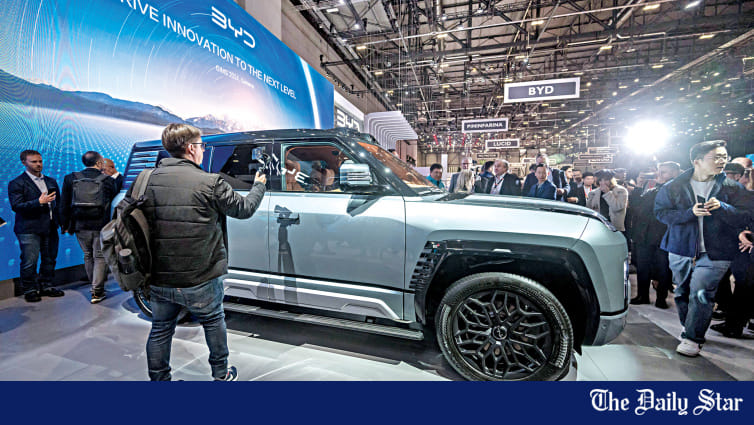
People are seen next to a sport utility vehicle of Chinese automaker BYD at the Geneva International Motor Show in Geneva, Switzerland. Electric car producers in China that cooperated with the EU will face a tariff of 20.8 percent, while those that did not cooperate would be subject to a 37.6 percent duty. Photo: AFP/FILE

The European Union on Thursday slapped extra provisional duties of up to 38 percent on Chinese electric car imports because of "unfair" state subsidies, despite Beijing's warnings the move would unleash a trade war.

Brussels launched an investigation last year into Chinese electric vehicle manufacturers to probe whether state subsidies were unfairly undercutting European automakers.

Since announcing the planned tariff hike last month -- on top of current import duties of 10 percent -- the European Commision has begun talks with Beijing to try to resolve the issue, with China threatening retaliation.

"Our investigation... concluded that the battery electric vehicles produced in China benefit from unfair subsidisation, which is causing a threat of economic injury to the EU's own electric car makers," the EU's trade chief Valdis Dombrovskis said.

In response, the commission said it has imposed provisional duties on Chinese manufacturers including 17.4 percent for market major BYD, 19.9 percent for Geely and 37.6 percent for SAIC.

The rates were adjusted slightly downwards for Geely and SAIC, from an initially-announced 20 percent and 38.1 percent, after further information provided by "interested parties", it said.

They will kick in from Friday, with definitive duties to take effect in November for a period of five years, pending a vote by the EU's 27 member states.

Electric car producers in China that cooperated with the EU will face a tariff of 20.8 percent, while those that did not cooperate would be subject to a 37.6 percent duty.

The move comes despite talks between Chinese and EU trade officials on June 22, but Brussels will continue "to engage intensively with China on a mutually acceptable solution", trade chief Dombrovskis said.

"Any negotiated outcome to our investigation must clearly and fully address EU concerns and be in respect of WTO rules," he said in a statement.

Beijing has already signalled its readiness to retaliate by launching an anti-dumping probe last month into pork imports, threatening Spanish exports. Chinese media suggest Beijing will trigger further probes.

Chinese officials have also railed against probes targeting state subsidies in the green tech sector including wind turbines and solar panels.

"It is plain for all to see who is escalating trade frictions and instigating a 'trade war'," a spokesperson for the Chinese commerce ministry said on June 21.

The United States has already hiked customs duties on Chinese electric cars to 100 percent, while Canada is considering similar action.

But Brussels faces a delicate balancing act as it seeks to defend Europe's auto industry -- the jewel in its industrial crown with iconic brands such as Mercedes -- while avoiding a showdown with China and meeting its targets for slashing carbon emissions.

The EU aims to get more Europeans driving electric vehicles as it plans to outlaw the sale of new fossil fuel-powered cars from 2035.

Chinese-made vehicles' market share in EU electric car sales climbed from around three percent to more than 20 percent in the past three years, according to the European Automobile Manufacturers' Association.

Chinese brands account for around eight percent of that share, it said.

Germany's Kiel Institute for the World Economy, alongside Austrian institutes, predicted the provisional higher taxes would reduce vehicle imports from China by 42 percent. They added that electric car prices could rise by an average of 0.3 to 0.9 percent in the EU.

Germany, a significant trade partner to China, is unhappy about the EU's move. German auto manufacturers fear any retaliation could hurt their activities in China.

Germany's Vice Chancellor Robert Habeck visited Beijing last month on an 11th hour mission to find a way out of a damaging trade war.

But Germany's moves to appease China, like reportedly offering a compromise to lower tariffs to 15 percent, were described by some in the automotive industry as a stunt.

In contrast, French auto makers have welcomed the tariffs to level the playing field.

Electric automaker Tesla, owned by tech billionaire Elon Musk, is the only company that has asked Brussels for its own duty rate calculated based on evidence it has submitted.​
 
Analyze

Analyze Post

Add your ideas here:
Highlight Cite Fact Check Respond

China's BYD opens EV plant in Thailand

China's electric vehicle giant BYD opened a factory in Thailand on Thursday, continuing its international expansion despite a market slowdown and hours before the European Union was due to impose swingeing tariffs on Chinese EV firms.

The plant in Rayong, an industrial area southeast of Bangkok, will be able to build up to 150,000 vehicles a year, according to the company, which dominates its domestic market.

Wang Chuanfu, Shenzhen-based BYD's chief executive, said production would initially focus on full electric vehicles and later expand to include plug-in hybrids, which combine a conventional engine with an electric motor.

"BYD Thailand plant has an annual capacity of 150,000 vehicles, including the four major processes of vehicle and parts production, and will create about 10,000 jobs," Wang said at an opening ceremony.

Thailand has long been a major assembly hub for Japanese car makers including Toyota and Honda, but is now seeking to shift production away from conventional vehicles and towards EVs.

The kingdom has offered substantial tax breaks for companies as it aims for 30 percent of its car production to be EVs by 2030. BYD overtook Elon Musk's Tesla in the fourth quarter of 2023 to become the world's top seller of electric vehicles.

Tesla reclaimed top spot in the first quarter of this year, but BYD is bullish about its expansion, insisting last month it would press ahead with a second factory in the European Union.

The Chinese automaker recorded a record annual profit of 30 billion yuan ($4.1 billion) last year, but in April reported lower than expected revenue for the first quarter of 2024.

BYD has faced a bitter price war in China, where a staggering 129 EV brands are slugging it out -- with only 20 achieving a domestic market share of one percent or more, according to Bloomberg.

China has led the global shift to electric vehicles, with almost one in three cars on its roads set to be electric by 2030, according to the International Energy Agency's annual Global EV Outlook. But European regulators have raised concerns about what they say is "overcapacity" created by excessive state subsidies.

Seeking to protect European manufacturers from cheaper Chinese imports, Brussels has proposed a provisional hike of tariffs on Chinese manufacturers: 17.4 percent for BYD, 20 percent for Geely and 38.1 percent for SAIC -- in addition to the current 10 percent import duty.

EU and Chinese trade chiefs held talks last weekend in a bid to avert a bitter trade war, but the tariffs are set to come into force on Thursday. But while they are high, the EU tariffs are significantly lower than the 100 percent rate the United States imposed from last month on Chinese electric cars.​
 
Analyze

Analyze Post

Add your ideas here:
Highlight Cite Fact Check Respond

Xi and Putin set out ambitions for Eurasian security club
REUTERS
Published :
Jul 04, 2024 21:49
Updated :
Jul 04, 2024 21:49
1720143401092.webp


SCO Secretary-General Zhang Ming, Iranian Interim President Mohammad Mokhber, Kyrgyz President Sadyr Japarov, Pakistani Prime Minister Shehbaz Sharif, Uzbek President Shavkat Mirziyoyev, Chinese President Xi Jinping, Kazakh President Kassym-Jomart Tokayev, Russian President Vladimir Putin, Tajik President Emomali Rakhmon, Belarusian President Alexander Lukashenko, Indian Foreign Minister Subrahmanyam Jaishankar and Director of the SCO Regional Anti-Terrorist Structure (RATS) executive committee Ruslan Mirzayev take part in a photo ceremony at Shanghai Cooperation Organization (SCO) summit in Astana, Kazakhstan July 4, 2024.
SCO Secretary-General Zhang Ming, Iranian Interim President Mohammad Mokhber, Kyrgyz President Sadyr Japarov, Pakistani Prime Minister Shehbaz Sharif, Uzbek President Shavkat Mirziyoyev, Chinese President Xi Jinping, Kazakh President Kassym-Jomart Tokayev, Russian President Vladimir Putin, Tajik President Emomali Rakhmon, Belarusian President Alexander Lukashenko, Indian Foreign Minister Subrahmanyam Jaishankar and Director of the SCO Regional Anti-Terrorist Structure (RATS) executive committee Ruslan Mirzayev take part in a photo ceremony at Shanghai Cooperation Organization (SCO) summit in Astana, Kazakhstan July 4, 2024. Photo : Reuters/Turar Kazangapov

China's President Xi Jinping and Russia's Vladimir Putin pressed their case on Thursday for closer security, political and economic cooperation between countries of the vast Eurasian region as a counterweight to Western alliances.

They were speaking on the second and final day of a summit in the Kazakh capital Astana of the Shanghai Cooperation Organisation (SCO), a club launched in 2001 by Russia, China and Central Asian states and now including India, Iran and Pakistan.

"SCO members should consolidate unity and jointly oppose external interference in the face of the real challenges of interference and division," Xinhua news agency quoted Xi as saying, warning against the West's "Cold War mentality".

President Putin, in his address to the SCO, reiterated Russia's call for "a new architecture of cooperation, indivisible security and development in Eurasia, designed to replace the outdated Eurocentric and Euro-Atlantic models, which gave unilateral advantages only to certain states".

He once again blamed the West for the war in Ukraine and said Russia was ready to freeze the conflict if Kyiv and its backers accepted Moscow's terms for talks.

Putin said last month the proposed new Eurasian security pact should be open to all countries across the region, including current NATO members. But the aim, he said, should be to gradually remove all external military presence from Eurasia, a clear reference to the United States.

The SCO nations represent new key buyers of Russian commodities such as oil and gas, as Western sanctions imposed over the Ukraine war have forced Moscow to pivot towards Asia.

'MULTI-POLAR WORLD'

Putin also hailed on Thursday the increasing use of national currencies - instead of the dollar - in trade between SCO countries and called for the creation of a new payment system within the group.

Western sanctions have left Moscow cut off from traditional payment systems such as SWIFT, while hundreds of billions of dollars in Russian foreign reserves remain frozen.

"The multi-polar world has become reality," Putin said. "More and more countries support a fair world order and are ready to vigorously defend their legal rights and traditional values."

Separately, India's Foreign Minister Subrahmanyam Jaishankar met his Chinese counterpart Wang Yi on the sidelines of the SCO gathering and agreed to step up talks to resolve issues on their border which have soured ties since an armed clash in 2020.​
 
Analyze

Analyze Post

Add your ideas here:
Highlight Cite Fact Check Respond

China, Russia to counter extra-regional forces in SE Asia
Agence France-Presse . Vientiane 27 July, 2024, 01:35

China and Russia's foreign ministers met their Southeast Asian counterparts Friday after vowing to counter 'extra-regional forces', a day before Washington's top diplomat was due to arrive.

Wang Yi and Sergei Lavrov were attending a three-day meeting of the 10-member Association of Southeast Asian Nations bloc in the Laos capital Vientiane.

Both held talks with counterparts from the bloc, while Wang also met with new British foreign secretary David Lammy.

On Thursday Wang and Lavrov agreed to work together in 'countering any attempts by extra-regional forces to interfere in Southeast Asian affairs', according to Moscow's foreign ministry.

They also discussed implementing 'a new security architecture' in Eurasia, Lavrov said in a statement, without elaborating.

According to a readout from Chinese state news agency Xinhua, Wang said Beijing was 'ready to work with Russia to... firmly support each other, safeguard each other's core interests'.

China is a close political and economic ally of Russia, and NATO members have branded Beijing a 'decisive enabler' of Moscow's war in Ukraine.

US Secretary of State Antony Blinken is expected to arrive in Vientiane on Saturday morning for talks with ASEAN foreign ministers.

Blinken has made Washington's alliances in Asia a top foreign policy priority, with the aim of 'advancing a free and open' Indo-Pacific — a veiled way of criticising China and its ambitions.

But Blinken shortened his Asia itinerary by a day to be present for Thursday's White House meeting between Biden and Israeli Prime Minister Benjamin Netanyahu.

Wang and Blinken will meet in Laos, a spokeswoman for Beijing's foreign ministry said, to 'exchange views on issues of common concern'.

On Friday Wang met ASEAN foreign ministers and hailed Beijing's deepening economic ties with the region.

For the customary joint handshake, Wang stood next to Myanmar's representative Aung Kyaw Moe, permanent secretary to the foreign affairs ministry.

The ASEAN bloc has banned Myanmar's junta from high-level meetings over its 2021 coup and crackdown on dissent that have plunged the country into turmoil.

Lavrov also met ASEAN counterparts at the venue in Vientiane but did not take questions from journalists

ASEAN ministers are expected to issue a joint communique after the three-day meeting.

One diplomatic source said the joint communique is being held up by lack of consensus over the wording of the paragraphs on the Myanmar conflict and disputes in the South China Sea.

Beijing claims the waterway — through which trillions of dollars of trade passes annually — almost in its entirety despite an international court ruling that its assertion has no legal basis.​
 
Analyze

Analyze Post

Add your ideas here:
Highlight Cite Fact Check Respond

Myanmar airstrikes on border hospital near China kill 10
Agence France-Presse . Bangkok 03 August, 2024, 01:21

Myanmar military airstrikes hit a hospital in a city controlled by an ethnic minority armed group close to the China border killing 10 people, local media reported on Friday.

Military planes carried out at least two air strikes on Laukkai city, normally home to some 25,000 people, late on Thursday night, a resident told AFP, requesting anonymity for security reasons.

Local media quoted one resident as saying 10 civilians were killed in the strike.

Myanmar's northern Shan state has been rocked by fighting since late June when an alliance of ethnic minority armed groups renewed an offensive against the military along a major trade highway to China.

The Myanmar National Democratic Alliance Army (MNDAA) group have held Laukkai since January after more than 2,000 junta troops surrendered there in one of the military's biggest defeats in decades.

MNDAA spokesman Li Jiawen told AFP a military airstrike had hit a hospital in Laukkai, but he had no information yet on casualties.

The junta has been approached for comment.

The junta has bombed Laukkai several times in recent weeks after the MNDAA renewed its offensive in northern Shan state, shredding a Beijing-brokered ceasefire.

Pictures taken on Thursday and shared with AFP by the Laukkai resident showed deserted streets.

In recent days MNDAA fighters have entered the town of Lashio, also in northern Shan state and home to the military's northeastern command.

Fighting was ongoing in Lashio on Friday, a military source told AFP, requesting anonymity to talk to the media.

Local media, citing a local resident, reported that MNDAA fighters had entered a military hospital in Lashio and killed an unspecified number of patients and medical staff.

AFP was unable to reach people on the ground in Lashio or confirm the report.

Dozens of civilians have been killed or wounded in the recent fighting in Shan state according to the junta and local rescue groups.

Neither the junta nor the ethnic alliance have released figures on their own casualties.

Myanmar's borderlands are home to myriad ethnic armed groups who have battled the military since independence from Britain in 1948 for autonomy and control of lucrative resources.

Some have given shelter and training to newer "People's Defence Forces" (PDFs) that have sprung up to battle the military after the coup in 2021.

China is a major ally and arms supplier to the junta, but analysts say it also maintains ties with armed ethnic groups in Myanmar that hold territory near its border.​
 
Analyze

Analyze Post

Add your ideas here:
Highlight Cite Fact Check Respond

China's stuttering recovery darkens global corporate growth outlook
1722729470659.webp

A woman leaves a cafe of Starbucks Coffee in Beijing, China. Coffee chain Starbucks, carmaker General Motors and technology firms hurt by curbs on exports to China are among those that have sounded the alarm on weakness in the nation. Photo: REUTERS/FILE

Global burger chains to car manufacturers are increasingly feeling the pinch from a faltering recovery in the world's No. 2 economy, China, and are strapping in for a bumpy ride ahead.

A protracted downturn in the property market and high levels of job insecurity have knocked the wind out of a fragile recovery in China, a global trading powerhouse, and the effects of its slowdown can be felt across borders.

Coffee chain Starbucks, carmaker General Motors and technology firms hurt by curbs on exports to China are among those that have sounded the alarm on weakness in the nation. The Chinese government's stimulus measures have so far failed to boost consumption, and the overleveraged property market has made consumers less likely to spend.

"It's a difficult market right now. And frankly, it's unsustainable, because the amount of companies losing money there cannot continue indefinitely," General Motors CEO Mary Barra said last week as the automaker's division in China shifted from being a profit engine to a drain on its finances.

China's $18.6 trillion economy grew more slowly than expected in the second quarter, and cautious households are building up savings and paying off debts. Retail sales growth sank to an 18-month low in June, and businesses cut prices on everything from cars to food to clothes.

In a bid to stem the rot, China outlined stimulus directed at consumers last month to support equipment upgrades and consumer goods trade-ins, but that has not allayed concerns.

US stocks plummeted for second straight session on Friday, and the Nasdaq confirmed it was in correction territory, after a soft jobs report stoked fears of an oncoming recession.

Some analysts have warned that barring a structural shift that gives consumers a greater role in the economy, the current path fuels risks of a prolonged period of near-stagnation and persistent deflation threats.

"There is a deep concern that Beijing is not introducing the kind of stimulus that helps broaden the economic base," said Quincy Krosby, chief global strategist for LPL Financial.

"It's becoming more difficult for US companies to look to the Chinese market as a reliable partner."

China remained a drag on Apple last quarter. The iPhone maker's sales declined a much steeper-than-expected 6.5 percent in the country, which accounts for a fifth of its total revenue.

French cosmetics giant L'Oreal said the Chinese beauty market will remain slightly negative into the second half of 2024 with no visible improvement in sentiment.

Other consumer companies' sales have been hurt as well, including Starbucks , McDonald's and Procter & Gamble, while soft domestic travel demand prompted a revenue warning from Marriott.

The sluggish growth was also evident in underwhelming results from luxury goods makers LVMH and Gucci-owner Kering and profit warnings from Burberry and Hugo Boss.

"The world was surprised at how weak China was economically as this year unfolded," said Marc Casper, CEO of medical equipment maker Thermo Fisher.

Meanwhile, foreign automakers from Tesla to BMW, Audi and Mercedes, are locked in an intense price war in China after ceding market share to domestic EV makers, led by BYD, who offer high-tech, low-cost models.

To be sure, the MSCI World with China Exposure Index , which tracks 52 companies with high revenue exposure to China, is up 11.6 percent this year, not far off a 12 percent rise in MSCI's broad gauge of global stocks.

However, most of the China-focused index's performance is thanks to a surge in semiconductor stocks, including Broadcom and Qualcomm, which have benefited from AI-driven demand.

Mounting Sino-US trade tensions and certain domestic policies have added to multinational companies' woes.

Beijing's anti-corruption campaign that began last year has caused disruptions that partly prompted GE HealthCare to lower its revenue growth forecast and sparked concerns over sales of Merck's Gardasil vaccine.

Meanwhile, tighter US export curbs on sharing high-end chip technology with China are impeding chipmakers from serving one of the largest markets for semiconductors.

Qualcomm said it took a revenue hit from the US curbs on exports to China, overshadowing its otherwise upbeat forecast on Wednesday.

Analysts said the pressures are unlikely to ease soon.

"It has been a surprise that (the slowdown) has lasted so long," said Stuart Cole, chief macroeconomist at Equiti Capital.

"Once the Covid restrictions were lifted the general expectation was that China would bounce back. But the Chinese pace of expansion we saw previously will not be seen any time soon."​
 
Analyze

Analyze Post

Add your ideas here:
Highlight Cite Fact Check Respond

China issues plan to boost household consumption
Agence France-Presse . Beijing 04 August, 2024, 22:21

1722815742108.png

A woman buys food at a stall at the Dacheng Road Night Market in Wuhan in central China's Hubei province on August 1. | AFP photo

China has issued a set of directives aimed at boosting household consumption, a weakness weighing on growth in the world's second-largest economy, with the plan targeting sectors including child and elder care, and food and beverage.

Leaders including president Xi Jinping pledged last month to help boost domestic consumption and ease pressure on China's ailing property sector, following a gathering of the ruling Communist Party's top brass.

The State Council, China's cabinet, published a list of 20 general directives on its website on Saturday evening, constituting a general roadmap for ministries and local authorities as the economy recovers after the lifting of strict pandemic measures at the end of 2022 that had hindered growth.

The plan, which does not include proposed budgets, urges authorities to 'increase the supply of care services for the elderly', a sector with growth potential in a country with an ageing population.

It also calls for the development of childcare services, as fewer young people opt to have babies due to the high cost of education and lack of social benefits.

Income tax reductions are also planned to offset the cost of caring for children under three and senior citizens, according to the document.

Beijing also pledged to ensure that eligible small businesses in the service sector can benefit from greater financial support, particularly from banks.

The plan calls for more food-themed festivals to be held, and for the promotion of street food 'snacks' — popular with locals — as well as pledges to encourage major foreign companies in the food and beverage industry to open their first outlets in China.

China is aiming for GDP growth of 'around 5 per cent' this year, but second-quarter growth slowed sharply to 4.7 per cent year-on-year, according to official figures published last month.

Its growth has been battered by a long-running debt crisis in the property market, which accounts for a quarter of gross domestic product.​
 
Analyze

Analyze Post

Add your ideas here:
Highlight Cite Fact Check Respond

China youth unemployment jumped to 17.1% in July

1723938109386.webp

People are seen attending a job fair in Beijing, China. Nearly 12 million students graduated from Chinese universities this June, heightening competition in an already tough job market. Photo: AFP/FILE

Youth unemployment in China ticked up to 17.1 percent in July, official figures showed, the highest level this year as the world's second-largest economy faces mounting headwinds.

China is battling soaring joblessness among young people, a heavily indebted property sector and intensifying trade issues with the West.

Chinese Premier Li Qiang, who is responsible for economic policy, on Friday called for struggling companies to be "heard" and "their difficulties truly addressed", according to the state news agency Xinhua.

The unemployment rate among 16- to 24-year-olds released Friday by the National Bureau of Statistics (NBS) was up markedly from June's 13.2 percent.

The closely watched metric peaked at 21.3 percent in June of 2023, before authorities suspended publication of the figures and later changed their methodology to exclude students.

Nearly 12 million students graduated from Chinese universities this June, heightening competition in an already tough job market and likely explaining July's sharp increase in joblessness.

In May, President Xi Jinping said countering youth unemployment must be regarded as a "top priority".

Among 25- to 29-year-olds, the unemployment rate stood at 6.5 percent for July, up from the previous month's 6.4 percent.

For the workforce as a whole, the unemployment rate was 5.2 percent.

However, the NBS figures paint an incomplete picture of China's overall employment situation, as they take only urban areas into account.

The new unemployment figures come on the heels of other disappointing economic data from Beijing, including figures showing dampened industrial production, despite recent government measures aimed at boosting growth.

Industrial production growth weakened in July, with the month's 5.1 percent expansion down from June's 5.3 percent and falling short of analyst predictions.

China's major cities also recorded another decline in real estate prices last month, a sign of sluggish demand.

Demand for bank loans also contracted for the first time in nearly 20 years, according to official figures published earlier this week.

International challenges are also mounting, with the European Union and the United States increasingly imposing trade barriers to protect their markets from low-cost Chinese products and perceived unfair competition.​
 
Analyze

Analyze Post

Add your ideas here:
Highlight Cite Fact Check Respond

China targets dairy imports from EU in latest barb in trade row

1724283286136.webp

A staff member arranges cartons of milk on refrigerator shelves at a supermarket in Beijing, China. The EU exported 1.68 billion euros ($1.87 billion) of dairy products to China last year. Photo: REUTERS/FILE

Beijing on Wednesday launched a probe into EU subsidies of some dairy products imported into China, the day after the bloc said it planned to impose five-year import duties of up to 36 percent on Chinese electric vehicles (EVs).

The investigation, which marks the latest barb in a trade standoff between the two, will cover a range of items including fresh cheese and curd, blue cheese, and some milk and cream, Beijing's commerce ministry said.

"The Ministry of Commerce has decided to initiate an anti-subsidy investigation on imported relevant dairy products originating in the European Union from August 21, 2024," the ministry said in a statement on its website.

Officials said they had received an application from the Dairy Association of China for an anti-subsidy probe into European products on July 29, and held consultations with the European Union on August 14.

Beijing said the investigation would cover EU subsidy schemes implemented in the year up to the end of March 2024, and damages to China's domestic industry between the start of 2020 and the end of March this year.

The probe takes aim at major pillars of the bloc's setup including the common agricultural policy as well as national subsidy plans in Ireland, Austria, Belgium, Italy, Croatia, Finland, Romania and the Czech Republic. It will last one year but may be extended for up to six months "under special circumstances", the ministry said.

The EU exported 1.68 billion euros ($1.87 billion) of dairy products to China last year, according to figures from the European Commission's Directorate-General for Agriculture and Rural Development, which cited Eurostat.

The EU Chamber of Commerce in China said the investigation "should not be considered a surprise" in the wake of the bloc's own imposition of import tariffs on Chinese EVs.

"Regrettably, the use of trade defense instruments by one government is increasingly being responded to seemingly in kind by the recipient government," the chamber said in a statement.

It said it "will be monitoring the ongoing investigation and hopes that it will be conducted fairly and transparently", adding that it expected its affected member firms to cooperate.

The news comes a day after the European Commission said it planned to impose five-year import duties on Chinese EVs, unless Beijing can offer an alternative solution to a damaging trade row over state subsidies.

Brussels last month hit EVs imported from China with hefty provisional tariffs -- on top of current duties of 10 percent -- after an anti-subsidy probe found they were unfairly undermining European rivals.

China said this month it had filed an appeal with the World Trade Organization (WTO) over the tariffs, saying the EU's decision "lacks a factual and legal basis".

Its foreign ministry has kept up a steady drumbeat of opposition to the measures, on Wednesday slamming them as a "typical protectionist and politically driven act".

"It ignores objective facts, disregards (WTO) rules, goes against the historical trend, (and) damages the EU's green transformation process and global efforts to address climate change," foreign ministry spokeswoman Mao Ning said.

She added that the EU "will only harm itself" with the imposition of tariffs.

Brussels has sought to tread carefully as it tries to defend Europe's crucial auto industry and pivot towards green growth while averting a showdown with Beijing.

But it has launched further investigations into Chinese subsidies for a range of transport and green energy firms.

Beijing, for its part, has begun its own probes into imported European brandy and pork.​
 
Analyze

Analyze Post

Add your ideas here:
Highlight Cite Fact Check Respond

Latest Posts

Latest Posts

Post