Chinese Defense

Saif
Senior Member
- Joined
- Jan 24, 2024
- Messages
- 22,319
- Likes
- 9,875
- Nation

- Axis Group


Xi warns Trump on Taiwan at Beijing summit
Chinese President Xi Jinping warned his US counterpart Donald Trump that missteps on Taiwan could push their two countries into “conflict”, a stark opening salvo as they met in Beijing on Thursday at a superpower summit. Trump had arrived in China with accolades for his host, calling Xi a...
 en.prothomalo.com
Xi warns Trump on Taiwan at Beijing summit
Beyond the pomp as he welcomed Trump, Xi in less effusive tones said the two sides “should be partners and not rivals”, while highlighting the issue of self-ruled democratic Taiwan -- which Beijing claims as its territory -- straight off the bat.
AFP
Beijing
Updated: 14 May 2026, 14: 10

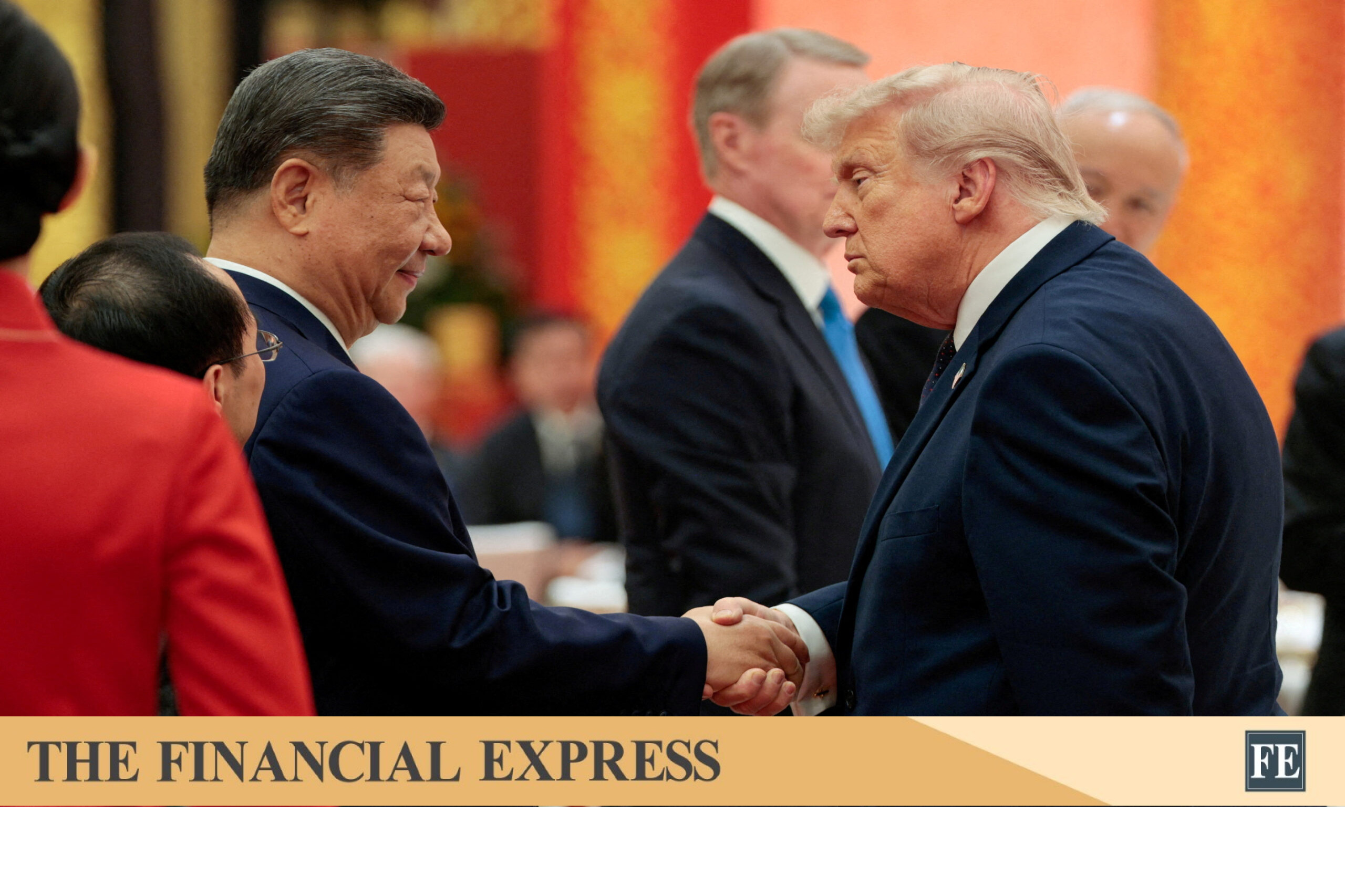
The scene as US President Donald Trump participates in events at the Great Hall of the People and does a greeting with the President of the People’s Republic of China Xi Jinping on 14 May 2026, in Beijing China during a trip focused on trade, regional security, and strengthening bilateral ties between the world’s two largest economies. REUTERS
Chinese President Xi Jinping warned his US counterpart Donald Trump that missteps on Taiwan could push their two countries into “conflict”, a stark opening salvo as they met in Beijing on Thursday at a superpower summit.
Trump had arrived in China with accolades for his host, calling Xi a “great leader” and “friend”, as he predicted that their countries would have “a fantastic future together”.
But beyond the pomp as he welcomed Trump, Xi in less effusive tones said the two sides “should be partners and not rivals”, while highlighting the issue of self-ruled democratic Taiwan -- which Beijing claims as its territory -- straight off the bat.
“The Taiwan question is the most important issue in China-US relations,” Xi said, according to remarks published by Chinese state media shortly after talks began.
“If mishandled, the two nations could collide or even come into conflict, pushing the entire China-US relationship into a highly perilous situation,” he added at the opening talks that lasted around two hours 15 minutes.
Can China and the United States transcend the so-called ‘Thucydides Trap’ and forge a new paradigm for major-power relations?... cooperation benefits both sides, while confrontation harms both-------Xi Jinping to Donald Trump.
Trump’s trip to Beijing is the first by a US president in nearly a decade, with the grand reception belying a host of unresolved trade and geopolitical tensions between the two countries.
Xi greeted Trump with a red-carpet welcome at the opulent Great Hall of the People, with military band fanfare, a gun salute and a host of schoolchildren jumping and chanting “welcome!”.

US President Donald Trump participates in an welcome ceremony with Chinese President Xi Jinping at the Great Hall of the People in Beijing, China, on 14 May 2026 REUTERS
Seemingly enjoying the ceremony, Trump said “the relationship between China and the USA is going to be better than ever before”.
Xi instead referenced an ancient Greek political theory about the risks of war when a rising power rivals a ruling power.
“Can China and the United States transcend the so-called ‘Thucydides Trap’ and forge a new paradigm for major-power relations,” Xi asked, adding that “cooperation benefits both sides, while confrontation harms both”.
There has been plenty of the latter since Trump’s last visit in 2017, with the two countries having spent much of 2025 embroiled in a dizzying trade war and at odds on many major global issues.
‘Blunt language’
Taiwan is a longstanding sore point.
The United States recognises only Beijing but under domestic law is required to provide weapons to Taiwan so that it can defend itself.
China has sworn to take the self-ruled democracy and has not ruled out using force, ramping up military pressure in recent years.

US President Donald Trump and Chinese President Xi Jinping tour the Temple of Heaven in Beijing, China, 14 May 2026 REUTERS
Following Xi’s comments on Thursday, Taipei called China the “sole risk” to regional peace, and insisted that “the US side has repeatedly reaffirmed its clear and firm support”.
But Trump said Monday he would speak to Xi about US arms sales to Taiwan, a departure from historic US insistence that it will not consult Beijing on the matter.
Adam Ni, editor of newsletter China Neican, told AFP that while such “blunt language” was not uncommon in Chinese foreign policy, it was unusual coming from Xi himself.
“Xi wants to make it very clear... he thinks the Taiwan issue is the potential powder keg between the two superpowers,” Ni added.
China has been “signalling a desire for US compromise on Taiwan in the lead up to the summit,” the National University of Singapore’s Chong Ja Ian told AFP.
Xi’s demand could suggest “they see some opportunity to convince Trump”, he said.
Iran overshadows
A new addition to the list of contentious issues to be discussed, the Iran war, threatens to weaken Trump’s position, having already forced him to postpone his trip from March.
Adam Ni, editor of newsletter China Neican, told AFP that while such “blunt language” was not uncommon in Chinese foreign policy, it was unusual coming from Xi himself.
The US president said he expected a “long talk” with Xi about Iran, which sells most of its US-sanctioned oil to China, but insisted that “I don’t think we need any help” from Beijing.

China's President Xi Jinping and US President Donald Trump visit the Temple of Heaven in Beijing on 14 May 2026 REUTERS
However, his secretary of state Marco Rubio, historically a fierce opponent of Beijing, said the US side was hoping “to convince (China) to play a more active role”.
Trump is also hoping for business deals on agriculture, aircraft and other sectors.
Elite businessmen in his delegation, including Nvidia’s Jensen Huang and Tesla’s Elon Musk, were on the stairs of the Great Hall of the People on Thursday for the welcome ceremony.
Musk told reporters afterwards the meeting had been “wonderful”, while Huang said the two presidents “were incredible”.
Xi later told the delegation that his country’s “doors to the outside world will open wider and wider” and that US companies would enjoy “even brighter prospects in China”.

China’s President Xi Jinping (2nd R) and US President Donald Trump (2nd L) talk as Eric Trump (R) and his spouse Lara Trump (L) look on during their visit to the Temple of Heaven in Beijing on 14 May 2026 REUTERS
On the eve of the summit, US Treasury Secretary Scott Bessent and Chinese Vice Premier He Lifeng met in South Korea to seek progress in ending a long-simmering trade war between the two.
Xi said the talks “reached results that were generally balanced and positive”, and urged both sides to “safeguard the current hard-won positive momentum”.
Trump and Xi are set to discuss extending a one-year tariff truce reached during their last meeting in South Korea in October.
China’s controls on rare earth exports and AI rivalry are among other topics expected to be taken up.
After their morning meeting, the two men took a break from negotiations, heading to the Temple of Heaven, a World Heritage site where China’s emperors once prayed for good harvests.
The two will return to the Great Hall of the People this evening for a state banquet.
Beyond the pomp as he welcomed Trump, Xi in less effusive tones said the two sides “should be partners and not rivals”, while highlighting the issue of self-ruled democratic Taiwan -- which Beijing claims as its territory -- straight off the bat.
AFP
Beijing
Updated: 14 May 2026, 14: 10
The scene as US President Donald Trump participates in events at the Great Hall of the People and does a greeting with the President of the People’s Republic of China Xi Jinping on 14 May 2026, in Beijing China during a trip focused on trade, regional security, and strengthening bilateral ties between the world’s two largest economies. REUTERS
Chinese President Xi Jinping warned his US counterpart Donald Trump that missteps on Taiwan could push their two countries into “conflict”, a stark opening salvo as they met in Beijing on Thursday at a superpower summit.
Trump had arrived in China with accolades for his host, calling Xi a “great leader” and “friend”, as he predicted that their countries would have “a fantastic future together”.
But beyond the pomp as he welcomed Trump, Xi in less effusive tones said the two sides “should be partners and not rivals”, while highlighting the issue of self-ruled democratic Taiwan -- which Beijing claims as its territory -- straight off the bat.
“The Taiwan question is the most important issue in China-US relations,” Xi said, according to remarks published by Chinese state media shortly after talks began.
“If mishandled, the two nations could collide or even come into conflict, pushing the entire China-US relationship into a highly perilous situation,” he added at the opening talks that lasted around two hours 15 minutes.
Can China and the United States transcend the so-called ‘Thucydides Trap’ and forge a new paradigm for major-power relations?... cooperation benefits both sides, while confrontation harms both-------Xi Jinping to Donald Trump.
Trump’s trip to Beijing is the first by a US president in nearly a decade, with the grand reception belying a host of unresolved trade and geopolitical tensions between the two countries.
Xi greeted Trump with a red-carpet welcome at the opulent Great Hall of the People, with military band fanfare, a gun salute and a host of schoolchildren jumping and chanting “welcome!”.
US President Donald Trump participates in an welcome ceremony with Chinese President Xi Jinping at the Great Hall of the People in Beijing, China, on 14 May 2026 REUTERS
Seemingly enjoying the ceremony, Trump said “the relationship between China and the USA is going to be better than ever before”.
Xi instead referenced an ancient Greek political theory about the risks of war when a rising power rivals a ruling power.
“Can China and the United States transcend the so-called ‘Thucydides Trap’ and forge a new paradigm for major-power relations,” Xi asked, adding that “cooperation benefits both sides, while confrontation harms both”.
There has been plenty of the latter since Trump’s last visit in 2017, with the two countries having spent much of 2025 embroiled in a dizzying trade war and at odds on many major global issues.
‘Blunt language’
Taiwan is a longstanding sore point.
The United States recognises only Beijing but under domestic law is required to provide weapons to Taiwan so that it can defend itself.
China has sworn to take the self-ruled democracy and has not ruled out using force, ramping up military pressure in recent years.
US President Donald Trump and Chinese President Xi Jinping tour the Temple of Heaven in Beijing, China, 14 May 2026 REUTERS
Following Xi’s comments on Thursday, Taipei called China the “sole risk” to regional peace, and insisted that “the US side has repeatedly reaffirmed its clear and firm support”.
But Trump said Monday he would speak to Xi about US arms sales to Taiwan, a departure from historic US insistence that it will not consult Beijing on the matter.
Adam Ni, editor of newsletter China Neican, told AFP that while such “blunt language” was not uncommon in Chinese foreign policy, it was unusual coming from Xi himself.
“Xi wants to make it very clear... he thinks the Taiwan issue is the potential powder keg between the two superpowers,” Ni added.
China has been “signalling a desire for US compromise on Taiwan in the lead up to the summit,” the National University of Singapore’s Chong Ja Ian told AFP.
Xi’s demand could suggest “they see some opportunity to convince Trump”, he said.
Iran overshadows
A new addition to the list of contentious issues to be discussed, the Iran war, threatens to weaken Trump’s position, having already forced him to postpone his trip from March.
Adam Ni, editor of newsletter China Neican, told AFP that while such “blunt language” was not uncommon in Chinese foreign policy, it was unusual coming from Xi himself.
The US president said he expected a “long talk” with Xi about Iran, which sells most of its US-sanctioned oil to China, but insisted that “I don’t think we need any help” from Beijing.
China's President Xi Jinping and US President Donald Trump visit the Temple of Heaven in Beijing on 14 May 2026 REUTERS
However, his secretary of state Marco Rubio, historically a fierce opponent of Beijing, said the US side was hoping “to convince (China) to play a more active role”.
Trump is also hoping for business deals on agriculture, aircraft and other sectors.
Elite businessmen in his delegation, including Nvidia’s Jensen Huang and Tesla’s Elon Musk, were on the stairs of the Great Hall of the People on Thursday for the welcome ceremony.
Musk told reporters afterwards the meeting had been “wonderful”, while Huang said the two presidents “were incredible”.
Xi later told the delegation that his country’s “doors to the outside world will open wider and wider” and that US companies would enjoy “even brighter prospects in China”.
China’s President Xi Jinping (2nd R) and US President Donald Trump (2nd L) talk as Eric Trump (R) and his spouse Lara Trump (L) look on during their visit to the Temple of Heaven in Beijing on 14 May 2026 REUTERS
On the eve of the summit, US Treasury Secretary Scott Bessent and Chinese Vice Premier He Lifeng met in South Korea to seek progress in ending a long-simmering trade war between the two.
Xi said the talks “reached results that were generally balanced and positive”, and urged both sides to “safeguard the current hard-won positive momentum”.
Trump and Xi are set to discuss extending a one-year tariff truce reached during their last meeting in South Korea in October.
China’s controls on rare earth exports and AI rivalry are among other topics expected to be taken up.
After their morning meeting, the two men took a break from negotiations, heading to the Temple of Heaven, a World Heritage site where China’s emperors once prayed for good harvests.
The two will return to the Great Hall of the People this evening for a state banquet.