| Global Defense, OSINT & Geopolitics Wire

[🇧🇩] Coastal/Inland Riverine Shipping & Passenger Logistics

[🇧🇩] Coastal/Inland Riverine Shipping & Passenger Logistics
22
3K
More threads by Bilal9

G Bangladesh Defense

Imperative of revitalising logistics sector

Atiqul Kabir Tuhin
Published :
Jul 02, 2025 22:30
Updated :
Jul 02, 2025 22:30

It is time to prioritise the development and seamless operation of inland waterways and railways as key components of a balanced and efficient multimodal logistics network.

At a recent seminar hosted by the Dhaka Chamber of Commerce and Industry (DCCI), experts and business leaders highlighted how Bangladesh's outdated logistics system is undermining the country's global competitiveness, hampering export growth and overall economic momentum. As the country prepares to graduate from the United Nations' Least Developed Country (LDC) category, addressing these logistical shortcomings must be a top priority. Upon LDC graduation, Bangladesh will lose numerous preferential trade assistance and benefits under International Support Measures (ISM) for LDCs. These include crucial advantages like duty-free quota-free (DFQF) market access (like the EU's Everything But Arms scheme), relaxed rules of origin, and flexibilities under the TRIPS Agreement for intellectual property, especially for pharmaceuticals. At the same time, the country will see gradual withdrawal of "Special and Differential Treatment" (S&DT) provisions from various World Trade Organization (WTO) agreements, while new trade-related obligations will be imposed. These changes will drive up the cost of trade and investment. For example, one study projects that LDC graduation will result in an 8-12 per cent increase in duties on Bangladesh's exports to EU countries, directly raising overall export costs. In this context, the importance of strengthening the country's outdated logistics sector cannot be overemphasised to offset these anticipated increases in international trade costs and safeguard the nation's global trade competitiveness.

An efficient logistics system that reduces lead time and cost is what keeps the wheels of the commerce turning. From the delivery of raw materials to manufacturers to the final product reaching consumers, both domestically and globally, logistics plays a crucial role in ensuring that goods and services are delivered without a hitch, and in a cost-effective and timely manner. The global logistics market is valued at $10 trillion and it is inextricably linked to every economic activity. The sector is particularly vital for export-oriented countries like Bangladesh. Regrettably, the country is among the countries where logistics costs are among the highest. It was revealed at the DCCI seminar that logistics costs in Bangladesh is roughly 15 to 20 per cent of GDP, far above the global average of 8 to 10 per cent. This aligns with an earlier World Bank Group report titled 'Moving Forward: Connectivity and Logistics to Sustain Bangladesh's Success,' which showed sector-wise logistics service expenses in the country ranges from 4.5 per cent to a staggering 48 per cent of sales, which is far higher than that of other competing countries.

Bangladesh's stark inefficiency in logistics is also reflected in global rankings. Bangladesh currently ranks 88th out of 139 countries in the World Bank's Logistics Performance Index (LPI), trailing significantly behind regional competitors like India (38th) and Vietnam (43rd). Its performance is even more concerning in the "trading across borders" category, where it is ranked 176th out of 190 countries. The World Bank report projected that mitigating Bangladesh's excessive logistics cost via targeted short-term and mid-term reform measures could increase its export earnings by as much as 20 per cent. Even a modest 1 per cent reduction in transport costs or dwell time alone could raise exports by over 7 per cent.

Bangladesh's poor ranking at LPI stems primarily from weaknesses in its trade and transport infrastructure, including congested ports and poor road networks, which collectively lead to high logistics costs. Further hindering its performance are significant inefficiencies in customs and border management, insufficient adoption of digital tracking and tracing systems, and procrastination of shipments. These factors, alongside fragmented governance and an over-reliance on road transport, collectively undermine the country's logistical efficiency and global competitiveness.

To address this shortcomings, experts at the DCCI seminar called for modernising Chattogram and Mongla ports since about 92 per cent of the country's export takes place though the ports. They have also proposed some key reforms such as digital platforms to connect shippers and transporters, warehouse automation, digital customs solutions, and greener logistical practices to improve the overall performance of the sector. Moreover, the construction of a dedicated expressway exclusively for trucks and lorries from Chattogram port to Sitakunda was suggested as a potential game-changer for streamlining the transport of import and export goods.

An efficient logistics system, however, goes beyond just building better roads and transport system; it requires an integrated multimodal logistics network that seamlessly combines road, rail, and waterways. In Bangladesh, 77 per cent of goods are transported by road, 16 per cent by waterways, 6 per cent by railways, and 1 per cent by other means. Such an overreliance on roads is a major drawback. If a significant portion of goods loaded or unloaded at ports could be transported via launches or barges, rather than being almost entirely loaded onto trucks, it could reduce both transportation costs and logistical complexities, easing pressure on the road network while enhancing overall efficiency.

The National Logistics Policy, introduced in 2024, aims to significantly reduce this dependency on roadways to 60 percent by 2041, while increasing the share of goods transported via river routes and railways to 25 percent and 14 percent, respectively. But the policy remains unimplemented.

Bangladesh is crisscrossed by hundreds of rivers that could be used to transport goods in a cheap and environmentally friendly way. But this natural resource remains underutilised. Historically, rivers have been intertwined with the country's culture, trade and development. Almost all the major cities and industrial hubs have grown around the country's vast network of rivers and natural water resources. However, over time, this landscape has changed dramatically. The number of active rivers has dwindled, many have lost their vitality, and waterways - once the arteries of the nation's transport system - have gradually been replaced by roads as the dominant mode of transporting people and goods. This overreliance on road transport has come at a significant cost, reflected in growing traffic congestion, escalating road construction and maintenance expenses, and increasing environmental pollution. It is, therefore, time to prioritise the development and operation of inland waterways and railways as key components of a balanced and efficient multimodal logistics network.

​
 
Riverine RoPax (or roll-on/roll-off passenger vessels) ferry MV Carnival Cruises carried passengers and vehicles from Dhaka to Bhola's Elisha (town near Bay of Bengal) in just 4.5 hours. Introduction of RoPax ferries in this route has changed the passenger and cargo logistics for this area which is not connected by roads to the rest of Bangladesh.

 
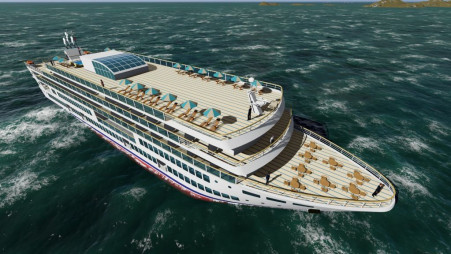
Bangladesh Inland Water Transportation Corp. has initiated builds of about 6 or 7 mini passenger sea-cruise ships suitable for coastal marine use (within twenty miles of shore).

The first one off the yard in Narayanganj, floated and going through interior fitment is MV Shamudra Bilash. Next will be two more, Oasis of Bengal, and Neelkamal. There are 6 or 7 new hulls undergoing construction other than the first one (see videos)


Here are News reports with details:
-----------------------------------------------------------------------------------

BIWTC to launch 3 cruise ships to boost coastal, regional tourism​


Bangladesh not included in international cruise map​

International operators will show interest to come to Bangladesh after launching these vessels; Tourism ministry to remove obstacles to encourage private investors operate cruise ships​

A model of the cruise ship to be launched by the Bangladesh Inland Water Transport Corporation for the first time in the country. The cruise liners, which will run in coastal belts and on the Chattogram-Kolkata route, are expected to boost coastal and regional tourism. PHOTO: COURTESY

A model of the cruise ship to be launched by the Bangladesh Inland Water Transport Corporation for the first time in the country. The cruise liners, which will run in coastal belts and on the Chattogram-Kolkata route, are expected to boost coastal and regional tourism. PHOTO: COURTESY BIWTC

Highlights:
  • Passenger capacity of each vessel: 160
  • Crew members: 74
  • Rooms for passengers: 70
  • Rooms for crew members: 18
  • Vessel length: 82M
  • Depth: 4M
  • The vessels will operate in coastal belts and on Chattogram-Kolkata route

The Bangladesh Inland Water Transport Corporation (BIWTC) is going to launch three cruise vessels for the first time in the country that would operate trips in the coastal belts and on the Chottogaram-Kolkata route.

"Initially we have given work order to Karnaphuli Ship Builders Limited to make three cruise vessels each with the capacity to carry 160 passengers and 74 crew members. Apart from night stay, the vessels will be able to carry more passengers for daylong tours," Khondaker Mahmudur Rahman Iman, chief planning manager, BIWTC, told The Business Standard.

Once the ships are launched, they hope that the other international cruise ship operators may show interest to come to Bangladesh which will increase the flow of foreign tourists in the country.

Tour operators said that the initiative would be a milestone for the country as still there is no cross-border cruise ship in Bangladesh and the country is not included in the international cruise line due to bureaucratic barriers.


Md Ziaul Islam, chief marine construction (ac) and project director, BIWTC told TBS, "All vessels will be of the same design and the same capacity. We will get these in the last quarter of 2023 according to the contract."
Each vessel will cost Tk77 crore, he added.

About the cost of travelling on these vessels he said, "The fare has not been fixed yet but the service will be like that of 5-star hotels. There will be three crew members for each passenger, so the expense will also be high."


He also said, along with sailing on the rivers these luxurious vessels can also travel inside 20 nautical miles of the sea. But it cannot travel in deep sea.


The vessel will travel from Dhaka to Chattogram, Khulna and Kolkata on river and sea routes, he added.

Currently, the MV Bay One, the first private sector luxury cruise ship in Bangladesh, is the only direct marine vessel operating on Chattogram's Karnaphuli River to the Bay of Bengal, and further south into the deep sea, all the way to the coral island of St Martin's route. It is the vessel of Karnaphuli Ship Builders that can carry 1,200 passengers at a time. However, it does not operate any international trip.


In the three ships of BIWTC, there will be a total of 70 rooms for passengers and 18 rooms for crew, according to the proposed design. Among the key features, the overall length of the vessels is 82 metres and depth 4 metres.

Difficulties to include Bangladesh on world cruise map

Journey Plus, a Bangladeshi tourism company, arranged the first ever trip by an international cruise liner in Bangladesh in 2017, and then again in 2019.

Journey Plus Chief Executive Tawfiq Rahman said, "We faced many difficulties including Bangladesh on the world's cruise map. But we did not get enough cooperation from the government".

"We did not take further initiative to arrange such a tour after 2019," he added.

Journey Plus arranged the 'Silversea Discover Expeditions' to bring 162 foreign tourists from 17 countries to Maheshkhali Island and the Sundarbans in 2017. They were on the Colombo to Kolkata Asia Expedition Cruise.

Journey Plus had to try several years to bring Silversea, a luxury cruise line headquartered in Monaco, to this region and to open new routes that would include Bangladesh.

Regarding launching international cruise ships like other countries in the world, State Minister for Tourism Mahbub Ali said that he would discuss with the home minister to bring the cruise ships operating on international routes to Bangladesh.

"We want that a foreigner who will come to Bangladesh will complete his immigration procedure on the ship so that they can visit all the tourism hot spots without facing hitches," he said.

Mahbub Ali said that they will take all initiatives so that private investors can operate cruise ships without any bureaucratic obstacles.

Focus to boost regional tourism through cruise line

Bangladesh and Sri Lanka are considering launching a cruise service between the countries to boost regional tourism.

A virtual meeting was held last year by the Bangladesh Tourism Board (BTB) with participation of the relevant stakeholders in this regard, said sources at the BTB.

BTB immediate past Chief Executive Officer Jabed Ahmed told The Business Standard, "We have a memorandum of understanding (MoU) on tourism with a number of countries. Now, we are going to sign an MoU regarding tourism with Sri Lanka too."

"We may include India in the cruise line considering the business viability," he said.

--------------------------------------------------------------------------------

BIWTC prepares to float three sea cruisers​

Mahfuz Ullah Babu
Mahfuz Ullah BabuOctober 1, 2025 7:22 pm

Photo: Courtesy
Share

State-owned Bangladesh Inland Water Transport Corporation (BIWTC) is gearing up to float three sea cruisers in the first half of 2026, deferred by a few months for furnishing works.

The ships – Shamudra Bilash, Oasis of Bengal, and Neelkamal – each will have star-rated amenities and amusement to carry over 300 tourists through the sea. They can sail from river ports and navigate within 20 nautical miles of the coast, BIWTC Chief Engineer and Project Director Md Ziaul Islam told TIMES of Bangladesh.

For the first time in Bangladesh, the three cruise ships will enable outbound tour packages to regional tourist destinations as well as inbound ones from countries like Thailand, Cambodia, Malaysia, Sri Lanka, Maldives, India, Pakistan, Iran, and the Gulf countries, said the corporation’s Communications Head Mohammad Nazrul Islam Misha.

Already built at the Karnafuly Dock in Narayanganj, the cruise ships were scheduled to be floated by the end of this year, said BIWTC Chairman Md Salim Ullah.

“However, for the sake of quality furnishing tasks, it may take a few more months,” he said.

According to the chairman, the ships will be chartered to private tour operators or the state-run Bangladesh Tourism Corporation for tour operations.


Misha said the government has been working on affordable Hajj through BIWTC ships, and the three cruise ships can also halve the travel cost compared to what Muslim pilgrims spend for air travel to Saudi Arabia.

Karnafuly’s Chairman and Managing Director Abdur Rashid told TIMES of Bangladesh that they are furnishing the ships with quality equipment, furniture, and appliances to please tourists, both domestic and international.

“As per the buyer’s requirement standards, we are procuring things both from local and international sources,” he added.

The initial cost of the three cruise ships was set at Tk232 crore, which may rise further, hinted BIWTC officials.
 
Last edited: