Home Watch Videos Wars

[🇧🇩] Corruption Watch

[🇧🇩] Corruption Watch
346
11K
More threads by Saif

G Bangladesh Defense

Costs of high-level corruption: Further down the kleptocratic route
High-level corruption

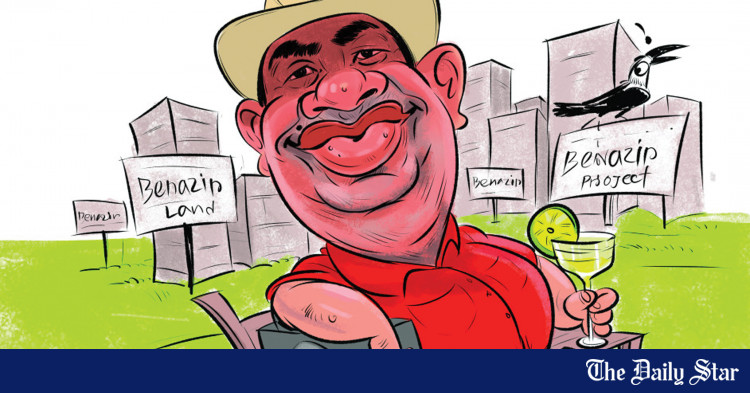
1719645103572.webp

VISUAL: SHAIKH SULTANA JAHAN BADHON

Mahatma Gandhi's quote that there is enough in this world to meet everyone's need but not for anyone's greed is aptly illustrated by the ongoing media and other credible exposures of evidence of corruption in Bangladesh. Confirming that sky is the limit, these revelations of high-level abuse of power, known as grand corruption, though nothing new except the procession of disclosures, have shocked and awed the nation.

Several key institutions, apparently sanctuaries of high-level corruption and related criminalities, have been exposed to risks of kleptocratic capture. These include the army, police, Rab, National Board of Revenue (NBR) and, not the least, the country's major political parties. A former army chief and his immediate family have been slapped with sanctions for "significant corruption," including assistance in evasion of accountability for criminal activity, facilitating improper awarding of military contracts, and acceptance of bribes. His actions have been assessed to have "contributed to undermining Bangladesh's democratic institutions and the public faith in public institutions and processes."

Having retired after gaining the dubious distinction of topping the list of kingpins behind sanctions against Rab for gross human rights violations, the former police chief has managed to flee the country with questionable ease, arguably as part of a suspected sinister deal. This at a time when he has been publicised to be under the Anti-Corruption Commission's (ACC) radar for amassing unbelievable amounts of income and wealth acquired across the country by ruthlessly violating entrusted institutional power coupled with political blessing, fraud and criminal extortion. In so doing, he applied the skills acquired over the years as a crime control professional and transformed himself from his mandated position of protector of law to a role model of lawbreaking. As widely expected, he was not the only instance of such brazenly normalised corruption in the police force as many other similar exposures followed, including that of the former Dhaka Metropolitan Police commissioner.

A member of NBR and president of its Customs, Excise and VAT Appellate Tribunal came to the spotlight, catalysed by his son's goat scandal and subsequent exposure of grotesque details of his and his family's accumulation of income and properties. He did so abusing his oversight role of revenue generation for the state, which he converted into that of the tax evasion guru as an illegitimate source of income. It is again obvious that he is not the sole X percent person in the NBR, nor is it possible that he operated in isolation without collusion and protection of many others.

No less troubling is the case of the brutal killing of an MP allegedly as an example of infighting of political power abusers over the share of booties of gold smuggling and the related illicit business facilitated and protected over the years by those mandated to control such criminalisation of politics. Again, this is no isolated case of political corruption, as symbolised by the case of an MP serving prison term in Kuwait for transnational crimes, including money laundering and human trafficking. Nor is criminalisation of politics a monopoly of the current ruling party, as its arch-rival left behind a legacy of no less grand corruption, arms smuggling and ruthless political criminalisation, including several attempts at the life of the top leader of their rival political party, causing multiple deaths.

As scandalous as these examples are, it is no surprise at all because successive regimes have driven the state to this level through their desperate bids to ensure partisan capture of the institutions to facilitate, promote and protect power abuse and thereby grant impunity to high-level perpetrators.

Implications of such grand corruption are destabilising for the state. Their money value can be concretely measured only by the government and relevant agencies, only if done with integrity, free from conflict of interest. For some general idea, one may consider the value of compromise of the least cost, best quality principle in procurements and other public expenditures in which the officials were involved and received kickbacks or shares; value of concealed and laundered income and wealth; undervalued price of acquired properties and taxes evaded, etc.

On the other hand, a close look at the files of clients of NBR officials will take independent investigators to a gold mine of data to explain why Bangladesh's tax-GDP ratio is one of the lowest in the world; why the target of increased pressures for higher revenue collection are the common people through indirect taxes; and why honest taxpayers are most often treated as enemies of unscrupulous NBR officials while tax evaders as close allies. Tax officials' bribery and kickback are more directly damaging for the state than any other sector. Irrespective of the amount a tax official collects to facilitate illicit tax evasion, the evaded tax amount is a direct loss of revenue. Add to this, the unabated problem of money laundering, the lion's share of which takes place through trade-based illicit transfers allegedly with the knowledge, facilitation and collusion of the revenue authority.

Collusive abuse of power in all these cases is also among the reasons why nothing has happened to the perpetrators. The former NBR member, for instance, conveniently outsmarted several initiatives for departmental procedure in response to allegations over the years, nor could the ACC proceed with concrete action. It's also no secret that he has been enjoying the patronage and protection of the business-politics-bureaucracy power structure, which also helped invincibility of the overall illegal tax evasion system.

Non-monetary costs of corruption are no less ominous for the state, the worst victim of which are the institutions in general and particularly those at the centre of recent focus. None of them has yet shown the courage to come up with any action or concrete pledge against those within their own ranks, who have pushed the respective institutions to severe reputational damage. None of them seem to care that it is time to face the mirror and undertake strategies to ensure accountability and justice in the short term, and overhaul themselves in the medium and long terms, which is indispensable to restore their credibility and uphold the spirit and values of Bangladesh's independence.

What has happened instead has only added to the already existing atmosphere of intimidation to the media, as demonstrated by the infamous statement by the BPSA, which has been viewed as nothing but an effort to grossly curtail media freedom guaranteed by the constitution. Aggrieved by the disclosures and with an apparent sense of insecurity as birds of the same feather, the association adopted the "shoot the messenger" tactic and blamed media reports as motivated, while in fact the statement itself was a motivated act to suppress disclosure of corruption information. It is also no coincidence that the home ministry reached out quickly to the information ministry with a note that practically endorsed the BPSA position.

Coming as all these do simultaneously with the creation (once again) of the provision in the national budget for an unconstitutional, discriminatory and corruption-friendly reward system for black money, the key message given to the people is that corruption enjoys systemic guarantee of impunity. Little do the power holders seem to care that by converting the commitment of zero tolerance against corruption in election manifestos and other public pronouncements into useless rhetoric, floodgates are being opened to further kleptocratic disorder of the state.

Dr Iftekharuzzaman is executive director at Transparency International Bangladesh (TIB).​
 
Analyze

Analyze Post

Add your ideas here:
Highlight Cite Fact Check Respond

Padma Bridge Project: Corrupt yet let off the hook too easily
Forced into retirement for graft, land surveyor gets his job back with lower salary

1719702624876.webp

Mainul Hasan

A government employee has been reinstated to his job after being dismissed for being involved in a fraudulent compensation scheme in the Padma Bridge project.

Mainul Hasan, a former land surveyor of Madaripur, was sent into forced retirement in November last year after the district administration and land ministry's investigation found him guilty of facilitating a scam, for which the government lost Tk 1.64 crore.

However, land ministry Secretary Khalilur Rahman reinstated him on June 9 this year, reducing his punishment from forced retirement by lowering his salary grade for five years.

Earlier in September 2022, a divisional case was filed against him over misconduct and corruption.

During Mainul's posting in Madaripur deputy commissioner's office in 2020, he was responsible for overseeing land acquisition for the Padma Bridge in Shibchar upazila.

He granted Tk 1.64 crore to two individuals for supposedly using 3.37 acres of their land for the project in Sujanagar mouza.

However, the land never belonged to the two in the first place, in fact, those were government land.

The compensation was provided based on forged documents.

Following allegations against Mainul, a three-member investigation committee was formed, led by the deputy director of local government.

The committee confirmed that Mainul issued compensation cheques on September 9 and September 20 of 2020. The land ministry also formed a separate probe committee.

"Allegations of negligence in the misconduct of duties are found true," the probe body concluded.

On November 8, 2022, the ministry issued a notification stating that Mainul would be forced into retirement for his involvement in corruption.

"This type of dishonest activity harms the interests of the government and tarnishes the image of the office. It shows a lack of honesty, impartiality, responsibility, and efficiency in his work," said the notification. It also stated that Mainul "personally benefited from the scheme".

Mainul's response to a show-cause letter was deemed unsatisfactory, according to the notification. However, on March 11, 2023, Mainul appealed to the land ministry.

After the appeal hearing, led by the secretary, the ministry backtracked from its original decision. Although the committee, which heard the appeal, was convinced that Mainul failed to provide satisfactory response in his defense, the forced retirement was suddenly deemed as "excessive punishment".

On June 9, 2024, a new notification was issued, reducing Mainul's punishment to a lower salary grade for five years.

Many senior government officials at the land ministry were baffled by the decision.

Requesting anonymity, an officer of the ministry, said the reduction in punishment does not set a good precedent for junior officers.

Mainul could not be reached for comments.

Contacted, Transparency International Bangladesh Executive Director Iftekharuzzaman said, "Specific allegations against the accused employee [Mainul] were proven and undeniable. The ministry officials, including the secretary who protected this employee, are guilty of supporting corruption."

Despite repeated attempts through texts and phone, the land secretary could not be contacted for comments.​
 
Analyze

Analyze Post

Add your ideas here:
Highlight Cite Fact Check Respond

Black money-holders laugh, loan defaulters to grumble
DOULOT AKTER MALA
Published :
Jun 29, 2024 23:55
Updated :
Jun 29, 2024 23:55
1719705665896.webp


A 'no pay, no claim' measure is adopted on interest expenses to accelerate repayment of loans as parliament Saturday passed the finance bill with contentious provisions for black-money whitening and duty-free car import.
In another major fiscal measure, opposed by many, the government imposed gains tax on investors in stocks.

From July 1, 2024, taxpayers would be able to claim tax benefit on interest amount as 'allowable expenses' if they pay it (interest amount) in that year.

In the Finance Act 2024, passed Saturday in parliament, the government has scrapped the existing provision to cushion loan defaulters.

Taxpayers will be able to lessen their tax liability by claiming the interest or profit expenses in their tax returns, if it is paid instead of the existing provision 'payable'.

Currently, section 46(7) of the Income Tax Act 2023 allows payable interest or profit expenses of taxpayers to claim tax benefit up to three years, even if it is not paid in this period.

However, if the amount remains unpaid within three years, the entire amount would be treated as taxable in the fourth year as 'special business income'.

Official sources say the loopholes in the law have been addressed in this Act by amending the longstanding provision helping loan defaulters to exploit the leniency for years.

"Only interest actually paid will be considered for tax benefit," says one revenue official.

Executive Director of the Policy Research Institute (PRI) Dr Ahsan H Mansur hails the measure he expects to minimize the country's bloated non-performing loans or NPLs, staying as a dead-weight on the banking system.

"It is justified to allow tax benefit if interest amount is paid, otherwise a loan defaulter would benefit in two ways," he says.

According to Bangladesh Bank (BB) data, default loan in the banking sector had hit an all-time high at Tk 1.82 trillion until March 2024.

However, in view of recurrent lending anomalies, it has been claimed that actual volume of default loans is higher than the official figure.

As per BB data, some 11.10 per cent of the disbursed loans have turned sour as bad loan.

In the new act, the parliament has kept the highest tax rate for individual taxpayers unchanged at 25 per cent for FY 2024-25. In the budget speech on June 6, 2024, the finance minister had proposed to raise the tax rate to 30 per cent.

Dr Mansur says the decision is justified as existing taxpayers should not be penalized only. "The government should find out the tax-evaders and people escaping tax net."

Also, the proposal on imposing 25-percent Customs Duty (CD) on import of vehicles by Members of Parliament (MPs) has not been passed by the parliament.

As a result, the MPs would go on enjoying the duty-free benefit on import of their high-end vehicles.

Also retained are the tax-holiday and zero-duty facilities on import of capital machinery for private Economic Zones and Hi-tech Parks.

Despite strong demands for continuation of tax-free benefit for individual investors in capital market, the parliament endorsed the budget proposal imposing 15-percent capital-gains tax on investment above Tk 5.0 million.

Also, the much-talked-about black money-whitening scheme by paying 15-percent tax for both individual and corporate taxpayers is ratified by the lawmakers.​
 
Analyze

Analyze Post

Add your ideas here:
Highlight Cite Fact Check Respond

Two companies of S Alam Group evade Tk 3,538 crore in VAT
Staff Correspondent 30 June, 2024, 23:58

Two companies of S Alam Group evaded Tk 3,538 crore in Value Added Tax through various ways in three years between 2019 and 2022.

The two companies----Vegetable Oil Ltd and S Alam Super Edible Oil Ltd--- evaded Tk 3,538 crore in VAT and they were also fined another TK 3,531 crore for evading the VAT amount.

The National Board of Revenue found the incident during an audit by the NBR's VAT wing of Customs Excise & VAT Commissionerate, Chattogram.

Of the amount, S Alam Vegetable Oil Ltd evaded Tk 1,917 crore and S Alam Super Edible Oil Ltd evaded Tk 1,621 crore between FY 2019-20 and FY 2021-22, according to the audit report.

Syed Mushfequr Rahman, commissioner of Customs Excise & VAT Commissionerate, Chattogram, told New Age that the companies had 90 days' time to appeal in this regard.

'Now the issue is out of our hand and only the tribunal will take decision after their appeal within the stipulated time,' he added.

The NBR official also said that the companies had denied the results now, but the audit was carried out by the field office of Customs, Excise & VAT Commissionerate, Chattogram, and was subsequently reviewed by a five-member committee headed by an additional commissioner, Chattogram VAT Commissionerate, which drew the same conclusion.

S Alam Group's company lawyer Mustafizur Rahman, however, told media that the VAT auditors had legal obligations to inspect the factory to assess the sales records and hear them, but they reached the decision without doing any of these.

He also said that they were not given the opportunity to be heard.​
 
Analyze

Analyze Post

Add your ideas here:
Highlight Cite Fact Check Respond

HC questions govt demands of unpaid VAT from S Alam companies
S Alam Group assets

1719875086826.webp


The High Court today questioned the legality of government's demand for unpaid VAT and the consequent fines of over Tk 7,000 crore from S Alam Vegetable Oil Ltd and S Alam Super Edible Oil Ltd.

On June 9, the Customs, VAT & Excise Commissionerate, Chattogram, in its adjudication orders asked the two companies to pay Tk 3,538 crore in "evaded VAT", Tk 3,531 crore in fines, and interest on the amounts, to the state coffers within 15 work days. Customs said the value added tax was evaded in fiscal years 2019-20 and 2021-22.

Today, the HC in two rules asked the respondents as to why the VAT determination orders -- issued by the commissioner of Customs, Excise & VAT Commissionerate, Chattogram, without hearing the two companies -- should not be declared illegal.

The respondents – the commissioner and deputy commissioners of the Chattogram commissionerate; and revenue officer of Customs, Excise & VAT, Karnaphuli Circle, Taltola Chowki, Patia, Chattogram -- were asked to come up with an explanation within 10 days.

The court also asked them why the commissioner of the Chattogram commissionerate should not be asked to dispose of the matter by strictly following sections 73 and 85 of the Value Added Tax and Supplementary Duty Act, 2012.

The HC bench of Justice Zafar Ahmed and Justice Sardar Md Rashed Jahangir issued the rules after two writ petitions were filed by the two companies.

The bench also fixed July 15 to hold a hearing on the rules.

During today's hearing, the companies' lawyer Ahsanul Karim told the bench that his clients on June 4 sought time from the commissionerate for their senior counsel to appear for hearings.

He said his clients were not heard before the adjudication orders were issued. The commissioner of the Chattogram commissionerate violated the principle of natural justice in passing the orders by not allowing his clients to defend themselves against allegations made in show-cause notices issued on October 4 and December 27 last year and on March 18 this year, the lawyer said.

Deputy Attorney General Nawroz MR Chowdhury representing the government told the court that the companies were given time on several occasions over the last one year to submit their statements before the commissioner to uphold the principle of natural justice.

But they had not done it. They cannot be given unlimited time under the relevant law, he said.

At one stage, Deputy Attorney General Samarebdranath Biswas told the HC that the companies' intention was not to pay the VAT.

Lawyer for the companies, Ahsanul said his clients never said that they would not pay the VAT.

According to an audit by the VAT wing of the National Board of Revenue, the companies have unpaid VAT and consequent penalties of over Tk 7,000 crore. They evaded VAT by presenting lower purchase and sales data in VAT returns and other means between 2019 and 2022.

The audit was subsequently reviewed by a five-member committee led by an additional commissioner of Chattogram VAT Commissionerate, which also arrived at the same conclusion.

The two companies denied any wrongdoing.​
 
Analyze

Analyze Post

Add your ideas here:
Highlight Cite Fact Check Respond

Posts you haven't read yet..

Members Online

Latest Posts

Back
 
G
O
 
H
O
M
E