| Global Defense, OSINT & Geopolitics Wire

[🇧🇩] Cottage Industry/SME in Bangladesh

[🇧🇩] Cottage Industry/SME in Bangladesh
71
6K
More threads by Saif

G Bangladesh Defense

SMEs struggle with complex policy and market access
Staff Correspondent 13 December, 2025, 23:49

Bangladesh’s small and medium enterprises are demonstrating remarkable resilience and innovation, but rising costs, export barriers, limited manpower, and policy constraints continue to pose major challenges, entrepreneurs said at the SME Product Fair 2025.

‘Starting was never easy, and sustaining growth without proper policy and financial support is even harder,’ said Farzana Islam Moury, a business graduate from Ahsanullah University of Science and Technology, founder of handicraft brand Craftimation, while speaking to New Age on the sidelines of the fair.

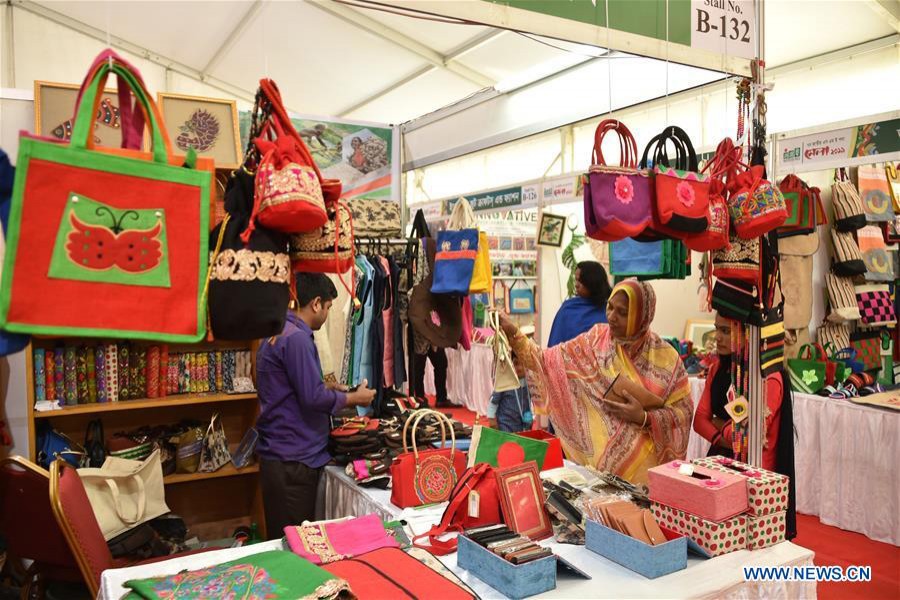
The SME fair, organised by the SME Foundation, which began at the Bangladesh-China Friendship Conference Centre in Dhaka’s Agargaon on 7 December, featuring over 350 SME enterprises, with nearly 60 per cent of participants being women entrepreneurs, will continue until 14 December.

Moury said, ‘Our goal is to preserve and present Bangladeshi heritage authentically. Anyone should be able to look at our products and instantly recognise the story, culture, and tradition behind them.’

Craftimation, founded in 2020, began its journey during the early days of the Covid-19 pandemic with an investment of only Tk 3,000.

Today, Craftimation employs around 20–22 permanent workers, along with additional project-based artisans for large orders.

Despite steady growth, Moury said high export costs and the absence of external investment remain significant barriers.

While the company exports products through third-party channels, mainly targeting Bangladeshi expatriates, fluctuating demand and logistics expenses make overseas expansion difficult for small businesses.

Currently, retail sales generate an average monthly turnover of Tk 4–5 lakh, while export and wholesale sales often exceed Tk 1 lakh.

Agribusiness ventures also highlighted market-building struggles.

Mushroom Palli, owned by 40-year-old Md Otiur Rahman Milon, attracted large crowds with mushroom-based products including soup, pickles, chutney, jelly, and dried mushrooms.

However, Milon said changing consumer perception was one of his biggest early challenges.

‘If people can afford to spend money on Cigarettes, why wouldn’t they eat mushrooms?’ he said.

Starting mushroom cultivation in 2019 on 20 decimals of land in Bauphal Upazila of Patuakhali with an investment of Tk 8 lakh, Milon faced ridicule from locals who referred to mushrooms as ‘frog umbrellas’.

In 2021, the collapse of his cultivation house nearly shut down the business, but he rebuilt it. Today, his enterprise generates sales of around Tk 1.5 lakh per month.

Still, he said, access to export markets and technical support remains limited. He plans to train 200 mushroom farmers by 2026 and develop a sustainable export pipeline.

Women entrepreneurs also stressed structural barriers.

Forty-five-year-old Sirajum Munira, a research officer at LAMP Hospital and founder of jute-based brand Sutar Kabyo, received the SME Foundation Award this year.

Starting eight years ago with Tk 10,000, her initiative now employs about 200 rural artisans in Parbatipur, Dinajpur, with monthly sales of Tk 18–20 lakh.

Munira said export certification requirements, such as ISO and Sedex, are major hurdles for small enterprises.

She said, ‘Certifications require significant investments that small businesses can’t afford. Without policy support and patronage, global scaling is extremely challenging.’

Although her products are already exported to Italy, Kuwait, and the United States, she called for government assistance to simplify export compliance.

Banks at the fair highlighted financing challenges faced by SMEs.

BRAC Bank relationship officer Oly Ahmed said many entrepreneurs lack information about suitable loan products.

He noted that the bank offers SME loans at 13.5 per cent interest, while women entrepreneurs under the TARA programme can access loans at 5 per cent interest.

Technology-driven SMEs raised concerns over funding and regulatory gaps.

Chief operating officer Md Mahfujul Haque of Dubotech Digital Ltd, a deep-tech company that recently won the National SME Award, said long R and D cycles, lack of specialised suppliers, and absence of clear import guidelines for oceanographic equipment remain major obstacles.

‘Building underwater robotics requires sustained research funding, regulatory clarity, and skilled manpower,’ he added.

Originating from the BRAC University research initiative BRACU DUBURI in 2017, the company went on to become Bangladesh’s first dedicated underwater robotics firm and achieved World Runner-Up at the international RoboSub competition.

He further said that Dubotech aims to develop autonomous underwater vehicles and expand inspection services for ports and energy infrastructure.

However, Haque stressed that without long-term R and D grants, innovation-friendly procurement policies, and low-interest financing, scaling such high-impact technology will remain difficult.

Despite diverse sectors and scales, entrepreneurs at the SME Product Fair 2025 shared a common message: innovation alone is not enough.

Without targeted policy support, affordable finance, and market access, the growth potential of Bangladesh’s SMEs will remain constrained.​
 

Simpler tax rules can transform our SMEs

1765762038908.webp


Bangladesh's tax-to-GDP ratio remains among the lowest in Asia, stuck at around 8-9 percent. This persistent weakness limits the state's capacity to invest in infrastructure, education, healthcare, energy and social protection. Public debate often focuses on taxing the wealthy or closing loopholes for large corporations. Yet an overlooked but critical challenge lies elsewhere: the vast number of small shop owners, traders and micro-entrepreneurs who remain outside the tax net.

For millions of small businesses across Bangladesh, from neighbourhood grocers to clothing retailers and roadside vendors, tax compliance is not just a financial burden but an administrative one. Filing an income tax return often requires professional help. VAT compliance is even more daunting. Record keeping, digital submissions and documentation standards make VAT practically inaccessible to the typical small trader operating with minimal staff and modest turnover. Unsurprisingly, most simply avoid the system altogether.

Yet these small enterprises account for a large share of the economy. The informal sector contributes more than one-third of GDP and employs the majority of the labour force. A tax system that fails to include this segment will always struggle to raise adequate revenue. This is compounded by the reality that Bangladesh's revenue administration lacks the manpower and technological capacity to monitor or audit millions of micro businesses. Expecting universal compliance under the current framework is unrealistic. Any workable tax policy must align with administrative capacity.

A practical solution, used successfully by many countries, is a flat rate, simplified tax and VAT regime for small businesses. Such systems sharply reduce compliance costs and encourage voluntary participation. India's GST Composition Scheme, which allows small businesses to pay a low fixed percentage of turnover with minimal paperwork, brought millions of traders into the formal tax base. Similar models in Indonesia, Pakistan, Turkey, Brazil and Kenya show that simplified taxation broadens the tax net far more effectively than complex, documentation-heavy systems.

A simplified model for Bangladesh could work in three parts. First, a fixed annual income tax could be set by shop size, turnover category or location. Second, a fixed VAT amount could be determined using the same criteria, removing the need for complex Mushak forms. Third, optional digital payment incentives could encourage early or consistent compliance.

Such a system would remove the need for accountants, reduce the fear of audits and make paying tax almost as simple as paying a utility bill. Even modest payments from millions of small traders would meaningfully expand national revenue. More importantly, a simplified self-reporting system would ease pressure on the revenue authority, lowering the need for additional manpower and reducing scope for arbitrary enforcement.

Simplification, however, must be matched with fair but firm enforcement. Once the state offers an easy way to comply, persistent evasion cannot be ignored. Strict penalties are needed to prevent large firms from splitting into smaller units to qualify for lower rates. Penalties must be clear and predictable, avoiding arbitrary actions that push businesses deeper underground. Balance matters. Heavy-handed enforcement fuels fear and corruption, while transparent enforcement supports long-term behavioural change. Policymakers should also resist the temptation to gradually raise flat tax rates.

Bangladesh does not need a perfect tax system. It needs a practical, inclusive and administratively simple one. A low burden flat rate tax scheme for small traders is among the most achievable reforms available. It is fair, efficient and better suited to the structure of the economy than the current one-size-fits-all model.

If Bangladesh is serious about sustainable development, stronger public services and lower reliance on debt, expanding the tax base is essential. Simplifying taxation for small traders may be the single most effective step towards that goal. A tax system people can understand and afford is one they are far more likely to join.

The writer is chairman of Unilever Consumer Care Ltd​
 
Export potential of Bangladesh's handicraft sector

Challenges and strategic pathways for global integration


Abu Mukhles Alamgir Hossain
Published :
Jan 15, 2026 00:12
Updated :
Jan 15, 2026 00:12

1768437309618.webp

Export diversification remains a critical development objective for Bangladesh as the country seeks to reduce its heavy reliance on readymade garments (RMG). Within this context, the handicraft sector presents a viable alternative export avenue due to its strong backward linkages with rural employment, cultural heritage, and environmentally sustainable production. Despite its long tradition and growing global relevance, the sector has not achieved commensurate success in international markets.

GLOBAL MARKET TRENDS IN HANDICRAFTS: The global handicraft market has experienced sustained growth over the past decade, driven by increasing consumer awareness of sustainability, ethical sourcing, and cultural authenticity. Handmade and eco-friendly products are increasingly preferred in developed markets, particularly in Europe and North America. Moreover, the expansion of e-commerce platforms has reduced entry barriers for small producers, enabling artisans from developing countries to access global value chains. Artworks and traditional crafts are also gaining recognition on humanitarian and cultural grounds, further strengthening demand.

The global market size of handicrafts-encompassing textile, metal, wood and stone, ceramic, pottery, vegetable fiber-based handicrafts, as well as eco-friendly products-is estimated at US$ 1,107 billion and is projected to reach US$ 2.3 trillion, growing at a CAGR of 10.15 per cent.

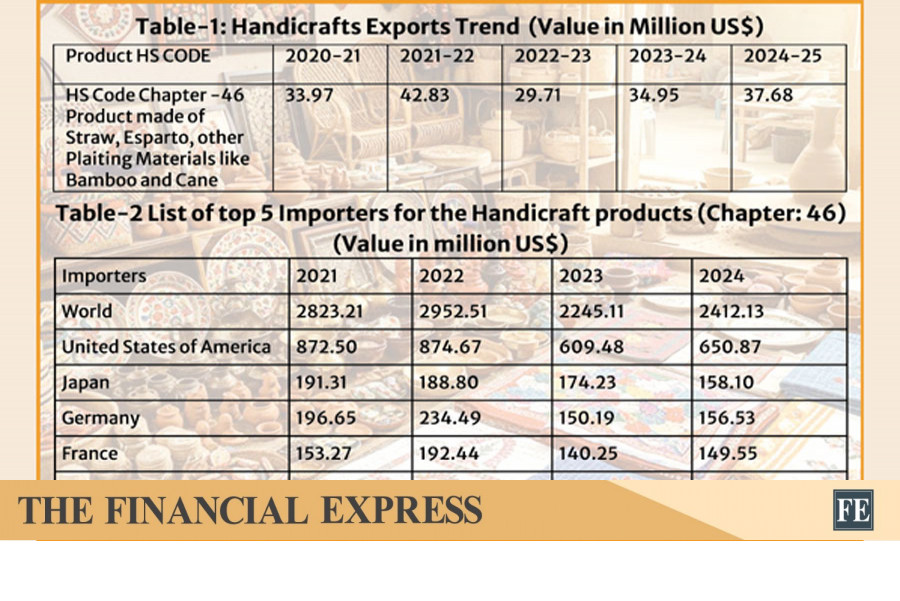
EXPORT PERFORMANCE IN HANDICRAFTS: Bangladesh's handicraft exports are concentrated largely under HS Chapter 46, which includes manufactures of straw, esparto, and other plaiting materials such as basketware and wickerwork. Although exports have shown gradual growth, Bangladesh's global market share remains very insignificant compared to major exporters like China and India. Weak branding, limited product diversification, and inadequate promotional efforts have restricted the sector's ability to scale up exports despite favorable global demand conditions. The export performance of the last five years is furnished in table 1.

There is a significant strategic planning gap between Bangladesh's export performance and the market size of the leading importing countries. Bangladesh can further increase its market share by deepening penetration in existing markets and pursuing product and market development.Import data of the leading countries for the last four years are presented below:

Beyond HS Chapter 46, exports from other segments of the handicrafts sector-classified under HS codes 560900, 420221, 420211, 340600, 630590, 570500, 570210, 530310, 531010, and 480210-are estimated at approximately USD 380 million. The global market size for these segments is estimated at USD 31.93 billion, of which Bangladesh accounts for only 1.18 per cent of the world market share.

COMPETITIVE ADVANTAGES OF BANGLADESH: Bangladesh possesses several intrinsic strengths that support the development of a competitive handicraft export sector. These include an abundant supply of skilled artisans with traditional craftsmanship, a strong raw material base in jute and natural fibers, and alignment with global sustainability trends. In recent years, there has also been progress in design development and export compliance, enhancing the sector's readiness for international markets. These advantages provide a solid foundation for future growth if supported by targeted interventions.

INTERNAL CONSTRAINTS AND STRUCTURAL WEAKNESSES: Notwithstanding its strengths, the handicraft sector faces significant internal challenges. The absence of dedicated research and development (R&D) and design centres limits innovation and product upgrading. Access to finance remains constrained, particularly for small producers and informal enterprises. The sector also suffers from a shortage of skilled artisans, inconsistent availability of raw materials, rising input costs, and inadequate infrastructure for storage and transportation. Furthermore, weak institutional coordination and insufficient government support have resulted in poor integration between local producers and global markets.

EXTERNAL CHALLENGES AND COMPETITIVE PRESSURES: Externally, Bangladesh's handicraft exports face intense competition from established producers, notably China and India, which benefit from scale economies, advanced design capabilities, and strong country branding. The proliferation of low-cost substitute products further erodes price competitiveness. Additionally, the lack of a coherent national branding strategy and limited international promotion reduce the visibility of Bangladeshi handicrafts in global markets.

EMERGING OPPORTUNITIES: Despite these challenges, several emerging trends offer new opportunities for the sector. The global shift toward sustainable lifestyles, growing demand for eco-friendly and locally made products, and the availability of donor funding for artisan development create a favourable external environment. Government policy initiatives aimed at product upgrading, combined with the rapid growth of e-commerce, present additional pathways for enhancing export performance.

POLICY IMPLICATIONS AND STRATEGIC RECOMMENDATIONS: To realise the full export potential of the handicraft sector, a comprehensive and updated policy framework is essential. Key measures should include the establishment of R&D and design centres, improved access to finance through targeted credit facilities and incentive schemes, and strengthened skill development and capacity-building programmes. Investments in infrastructure, logistics, and digital platforms are also critical to enhancing market access and export competitiveness.

The Handicrafts Policy 2018 (or existing policy) has not yet been revised to adequately reflect the current global market dynamics and the evolving challenges faced by sector stakeholders. Immediate government intervention is, therefore, necessary. In addition, nationwide cluster mapping to develop an accurate and updated database of artisans and enterprises is crucial for evidence-based policymaking and effective government support.

Equally important is the development of a strong country branding strategy and proactive participation in international trade fairs and online marketplaces. Emphasis on sustainable and eco-friendly production should remain central to policy interventions.

The handicraft sector offers Bangladesh a strategic opportunity to promote export diversification, rural employment, and sustainable development. While the sector faces both internal and external constraints, favourable global trends and emerging market opportunities provide a strong rationale for renewed policy attention. With coordinated institutional support, targeted investment, and effective global positioning, Bangladesh can enhance the competitiveness of its handicraft industry and secure a stronger role in the international handicraft market.

Abu Mukhles Alamgir Hossain is Director (Current Charge), Export Promotion Bureau (EPB).​
 

SME and start-up revolution: Can FBCCI become the new engine of growth?
Sakif Shamim

Published :
Mar 08, 2026 13:49
Updated :
Mar 08, 2026 13:49

1773017053123.webp


Bangladesh is now standing at a very important economic turning point. The country is preparing to graduate from the least developed country (LDC) category in 2026, and the vision of becoming a developed nation by 2041 is no longer just a political slogan; it is now a real economic goal. However, an important question remains – where will the next engine of economic growth come from? Large industries and export-oriented sectors are certainly important, but sustainable and inclusive growth usually depends on small and medium enterprises (SMEs) and emerging start-up businesses. In this context, the key question is how the country’s top business organisation, FBCCI, can lead an SME and start-up revolution in Bangladesh.

According to the latest Economic Census of the Bangladesh Bureau of Statistics (BBS) conducted in 2013, there are more than 7.8 million economic establishments in the country, and about 99 per cent of them are small and medium enterprises. Later studies and analyses by both government and private organisations show that the SME sector creates more than 80 per cent of total employment in Bangladesh and contributes around 25–30 per cent to the national GDP. Reports from the World Bank and the Asian Development Bank also identify SMEs as one of the main drivers of employment generation and inclusive economic growth in the country.

At the same time, the start-up ecosystem in Bangladesh has grown significantly over the last decade. Data from LightCastle Partners and the Bangladesh Association of Software and Information Services (BASIS) shows that Bangladeshi start-ups attracted around 400 million US dollars in foreign and local investment in 2021 – the highest in the country’s history. Although global investment slowed down in 2022 and 2023, start-up activities in sectors such as fintech, e-commerce, logistics, and health technology have continued to expand.

In reality, SMEs and start-ups are two stages of the same growth cycle. Start-ups are the starting point of innovation, while SMEs expand production and create jobs. However, several challenges still exist. Studies and policy reports from the Bangladesh Bank show that access to financing remains one of the biggest barriers for entrepreneurs. High interest rates, collateral-based lending systems, and long approval processes often discourage many promising entrepreneurs. According to an analysis by the International Finance Corporation (IFC), there is a significant financing gap in Bangladesh’s SME sector, and many entrepreneurs remain outside the formal financial system.

In this situation, the role of FBCCI should not remain limited to being only a representative body of businesses. It can also become a strong policy think tank that supports economic decision-making. In many South Asian countries, leading business chambers actively help governments through research, data analysis, and policy recommendations. In Bangladesh, FBCCI regularly provides pre-budget proposals, but more structured and data-driven work is still needed, especially for strengthening the SME and start-up ecosystem.

First, it is important to create a national SME and start-up data observatory. Such a platform could collect and analyse information about sector performance, financing flows, employment trends, and regional inequalities. Second, FBCCI can play a strong role in promoting alternative financing systems such as venture debt, cluster funds, crowdfunding, and equity investment. The Bangladesh Securities and Exchange Commission (BSEC) has already introduced the SME Board in the capital market to make it easier for small and medium companies to raise funds. However, coordinated support from business chambers can make this initiative much more effective.

Third, skill development and technology transformation are extremely important for the future of SMEs and start-ups. According to the World Economic Forum, in the era of the Fourth Industrial Revolution, it is almost impossible to compete without strong digital skills. Bangladesh’s success in ICT exports and the freelancing sector shows that investment in human capital can bring quick results. FBCCI can help by launching regional skill development programmes, mentorship initiatives, and technology support systems through its member organisations.

Fourth, SMEs and start-ups must also be connected to export diversification. At present, the ready-made garments sector contributes more than 80 per cent of Bangladesh’s total exports, according to the Export Promotion Bureau (EPB). In the long run, such heavy dependence on a single sector can be risky. Therefore, sectors like light engineering, agro-processing, IT services, pharmaceuticals, and the creative economy should receive stronger policy support so that small and medium entrepreneurs can enter international markets and expand their businesses.

Finally, no economic revolution can succeed without good governance and transparency. SME policies, tax systems, and business registration procedures should become simpler and more digital. Bangladesh has previously faced challenges in the World Bank’s “Doing Business” rankings, which clearly shows that improving the overall business environment is still an important priority.

The SME and start-up revolution is not a temporary slogan; it is a long-term structural transformation. If FBCCI goes beyond its traditional representative role and takes leadership in research, policy advocacy, data analysis, and skill development, it can truly become the new engine of economic growth for Bangladesh. Large industries may drive the economy forward, but small and medium enterprises give it life and energy.

The next chapter of Bangladesh’s economic journey will be written by entrepreneurs – people who start small but dream big. To turn those dreams into reality, the country needs strong policies, supportive institutions, and effective leadership. In that sense, FBCCI now has a historic opportunity to transform itself from a traditional organisation into a powerful institutional force for national development.

The new engine of growth may already be forming quietly – in small factories, shared working spaces, or on the laptop of a young entrepreneur. The real question is simple – are we ready to provide the right fuel for that engine?

- Sakif Shamim, a Fellow of Life Management Institute, is the Managing Director of Labaid Cancer Hospital and Super Speciality Centre and Deputy Managing Director of Labaid Group​
 

Solar energy and SMEs

Wasi Ahmed
Published :
Apr 01, 2026 00:31
Updated :
Apr 01, 2026 00:31

1775002590131.webp


A recent study report on the impact of solar-based power on Bangladesh's small and medium enterprises (SMEs) has captured significant attention, not only for its environmental implications but also for its strong economic cause. Prepared by the Change Initiative, the report suggests that SMEs in Bangladesh could reduce operational costs by 30-50 per cent through decentralised rooftop solar adoption, while simultaneously strengthening their long-term competitiveness in export markets by complying with increasingly stringent environmental standards. These findings were presented at a press conference in the capital, alongside detailed factory-level assessments of energy consumption and carbon emissions across selected SME clusters.

SMEs are the backbone of Bangladesh's industrial economy. They represent over 90 per cent of industrial units, employ around 85 per cent of the industrial workforce, and contribute approximately 25-30 per cent to the national GDP. Despite their central role, SMEs remain highly vulnerable due to their dependence on a fossil fuel-dominated energy system, where nearly 95 per cent of electricity is generated from non-renewable sources. This dependence exposes businesses to fluctuating global fuel prices, supply disruptions and increasing regulatory pressures tied to carbon emissions. In such a context, solar power offers not just an alternative energy source, but a strategic pathway towards resilience and sustainability.

One of the most compelling advantages of solar power for SMEs is cost stability. Traditional electricity costs are subject to frequent changes driven by global energy markets, currency fluctuations, and domestic supply constraints. In contrast, rooftop solar systems provide a predictable and often significantly lower cost of electricity once installed. For SMEs operating on tight margins, this predictability can improve financial planning, reduce risk and free up capital for reinvestment in production, technology upgrades, or workforce development. Over time, the savings generated from solar adoption can substantially enhance profitability and competitiveness.

The study focuses on four key sectors within BSCIC industrial estates -- tannery, plastic manufacturing, plastic packaging and light engineering -- which together account for an estimated 46.99 million tonnes of CO2 equivalent emissions annually. Importantly, these sectors also present significant opportunities for emissions reduction through energy efficiency improvements and solar integration. For instance, plastic manufacturing shows the highest potential, with a possible 33-49 per cent reduction in emissions, followed by tannery and light engineering sectors with 19-33 per cent and 19-31 per cent reduction potential respectively. Even the packaging sector, with relatively lower margins, could achieve a 15-28 per cent reduction.

Beyond cost savings and emissions reduction, solar power adoption can directly influence SMEs' access to international markets. Global buyers, especially in Europe and North America, are increasingly prioritising suppliers that meet environmental, social, and governance (ESG) standards. For export-oriented SMEs, integrating solar energy into their operations can serve as a powerful signal of sustainability compliance, potentially unlocking new business opportunities and strengthening relationships with environmentally conscious clients. In some cases, failure to meet such standards may result in lost contracts or reduced market access, making the transition to clean energy not just beneficial but necessary.

The report highlights the transformative potential of solar deployment in BISCIC estates. By allocating just 10 per cent of BSCIC estate space to solar installations, Bangladesh could develop approximately 57 MW of solar capacity, generating nearly 83,000 MWh of electricity annually and reducing emissions by over 51,000 tonnes of CO2 equivalent each year. This demonstrates that even modest spatial investments can yield substantial energy and environmental returns. Moreover, estate-level solar systems can enable shared infrastructure models, reducing individual investment burdens for SMEs and fostering collective efficiency.

Another critical benefit lies in energy independence. Many SMEs currently rely heavily on grid electricity and, in some cases, costly diesel generators to manage power outages. Solar systems, particularly when paired with battery storage, can provide a reliable backup power source, ensuring uninterrupted operations. This is especially valuable in sectors where production downtime can lead to significant financial losses or damage to materials. By generating their own electricity, SMEs can reduce dependence on external energy suppliers and enhance operational continuity.

However, despite these clear advantages, the adoption of solar power among SMEs faces several barriers, including high upfront costs, limited access to financing and a lack of technical knowledge. The report underscores the importance of supportive policy measures to address these challenges. Tax incentives, subsidies, and innovative financing mechanisms -- such as green loans, carbon pricing frameworks, and philanthropic grants -- can play a crucial role in lowering entry barriers. Additionally, capacity-building initiatives and technical support can help SMEs better understand and implement solar solutions effectively.

Ultimately, the study presents an urgent case for rethinking how SMEs approach energy consumption. With an estimated 14 million tonnes of carbon emissions at stake and a potential 50 per cent reduction in operational costs within reach, the shift towards solar energy represents both an environmental imperative and an economic opportunity. As the lead researcher of the study noted, factory rooftops across the country remain largely underutilised, representing untapped potential for clean energy generation.

Solar power no doubt offers a multifaceted solution for SMEs in Bangladesh -- reducing costs, enhancing competitiveness, improving energy security and contributing to climate goals. With the right combination of policy support, financial innovation and industry awareness, SMEs can transition from being passive energy consumers to active participants in a more sustainable and resilient energy future.​