Home Watch Videos Wars Movies Login

[🇧🇩] Energy Security of Bangladesh

[🇧🇩] Energy Security of Bangladesh
525
18K
More threads by Saif

G Bangladesh Defense

MGI’s $700m investment in Cumilla EZ stuck in energy crisis

1732494207508.webp


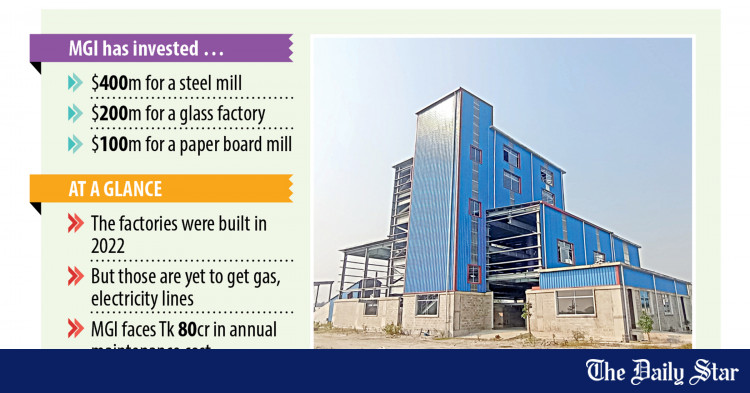
Three production units owned by Meghna Group of Industries (MGI) have been sitting idle inside the Cumilla Economic Zone despite two years having passed since construction works were completed due to a lack of gas and power connections

The industrial conglomerate has already invested $700 million in the three units, with $400 million going towards a steel mill, $200 million for a glass factory and $100 million for a paperboard manufacturing unit, according to Mostafa Kamal, chairman and managing director of MGI.

Additionally, the company has been incurring around Tk 80 crore in annual losses since 2022 to maintain the inactive units, Kamal said.

Officials blame the previous government's allocation of land to the private sector players without adequate assessment

He added that the Bangladesh Economic Zones Authority (Beza) could not provide any answers about when gas and power supplies would be ensured. Instead, public officials blame the previous government's allocation of land to the private sector players without adequate assessment.

The Cumilla Economic Zone, located in the district's Meghna upazila along the Dhaka-Chattogram highway, spans 350 acres.

While recalling the tumultuous timeline so far, Kamal said BEZA held a multilateral meeting featuring representatives from the Gas Transmission Company (GTCL), Petrobangla, Titas Gas Transmission and Distribution Company Limited (TGTDCL), Cumilla EZ and the Energy Division in 2022.

Various decisions were made to speed up the process of providing electricity and gas connections, but none have had any tangible impact yet.

To speed up the connection process, Kamal said MGI even provided an additional Tk 100 crore for the development of the grid network and Tk 100 crore for GTCL's pipeline infrastructure.

But the slow rate of progress is frustrating, he added. Ashik Chowdhury, executive chairman of both Beza and the Bangladesh Investment Development Authority (Bida), said discussions were underway with MGI and utility service providers to find a solution.

An inter-ministerial meeting will be held to speed up the process of providing gas and electricity connections to the economic zone, he added.

Chowdhury also blamed the previous government's "indiscriminate" land allocation to the private sector for the current situation.

Shahnewaz Parvez, the managing director of TGTDCL, said they could not currently provide new connections to industries and economic zones due to an ongoing national gas crunch.

A meeting regarding gas connections for economic zones was held by Petrobangla recently, where it was decided to seek a final decision from the Ministry of Power, Energy and Mineral Resources, Parvez said.

He added that the situation could worsen if adequate liquefied natural gas is not imported.

Abdur Rashid Khan, managing director (additional charge) of PGCB, said they provide high-voltage industrial connections while distributors like the Bangladesh Rural Electrification Board (BREB) give connections to private economic zones.

"I am not aware of any application from the Cumilla Economic Zone," he told The Daily Star.​
 
Analyze

Analyze Post

Add your ideas here:
Highlight Cite Respond

Energy rationing causes industrial output fall
Syed Mansur Hashim
Published :
Nov 27, 2024 00:43
Updated :
Nov 27, 2024 00:43

1732667988558.webp


That the business community is upset is quite understandable. Business entities had poured in billions of Taka (BDT) over the years to expand industrial production on false promises made by policymakers of the immediate past regime. Assurances have turned out to be hollow and are now beginning to bite. These were some of the complaints voiced by business representatives at a seminar titled 'Ways of Mitigating Energy Crisis in the Industrial Sectors', organised by the Bangladesh Chamber of Industries (BCI) recently.

The energy advisor agreed with the predicament the industrialists face today, i.e. falling energy supplies vis-à-vis increased cost of energy inputs, the two together providing the perfect perspective for industrial stagnation. Forget about industrial growth, the current state of affairs is going to lead to factory closures and a curtailment of existing industrial production capacity.

While it is easy to blame the excesses of a previous regime, the quandary for the present energy advisor is what to do with the dwindling energy reserves at hand. There is no point in crying over spilled milk. Several useful recommendations were made at the seminar. First of all, there is no denying the fact that since the entire energy system is essentially state-owned, the issue of pilferage has largely remained unaddressed.

Despite claims made over the years by many utility companies that they have tried to stop the illegal connections, their efforts were meaningless in addressing the issue for two reasons: (1) corrupt practices by a section of officials, and (2) the influence exerted by local political elements directly involved in handing out such illegal connections, for personal profit. Now there is a non-partisan government in power. What excuse is there for tolerating such practices? As per data, plugging the loopholes in the system would save around 10 per cent of daily gas production, precious natural gas that could feed energy-starved productive sectors of the economy.

Interestingly enough, this government too has shied away from taking tough decisions when it comes to conserving natural gas. In an age of unprecedented fall in production, foot dragging continues on the issue of allowing for CNG supplies. This was a disastrous decision taken decades ago by another government that was under the impression that Bangladesh would forever be 'floating on gas' - something that turned out to be a mirage. Two decades later, the continued wastage of this precious fuel that should have been reserved for industrial use is instead, being burnt away uselessly as auto-gas.

As for business entities, the smart ones foresaw the writing on the wall. Some entities used past profits to electrify their factory rooftops with multi-megawatt solar solutions to wean off REB bills. The investments paid off rather fast thanks to availability of the right type of credit at hand. Other industrialists foresaw the possibility of an energy crunch and many RMG factory owners shifted their boiler technology to consume 'jhut' and other waste products coming from their factory lines. Yet others went a step further and turned their entire industrial production 'green' and reaped the profits by tapping into value-added orders from abroad. These steps were taken by a handful of industrial groups and they have survived the continued contraction of energy supplies. That is not the case with the bulk of industry. As for policymakers, there is no good news round the corner. It is time to take some hard decisions and clamp down on the corruption-riddled operations of state enterprises that constitute the energy sector. Take action now while there is still some hope of conserving what little resource there is.​
 
Analyze

Analyze Post

Add your ideas here:
Highlight Cite Respond
When India launched solar energy policy, the tariff of 1 unit of electricity was rs. 13. At that time I used to hear that it will fall below Rs 2 by 2030. However, that happened in Gujarat couple of years back. I recommend BD and Pakistan to go for Solar power in large scale. It has become a very cost-effective source of power now a days. It comes with no pollution and damage to environment.
 
Analyze

Analyze Post

Add your ideas here:
Highlight Cite Respond
When India launched solar energy policy, the tariff of 1 unit of electricity was rs. 13. At that time I used to hear that it will fall below Rs 2 by 2030. However, that happened in Gujarat couple of years back. I recommend BD and Pakistan to go for Solar power in large scale. It has become a very cost-effective source of power now a days. It comes with no pollution and damage to environment.
Solar technology is still in its infancy. Widespread use of solar power needs more time.
 
Analyze

Analyze Post

Add your ideas here:
Highlight Cite Respond

Diesel to flow thru 250km Ctg-Dhaka pipeline mid-Dec

1732753668344.webp


Bangladesh is set to reach a milestone in fuel transport with the commissioning of the 250-kilometre Chattogram-Dhaka diesel pipeline in the middle of December.

The launch of the first underground pipeline -- from the port city's Patenga area to Godnail and then to Fatullah on the outskirts of the capital -- is expected to save about Tk 230 crore every year in fuel transport costs, according to officials of the Bangladesh Petroleum Corporation.

At present, diesel is transported from Chattogram to the rest of the country by river, rail and road, which causes frequent incidents of oil theft.

Besides, problems arise in fuel transportation due to the navigability crisis on waterways during the dry season. This often leads to disruption in fuel supply.

BPC is implementing the project at a cost of Tk 3,600 crore through the 24th Engineer Construction Brigade of the Bangladesh Army.

The pipeline has already gone through a hydro test with water successfully transmitted from one end of the pipeline to the other, according to Colonel Jahangir Hossain, the project director of the 24th Engineer Construction Brigade.

There are nine pumping stations in the pipeline and the equipment of the stations are being tested.

"I hope we will be able to commission the pipeline by mid-December," Hossain added.

The pipeline can transport 2.7 to 3 million metric tons of diesel annually, which can be increased to 5 million metric tons in stages.

In fiscal 2023-24, 5.4 million metric tons of fuel were transported by waterways across the country, according to BPC.

Of this, 2.7 million metric tons were transported from Chattogram to Godnail and Fatullah depots in Dhaka. Currently, 110 ships carry fuel on this route every month.

The long-awaited pipeline has two segments: a 241.28-kilometre 16-inch diameter pipeline from Patenga to Godnail depot in Narayanaganj through Feni, Cumilla, Chandpur and Munshiganj and an 8.29-kilometre 10-inch diameter pipeline from Godnail to Fatulla.

The pipeline from Patenga to Godnail has touched the bottom of 22 rivers and canals. Out of these, 10 are large rivers.

A new depot with a capacity of 21,000 metric tons has been built in Barura, Comilla.

The storage capacities at the Godnail and Fatullah depots have also been increased, said Aminul Haque, who is acting as the project director on behalf of BPC.

The Executive Committee of the National Economic Council approved the 'Fuel Supply from Chattogram to Dhaka Pipeline' project at a cost of Tk 2,861.31 crore in October 2018.

After amending the development project proposal several times, the cost has now reached Tk 3,600 crore. The project implementation period has been set until December this year.

It is the second underground fuel pipeline project after the 110-kilometre Single Point Mooring (SPM) Project from the deep sea in Maheshkhali to the Eastern Refinery in Chattogram.

Although the trial transmission of the twin pipeline for diesel and crude oil was completed on February 29 and March 9 respectively this year, commercial operation has been stalled in the absence of an operator.

The SMP was built to transport fuel to the depot directly from a deep-sea mooring.

Currently, imported fuel from Chattogram Port is transported to the depot through feeder vessels.

During the previous Awami League government, the single-source tendering method was followed in appointing an operator for the SPM project, according to BPC officials.

The interim government has now started the process of appointing an operator for SPM following the open tender method.

Contacted, BPC Chairman Md. Amin ul Ahsan told The Daily Star that the current government has decided to appoint the Chinese company that built the project as the operator on a government-to-government basis.

The operator will soon start the SPM project after completing the due process, he added.​
 
Analyze

Analyze Post

Add your ideas here:
Highlight Cite Respond

Titas loses Tk 3,000cr amid rising system losses across Bangladesh
Emran Hossain 29 November, 2024, 00:24

1732841640498.webp


Bangladesh’s largest gas distributor lost gas worth about Tk 3,000 crore during the past financial year as its system loss climbed further up compared with the year before.

The system loss, as reported by the state-owned company, Titas Gas Transmission and Distribution Company Limited, reached 7.66 per cent in 2023–24, up from 5.28 per cent reported in 2022–23.

The overall loss of the company, responsible for supplying gas to about 30 lakh customers, mainly in five zones in Dhaka and Mymensingh, increased by 350 per cent.

Titas gas distributes 55 per cent of all gas produced annually.

The officially-announced system loss has always been viewed with suspicion. In 2022, a government analysis revealed the year’s system loss to be 13 per cent against the officially-announced 2 per cent.

‘The system loss more or less has been the same always,’ said Arpana Islam, general manager, finance division of Titas gas.

She did not admit that the system loss was ever as high as 13 per cent but confirmed that it was never 2 per cent either.

Officially, 2 per cent system loss was announced in 2021 and 2020 as well.

Titas officials also said that the system loss was never actually calculated. The loss was kept at 2 per cent following a decision of the energy ministry, they said.

Energy experts long accused Titas of corruption, gas theft and inefficiency and cited the mismatch in the account of system loss as evidence.

Authorities, however, came up with explanations, such as, its decades-old rusty and porous pipe line causing a substantial loss of gas every year.

In the past financial year of 2023–24, the Titas’s finance division said that the company received 15,698 million cubic metres of gas and sold 14,495mmcm.

The sale of the gas earned the company Tk 35,692 crore.

The gas supply under the non-metered category, providing piped gas to households, increased by 5mmcm, though there was no reason for the supply to increase. A moratorium on giving new connections to households has been in place for about a decade due to rapid depletion of the gas reserve.

The 5mmcm of gas is equal to over 41 lakh tonnes of oil.

Household remains the country’s single-largest gas consumer category.

The increase in household gas supply indicates unabated theft of gas which often occurs with the help of the department’s officials through illegal gas connections.

Energy experts argue that establishing illegal connections by reaching gas pipelines buried deep under the earth is not possible without help from government officers.

Entire villages and neighbourhoods in cities can be found that run on illegal gas connections with pipes dangling dangerously overhead or running along the ground, exposed to direct human and transport contacts.

Titas has failed to come up with an exact account of illegal connections though the problem persists over decades.

In 2022–23, Titas disconnected 2.82 lakh illegal connections through which all types of consumers—industries, households, commercial clients and captive consumers—were involved in gas theft. Allegations are there that disconnected connects are usually are re-established bringing opportunity to the corrupt officials to make yet another round of illegal income.

The gas supply to industries dropped by almost 6 per cent in the last financial year with the supply in the sector falling to 3,842mmcm from 4,075 mmcm.

The drop in the industrial gas supply is shocking and runs counter to the narrative developed by the immediate past Awami League government about a robust economic growth.

‘Energy crisis led to the drop in the industrial gas supply,’ said Kazi Mohammad Saidul Hasan, general manager, operation division of the Titas gas.

‘The pressure of gas was particularly very low. Industries require high pressure for production,’ he explained.

Industrialists said that their reliance on liquefied petroleum gas greatly increased in the past year because the government had failed to ensure energy even after increasing its price.

In January last year, gas prices were increased by up to 179 per cent for industries, power and commercial sectors.

Some consumers, however, received more gas in the past financial year compared with the year before. For example, fertiliser industry received 135 per cent more gas, CNG filling stations received over 9 per cent more gas, while the power sector received 5 per cent more gas.

Titas, supplying gas with 13,391kilometres of pipeline, reported a loss of Tk 744 crore in the past financial year.

The loss rose by more than 350 per cent compared with the previous year for what the company said a rise in tax. Titas now needs to pay a minimum tax.

In the past financial year, Titas paid Tk 872 crore in tax against its distribution margin of Tk 303 crore.

Titas is a non-profit company that is allowed to charge only Tk 0.23 for distributing a cubic feet of gas.

In March 2022, Bangladesh Energy Regulatory Commission revealed in a public hearing that Titas was charging its customers far more than it should regarding its actual supply.

Then Titas managing director Md Haronur Rashid Mullah admitted at the public hearing that 10 per cent of his employees might be dishonest.

Titas has nearly 2,000 staff.​
 
Analyze

Analyze Post

Add your ideas here:
Highlight Cite Respond

Govt should stop theft, corruption to fish Titas out of trouble
30 November, 2024, 00:00

GAS supply to households has increased despite a moratorium on fresh connections that has been in place for about a decade because of gas reserve depletion. Gas supply to industries declined by about 6 per cent in the 2024 financial year, falling from 4,075 million cubic metres to 3,842mmcm. And, the overall loss of Titas Gas Transmission and Distribution Company, which supplies gas to about three million consumers mainly in five zones in Dhaka and Mymensingh, increased by 350 per cent in the 2024 financial year in comparison with the loss the company incurred in the 2023 financial year. Titas, which supplies gas using a pipeline network spanning 13,391 kilometres, in the 2024 financial year reported Tk 7.44 billion in losses. Titas, however, says that the loss largely resulted from the company having to pay taxes, which has been made mandatory, to the state exchequer. With the tax issue having been set aside, a 2022 government analysis put the system loss at 13 per cent against the official figure of 2 per cent, which experts have always viewed with suspicion. The system loss has almost always been the same, as the general manager of the company’s finance division general manager says. The official seeks to say that it has never been as high as 13 per cent and neither has it ever been as low as 2 per cent.

Titas officials say that the system loss of the company has never been calculated and the figure has been put at 2 per cent in keeping with a decision of the energy ministry. This shows that the company has almost always resorted to the juggling of figures to cover up the theft of gas and the inefficiency of the company management. Energy experts have for long blamed Titas for its corruption, the theft of gas and inefficiency, which they believe are evident in the mismatch of the account of its system loss. The authorities have always sought to explain that the leak of gas sent through rusty and porous pipes were causing a substantial loss of gas every year. An increase by five million cubic metres, which is equivalent to more than 4.1 million tonnes of oil, in the supply of gas to non-metered households with no fresh connection having been offered for about a decade, as experts believe, is reflective of unabated gas theft through illegal connections, which are mostly done with the connivance of Titas officials and employees. The company in the 2023 financial year severed 282,000 illegal connections used by consumers of all categories — industries, households, commercial clients and captive consumers. The managing director of Titas at a hearing that the Energy Regulatory Commission held in March 2022 said that 10 per cent of Titas employees might be dishonest. The situation can be well assumed to have so far persisted as it has not improved.

The government should, therefore, earnestly stop the theft of gas, corruption within the agency and attend to issues of inefficiency to fish Titas Gas Transmission and Distribution Company out of trouble.​
 
Analyze

Analyze Post

Add your ideas here:
Highlight Cite Respond

PDB to give up role as sole buyer of electricity from private producers

1733012702943.webp


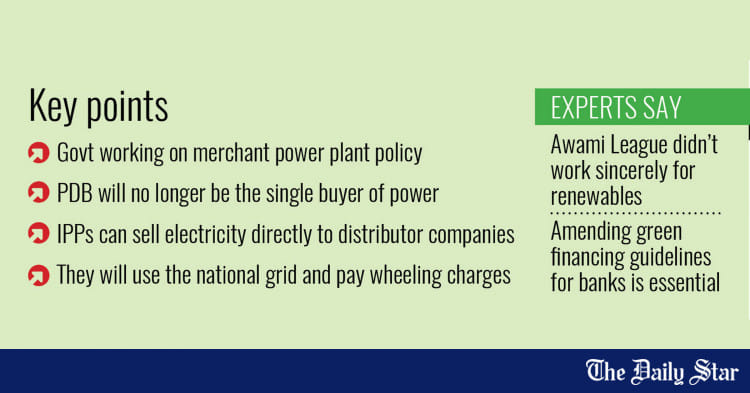
The Bangladesh Power Development Board (PDB) will no longer be the sole buyer of electricity produced by independent power producers (IPPs), said Fouzul Kabir Khan, adviser to the Ministry of Power, Energy and Mineral Resources.

He said the government is working on a merchant power plant policy, under which the PDB will purchase a minimum 10-20 percent of total power offtake from any new private plants.

Currently, the PDB is the sole buyer of electricity in the country, purchasing power from IPPs and through import and then reselling it to six distributor companies. The government also guarantees a minimum offtake. If the PDB is unable to purchase that amount, they pay IPPs for unproduced power.

However, the adviser said for any agreements made under the new policy, the private producer has to sell electricity directly to buyers or distributor companies by paying wheeling charges to use the national grid.

The adviser was addressing a seminar, titled "Energy Transition to Renewables: Role of Domestic Financial Institution", organised by the Economic Reporters Forum (ERF) at its auditorium yesterday.

About the barriers hindering the transition to renewables, Khan said one major reason was that the Awami League government set renewable energy targets but did not work sincerely towards those.

"Banks have financed many projects seeing the faces of the people, not based on the assets of investors or after checking balance sheets," he said.

"There is a myth that land scarcity poses an obstacle to setting up solar power plants, but this is not true," he said, adding that the government had acquired plenty of land that is not being utilised properly.

"We don't have any other choices but to go towards renewables," Khan stressed.

Regarding the demand to reduce import duties on items used for solar energy projects, he said they had already withdrawn advance income taxes and other duties on such products.

However, he stressed that they would emphasise local production.

"If you ask to reduce import duties on cables, how would it be logical? We have local cable manufacturers. There is nothing we cannot produce locally. If we want to be self-contained, we need to go for local manufacturing of panels, inverters, batteries and so on," he added.

While presenting the keynote paper, Gouranga Nandy, chairperson of the Centre for Environment and Participatory Research, said the country will require a staggering Tk 87,000 crore in investment over the next six years to achieve the renewable energy target to have a mix of 30 percent renewable energy in its total power generation by 2030.

He said domestic commercial banks need to scale up investment in solar and wind power projects if the country wants to meet its renewable energy goal.

Citing Bangladesh Bank data, he said domestic banks have invested around Tk 73,000 crore in green and sustainable projects in the last six years, but less than 3 percent went to renewable energy projects.

Khondaker Golam Moazzem, research director at the Centre for Policy Dialogue, said the banks usually lend on a six to eight-year repayment method, which is tough for a renewable project as it takes more time for such initiatives to turn a profit.

"It takes around 10-12 years for repayment and the banks need to ease their policy," he said.

Hasan Mehedi, chief executive of CLEAN, a co-organiser of yesterday's event, said each megawatt of installed solar power would annually save the country Tk 26.1 million worth of furnace oil imports.

He suggested Bangladesh Bank amend the green financing guidelines for local banks.

ERF President Refayet Ullah Mirdha chaired the event while City Bank's Chief Economist Ashanur Rahman, Action Aid's Abul Kalam Azad, and Campaign for Sustainable Rural Livelihoods' Ziaul Hoque Mukta also spoke.​
 
Analyze

Analyze Post

Add your ideas here:
Highlight Cite Respond

Members Online

No members online now.

Latest Posts

Back
 
G
O
 
H
O
M
E