This Unassuming Village Produces Some of the World’s Strongest Mountaineers
Unlike their Nepalese counterparts, Pakistan’s untrained high-altitude workers seldom have their own guiding companies or receive acknowledgement for their vital role in mountaineering. But a shift could be on the horizon.
Bernadette McDonald
June 11, 2024
Photo: Simone Moro collection
Camp 3 was dreamlike and cold, the full moon bathing the tent in an ethereal light and illuminating the elusive summit 1,400 meters above. Four climbers—Alex Txikon from Basque country, Tamara Lunger and
Simone Moro from Italy, and Ali Sadpara from Pakistan—shared one goal: the historic
first winter ascent of Pakistan’s second-highest mountain, Nanga Parbat (8,125m). Ali was the workhorse on the team, breaking trail, carrying massive loads, and rigging most of the lines, all without supplemental oxygen.
On day 56 of the expedition, the team arrived at Camp 4 (7,100m) at 3:30 p.m. At 6:00 the next morning, they crept from their tent into a pitch-black world, an unforecasted polar jet stream hitting them like a punch to the face. The tiny orbs of light from their headlamps slashed at the darkness as they climbed.
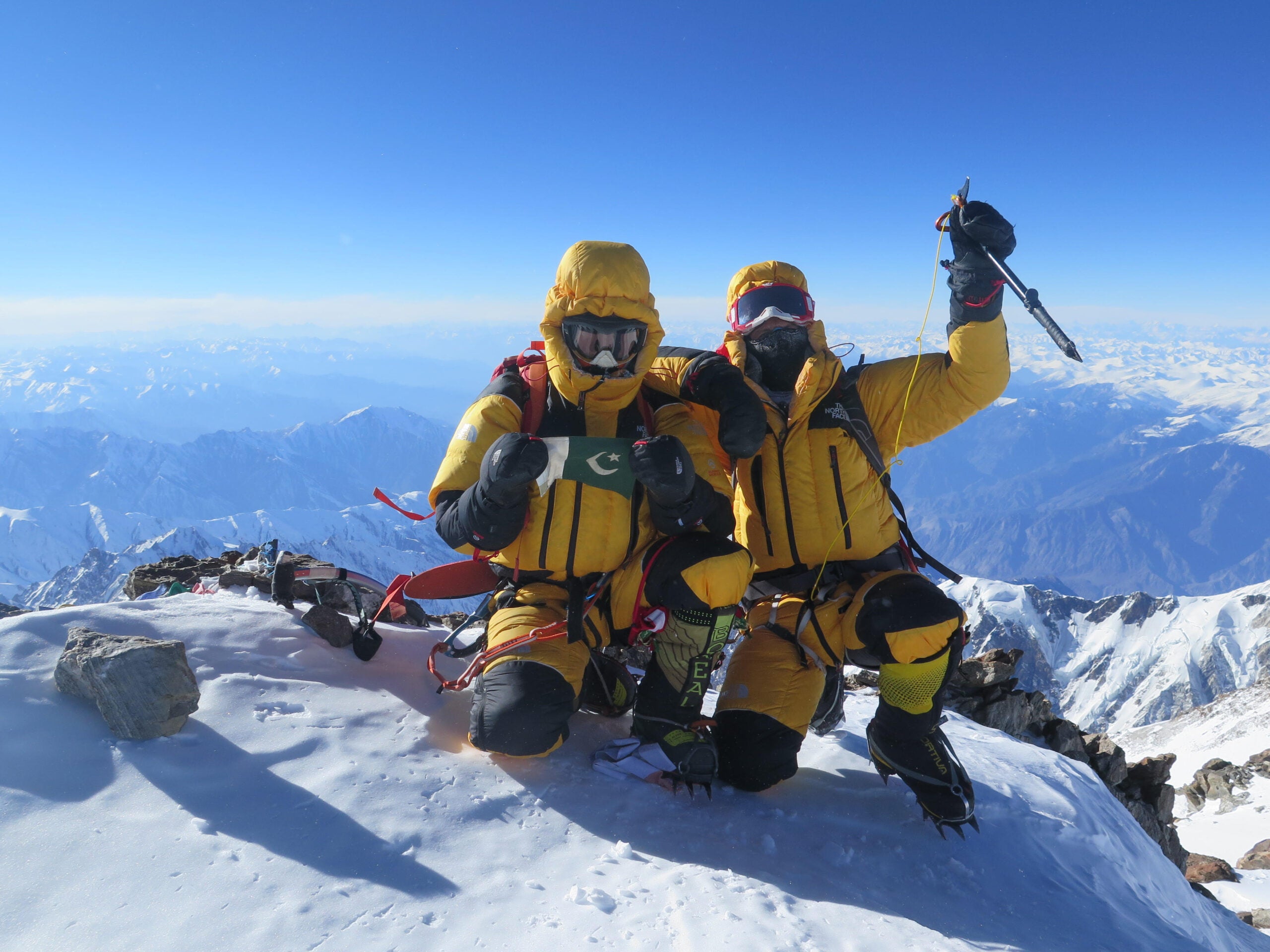
Moving faster than the others, Ali stopped five meters from the summit to let his partners catch up. He waited, banging his arms together, shuffling his feet, trying to stay warm. When Alex reached him, the pair fell to their knees, embracing each other. Tamara had turned back, but Simone eventually appeared. Each had fought for their life against the harsh winter elements, battling to keep the horrendous cold and shrieking wind from piercing their skin, and now they were on the summit.
It was February 26, 2016, and it was a historic moment. Alex, Simone, and Ali had done what 34 teams over the last 50 years had failed to do: make the first winter ascent of Nanga Parbat. In the following days, all of Pakistan celebrated, draping garlands of flowers around the climbers’ necks. Crowds cheered, calling Ali a national hero. Although they may not have known his name before, they did now—and they knew where he was from.
Ali Sadpara and his son Sajid near their home in northern Pakistan. Photo: Sajid Sadpara Collection
Like most people from northern Pakistan, Ali’s last name, Sadpara, is also the name of his village, where 2,000 people live in a maze of narrow alleyways lined by two-story clay and stone houses. Sadpara is a largely colorless place, with the occasional splash of red from a jacket drying in the sun or the turquoise of a freshly painted door. There are no coffee houses or restaurants.
Motorized vehicles are absent because the cobbled roads are barely wide enough for pedestrians. An open water channel flows through the streets. The odd chicken pecks and clucks. It’s quiet. It’s hard to imagine that this place is home to some of the strongest mountaineers in the world—and that most of the local climbers have made multiple ascents of Pakistan’s five 8,000-meter peaks.
Considering the number of world-class climbers hailing from small villages like Sadpara, it seems preposterous that young Pakistani climbers learn their dangerous trade on the job. While the lucrative allure of Everest has brought several enviable training facilities to neighboring Nepal, these centers took significant foreign financial backing and years of effort to create. But there has been little appetite for replicating them in Pakistan. Of course, the countries’ climatological and geographical differences play a role: Nepal has two distinct climbing seasons while Pakistan has one. Nepal has eight 8,000ers. Pakistan has five. But the impact of training is undeniable: there are over 70 internationally qualified Nepali mountain guides. Pakistan has none.
As a result, Sadpara climbers have long relied on local mentors rather than formal programs for their high-altitude knowledge. But that may soon change.
Born Muhammad Ali Sadpara in 1976, Ali was the youngest of 11 children, eight of whom didn’t survive childhood. He shepherded livestock with his father in the pastures above Sadpara until, in his 20s, he got a job with a Korean cleanup expedition to K2, clearing the high camps of shredded tents, food waste, and fixed lines. His first summit was in 2006 when he hoisted Pakistan’s green crescent flag on the 7,029-meter Spantik Peak.
He summited Gasherbrum II (8,034m) later that year, breaking trail, fixing lines, carrying massive loads of supplies and oxygen, and setting up camps for clients. Word of his first 8,000-meter summit followed him home, where his neighbors placed the ritual garland around his neck and did much congratulatory tea drinking. Two summits of Nanga Parbat followed, then Gasherbrum I (8,080m) in 2010. Paying climbers wanted him on their expeditions for his strength and natural intelligence, complemented by a curious and sincere temperament. His smile could light up a tent.
In 2011, Ali joined a Polish winter expedition to Broad Peak (8,051m). When the team reached Camp 2 during their summit bid, they discovered their tents had blown away. They spent the night sitting in the remains of a tattered tent abandoned by a previous expedition: no floor, drifting snow, and nearly –50°F temperatures. Sixty-mile-per-hour winds prevented them from even crawling into their sleeping bags.
Ali had never experienced conditions so harsh, and endured frostbite on his toes as a result. When he attempted Gasherbrum I the following year, he learned that the frostbite from Broad Peak would bother him for the rest of his life.
Ali’s historic winter ascent of Nanga Parbat earned him respect from the global climbing community and the Pakistani government. However, despite his achievements, he faced challenges gaining financial support. Nevertheless, he continued to make significant strides. He completed a fourth ascent of Nanga Parbat, a winter ascent of Pumori (7,161m) in Nepal, and attempted Everest. In 2018, he climbed K2, and the following year, he summited both Lhotse (8,516m) and Makalu (8,485m).
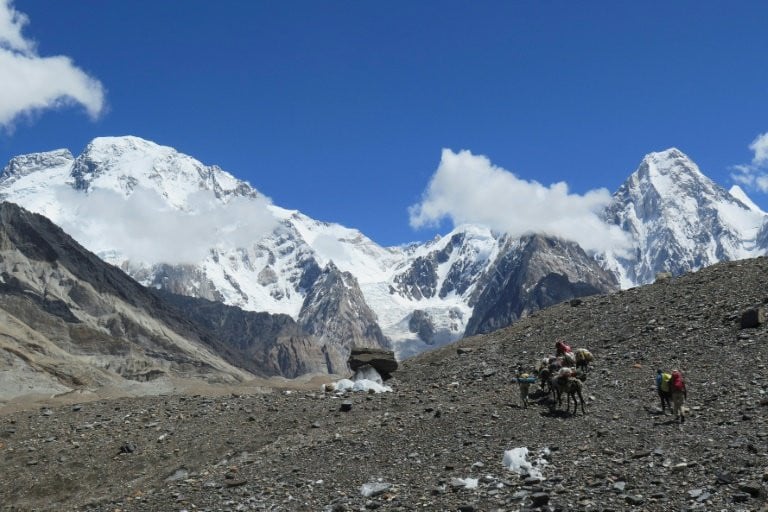
K2 as seen from the Baltoro Glacier, Pakistan. Photo: Brad Jackson/Getty
But winter climbs continued to entice Ali, and K2 still had not seen a winter ascent. In December 2020 he, his son Sajid, and their Icelandic client, John Snorri, arrived at K2, hoping to make a bid for the summit. There were more than 60 climbers at base camp, which was buzzing with competition. The trio began fixing ropes immediately.
By January 12, the fixed lines reached Camp 3. Then, a series of storms pinned everyone down in base camp. Finally, one weather forecaster predicted a short good weather window. Nepali climbers Mingma G and Nirmal (“Nims”) Purja joined forces and began heading up the mountain with a 10-person Nepali team.
But Ali and his group followed a different forecaster and remained in base camp. The Nepali team topped out four days later. Their summit video went viral on social media. What a sight: ten Nepalis singing their national anthem as they touched the 8,611-meter summit of K2 for the first time in winter.
As happy as Ali was for his friend Mingma G, it was a crushing blow.
Unlike their Nepalese counterparts, Pakistan’s untrained high-altitude workers seldom have their own guiding companies or receive acknowledgement for their vital role in mountaineering. But a shift could be on the horizon.

www.climbing.com


 General