Bangladesh Defense
Saif
Senior Member
- Jan 24, 2024
- 20,857
- 9,685
- Nation

- Residence
- Axis Group


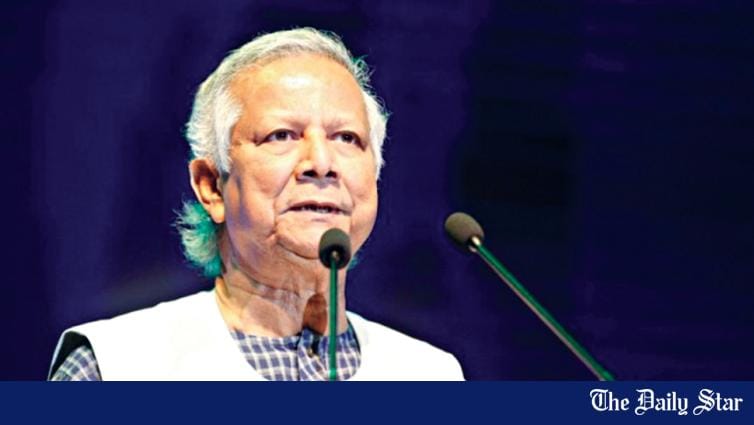
Yunus under criticism over privileges
Nobel laureate Professor Muhammad Yunus, acclaimed globally for his microcredit and other works, has come under criticism recently from various quarters after several of his Grameen entities received official approvals and other facilities since he took office as...
 www.newagebd.net
Yunus under criticism over privileges
Solamain Salman 09 May, 2025, 00:29

Nobel laureate Professor Muhammad Yunus, acclaimed globally for his microcredit and other works, has come under criticism recently from various quarters after several of his Grameen entities received official approvals and other facilities since he took office as chief adviser to the Bangladesh interim government on August 8, 2024 following the ouster of the Awami league regime amid a student-led mass uprising.
Yunus-founded organisations, businesses or initiatives that have received approval and other facilities over the past eight months included a private university, a digital wallet service, a manpower export licence, the reinstatement of Grameen Bank’s tax exemption for five years, and a reduction in government stakes in Grameen Bank to 10 per cent from 25 per cent.
Apart from these entities, the cases, including a labour law violation case and a money-laundering case, against Yunus and his colleagues were also dismissed without completing the trial proceedings soon after he came to power, raising questions.
Asked, jurist Shahdeen Malik said that there would be a certain perception about the facilities received and, in popular perception, the steps may give rise to skepticism and loss of trust in the chief adviser.
‘And also conflict of interest is another dimension which should have been considered more seriously,’ he added.
The government on March 17 approved a private university named ‘Grameen University’ in Dhaka, which will operate under the Grameen Trust, established by Yunus.
Grameen Telecom’s current chair, Md Ashraful Hassan, also chair of the proposed Grameen University’s board of trustees, submitted an application on December 17, 2024 seeking approval for the new university.
Within three months of the application, the university received the approval, and it is the first private university that was approved since the interim government came to power.
Contacted, University Grants Commission member Professor Mohammad Anwar Hossen said, ‘Three UGC members along with officials inspected the campus of Grameen University and made a report that was sent to the education ministry.’
Noting that there was no influence from anyone regarding the report, he said, ‘We made the report in accordance with the Private University Act, 2010.’
Asked, Gonotantrik Odhikar Committee (democratic rights committee) member and former Jahangirnagar University economics professor Anu Muhammad told New Age, ’While he (Muhammad Yunus) is in the position of chief adviser, it looks odd for organisations to take such privileges, which he founded.’
He further said, ‘Providing special privileges to all Grameen institutions, the reduction in the government share [in Grameen Bank], or the [favourable decisions on] personal cases against Professor Yunus do not seem to have been handled in a clean manner.’
Mentioning that injustice and persecution were faced by Professor Yunus during the previous regime, he said, ‘However, the process in which his cases were resolved does not seem to have been clean.’
Anu Muhammad also observed that there is now no sign that the country’s courts are currently not being run under any political influence or orders from above.
In January 2025, Grameen Employment Services Limited, also established by Yunus, received a lucrative manpower export licence, numbering RL No. 2806, from the Bureau of Manpower, Employment and Training, while the company also became a member of the Bangladesh Association of International Recruiting Agencies in April.
GESL managing director, Qazi Nazrul Huque, who also heads the Grameen Shikkha, said that the GESL had applied for the licence first in 2009, but the previous government had left it unapproved over the years due to political reasons.
Nazrul went on to say that the GESL aim is to train skilled manpower and facilitate overseas employment for them.
While 90 per cent of the company’s shares are owned by the Yunus Centre, the remaining 10 per cent are held by the Grameen Shikkha.
Soon after Yunus took the charge as chief adviser, Samadhan Services Limited, a concern of Grameen Telecom, secured approval for becoming a payment service provider in Bangladesh on September 2, 2024.
Samadhan received the required ‘no objection certificate’ from the Bangladesh Bank, which cleared the way for Samadhan Services to obtain its PSP licence.
Contacted, Grameen Telecom managing director Md Nazmul Islam told New Age that they had applied for a PSP licence in November 2021 after fulfilling all the requirements, but the central bank did not give the approval until August 2024.
‘We neither lobbied nor used influence for getting the NOC,’ he said, adding that Grameen Telecom did not take any undue advantage from the government using influence of the chief adviser.
Repealing the Grameen Bank Ordinance 1983, under which Grameen Bank was established, the then Awami League-led coalition government in 2013 enacted the Grameen Bank Act, 2013 to replace the ordinance.
The interim government on April 17 decided in principle to issue a new Grameen Bank Ordinance, reducing the government stake in Grameen Bank to 10 per cent from the existing 25 per cent.
The approval was given in a meeting of the advisory council chaired by chief adviser Muhammad Yunus.
The new ordinance also sought to enhance the control of the shareholders over Grameen Bank by increasing their stakes to 90 per cent from the existing 75 per cent.
As per the amendments, nine board members are to be elected from among the beneficiaries. From among the nine board members, three directors are to be nominated while the chair is to be selected by the board from among the three directors. This process removes the government’s role in appointing the bank’s chair.
In addition, two months after Yunus took over as the chief adviser the National Board of Revenue granted Grameen Bank a tax exemption for five years until 2029, according to a statutory regulatory order issued on October 10, 2024.
NBR officials, however, pointed out that since its establishment in 1983 Grameen Bank had been receiving the tax exemption benefit, but the exemption was cancelled in 2020 by the then government.
The tax exemption order came following a letter submitted by Nur Mohammad, managing director of Grameen Bank, to the NBR seeking the tax exemption facility.
NBR chair Abdur Rahman Khan said, ‘Other microfinance institutions in the country have also been receiving tax exemptions on their income.’
Asked about the privileges received by Yunus-founded entities, Transparency International Bangladesh executive director Iftekharuzzaman said, ‘As the relevant decisions are about entities having involvement of the head of the interim government and as he is entrusted with the responsibility to lead the country’s transition to a transparent and accountable system of governance in the wake of the fall of a regime that normalised abuse of power, it would be expected that no violation of the due process has taken place nor any conflict of interest was involved during the time.’
‘To avoid any possible perception of wrongdoing or undue advantage, it would be helpful if the key justifications based on which the relevant decisions were reached are proactively disclosed for public information, especially to demonstrate that no conflict of interest was involved,’ he added.
On the other hand, just three days after Yunus took oath as the chief adviser on August 8, 2024, a Dhaka court acquitted him in a money laundering case that was under trial.
Besides, just a day before his oath on August 8, Yunus, also the then chair of the Grameen Telecom, and the company’s directors were also acquitted in a labour-law violation case in which they were sentenced to six-month imprisonment on January 1, 2024.
Asked, the chief adviser’s press secretary Shafiqul Alam said that the recent approvals for Grameen entities or facilities, including a private university, a manpower export licence, and a digital wallet licence, were given following due procedures and without any influence by the chief adviser.
The allegations of taking undue advantages against Professor Yunus and his entities were a smear campaign by a quarter, he observed.
‘Professor Yunus had a dream to establish a world-class university and applied for the university in 2012. But it did not get approval from the previous government due to political vendetta against him,’ Shafiqul told New Age on Monday.
He said the interim government led by Professor Yunus has just disposed of the long-pending applications of the Grameen entities.
Apart from this, the decision to reduce the share of the government in Grameen Bank has also been taken for the benefit of the women shareholders of the bank and Professor Yunus did not influence in the case, nor did he take any benefit from the bank, the press secretary categorically explained.
Although Professor Yunus has founded the entities but currently he is not involved in any of them and he has no share in these organisations, he added.
About the cases withdrawn or dismissed recently, Shafiqul said the lawyers concerned could better explain it.
Professor Yunus on several occasions has also announced that he does not have any personal property.
The 84-year-old Yunus, who is credited with lifting millions out of poverty with his pioneering microfinance bank, did face more than 170 cases over various charges during the AL regimes.
The cases filed against him were decried by different quarters as politically motivated and aimed to harass him but the quick dismissal of the cases soon after he came to power raised questions.
The Grameen Bank and Yunus were jointly awarded the Nobel Peace Prize in 2006 for helping millions out of poverty with small loans.
Yunus reportedly first came to the attention of the Awami League when he formed a political party, Nagarik Shakti, during the army-backed interim regime during 2007–2008.
At that time, Hasina and her main rival, former prime minister Khaleda Zia, were arrested in various corruption cases.
It is said that Yunus and some civil-society figures, including newspaper editors, were trying to remove Hasina and Khaleda from politics, the attempt that has since come to be called the ‘Minus Two Formula.’
Hasina and her Awami League won the national election, returning to power in 2009.
Two years later, Bangladesh’s central bank removed Yunus from his position as the head of Grameen Bank, over a retirement age-related issue.
Hasina blasted Yunus on various occasions and she also blamed him for barring the World Bank funding for the Padma Bridge, an allegation Yunus denied.
Even, Hasina in 2022 publicly said that Yunus should be given two dips in the Padma River before being placed him on the bridge.
Solamain Salman 09 May, 2025, 00:29
Nobel laureate Professor Muhammad Yunus, acclaimed globally for his microcredit and other works, has come under criticism recently from various quarters after several of his Grameen entities received official approvals and other facilities since he took office as chief adviser to the Bangladesh interim government on August 8, 2024 following the ouster of the Awami league regime amid a student-led mass uprising.
- Grameen University approved
- Grameen Employment gets manpower export licence
- Grameen Telecom gets approval for digital wallet
- Govt stake in Grameen Bank lowered to 10pc from 25pc
- Grameen Bank’s 5-year tax exemption reinstated
Yunus-founded organisations, businesses or initiatives that have received approval and other facilities over the past eight months included a private university, a digital wallet service, a manpower export licence, the reinstatement of Grameen Bank’s tax exemption for five years, and a reduction in government stakes in Grameen Bank to 10 per cent from 25 per cent.
Apart from these entities, the cases, including a labour law violation case and a money-laundering case, against Yunus and his colleagues were also dismissed without completing the trial proceedings soon after he came to power, raising questions.
Asked, jurist Shahdeen Malik said that there would be a certain perception about the facilities received and, in popular perception, the steps may give rise to skepticism and loss of trust in the chief adviser.
‘And also conflict of interest is another dimension which should have been considered more seriously,’ he added.
The government on March 17 approved a private university named ‘Grameen University’ in Dhaka, which will operate under the Grameen Trust, established by Yunus.
Grameen Telecom’s current chair, Md Ashraful Hassan, also chair of the proposed Grameen University’s board of trustees, submitted an application on December 17, 2024 seeking approval for the new university.
Within three months of the application, the university received the approval, and it is the first private university that was approved since the interim government came to power.
Contacted, University Grants Commission member Professor Mohammad Anwar Hossen said, ‘Three UGC members along with officials inspected the campus of Grameen University and made a report that was sent to the education ministry.’
Noting that there was no influence from anyone regarding the report, he said, ‘We made the report in accordance with the Private University Act, 2010.’
Asked, Gonotantrik Odhikar Committee (democratic rights committee) member and former Jahangirnagar University economics professor Anu Muhammad told New Age, ’While he (Muhammad Yunus) is in the position of chief adviser, it looks odd for organisations to take such privileges, which he founded.’
He further said, ‘Providing special privileges to all Grameen institutions, the reduction in the government share [in Grameen Bank], or the [favourable decisions on] personal cases against Professor Yunus do not seem to have been handled in a clean manner.’
Mentioning that injustice and persecution were faced by Professor Yunus during the previous regime, he said, ‘However, the process in which his cases were resolved does not seem to have been clean.’
Anu Muhammad also observed that there is now no sign that the country’s courts are currently not being run under any political influence or orders from above.
In January 2025, Grameen Employment Services Limited, also established by Yunus, received a lucrative manpower export licence, numbering RL No. 2806, from the Bureau of Manpower, Employment and Training, while the company also became a member of the Bangladesh Association of International Recruiting Agencies in April.
GESL managing director, Qazi Nazrul Huque, who also heads the Grameen Shikkha, said that the GESL had applied for the licence first in 2009, but the previous government had left it unapproved over the years due to political reasons.
Nazrul went on to say that the GESL aim is to train skilled manpower and facilitate overseas employment for them.
While 90 per cent of the company’s shares are owned by the Yunus Centre, the remaining 10 per cent are held by the Grameen Shikkha.
Soon after Yunus took the charge as chief adviser, Samadhan Services Limited, a concern of Grameen Telecom, secured approval for becoming a payment service provider in Bangladesh on September 2, 2024.
Samadhan received the required ‘no objection certificate’ from the Bangladesh Bank, which cleared the way for Samadhan Services to obtain its PSP licence.
Contacted, Grameen Telecom managing director Md Nazmul Islam told New Age that they had applied for a PSP licence in November 2021 after fulfilling all the requirements, but the central bank did not give the approval until August 2024.
‘We neither lobbied nor used influence for getting the NOC,’ he said, adding that Grameen Telecom did not take any undue advantage from the government using influence of the chief adviser.
Repealing the Grameen Bank Ordinance 1983, under which Grameen Bank was established, the then Awami League-led coalition government in 2013 enacted the Grameen Bank Act, 2013 to replace the ordinance.
The interim government on April 17 decided in principle to issue a new Grameen Bank Ordinance, reducing the government stake in Grameen Bank to 10 per cent from the existing 25 per cent.
The approval was given in a meeting of the advisory council chaired by chief adviser Muhammad Yunus.
The new ordinance also sought to enhance the control of the shareholders over Grameen Bank by increasing their stakes to 90 per cent from the existing 75 per cent.
As per the amendments, nine board members are to be elected from among the beneficiaries. From among the nine board members, three directors are to be nominated while the chair is to be selected by the board from among the three directors. This process removes the government’s role in appointing the bank’s chair.
In addition, two months after Yunus took over as the chief adviser the National Board of Revenue granted Grameen Bank a tax exemption for five years until 2029, according to a statutory regulatory order issued on October 10, 2024.
NBR officials, however, pointed out that since its establishment in 1983 Grameen Bank had been receiving the tax exemption benefit, but the exemption was cancelled in 2020 by the then government.
The tax exemption order came following a letter submitted by Nur Mohammad, managing director of Grameen Bank, to the NBR seeking the tax exemption facility.
NBR chair Abdur Rahman Khan said, ‘Other microfinance institutions in the country have also been receiving tax exemptions on their income.’
Asked about the privileges received by Yunus-founded entities, Transparency International Bangladesh executive director Iftekharuzzaman said, ‘As the relevant decisions are about entities having involvement of the head of the interim government and as he is entrusted with the responsibility to lead the country’s transition to a transparent and accountable system of governance in the wake of the fall of a regime that normalised abuse of power, it would be expected that no violation of the due process has taken place nor any conflict of interest was involved during the time.’
‘To avoid any possible perception of wrongdoing or undue advantage, it would be helpful if the key justifications based on which the relevant decisions were reached are proactively disclosed for public information, especially to demonstrate that no conflict of interest was involved,’ he added.
On the other hand, just three days after Yunus took oath as the chief adviser on August 8, 2024, a Dhaka court acquitted him in a money laundering case that was under trial.
Besides, just a day before his oath on August 8, Yunus, also the then chair of the Grameen Telecom, and the company’s directors were also acquitted in a labour-law violation case in which they were sentenced to six-month imprisonment on January 1, 2024.
Asked, the chief adviser’s press secretary Shafiqul Alam said that the recent approvals for Grameen entities or facilities, including a private university, a manpower export licence, and a digital wallet licence, were given following due procedures and without any influence by the chief adviser.
The allegations of taking undue advantages against Professor Yunus and his entities were a smear campaign by a quarter, he observed.
‘Professor Yunus had a dream to establish a world-class university and applied for the university in 2012. But it did not get approval from the previous government due to political vendetta against him,’ Shafiqul told New Age on Monday.
He said the interim government led by Professor Yunus has just disposed of the long-pending applications of the Grameen entities.
Apart from this, the decision to reduce the share of the government in Grameen Bank has also been taken for the benefit of the women shareholders of the bank and Professor Yunus did not influence in the case, nor did he take any benefit from the bank, the press secretary categorically explained.
Although Professor Yunus has founded the entities but currently he is not involved in any of them and he has no share in these organisations, he added.
About the cases withdrawn or dismissed recently, Shafiqul said the lawyers concerned could better explain it.
Professor Yunus on several occasions has also announced that he does not have any personal property.
The 84-year-old Yunus, who is credited with lifting millions out of poverty with his pioneering microfinance bank, did face more than 170 cases over various charges during the AL regimes.
The cases filed against him were decried by different quarters as politically motivated and aimed to harass him but the quick dismissal of the cases soon after he came to power raised questions.
The Grameen Bank and Yunus were jointly awarded the Nobel Peace Prize in 2006 for helping millions out of poverty with small loans.
Yunus reportedly first came to the attention of the Awami League when he formed a political party, Nagarik Shakti, during the army-backed interim regime during 2007–2008.
At that time, Hasina and her main rival, former prime minister Khaleda Zia, were arrested in various corruption cases.
It is said that Yunus and some civil-society figures, including newspaper editors, were trying to remove Hasina and Khaleda from politics, the attempt that has since come to be called the ‘Minus Two Formula.’
Hasina and her Awami League won the national election, returning to power in 2009.
Two years later, Bangladesh’s central bank removed Yunus from his position as the head of Grameen Bank, over a retirement age-related issue.
Hasina blasted Yunus on various occasions and she also blamed him for barring the World Bank funding for the Padma Bridge, an allegation Yunus denied.
Even, Hasina in 2022 publicly said that Yunus should be given two dips in the Padma River before being placed him on the bridge.