Bangladesh Defense
Saif
Senior Member
- Jan 24, 2024
- 21,100
- 9,688
- Nation

- Residence
- Axis Group


Modernising Bangladesh’s defence is a strategic necessity
A robust defence framework enables a state to protect its interests.
Modernising Bangladesh’s defence is a strategic necessity
19 August 2025, 09:15 AM
Mamun Abdullahi , Tamim Muntasir , and Afsana Rahman

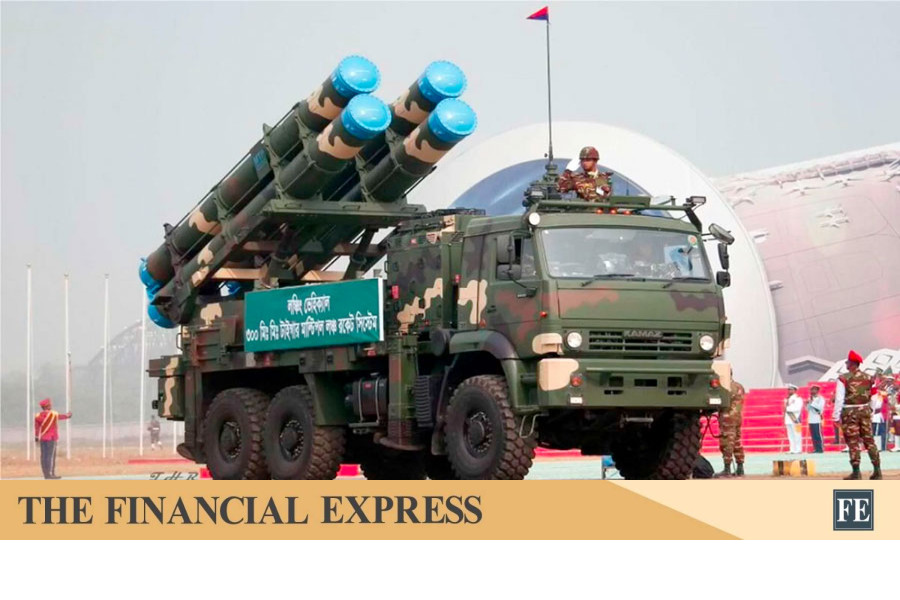
Photo: COLLECTED
Earlier in July, the crash of a Bangladesh Air Force FT-7 BGI training jet into Uttara's Milestone School, which claimed 36 lives and injured over 170, highlighted concerns over the continued use of outdated jets. The FT-7 BGI, a Chinese-made "multi-role" fighter acquired in 2013, is an upgraded version of the Chengdu J-7, produced between 1965 and 2013. The ill-fated jet was among a fleet of approximately 40 such aircraft in Bangladesh's inventory, all sourced from China. Despite its age and limitations, Bangladesh continues to use these jets due to their low cost and training reliability. Experts have long recommended shifting to safer, modern aircraft, but political and financial considerations have kept the ageing F-7 fleet in operation, raising questions about risks for both pilots and civilians.
In an era of rapid technological change, shifting power dynamics, and unconventional security threats (non-military issues disrupting peace), defence has become critical for states seeking sovereignty and stability. A robust defence framework enables a state to protect its interests, support foreign policy, and provide a secure environment for economic growth. Given Bangladesh's location at the crossroads of the Indo-Pacific, the country is vulnerable to being drawn into major power rivalries as competition intensifies in the region.
In this regard, the Dacca Institute of Research and Analytics (DAIRA) published a policy brief, titled "Bangladesh Defence Strategy: Capability Gaps and Future Directions," which examines challenges in Bangladesh's defence planning and outlines pathways for a resilient, forward-looking security architecture. As regional dynamics shift rapidly, addressing capability gaps is essential for safeguarding sovereignty and advancing national interests.
Bangladesh, however, lacks a formal national security strategy. No official document sets out its vision, objectives, or priorities. The concept of "national security" remains poorly defined and largely absent from public discourse, often treated as taboo. As a result, challenges have been managed in a reactive rather than strategic way.
According to Stephen Walt's balance of threat theory, four variables determine the assessment of external threats: aggregate power, offensive capabilities, offensive intentions, and geographical proximity. Applying this framework, Bangladesh's neighbourhood presents significant challenges. Both of its primary neighbours possess substantial offensive capabilities and have at times demonstrated hostile intentions. Proximity intensifies the security dilemma.
The interim government faces mounting security challenges amid shifting geopolitics. The Myanmar border has become a war zone, with Arakan Army attacks prompting new Rohingya influxes. Relations with India have been strained since August 5 last year. One Bangladeshi mission in Agartala even came under attack. Internally, the rise of the Kuki-Chin National Front poses a threat to stability. Conflicts in the Middle East risk disrupting labour exports and remittances. Situated near nuclear-armed China, India, and Pakistan, Bangladesh also faces risks from regional nuclear tensions. These threats underscore the urgent need to strengthen the armed forces for both external defence and internal security.
The recent Iran-Israel confrontation has triggered a global rethinking of national security doctrines. India's response following the Pahalgam incident exemplifies how regional crises can escalate rapidly, catching adversaries unprepared and setting new thresholds for conflict. A future conflict of similar or greater scale could disrupt the regional security architecture, directly impacting Bangladesh. Asymmetric warfare, drone strikes, cyber offensives, and grey-zone conflicts are forcing states to reassess their defence readiness.
For Bangladesh, this comes amid internal political transition after the 2024 July-August mass uprising. While economic development has traditionally dominated the agenda, emerging realities now demand greater strategic focus. With over a million Rohingya refugees and instability spilling over from Myanmar, Bangladesh can no longer afford to sideline hard security.
Under Forces Goal 2030, the Bangladesh Army has acquired modern Russian BTR-80 and Turkish Otokar Cobra APCs, along with Chinese MBT-2000 and VT-5 tanks, and advanced artillery. Yet significant gaps remain: limited armoured fleets lack advanced networking, older APCs reduce survivability, and artillery and cyber capabilities are underdeveloped. Modern warfare demands advanced air power, yet the Bangladesh Air Force remains constrained by outdated MiG-29B and F-7 interceptors, with limited radar range, payload, and endurance, and no in-flight refuelling capacity. The non-homogeneous fleet complicates maintenance. Similarly, the navy lacks vertical launch systems (VLS) necessary for high-intensity operations, relying on costly foreign procurement while facing Missile Technology Control Regime (MTCR) restrictions on missiles exceeding 300 kilometres. India's MTCR-enabled advancements further widen strategic gaps in maritime capability.
To address the gaps, Bangladesh needs technology transfer and joint development for domestic missile production, reducing costs and building an advanced industrial ecosystem. Bangladesh and Türkiye are advancing joint-venture initiatives to establish Dhaka as a regional hub for defence manufacturing and export. However, Bangladesh should also explore partnerships beyond Turkey to broaden capacity.
A constitutionally mandated national security council and unified security strategy are vital. Current fragmented planning limits civilian input. A trusted civil-military partnership is essential to build a coherent, future-ready defence system. Bangladesh should institutionalise Strategic Defence Reviews every five years to align modernisation with evolving threats. Shifting to multi-domain, technology-driven warfare and gradually increasing defence spending within a phased plan are essential. Emphasising technology transfer and local production will reduce dependency, while diversifying suppliers beyond China will enhance quality and access. Expanding local production of unmanned aerial vehicles (UAVs), armoured vehicles, and artillery can position Bangladesh as a regional defence hub. The Air Force needs 12 to 15 modern squadrons, and the Navy requires vertical launching system (VLS) platforms and improved maritime awareness. Cyber, electronic warfare, and CBRN readiness must also be strengthened, alongside improved civil-military coordination to align defence with economic and strategic goals.
Bangladesh's emerging security challenges require a comprehensive defence strategy to modernise outdated platforms and fragmented planning. To achieve this, Bangladesh must prioritise forming a national security council for long-term planning, mitigate defence gaps, foster local weapons manufacturing, and institutionalise civilian-military collaboration. These steps are essential for building a self-reliant, modern defence system capable of responding to current threats and adapting to future ones while aligning with broader economic and geopolitical goals.
Mamun Abdullahi is foreign and security analyst at Dacca Institute of Research and Analytics (DAIRA).
Tamim Muntasir is a researcher of Foreign Affairs and Security at Dacca Institute of Research and Analytics (DAIRA).
Afsana Rahman is research assistant of Foreign Affairs and Security at Dacca Institute of Research and Analytics (DAIRA).
19 August 2025, 09:15 AM
Mamun Abdullahi , Tamim Muntasir , and Afsana Rahman
Photo: COLLECTED
Earlier in July, the crash of a Bangladesh Air Force FT-7 BGI training jet into Uttara's Milestone School, which claimed 36 lives and injured over 170, highlighted concerns over the continued use of outdated jets. The FT-7 BGI, a Chinese-made "multi-role" fighter acquired in 2013, is an upgraded version of the Chengdu J-7, produced between 1965 and 2013. The ill-fated jet was among a fleet of approximately 40 such aircraft in Bangladesh's inventory, all sourced from China. Despite its age and limitations, Bangladesh continues to use these jets due to their low cost and training reliability. Experts have long recommended shifting to safer, modern aircraft, but political and financial considerations have kept the ageing F-7 fleet in operation, raising questions about risks for both pilots and civilians.
In an era of rapid technological change, shifting power dynamics, and unconventional security threats (non-military issues disrupting peace), defence has become critical for states seeking sovereignty and stability. A robust defence framework enables a state to protect its interests, support foreign policy, and provide a secure environment for economic growth. Given Bangladesh's location at the crossroads of the Indo-Pacific, the country is vulnerable to being drawn into major power rivalries as competition intensifies in the region.
In this regard, the Dacca Institute of Research and Analytics (DAIRA) published a policy brief, titled "Bangladesh Defence Strategy: Capability Gaps and Future Directions," which examines challenges in Bangladesh's defence planning and outlines pathways for a resilient, forward-looking security architecture. As regional dynamics shift rapidly, addressing capability gaps is essential for safeguarding sovereignty and advancing national interests.
Bangladesh, however, lacks a formal national security strategy. No official document sets out its vision, objectives, or priorities. The concept of "national security" remains poorly defined and largely absent from public discourse, often treated as taboo. As a result, challenges have been managed in a reactive rather than strategic way.
According to Stephen Walt's balance of threat theory, four variables determine the assessment of external threats: aggregate power, offensive capabilities, offensive intentions, and geographical proximity. Applying this framework, Bangladesh's neighbourhood presents significant challenges. Both of its primary neighbours possess substantial offensive capabilities and have at times demonstrated hostile intentions. Proximity intensifies the security dilemma.
The interim government faces mounting security challenges amid shifting geopolitics. The Myanmar border has become a war zone, with Arakan Army attacks prompting new Rohingya influxes. Relations with India have been strained since August 5 last year. One Bangladeshi mission in Agartala even came under attack. Internally, the rise of the Kuki-Chin National Front poses a threat to stability. Conflicts in the Middle East risk disrupting labour exports and remittances. Situated near nuclear-armed China, India, and Pakistan, Bangladesh also faces risks from regional nuclear tensions. These threats underscore the urgent need to strengthen the armed forces for both external defence and internal security.
The recent Iran-Israel confrontation has triggered a global rethinking of national security doctrines. India's response following the Pahalgam incident exemplifies how regional crises can escalate rapidly, catching adversaries unprepared and setting new thresholds for conflict. A future conflict of similar or greater scale could disrupt the regional security architecture, directly impacting Bangladesh. Asymmetric warfare, drone strikes, cyber offensives, and grey-zone conflicts are forcing states to reassess their defence readiness.
For Bangladesh, this comes amid internal political transition after the 2024 July-August mass uprising. While economic development has traditionally dominated the agenda, emerging realities now demand greater strategic focus. With over a million Rohingya refugees and instability spilling over from Myanmar, Bangladesh can no longer afford to sideline hard security.
Under Forces Goal 2030, the Bangladesh Army has acquired modern Russian BTR-80 and Turkish Otokar Cobra APCs, along with Chinese MBT-2000 and VT-5 tanks, and advanced artillery. Yet significant gaps remain: limited armoured fleets lack advanced networking, older APCs reduce survivability, and artillery and cyber capabilities are underdeveloped. Modern warfare demands advanced air power, yet the Bangladesh Air Force remains constrained by outdated MiG-29B and F-7 interceptors, with limited radar range, payload, and endurance, and no in-flight refuelling capacity. The non-homogeneous fleet complicates maintenance. Similarly, the navy lacks vertical launch systems (VLS) necessary for high-intensity operations, relying on costly foreign procurement while facing Missile Technology Control Regime (MTCR) restrictions on missiles exceeding 300 kilometres. India's MTCR-enabled advancements further widen strategic gaps in maritime capability.
To address the gaps, Bangladesh needs technology transfer and joint development for domestic missile production, reducing costs and building an advanced industrial ecosystem. Bangladesh and Türkiye are advancing joint-venture initiatives to establish Dhaka as a regional hub for defence manufacturing and export. However, Bangladesh should also explore partnerships beyond Turkey to broaden capacity.
A constitutionally mandated national security council and unified security strategy are vital. Current fragmented planning limits civilian input. A trusted civil-military partnership is essential to build a coherent, future-ready defence system. Bangladesh should institutionalise Strategic Defence Reviews every five years to align modernisation with evolving threats. Shifting to multi-domain, technology-driven warfare and gradually increasing defence spending within a phased plan are essential. Emphasising technology transfer and local production will reduce dependency, while diversifying suppliers beyond China will enhance quality and access. Expanding local production of unmanned aerial vehicles (UAVs), armoured vehicles, and artillery can position Bangladesh as a regional defence hub. The Air Force needs 12 to 15 modern squadrons, and the Navy requires vertical launching system (VLS) platforms and improved maritime awareness. Cyber, electronic warfare, and CBRN readiness must also be strengthened, alongside improved civil-military coordination to align defence with economic and strategic goals.
Bangladesh's emerging security challenges require a comprehensive defence strategy to modernise outdated platforms and fragmented planning. To achieve this, Bangladesh must prioritise forming a national security council for long-term planning, mitigate defence gaps, foster local weapons manufacturing, and institutionalise civilian-military collaboration. These steps are essential for building a self-reliant, modern defence system capable of responding to current threats and adapting to future ones while aligning with broader economic and geopolitical goals.
Mamun Abdullahi is foreign and security analyst at Dacca Institute of Research and Analytics (DAIRA).
Tamim Muntasir is a researcher of Foreign Affairs and Security at Dacca Institute of Research and Analytics (DAIRA).
Afsana Rahman is research assistant of Foreign Affairs and Security at Dacca Institute of Research and Analytics (DAIRA).