[🇧🇩] Healthcare Industry in Bangladesh

Quick Reply ✓ Posted!
[🇧🇩] Healthcare Industry in Bangladesh
80
5K
More threads by Saif

G Bangladesh Defense

World’s latest medical technologies to be brought to Bangladesh: Minister


1789963644298.webp


Health and Family Welfare Minister Sardar Md Sakhawat Husain on Sunday said the government will bring the latest medical technologies from around the world to Bangladesh to provide advanced treatment.

He said Prime Minister Tarique Rahman has also instructed the authorities to ensure world-class healthcare facilities at hospitals across the country.

The minister made the remarks while addressing a seminar at Dhaka Medical College in the morning, marking Polycystic Ovary Syndrome (PCOS) Awareness Week.

He said PCOS, a hormonal and metabolic disorder affecting women, is contributing to the rising rate of infertility in the country.

“In many countries around the world, modern medical treatment has created opportunities for women suffering from the condition to conceive,” Sakhawat said.

He said Bangladesh has already contacted technologically advanced countries, including China, to bring modern medical technologies to the country soon.

The minister also highlighted that 8-10 precent of women in Bangladesh suffer from the condition.​
 

MEDICAL OPPORTUNITY MISSED FOR POLICY PARADOXES
Billion-dollar medical device market unexplored, import dependence grows

Rising healthcare demand, manufacturing expertise offer opportunities for investors, but policy inadequacies keep industry stymied


1792796990164.webp


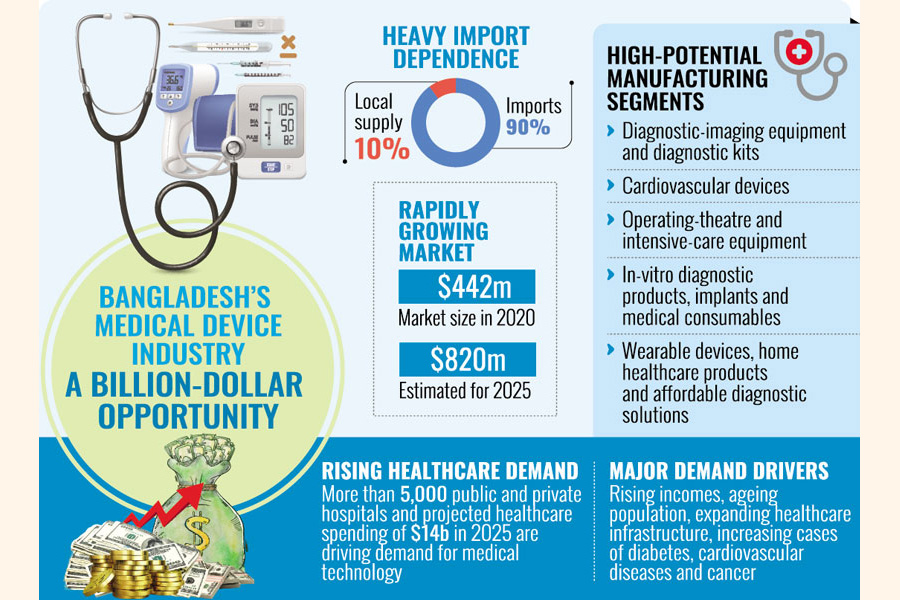
Bangladesh imports nearly 90 per cent of its medical equipment as a potential billion-dollar manufacturing opportunity is left largely untapped for policy shortcomings in the main.

As healthcare demand rises and hospitals expand, the country faces a paradox: a fast-growing market for medical technology, but a domestic industry that captures only a fraction of its value.

The market was estimated at $442 million in 2020 and projected to reach about $820 million by 2025, according to industry estimates cited in a sector study.

Rising incomes, an ageing population and the growing burden of non-communicable diseases are driving demand for diagnostic equipment, hospital supplies and medical technologies. Yet converting that demand into a competitive manufacturing industry will require the government to address policies that often make importing finished devices cheaper than producing them locally.

"We are manufacturing 99 per cent of our medicines but in medical device and equipment market the share of the local manufacturers is only 10 per cent," says Abdur Razzak, General Secretary of Bangladesh Association for Medical Devices and Surgical Instruments Manufacturers and Exporters' Association.

And this is happening in the same market, he points out.

About the existing challenges he has said high lending rate and rising dollar prices are seriously affecting the industry.

Mr Razzak, also the founder of JMI, a leading medical device-manufacturing company of the country, laments that public- healthcare sector had once stopped procuring products of his company for three years till 2025.

"Instead, they went for imported products," he says, adding that this kind of attitude is a barrier to promoting local manufacturing sector.

Bangladesh has over 5,000 public and private hospitals, with healthcare spending estimated at US$14 billion in 2025. Infrastructure upgrades and rural healthcare expansion are driving device adoption.

"The growing burden of non-communicable diseases (NCDs)-diabetes, cardiovascular issues, and cancer-is fueling strong demand for diagnostic tools and medical equipment. Diabetes cases alone are projected to reach 43 million by 2030," says a report by the Bangladesh Investment Development Authority.

As nearly 90 per cent of medical equipment is imported, it reflects the limited scale of domestic production and technological constraints facing local manufacturers. Existing manufacturing is concentrated in relatively low-technology products, including consumables, orthopaedic supplies, medical furniture and basic electro-diagnostic equipment.

According to industry insiders, the opportunity is being driven by rising incomes, an ageing population and the growing burden of non-communicable diseases, including diabetes, cardiovascular conditions and cancer.

Greater awareness of early diagnosis, alongside demand for long-term treatment, is expected to expand the use of medical devices across hospitals, clinics and households.

Bangladesh's healthcare infrastructure is also growing. The country has more than 5,000 public and private hospitals, while healthcare expenditure was projected to reach $14 billion by 2025.

The government plans to expand healthcare delivery, including outside major cities, could further increase demand for equipment and diagnostic services.

Bangladesh's medical- device imports have grown at an annual compound rate of about 10 per cent, compared with estimated global industry growth of 4.0-6.0 per cent, according to the study. This illustrates both the strength of domestic demand and the extent to which local manufacturers have yet to capture it.

Despite the growth potential, healthcare financing remains limited. Total health expenditure stood at 2.48 per cent of gross domestic product in 2019, while government spending was less than 1.0 per cent of GDP. Healthcare accounted for about 5.0 per cent of the national budget in recent years, according to the study.

Patients bear a substantial share of medical costs. Out-of-pocket payments accounted for about 73 per cent of healthcare expenditure in 2019, while insurance penetration was just 0.5 per cent, compared with an average of 3.3 per cent in emerging economies. Per-capita health spending rose from $9 in 2000 to $46 in 2019, but remained low relative to regional peers, a JICA study shows.

Diagnostic equipment, instruments and appliances account for about half of medical-device imports by value. Other segments include in-vitro diagnostic products, patient aids, implants and consumables.

The study identifies cardiovascular devices, diagnostic-imaging equipment, diagnostic kits and operating theatre and intensive-care equipment as areas with strong growth potential.

Experts have said foreign investment and joint ventures could accelerate the large shale production process, giving domestic companies access to production expertise, product designs and international distribution networks. Existing manufacturers could also expand into higher-value products as their technical- capacity improves.

Manufacturers face complex regulations, bureaucratic procedures, limited backward-linkage industries and restricted access to finance.

Incentives alone may, therefore, be insufficient. Investors need predictable regulations, transparent registration procedures and a tax structure that encourages domestic production without compromising safety or quality, the JICA study report reads.

"Developing the industry will require coordinated action by the government, manufacturers, healthcare providers, universities, research institutions and financial organisations. Priorities include attracting foreign manufacturers, encouraging reinvestment by existing companies, developing technical skills and improving access to finance," it says.

"Closer collaboration between industry and academia could support the design and commercialisation of products suited to local healthcare needs. Hospitals could help test new devices and build confidence among doctors and patients, while banks and investment funds could finance businesses requiring substantial upfront capital.

"Over the longer term, Bangladesh could move beyond basic equipment assembly towards designing and manufacturing more sophisticated technologies. Wearable devices, home healthcare products and affordable diagnostic solutions could offer opportunities, particularly for rural and underserved communities" says the JICA report.

Low labour costs and an established manufacturing base provide a starting advantage, but they do not guarantee success in a sector where technical expertise, regulation and reliability are decisive, it says, adding that without reforms to tariffs, regulation and investment conditions, Bangladesh risks continuing to spend heavily on imported equipment while capturing only a small share of the value generated by its expanding healthcare market.

The government recently offered some incentives, including zero-rated Advance Tax on imported capital equipment and parts for public-welfare-service sectors, hospitals and healthcare facilities, reduction in import duties on raw materials for medical equipment, reduction in CD on medical -device manufacturing and VAT exemption on locally manufactured medical bed.

Industry experts feel that with sustained investment and effective policy support, medical devices could emerge as a new manufacturing frontier, complementing the country's export-oriented garment and pharmaceutical industries.​
 

Unlocking medical device market's potential
1792969910615.webp


Bangladesh is making steady progress in expanding healthcare services, but one important issue deserves policymakers' urgent attention. It concerns the country's excessive import dependence for medical devices. According to a recent Financial Express report, Bangladesh imports nearly 90 per cent of its medical equipment. Even basic devices that could be manufactured locally are sourced from abroad. At a time when diversifying the export basket is crucial ahead of the country's graduation from the Least Developed Country (LDC) category, such heavy reliance on imports is economically counterproductive. The country's medical device market is estimated to be worth around US$1.0 billion and could grow to US$3.0 billion by 2030, driven by an ageing population, increasing prevalence of non-communicable diseases and rising demand for healthcare services. Building domestic manufacturing capacity for medical devices would not only reduce import dependence and save foreign currency but also create jobs, strengthen local industries and open up new avenues for economic growth.

Bangladesh's dependence on imported medical equipment stands in stark contrast to its success in developing a burgeoning pharmaceutical industry. The country once imported 90 per cent of its essential medicines. The National Drug Policy of 1982 turned the tide, paving the way for growth of a vibrant domestic pharmaceutical sector. Today, local manufacturers meet 99 per cent of the country's demand for medicines, while the sector earns more than US$200 million annually from exports. The experience offers a valuable lesson for the medical device sector. Sector insiders lament that a lack of policy support is holding back the growth of domestic devices. Medical equipment importers are well connected and manage to influence policy decisions in favour of imports. As a result, existing policies allegedly make imported finished medical devices cheaper than manufacturing them locally. They believe that, with the right policy support, Bangladesh could manufacture up to 80 per cent of its medical equipment locally.

To unlock this potential, stakeholders call for simpler business registration procedures and reforms to the tax structure to favour domestic production. Public procurement policies could also play a crucial role by encouraging both public and private hospitals to use locally manufactured medical devices that meet the required standards. Apart from development of a domestic base, experts think it is necessary to explore the potential for foreign investment and joint ventures in the sector. Foreign investment can enhance the capacity of domestic companies by giving them access to advanced technologies, production expertise, product designs and international distribution networks. Once their technical capabilities increase, local manufacturers could gradually move into higher-value products and explore export markets.

Encouragingly, the government has pledged to protect and promote domestic industry. Speaking at a recent seminar, the health minister said the government would provide all possible support to local innovators, researchers and entrepreneurs to help establish a strong medical device industry. It is hoped that such commitments would be translated into concrete policy measures in earnest. With a coherent policy framework, strategic investment and collaboration between the government and the industry, Bangladesh can reduce its reliance on imported medical devices, strengthen its healthcare system and build a new engine of industrial growth.​
 

Tk 44,757cr health infrastructure expansion proposed amid staff crisis

Experts for fully functionalising existing facilities

Jahidul Islam . Dhaka


1793147956414.webp


The Health Services Division has proposed a Tk 44,757 crore project to expand the upazila health complexes and equip them for dialysis, intensive care and cardiac treatment amid a severe shortage of healthcare personnel.

The proposal earmarks Tk 19,561.11 crore for hospital, residential and service buildings covering about 41.62 lakh square metres, alongside Tk 12,000.15 crore for medical equipment, said officials at the planning ministry.

According to the proposal, the project will be implemented in all but 60 upazilas situated in the district headquarters.

The proposal argues that expanding capacity and specialised services would enable more patients to receive treatment locally and reduce referrals.

Health economists and experts, however, called for properly functionalising local health facilities first as well as focusing on workforce development to prevent wastage of resources and prevent modern equipment from remaining unused.

Officials said that the Socio Economic Infrastructure Division of the Planning Commission would hold a scheduled meeting of the project evaluation committee today to assess the proposal titled ‘Construction, Reconstruction, Upgrading, Renovation, Repair of Infrastructure at Upazila Health Complexes in Bangladesh’.

A Planning Commission working paper prepared ahead of the project evaluation committee’s meeting has identified health personnel shortages and is set to ask for recruitment process alongside construction so that the expanded facilities can provide services immediately after completion.

Figures presented in parliament in June this year showed 23,223 vacant government health posts—9,407 doctors, 5,032 nurses and 8,784 other health workers.

The Bangladesh Health Workforce Strategy 2024 published by the Ministry of Health and Family Welfare, identifies shortages, uneven distribution and an imbalance in professional categories as major challenges, with a massive three-quarters of government doctors and nurses posted in urban areas.

The Directorate General of Health Services would implement the project, with construction undertaken by the Public Works Department and the Health Engineering Department.

The project proposes complete new 151-bed hospitals in 24 upazilas, additional buildings accommodating 51 beds each in 18 upazilas, 101 beds each in 305 upazilas, and 120 beds each in 13 upazilas.

In another 83 upazilas, dilapidated and unusable 31-bed buildings would be demolished and replaced with 132-bed facilities.

Integrated multi-storey service buildings would be constructed in 440 upazilas, while four residential buildings with doctors’ and nurses’ dormitories and staff quarters would be built in each of 195 upazilas.

Planned services include, among other services and upgrades, intensive and coronary care, stroke, trauma and infectious disease treatment, kidney dialysis, eye care, cancer screening and separate physiotherapy facilities for male and female patients and modern operation theatres.

Planning ministry officials said that today’s meeting of the project evaluation committee would suggest phased implementation based on land availability and resolving land-related issues.

A health economics expert, however, observed that the government should focus on making the existing hospitals functional first.

Professor Syed Abdul Hamid of Dhaka University Institute of Health Economics told New Age that after properly functionalising local health facilities, expansion should be made based on local demand and backed by operational funding.

Dr Abdur Razzaque Sarker, a senior research fellow at the Bangladesh Institute of Development Studies, said rising non-communicable diseases justified better rural treatment facilities, but workforce development was essential to prevent new equipment from remaining unused.

Asked about operational capacity and staffing, Health Services Division secretary Dr ANM Bazlur Rashid told New Age that the project was at the initial appraisal stage and it was too early to comment on human resource requirements.

He said he would be able to comment after receiving observations from the project evaluation committee meeting.

The Planning Commission will also assess a separate Tk 11,993.26 crore proposal today, to build, reconstruct and refurbish 16,265 facilities under an integrated rural primary healthcare network, envisaging 56,022 personnel, including 14,661 additional positions.

The Planning Commission working paper, however, questions whether an integrated staffing plan has been agreed and duplication has been critically avoided.​
 

What is holding back the health sector’s development spending?

Rumana Huque

1794528114446.webp

VISUAL: SALMAN SAKIB SHAHRYAR

The health sector in Bangladesh faces a troubling paradox: on the one hand, public hospitals struggle with shortages of medicines, diagnostic equipment, and healthcare professionals, while on the other, a substantial portion of the budget allocation remains unutilised. An October report by The Daily Star reveals that during the first quarter (July-September) of the current fiscal year, the Health Services Division (HSD) spent only 1.78 percent of its direct Annual Development Programme (ADP) allocation, while the Medical Education and Family Welfare Division (MEFWD) spent 1.86 percent. Together, the two divisions spent just Tk 209 crore from the direct project allocations of Tk 11,513 crore. These exclude Tk 23,577 crore in block allocations for the two divisions, reportedly unused during the period. Both divisions performed below the national ADP implementation rate of 3.89 percent.

Although it is not unusual for the development expenditure to be generally slower during the first quarter, the above-mentioned figures raise an important question: why has the health ministry struggled to translate its budget allocations into implementable programmes? The explanation lies in interconnected structural challenges: discontinuation of the Sector-Wide Approach (SWAp), changes in government and policy priorities, inadequate institutional capacity, and delays in preparing and approving Development Project Proposals (DPPs).

For more than two decades, Bangladesh has implemented major development activities through successive Health, Population and Nutrition Sector Programmes (HPNSPs) under SWAp. These programmes provided a common planning and financing framework, with operational plans covering immunisation, disease control, maternal and child health, family planning, nutrition, and the strengthening of the healthcare system. The fourth programme ended in June 2024, and the proposed fifth programme was discontinued during the interim government. The decision reflected concerns about duplication, overlapping management structures, inefficiencies and weak accountability.

The transition has changed not only how projects are financed, but also how they must be planned and managed. Under the replacement arrangement, development activities are increasingly expected to be implemented through individual DPPs. Preparing these proposals requires technical design, costing, feasibility assessment, procurement planning and multiple approvals. While some DPPs have been prepared and approved, the broader pipeline has not been sufficiently ready for implementation. The fundamental problem here is that the previous programme management structure was discontinued before an equally functional alternative was firmly established.

Changes in government and administrative leadership have brought to the table new policy commitments and development priorities. Reconsidering projects, agreeing on priorities, and translating new commitments into feasible designs take time. The interim administration initiated the shift away from SWAp, while the elected government introduced its own health sector commitments and substantially increased development allocations. However, defining new priorities, reviewing earlier proposals and translating commitments into costed projects require institutional continuity and adequate preparation. The health sector faces competing demands: uninterrupted vaccine administration, essential medicine and contraceptive supplies, maternal and child healthcare, communicable and non-communicable disease control, stronger primary care, disease surveillance, recruitment of health personnel, emergency services, and hospital infrastructure.

The issue is how these priorities are sequenced. Essential services should take priority over less urgent infrastructure investment. A need-based, costed project pipeline must come before or at least accompany budget commitments. Without an agreed, need-based prioritisation framework, implementing agencies may struggle to determine which projects should proceed first. The health ministry needs to distinguish immediate service delivery requirements from medium-term system strengthening and long-term infrastructure investment. The priority should be projects that address urgent population health needs, demonstrate implementation readiness, and protect continuity of essential services.

Preparing a DPP is not simply completing an administrative form. It requires expertise in epidemiology, needs assessment, financial analysis, costing, procurement, monitoring and evaluation, and project management. However, officials under different directorates already carry extensive responsibilities for managing services, personnel, administration, disease outbreaks, procurement and coordination with the ministry and field-level facilities. The Directorate General of Health Services (DGHS), for example, oversees hospitals, primary healthcare, disease control, planning and research, management information systems, and other technical operations. Similarly, the Directorate General of Family Planning (DGFP) and medical education institutions have their own workloads. Hence, the responsibility of preparing the DPPs may not reasonably be assigned as additional duties without dedicated technical support, clear accountability and sufficient time.

Under SWAp, designated line directors, programme managers and deputy programme managers undertook development programme management responsibilities. After SWAp was discontinued, the ministry abolished these designations in September 2025, removing the previous programme management arrangements. But doing so did not make the need for specialised development planning disappear. The ministry and DGHS have planning functions, but the transition to multiple project-based arrangements requires a stronger, multidisciplinary project preparation capacity. The challenge is not necessarily a shortage of capable officials, but the absence of sufficiently protected time, specialised technical teams, and the institutional arrangement to translate policy priorities into implementable projects. The same problem extends to other implementing agencies, including DGFP and institutions responsible for infrastructure, medical education and specialised services.

A block allocation is a provision for prospective projects, not money that can be spent immediately without the required approvals. Without approved DPPs and appointed project personnel, implementing agencies cannot proceed with many planned procurement and implementation activities, and expenditure will lag even when resources are available on paper. This is particularly relevant to the substantial block allocation in FY2026-27. Routine delays in fund release and budget processing can add to the problem. Delays may subsequently encourage hurried procurement towards the end of the financial year, increasing risks to efficiency and value for money. That would substitute one governance problem for another. Faster expenditure should not come at the expense of quality and accountability.

What the country needs is faster preparation and more disciplined execution, not spending just for the sake of it. The immediate priority must be establishing a dedicated, multidisciplinary project preparation and implementation support team within the health ministry, working closely with DGHS, DGFP, the Planning Commission, and other implementing agencies. The mechanism can bring together health planners, health economists, public health specialists, finance and procurement professionals, and experienced project managers. Development partners and research institutions could provide time-bound technical assistance. Second, the ministry should develop a prioritised, costed project pipeline with clearly assigned responsibilities and timelines for DPP preparation, appraisal, approval and implementation. Existing services requiring uninterrupted financing should be identified first. Clear delegation to DGHS, DGFP and relevant technical agencies, alongside stronger coordination with the Planning Commission and Finance Division, would ease the burden on central policymakers.

Third, senior policymakers and DGHS directors need to provide strategic oversight to undertake technical project preparation by the team. Clear delegation, dedicated project teams, and stronger coordination between planning and implementing agencies are essential. Fourth, quarterly monitoring can track allocations, approvals, fund releases, expenditure and service outcomes. Progress against these milestones can be publicly reported. Last but not the least, development and operating budgets must be better coordinated. New hospitals and equipment investments will yield limited benefits without recurrent financing for staff, maintenance and essential supplies.

That Bangladesh needs greater public investment in healthcare is beyond dispute. But the experience of the July-September period of this fiscal year shows why the ability to plan and deliver matters as much as the size of an allocation. The challenge is not simply to accelerate spending but to establish the structures, expertise and accountability necessary to convert financial resources into quality healthcare. Unless the country invests in the institutional capacity to plan and implement its health budget, larger allocations will hardly meet all healthcare needs.

Dr Rumana Huque is professor in the Department of Economics at Dhaka University and executive director at ARK Foundation.​
 

PKDefense Forums: Country-by-Country Military Discussions

Log In Register Forums
Videos
Back