At least 93 dead as violence grips the country
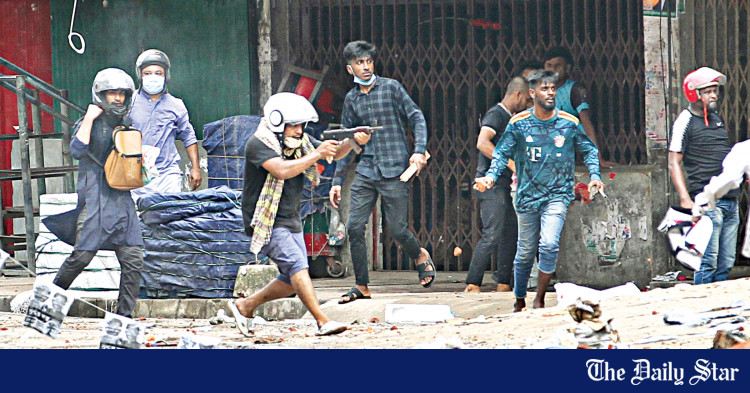
an alleged ruling party activist chases protesters brandishing a firearm in Enayet Bazar area of Chattogram during a clash between the protesters, and police aided by ruling party men. Photo: Star
At least 93 people were killed and more than a thousand others injured, many with bullets, as a new wave of violence convulsed Bangladesh yesterday.
Ruling party activists and police clashed with anti-government protesters in at least 20 districts on the first day of the student-led non-cooperation movement designed to keep pressure on Prime Minister Sheikh Hasina to step down.
With yesterday's count, the total death toll in anti-government protests crossed 300 in just three weeks, making it the bloodiest period in the history of Bangladesh's civil movement.
A wounded protester is being carried on a rickshaw in the capital's Farmgate area. Photo:Reuters
The day began with an eerie calm, but it turned violent after supporters of the ruling Awami League descended on the streets to subdue anti-government protests.
As violence spread, an angry mob attacked a police station in the northern district of Sirajganj, beating 13 police personnel to death. Separately, at least five people died in clashes in Raiganj upazila of Sirajganj, taking the total death toll to 18 in the district, the highest tally among all.
In the capital, at least 12 people were killed. Most of them were brought dead to Dhaka Medical College and Hospital.
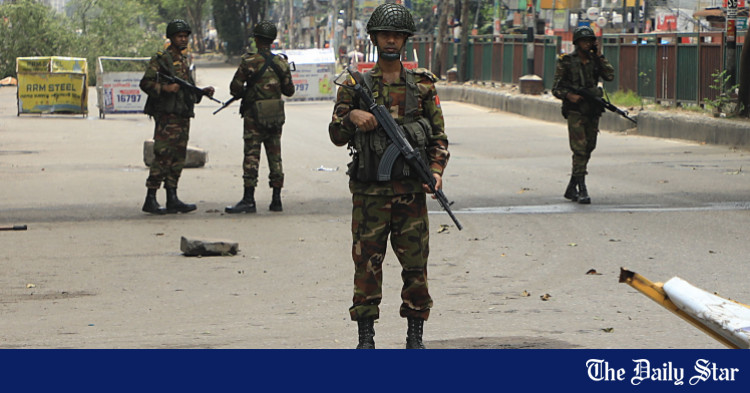
With the country already on the boil, attackers torched or vandalised the homes of some ruling party lawmakers, Awami League offices, police stations, law-enforcement vehicles, prison vans and hospital buses throughout the day, forcing the authorities to tighten a nationwide curfew and block 4G mobile internet to quell the violence.
Details of death and destruction kept coming from across the country until late last night. The death toll is likely to rise as many were hospitalised with grievous injuries, according to reports filed by The Daily Star's district correspondents. At least 70 establishments owned by individuals or the government were set on fire, according to fire service data.
Bangladesh announced the shutdown of public and private offices, including banks, for three days, while students scheduled a long march for today, setting themselves on a potential collision course with pro-government groups.
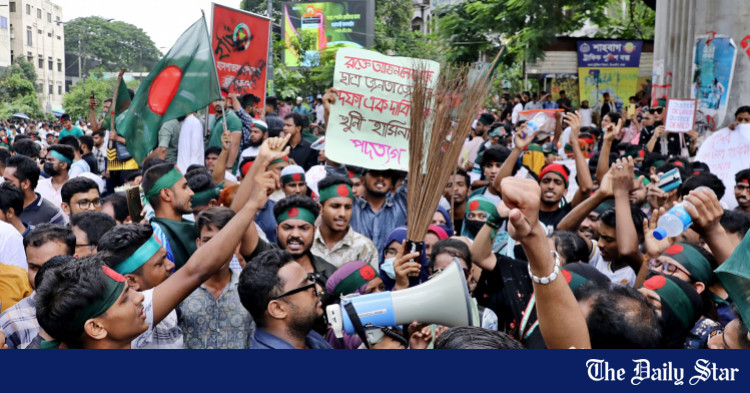
It all came as protesters whittled their demands down to just one: the resignation of Hasina and her cabinet members. Simultaneously, they started a non-cooperation movement, urging citizens not to pay taxes and migrant workers not to send remittances from abroad through banking channels.
two bullet-hit persons lie motionless on the street in Azampur of Uttara in Dhaka. Photo: Collected
The latest spell of violence was born out of job quota reform protests led by students. The protests entered a dangerous phase after at least 208 people were killed in indiscriminate firing by law enforcers, members of Border Guard Bangladesh and ruling party activists, in a spasm of violence from July 16 to August 3.
Tension in Bangladesh has been simmering since Saturday night, following AL General Secretary Obaidul Quader's announcement that the ruling party activists would be on the streets to maintain their positions against protesters.
In Dhaka, some areas felt like battlefields yesterday as police, ruling party activists and protesters engaged in three-way violence at Farmgate, Dhanmondi, Mirpur 10, Uttara, Shahbagh and Gulistan.
Hundreds of ruling party supporters wielding sticks walked down Kazi Nazrul Islam Avenue towards the Karwan Bazar intersection around 12:50pm, raising fears of violence.
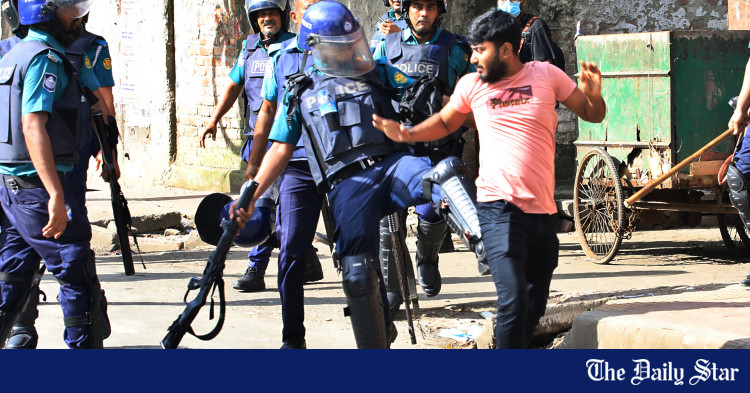
The road stretching from Farmgate to Bangla Motor resembled a "battlefield" as police and ruling party men fired indiscriminately on a huge crowd of protesters, who were advancing towards Farmgate with sticks in hand. They were also carrying drums and plastic traffic barriers to the protest site. At times, they threw brickbats at the police and Awami League supporters along the way.
A clash broke out between protesters and ruling party men near the Awami League office in the capital's Dhanmondi around 12:30pm when protesters from Dhanmondi-2 moved to Dhanmondi-3. Sounds of gunshots and stun grenades rang out in the area.
Most shopping malls, shops, bank branches and other establishments were closed. Public transport disappeared from the streets, forcing people to walk home or to workplaces, while long-haul buses and trains suspended their services.
In Old Dhaka, a clash between police and protesters halted proceedings at the Chief Metropolitan Magistrate's Court premises.
Over a hundred protesters, along with pro-BNP lawyers, broke a collapsible gate to the court premises, which the police had cordoned off since morning. The protesters threw brickbats at the doors and windows in the court area, witnesses said. Two prison vans and two police cars were vandalised by unidentified people as violence broke out.
The body of Rangpur district unit Swechchhasebak League member Khairul Islam Sabuj being taken to a hospital after he was killed in violence in the city's Supermarket area. Photo: Collected
The Shahbagh intersection was on edge after rival groups gathered since morning, leading to a violent clash. Both groups barged into the Bangabandhu Sheikh Mujib Medical University premises and engaged in another round of clashes. At least 24 vehicles were set on fire with black smoke billowing skywards.
Meanwhile, the Mirpur-10 intersection turned into a hotspot as protesters arrived in droves. AL men, some of them with firearms, had already occupied the area, backed by police. Numerous gunshots rang out, sending panic through the area.
Violence beyond Dhaka
In Laxmipur, eight people were killed and 100 others were wounded in a clash between protesters and members of Jobo League and Chhatra League, police said. Three of the victims suffered gunshots, while five were beaten dead.
In Narsingdi, at least six AL leaders were beaten to death and several others injured in a clash between AL supporters and protesters. The incident took place in front of a mosque next to the Madhabdi Municipal Building, according to KM Shahidul Islam Shohag, additional superintendent of police.
In Feni, at least eight people were killed in clashes as Awami League men attacked protesters. Several people were injured in the incident, reports our correspondent. Their identities could not be immediately confirmed.
In the northern city of Rangpur, four people died in clashes. Abdul Jalil, an official of the Rangpur Medical College and Hospital, confirmed two of the deaths.
One of the dead was identified as Haradhan Roy, president of the Parshuram Thana Awami League and councillor of Ward 4 in Rangpur city. The second man was his driver whose name could not be known.
In Sylhet, four people were shot dead and at least 25, including policemen and members of Border Guard Bangladesh, were injured in a clash. One of the deceased was identified as Taj Uddin, 43, a businessman of Dharabohor village in Sylhet's Golapganj upazila.
Meanwhile, protesters and police clashed around 12:00pm, half an hour after hundreds of demonstrators gathered at the Court Point area in Sylhet city. Police fired shotguns, tear shells and stun grenades to disperse the protesters.
In Bogura, separate clashes left at least five people dead and many others injured, with 32 hospitalised.
One of them, Manirul Islam, 24, was shot dead as police opened fire on protesters after they attacked Dupchanchia Police Station. He was brought dead to a local hospital, according to a doctor. Besides, two others were brought dead to Shaheed Ziaur Rahman Medical College in Bogura.
"It seems they died of gunshot wounds. But we could not confirm it," Abdul Wadud, deputy director of the hospital, told The Daily Star. At least 32 people are currently undergoing treatment at the hospital.
In Pabna, at least three people were killed and 50 others injured during a clash between protestors and ruling party men. One person was brought dead, while two others died of their injuries at the Pabna Sadar Hospital, said its assistant director, Rafiqul Hasan.
In Munshiganj, at least three persons were killed and 20 others injured near the Super Market area.
Abu Hena Mohammad Jamal, superintendent of Munshiganj General Hospital, said two persons were brought dead and many were hospitalised with injuries. The doctors, however, could not give details on the nature of the injuries.
Police did not open fire, Munshiganj Additional Superintendent of Police Khairul Hasan said, adding that he was unaware of any casualty.
In Magura, at least four people were killed and 20 others were injured in clashes that involved protesters on one side and police and ruling party men on the other.
In Kishoreganj, at least three people, including a woman, were killed and over 100 injured in a clash between protesters and AL activists.
Witnesses reported that the AL office was vandalised and set on fire during the conflict. Subsequently, the protesters blocked the road for three hours.
In Cumilla's Debidwar upazila, three persons were killed and several others were injured in a clash. One of them was Md Rubel, 33, who was rushed to a local hospital with a head injury, where a doctor declared him dead.
The clash started as AL supporters attacked protesters with sharp weapons in the New Market area in Debidwar upazila.
In Chattogram, at least 172 people have been admitted to Chattogram Medical College Hospital, after they were wounded with bullets in a clash between protesters, police and AL activists.
In Khulna, unidentified people torched the Khulna Zilla parishad office.
In Faridpur, the district Awami League office was vandalised, while a BCL office was torched allegedly by protesters. The protesters also set fire to 10 motorcycles in front of the district AL office in the town. Besides, police fired rubber bullets, sound grenades and teargas shells when the Kotwali Police Station was attacked.

 Bangladesh Defense