| Global Defense, OSINT & Geopolitics Wire

[🇮🇳] India's Space Program

[🇮🇳] India's Space Program
68
4K
More threads by Saif

G   Indian Defense

India successfully launches its first space docking mission

1735602862261.webp

Photo: Courtesy/ISRO

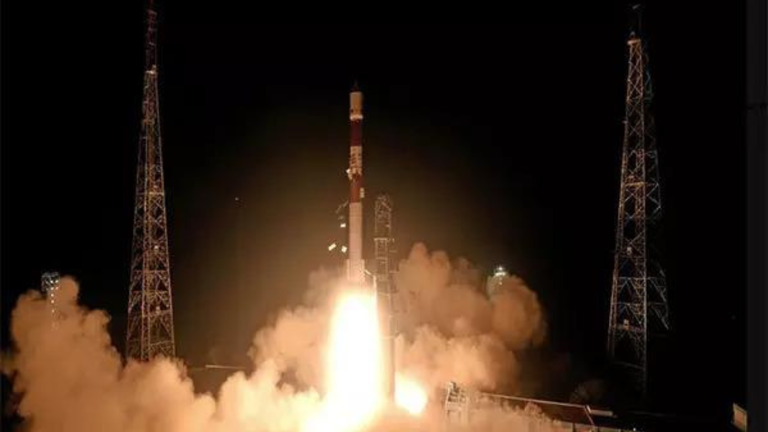
India tonight successfully launched a critical space mission aimed at demonstrating for the first time its ability to join two satellites in space. If successful, this feat would make India the fourth country to possess the technology after the US, Russia, and China.

The mission, christened SpaDeX (Space Docking Experiment), is a pioneering mission to establish India's capability in orbital docking, a key technology for future human spaceflight, bringing back lunar soil and landing a manned mission on the moon and set up a space station, the national space agency said.

"PSLV-C60 successfully launches SpaDeX and 24 payloads," Science and Technology Minister Jitendra Singh tweeted on the microblogging site of Indian Space Research Organization (ISRO) after the rocket's liftoff from Sriharikota space port in Andhra Pradesh, about 110km from Chennai, at around 10:00pm local time.

Four minutes later, Singh announced "successful separation of SpaDeX satellites" and said it "marks another milestone in India's space journey."

SpaDeX mission is a cost-effective technology demonstrator mission for the demonstration of in-space docking using two small spacecraft.

The Spadex mission will see two satellites Chaser and Target align in the same orbit, reduce distance between each other, join and transfer electrical power between them, and then separate. After they separate, payloads on board both the satellites will continue to function for two years.

This technology is essential for India's space ambitions such as Indian on the moon, bringing back sample of soil from moon, the building and operation of India's space station.

In-space docking technology is also essential when multiple rocket launches are required to achieve common mission objectives.

Through today's mission, India is marching towards becoming the fourth country in the world to have space docking technology after the US, Russia and China, according to ISRO​
 

ISRO says it germinated seed in microgravity conditions in spacecraft


1736038459417.webp

Photo: ISRO

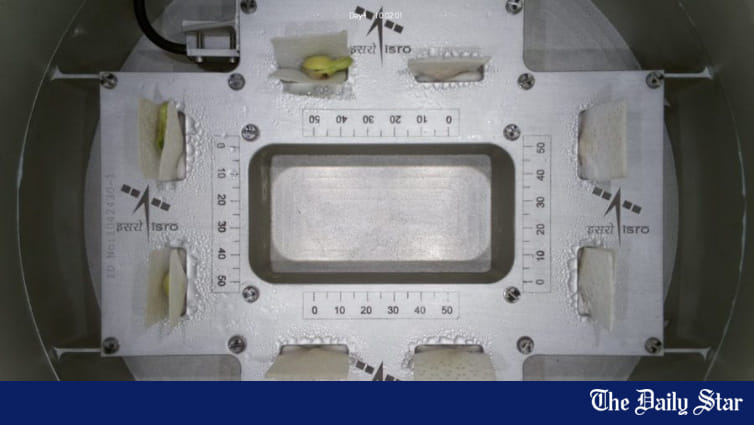
India's space agency today said it has successfully germinated cowpea seeds in microgravity conditions in a craft sent to space.

The cowpea seeds were sent on the PS-4 Orbital Experiment Module (POEM-4) mission on December 30 and have germinated in the near zero-gravity conditions in just four days and enclosed the surroundings of space.

The experiment demonstrated progress in understanding how plants grow in space conditions, the Indian Space Research Organisation tweeted.

"Life sprouts in space! VSSC's CROPS (Compact Research Module for Orbital Plant Studies) experiment onboard PSLV-C60 POEM-4 successfully sprouted cowpea seeds in 4 days. Leaves expected soon," said #ISRO #BiologyInSpace.

ISRO Chairman S Somnath told NDTV that the cowpea germination is a maiden attempt to try and understand how life works in space.

The POEM module is carrying two other live biology experiments that will try to grow spinach cells and gut bacteria.

The research involved eight cowpea seeds placed in a regulated closed-box setting with precise temperature control, establishing essential groundwork for agricultural studies beyond the earth, ISRO said.

The system includes high-definition cameras, sensors for oxygen and carbon dioxide levels, humidity detectors, temperature monitors and soil moisture measuring devices.

The germination of cowpea seeds offers significant potential for future space expeditions, particularly for extended missions and establishing human settlements on other celestial bodies.​
 
ISRO Lives up to its expectation. Releases the video of Capturing Space debris by its SPEDEX.

Video: Isro demonstrates tethered debris capture in space​

Story by India Today Science Desk
• 12h • 2 min read

1736230000493.webp


Video: Isro demonstrates tethered debris capture in space

Video: Isro demonstrates tethered debris capture in space
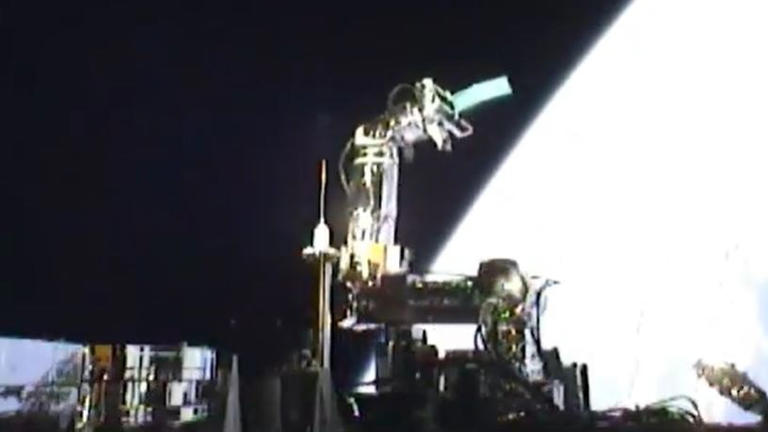
The Indian Space Research Organization (Isro) on Monday released a video which showed a sophisticated robotic arm of its SpaDeX (Space Docking Experiment) mission capturing tethered debris in space using visual servoing, motion prediction, and a parallel end-effector for precise manipulation.

Following the successful demonstration of tethered debris capture, the robotic manipulator will now be capable of capturing free-floating debris in the space environment and refuelling tethered and free-floating spacecraft.

The Debris Capture Robotic Manipulator (DC-RM), developed by Isro's Vikram Sarabhai Space Centre (VSSC), features seven movable joints and can relocate itself on the PS4-Orbital Experiment Module (POEM-4) platform using an inchworm-like mechanism.

Its design includes advanced robotic joints, arm controllers, grappling mechanisms, cameras for precise movement, and obstacle-avoidance software powered by a high-performance processor.


One of the primary goals of the experiment is to demonstrate the robotic arm's ability to operate over a large area in orbit. It also serves as a step toward developing robotic technologies for future missions, including India's planned space station, the Bharatiya Antariksh Station (BAS).

The arm's functions are expected to include visual inspection, end-to-end movement, cable-free operations, and remote task execution using a "digital twin" model.

In addition to robotic advancements, the SpaDeX mission is designed to showcase autonomous rendezvous and docking capabilities. This involves controlling one spacecraft using the Attitude Control System of another in a docked configuration.

These technologies aim to support future manned and deep-space missions by enhancing Isro's operational capabilities in space.

Earlier in the day, Isro achieved another remarkable milestone with its Compact Research Module for Orbital Plant Studies (CROPS) aboard the PSLV-C60 mission after the cowpea seeds sent into space successfully sprouted their first leaves.

CROPS experiment was launched aboard the PSLV-C60 mission on December 30, 2024 to study how plants adapt and grow in the distinctive conditions of space, paving the way for advancements in space agriculture and long-term human space exploration.


Related video: SpaDeX Chaser captures Earth from space as Isro preps for docking next week, watch! (The Economic Times)

AA1aiqTY.img
The Economic Times
SpaDeX Chaser captures Earth from space as Isro preps for docking next week, watch!
 

Isro to dock SpaDeX satellites on Tuesday, epic space chase in final phase​

Story by India Today Science Desk
• 1d • 2 min read

1736231916884.webp

India's ambitious Space Docking Experiment (SpaDeX) mission is poised for a historic milestone as its two satellites, the Chaser and Target, prepare to dock in orbit on January 7, 2025.

This mission marks a significant advancement in India's space capabilities, positioning the country among an elite group of nations capable of executing on-orbit docking operations.

Launched on December 30, 2024, the SpaDeX satellites are currently engaged in a carefully orchestrated sequence to close the distance between them.

Initially separated by approximately 20 kilometers, the satellites are gradually reducing this gap through precise maneuvers.

According to M. Sankaran, Director at the UR Rao Satellite Centre, the onboard propulsion systems will be activated to maintain and then decrease this distance to facilitate a successful docking.


The docking process involves intricate coordination, with the satellites set to communicate via an inter-satellite radio frequency link once they are within 5 kilometers of each other.

This communication will allow them to exchange vital data regarding their positions and orientations, crucial for the final approach. The docking mechanism itself is designed to execute a "hugging" action, ensuring a secure connection between the two spacecraft.


Spadex

Spadex
This mission is not just a technical demonstration; it represents years of research and development. The concept dates back to 1989, but it gained momentum after project approval in 2016.

Extensive testing has been conducted to validate the docking mechanisms and sensors required for this operation.


Related video: SpaDeX Chaser captures Earth from space as Isro preps for docking next week, watch! (The Economic Times)
SpaDeX Chaser captures Earth from space as Isro preps for docking next week, watch!


Successful completion of the SpaDeX mission would not only demonstrate India's growing prowess in space technology but also lay the groundwork for future endeavors such as satellite servicing and the establishment of India's planned space station, Bharatiya Antariksha Station.

As noted by Union Minister Jitendra Singh, India is set to become the fourth country globally to achieve such advanced docking capabilities.

With the countdown underway, all eyes are on ISRO as it prepares for this landmark event that could redefine India's role in global space exploration.


Drift arrested, SpaDeX satellites under control; minister reviews Isro progress​

Story by Chethan Kumar
• 19h • 2 min read

1736504111473.webp


Drift arrested, SpaDeX satellites under control; minister reviews Isro progress

Drift arrested, SpaDeX satellites under control; minister reviews Isro progress
BENGALURU: A day after a drift between satellites caused Isro to postpone its Space Docking Experiment (SpaDeX) for the second time, the space agency has managed to put the spacecraft in a slow drift course.

“...The drift has been arrested and spacecrafts put in a slow drift course to move closer to each other. By tomorrow (Jan 10), it is expected to reach initialisation conditions,” Isro said Thursday.


The space agency, however, did not confirm if it will attempt the docking on Friday or on a later date.

Earlier in the day, Union minister Jitendra Singh, Minister of State for Space, met with senior Isro officials — including chairman S Somanath and chairman-designate V Narayanan — to discuss the space agency's ambitious upcoming missions for early 2025.

Isro has outlined an aggressive launch schedule for the first half of 2025, including two GSLV missions, a commercial LVM3 launch, and the crucial first uncrewed test of the Gaganyaan human spaceflight programme.

Leading the calendar is the GSLV-F15 mission, scheduled for late Jan. This mission will deploy the NVS-02 navigation satellite, enhancing India’s NavIC constellation. The satellite features indigenously developed atomic clocks and new L1 band signal capabilities, with launch vehicle integration currently in advanced stages at Sriharikota.


Related video: Watch: The Moment ISRO's SpaDex Lifted Off Towards 'Antariksh Station' (Republic World)
Watch: The Moment ISRO's SpaDex Lifted Off Towards 'Antariksh Station'
Unmute
0

View on WatchView on Watch

“A major highlight is the upcoming Isro-Nasa collaboration Nisar (Nasa-Isro Synthetic Aperture RADAR) mission, to be launched aboard GSLV-F16. This advanced microwave remote sensing satellite will provide comprehensive Earth observation data every 12 days, particularly valuable for monitoring agriculture, earthquakes, and landslides,” a government statement read.

March 2025 will see the commercial LVM3-M5 mission launching BlueBird Block-2 satellites for US firm AST SpaceMobile Inc., under an agreement with NewSpace India Limited (NSIL).
For more news like this visit TOI. Get all the Latest News, City News, India News, Business News, and Sports News. For Entertainment News, TV News, and Lifestyle Tips visit Etimes