Bangladesh Defense
Saif
Senior Member
- Messages
- 21,737
- Likes
- 9,794
- Nation

- Residence
- Axis Group

Megaproject worth Tk 334.75b ready for ECNEC endorsement
A megaproject for building the long-cherished Padma Barrage with an estimated cost of Tk 334.75 billion is ready to go for endorsement at the next ECNEC meeting, officials say. The project is among 16 agenda placed on the notice for the Executive Committee of the National Economic Council (ECNEC)
Multipurpose Padma barrage seems not far off
Megaproject worth Tk 334.75b ready for ECNEC endorsement
Meant to mitigate dehydration effects caused in vast areas by Farakka Barrage
JAHIDUL ISLAM
Published :
May 11, 2026 00:02
Updated :
May 11, 2026 00:02
A megaproject for building the long-cherished Padma Barrage with an estimated cost of Tk 334.75 billion is ready to go for endorsement at the next ECNEC meeting, officials say.
The project is among 16 agenda placed on the notice for the Executive Committee of the National Economic Council (ECNEC) meeting scheduled for Wednesday, according to officials at the Planning Commission.
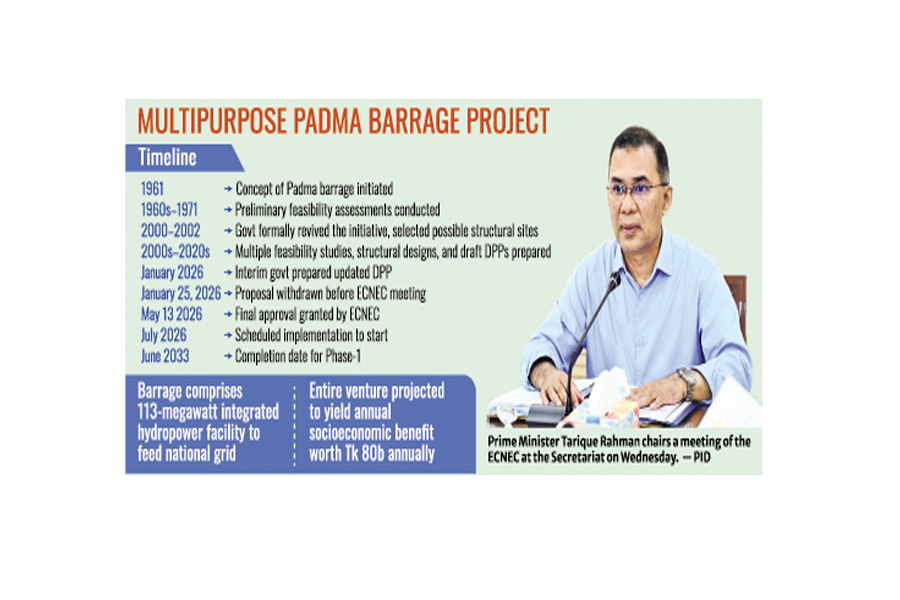
Prime Minister Tarique Rahman is scheduled to preside over the meeting of the government's highest policymaking body.
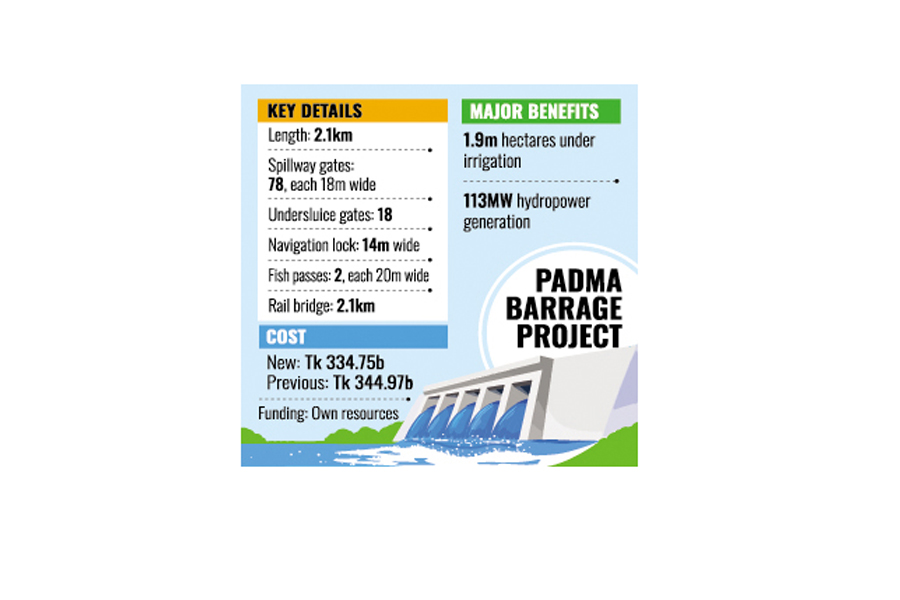
Earlier last month, the commission processed the project with an estimated cost of Tk 344.97 billion for placement at the first ECNEC meeting of the current government, but it was withdrawn at the last moment.
According to the proposal, an additional month of detailed evaluation helped reduce the project cost by Tk 10.23 billion, "bringing efficiency in its implementation plan".
The total estimated cost of the project is Tk 504.44 billion according to proposal placed at the meeting of project-evaluation committee (PEC) held last year, but the meeting recommended implementing it in two phases.
Officials say the project is expected to bring around 1.9 million hectares of land under irrigation, boosting agricultural output in 19 districts of four divisions: Dhaka, Khulna, Rajshahi and Barishal. People in Kushtia, Faridpur, Jashore, Khulna, Barishal, Pabna and Rajshahi districts are set to be core beneficiaries.
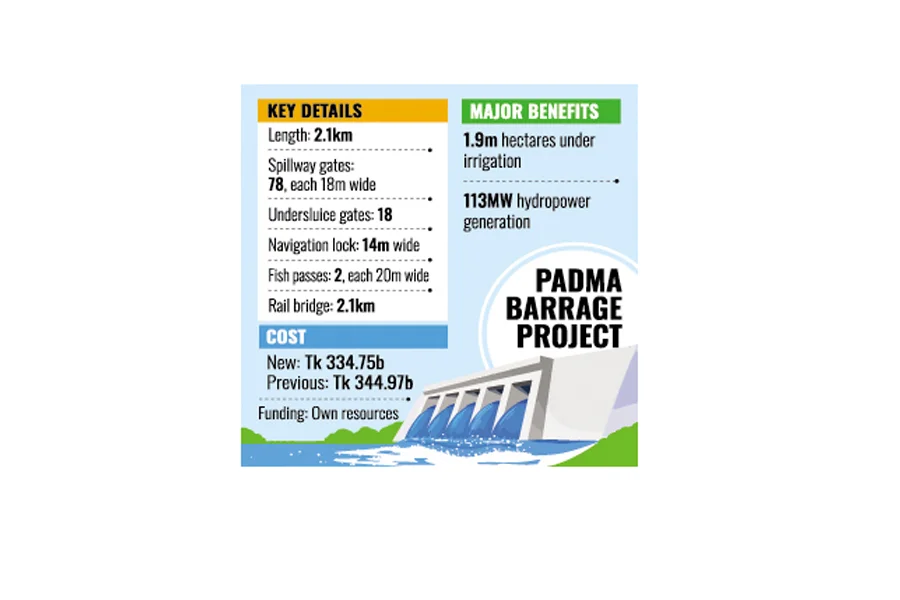
According to the project proposal, the 2.1-kilometre barrage will include 78 spillway gates, each 18- metre wide, along with 18 undersluice gates.
It will also feature a 14-metre-wide navigation lock, two 20-metre-wide fish passes to support aquatic ecosystems, and a 2.1-km railway bridge over the structure.
The megaproject is expected to generate around 113 megawatts of hydropower and ensure water supply to key installations, including the Rooppur Nuclear Power Plant.
"Although the Padma-dependent area (PDA) in the south-west and north-west regions covers only about 3.0 per cent of Bangladesh's land area, it supports nearly one-third of the country's population," the proposal reads.
It further explains that the Farakka Barrage established in the 1970s, in India, diverted around 35,000-40,000 cusecs of Padma River waters during the dry season to the Bhagirathi-Hooghly system to improve navigability of Kolkata Port. This significantly reduced downstream flow in Bangladesh.
As a result, flows in major river systems in the southwest and northwest, including the Ichamati-Mathabhanga, Gorai-Modhumoti, Chandana-Barasia, Arial Khan and Boral, have severely declined. This has damaged agriculture, fisheries, forestry, navigation, and domestic water supply, while also degrading the regional ecosystem.
Reduced freshwater flow has further worsened salinity intrusion and biodiversity loss in the Sundarbans, putting livelihoods in the coastal belt under increasing pressure.
Given that the Padma remains a key surface-water source for major regions, including Rajshahi, Pabna, Kushtia, Jashore, Khulna, Faridpur and Barishal, "sustainable water management" is deemed crucial for agriculture, fisheries, biodiversity conservation and balanced regional development.
In this context, a barrage on the Padma River is proposed as a key intervention to revive river systems, reduce salinity intrusion, improve drainage and irrigation, and help restore ecological balance, including in the Sundarbans.
Although development partners, including China, had earlier shown interest in financing, uncertainty over external funding has led the government to opt for full financing from its own resources.
The proposal estimates Tk 186.02 billion for barrage construction and related infrastructure, Tk 7.43 billion for electrical works and hydropower generation, and Tk 4.18 billion for Gorai offtake-related facilities.
The idea of a Ganges or Padma Barrage dates back to the pre-independence period, with the then East Pakistan Water and Power Development Authority having initiated the first study in 1961. Multiple pre-feasibility studies were conducted until 2000.
In 2002, the Water Resources Planning Organisation (WARPO) recommended constructing the barrage either at Thakurbari in Kushtia or Pangsha in Rajbari. Detailed feasibility studies and engineering designs were later carried out between 2009 and 2016.
Megaproject worth Tk 334.75b ready for ECNEC endorsement
Meant to mitigate dehydration effects caused in vast areas by Farakka Barrage
JAHIDUL ISLAM
Published :
May 11, 2026 00:02
Updated :
May 11, 2026 00:02
A megaproject for building the long-cherished Padma Barrage with an estimated cost of Tk 334.75 billion is ready to go for endorsement at the next ECNEC meeting, officials say.
The project is among 16 agenda placed on the notice for the Executive Committee of the National Economic Council (ECNEC) meeting scheduled for Wednesday, according to officials at the Planning Commission.
Prime Minister Tarique Rahman is scheduled to preside over the meeting of the government's highest policymaking body.
Earlier last month, the commission processed the project with an estimated cost of Tk 344.97 billion for placement at the first ECNEC meeting of the current government, but it was withdrawn at the last moment.
According to the proposal, an additional month of detailed evaluation helped reduce the project cost by Tk 10.23 billion, "bringing efficiency in its implementation plan".
The total estimated cost of the project is Tk 504.44 billion according to proposal placed at the meeting of project-evaluation committee (PEC) held last year, but the meeting recommended implementing it in two phases.
Officials say the project is expected to bring around 1.9 million hectares of land under irrigation, boosting agricultural output in 19 districts of four divisions: Dhaka, Khulna, Rajshahi and Barishal. People in Kushtia, Faridpur, Jashore, Khulna, Barishal, Pabna and Rajshahi districts are set to be core beneficiaries.
According to the project proposal, the 2.1-kilometre barrage will include 78 spillway gates, each 18- metre wide, along with 18 undersluice gates.
It will also feature a 14-metre-wide navigation lock, two 20-metre-wide fish passes to support aquatic ecosystems, and a 2.1-km railway bridge over the structure.
The megaproject is expected to generate around 113 megawatts of hydropower and ensure water supply to key installations, including the Rooppur Nuclear Power Plant.
"Although the Padma-dependent area (PDA) in the south-west and north-west regions covers only about 3.0 per cent of Bangladesh's land area, it supports nearly one-third of the country's population," the proposal reads.
It further explains that the Farakka Barrage established in the 1970s, in India, diverted around 35,000-40,000 cusecs of Padma River waters during the dry season to the Bhagirathi-Hooghly system to improve navigability of Kolkata Port. This significantly reduced downstream flow in Bangladesh.
As a result, flows in major river systems in the southwest and northwest, including the Ichamati-Mathabhanga, Gorai-Modhumoti, Chandana-Barasia, Arial Khan and Boral, have severely declined. This has damaged agriculture, fisheries, forestry, navigation, and domestic water supply, while also degrading the regional ecosystem.
Reduced freshwater flow has further worsened salinity intrusion and biodiversity loss in the Sundarbans, putting livelihoods in the coastal belt under increasing pressure.
Given that the Padma remains a key surface-water source for major regions, including Rajshahi, Pabna, Kushtia, Jashore, Khulna, Faridpur and Barishal, "sustainable water management" is deemed crucial for agriculture, fisheries, biodiversity conservation and balanced regional development.
In this context, a barrage on the Padma River is proposed as a key intervention to revive river systems, reduce salinity intrusion, improve drainage and irrigation, and help restore ecological balance, including in the Sundarbans.
Although development partners, including China, had earlier shown interest in financing, uncertainty over external funding has led the government to opt for full financing from its own resources.
The proposal estimates Tk 186.02 billion for barrage construction and related infrastructure, Tk 7.43 billion for electrical works and hydropower generation, and Tk 4.18 billion for Gorai offtake-related facilities.
The idea of a Ganges or Padma Barrage dates back to the pre-independence period, with the then East Pakistan Water and Power Development Authority having initiated the first study in 1961. Multiple pre-feasibility studies were conducted until 2000.
In 2002, the Water Resources Planning Organisation (WARPO) recommended constructing the barrage either at Thakurbari in Kushtia or Pangsha in Rajbari. Detailed feasibility studies and engineering designs were later carried out between 2009 and 2016.