[🇧🇩] India's Water Terrorism Against Bangladesh

[🇧🇩] India's Water Terrorism Against Bangladesh
259
11K
More threads by Saif

G Bangladesh Defense

Multipurpose Padma barrage seems not far off
Megaproject worth Tk 334.75b ready for ECNEC endorsement

Meant to mitigate dehydration effects caused in vast areas by Farakka Barrage

JAHIDUL ISLAM

Published :
May 11, 2026 00:02
Updated :
May 11, 2026 00:02
1778465631148.webp


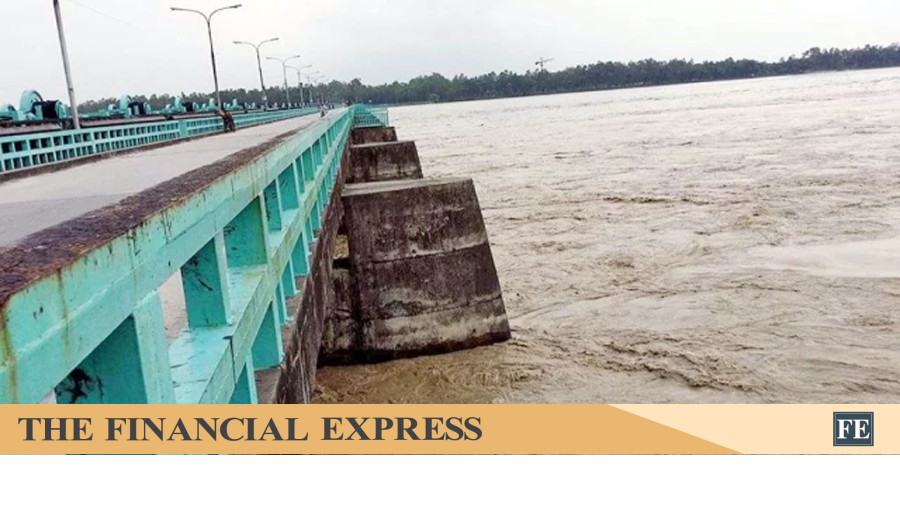
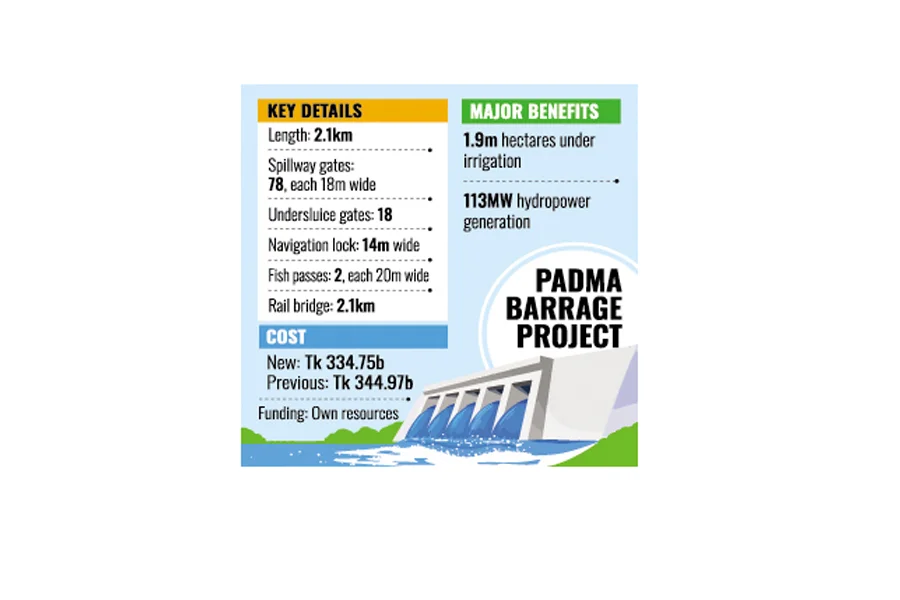
A megaproject for building the long-cherished Padma Barrage with an estimated cost of Tk 334.75 billion is ready to go for endorsement at the next ECNEC meeting, officials say.

The project is among 16 agenda placed on the notice for the Executive Committee of the National Economic Council (ECNEC) meeting scheduled for Wednesday, according to officials at the Planning Commission.

Prime Minister Tarique Rahman is scheduled to preside over the meeting of the government's highest policymaking body.

Earlier last month, the commission processed the project with an estimated cost of Tk 344.97 billion for placement at the first ECNEC meeting of the current government, but it was withdrawn at the last moment.

According to the proposal, an additional month of detailed evaluation helped reduce the project cost by Tk 10.23 billion, "bringing efficiency in its implementation plan".

The total estimated cost of the project is Tk 504.44 billion according to proposal placed at the meeting of project-evaluation committee (PEC) held last year, but the meeting recommended implementing it in two phases.

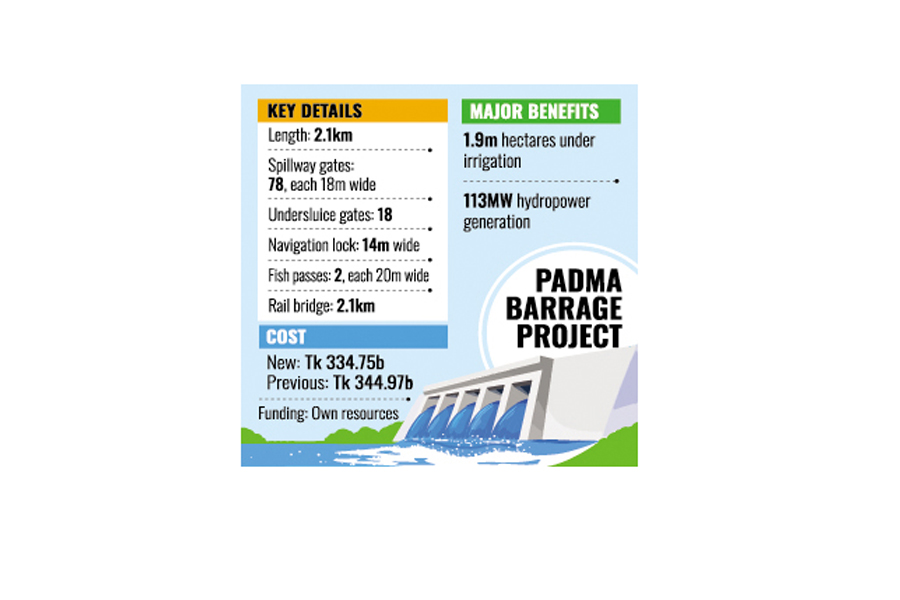
Officials say the project is expected to bring around 1.9 million hectares of land under irrigation, boosting agricultural output in 19 districts of four divisions: Dhaka, Khulna, Rajshahi and Barishal. People in Kushtia, Faridpur, Jashore, Khulna, Barishal, Pabna and Rajshahi districts are set to be core beneficiaries.

According to the project proposal, the 2.1-kilometre barrage will include 78 spillway gates, each 18- metre wide, along with 18 undersluice gates.

It will also feature a 14-metre-wide navigation lock, two 20-metre-wide fish passes to support aquatic ecosystems, and a 2.1-km railway bridge over the structure.

The megaproject is expected to generate around 113 megawatts of hydropower and ensure water supply to key installations, including the Rooppur Nuclear Power Plant.

"Although the Padma-dependent area (PDA) in the south-west and north-west regions covers only about 3.0 per cent of Bangladesh's land area, it supports nearly one-third of the country's population," the proposal reads.

It further explains that the Farakka Barrage established in the 1970s, in India, diverted around 35,000-40,000 cusecs of Padma River waters during the dry season to the Bhagirathi-Hooghly system to improve navigability of Kolkata Port. This significantly reduced downstream flow in Bangladesh.

As a result, flows in major river systems in the southwest and northwest, including the Ichamati-Mathabhanga, Gorai-Modhumoti, Chandana-Barasia, Arial Khan and Boral, have severely declined. This has damaged agriculture, fisheries, forestry, navigation, and domestic water supply, while also degrading the regional ecosystem.

Reduced freshwater flow has further worsened salinity intrusion and biodiversity loss in the Sundarbans, putting livelihoods in the coastal belt under increasing pressure.

Given that the Padma remains a key surface-water source for major regions, including Rajshahi, Pabna, Kushtia, Jashore, Khulna, Faridpur and Barishal, "sustainable water management" is deemed crucial for agriculture, fisheries, biodiversity conservation and balanced regional development.

In this context, a barrage on the Padma River is proposed as a key intervention to revive river systems, reduce salinity intrusion, improve drainage and irrigation, and help restore ecological balance, including in the Sundarbans.

Although development partners, including China, had earlier shown interest in financing, uncertainty over external funding has led the government to opt for full financing from its own resources.

The proposal estimates Tk 186.02 billion for barrage construction and related infrastructure, Tk 7.43 billion for electrical works and hydropower generation, and Tk 4.18 billion for Gorai offtake-related facilities.

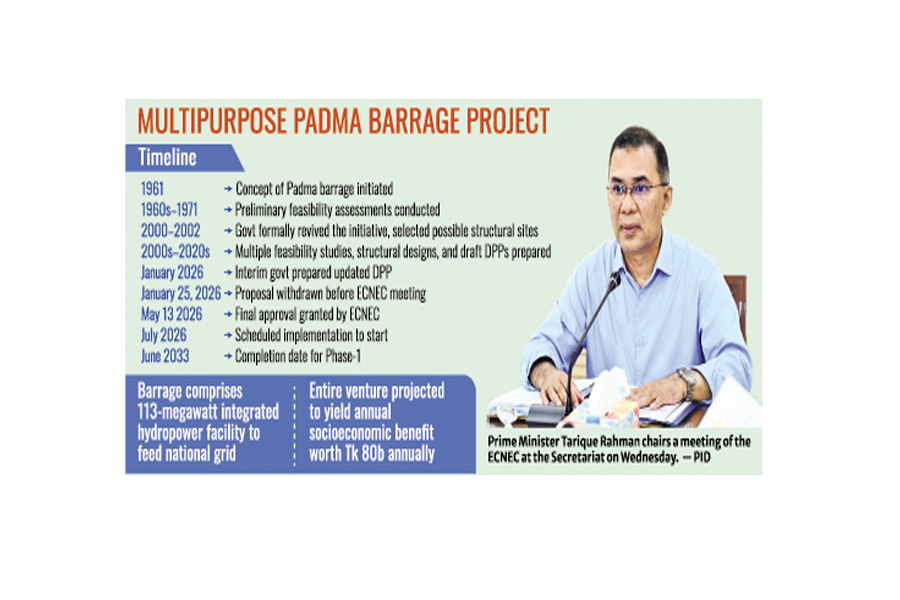
The idea of a Ganges or Padma Barrage dates back to the pre-independence period, with the then East Pakistan Water and Power Development Authority having initiated the first study in 1961. Multiple pre-feasibility studies were conducted until 2000.

In 2002, the Water Resources Planning Organisation (WARPO) recommended constructing the barrage either at Thakurbari in Kushtia or Pangsha in Rajbari. Detailed feasibility studies and engineering designs were later carried out between 2009 and 2016.​
 

Teesta and trust between two neighbours

Mir Mostafizur Rahaman

Published :
May 11, 2026 21:24
Updated :
May 11, 2026 21:24

1778542988670.webp


For more than a decade, the unresolved Teesta water-sharing agreement has stood as one of the most visible reminders of the fragility and asymmetry that continue to shape relations between India and Bangladesh. Every few years, New Delhi reiterates its commitment to concluding the deal. Every few years, Dhaka expresses cautious optimism. And every few years, the process stalls again -- trapped in the complexities of Indian federal politics, regional calculations and electoral considerations.

The recent political shift in West Bengal may have created a real opportunity in years to finally resolve the dispute.

With Mamata Banerjee ousted from power in the West Bengal assembly elections and the Bharatiya Janata Party forming the state government, the longstanding political excuse for delaying the Teesta agreement has effectively disappeared. If India still fails to move forward now, Dhaka will inevitably conclude that the obstacle to signing the Teesta water sharing deal was never Mamata Banerjee -- but a deeper reluctance within the Indian state itself.

For Bangladesh, the Teesta is not a symbolic issue. It is a matter of survival for millions.

The Teesta River is the lifeline of northern Bangladesh, flowing through districts where agriculture, livelihoods and local ecosystems depend heavily on its waters. During the dry season, water scarcity has become acute, devastating crop production and intensifying economic hardship in the region. Farmers in greater Rangpur region and adjoining areas have long spoken of shrinking riverbeds, failed irrigation cycles and increasing uncertainty over farming.

Bangladesh has repeatedly argued that a fair distribution of Teesta waters is not only a bilateral obligation but also a humanitarian necessity. The country's expectation was shaped by earlier precedents. After years of negotiations, India and Bangladesh successfully concluded the landmark Ganges water-sharing treaty in 1996, proving that even difficult transboundary water disputes could be resolved through political will and diplomatic maturity.

The Teesta agreement appeared poised to become the next major breakthrough.

During the tenure of former Indian Prime Minister Manmohan Singh, negotiations between the two countries advanced substantially. Officials from both sides worked through technical details and reportedly reached a near-final formula for water allocation. Expectations rose sharply ahead of Singh's 2011 visit to Dhaka, during which the agreement was expected to be formally signed.

But in a dramatic last-minute reversal, the deal collapsed.

Mamata Banerjee, then chief minister of West Bengal, opposed the proposed arrangement and withdrew support just before the visit. Her government argued that West Bengal itself faced water shortages and that the proposed formula would adversely affect the state's northern districts. Banerjee maintained that the central government had failed to adequately consult Kolkata before finalising the agreement.

Her objections were rooted partly in regional politics and partly in genuine concerns over water availability. West Bengal officials claimed that the Teesta's lean-season flow was insufficient to accommodate Bangladesh's demands without hurting irrigation and agricultural needs within the state. Banerjee also argued that the hydrological data used during negotiations did not accurately reflect ground realities.

Whether one accepted those arguments or not, the political consequences were immediate and lasting.

The failure to sign the Teesta agreement during Manmohan Singh's Dhaka visit deeply embarrassed New Delhi and generated considerable disappointment in Bangladesh. For many Bangladeshis, it became a defining example of how India's internal political divisions could override solemn diplomatic commitments made to a neighbouring country.

That disappointment carried broader implications because Bangladesh, over the past 15 years, has consistently demonstrated strategic goodwill towards India.

Dhaka addressed many of New Delhi's core security concerns, particularly on cross-border insurgency and regional connectivity. Successive Bangladeshi governments facilitated transit, strengthened counterterrorism cooperation and expanded economic integration despite often facing domestic criticism for becoming overly accommodative towards India cause.

Yet on Teesta -- arguably Bangladesh's most emotionally resonant bilateral issue -- India repeatedly failed to deliver.

Successive governments in New Delhi sought to reassure Dhaka by insisting that the central leadership remained committed to the agreement. The problem, Indian officials repeatedly explained, was opposition from the West Bengal government. Since water is constitutionally linked to state interests under India's federal structure, New Delhi argued that it was unable to impose a settlement without Kolkata's cooperation.

This explanation, while institutionally valid, gradually began losing credibility in Bangladesh.

Critics asked a simple question: if India truly considered Bangladesh a strategic priority, why was it unable to build domestic political consensus on an issue it had already negotiated extensively? The perception grew that Bangladesh's interests could always be subordinated to Indian electoral politics whenever convenient.

That perception became stronger, as relations between the two countries entered a more strained phase in recent years. Political trust between them weakened further.

Disputes over border killings, the Citizenship Amendment Act, visa restrictions, trade imbalances and increasingly sharp rhetoric in Indian domestic politics have all contributed to unease intensifying further in Bangladesh.

This is precisely why the current political transition in West Bengal matters.

For years, New Delhi pointed to Mamata Banerjee's resistance as the principal barrier. That barrier is now gone. The BJP controls both the central government and the state government in West Bengal. Coordination problems that once paralysed decision-making should, in theory, no longer exist.

If the Modi government genuinely intends to strengthen relations with Bangladesh, there is no better opportunity than this.

A Teesta agreement would carry significance far beyond water sharing. It would signal that India is capable of honouring commitments to its neighbours despite domestic political complexities. It would demonstrate strategic seriousness at a time when regional geopolitics is rapidly changing. And it would help counter growing perceptions in Bangladesh that New Delhi takes Dhaka's Cooperation for granted.

The geopolitical context makes the issue even more urgent.

China has steadily expanded its footprint in Bangladesh through infrastructure investments, development financing and strategic engagement. Bangladesh, meanwhile, has increasingly sought to diversify its international partnerships rather than rely excessively on any single power. India remains Bangladesh's most important neighbour, but goodwill can no longer be assumed as permanent or unconditional.

In this environment, symbolic gestures matter. Concrete deliverables matter even more.

Resolving the Teesta dispute would not eliminate all bilateral tensions overnight. Water-sharing arrangements involving transboundary rivers are inherently difficult, particularly amid climate stress, erratic rainfall and rising demand. West Bengal's concerns regarding water availability also deserve serious scientific evaluation rather than political dismissal.

But complexity cannot become an excuse for perpetual paralysis.

The Modi government frequently speaks of "Neighbourhood First" and regional connectivity. Those ambitions require political credibility. Bangladesh has often supported India at moments when doing so carried domestic political risks. Reciprocity now demands movement from New Delhi.

There is also a larger principle at stake.

South Asia remains one of the least integrated regions in the world despite deep cultural, historical and geographical ties. One major reason is the persistent inability of states in the region to institutionalise trust. Agreements are delayed, politicised or abandoned depending on electoral calculations. As a result, regional cooperation remains hostage to short-term politics.

The Teesta dispute has become a textbook example of that dysfunction.

India now has an opportunity to change the narrative. With political alignment between Kolkata and New Delhi, the structural obstacle repeatedly cited over the last decade has effectively disappeared. If negotiations restart seriously and a final agreement emerges, it could revive confidence not only in India-Bangladesh relations but also in the broader possibility of cooperative regional diplomacy in South Asia.

The question now is whether New Delhi is prepared to seize the moment -- or whether Teesta will continue flowing as a river of missed opportunities between two neighbours who can no longer afford the luxury of distrust.​
 

Govt plans Padma Barrage project costing Tk 334.74 billion
According to sources at the Planning Ministry, the project has mainly been prepared to provide some relief from the water crisis during the dry season caused by the Farakka Barrage. After decades of study and examination, the Padma Barrage project is now awaiting approval.

Eiahai Nakib
Dhaka
Updated: 11 May 2026, 20: 51

1778545233355.webp

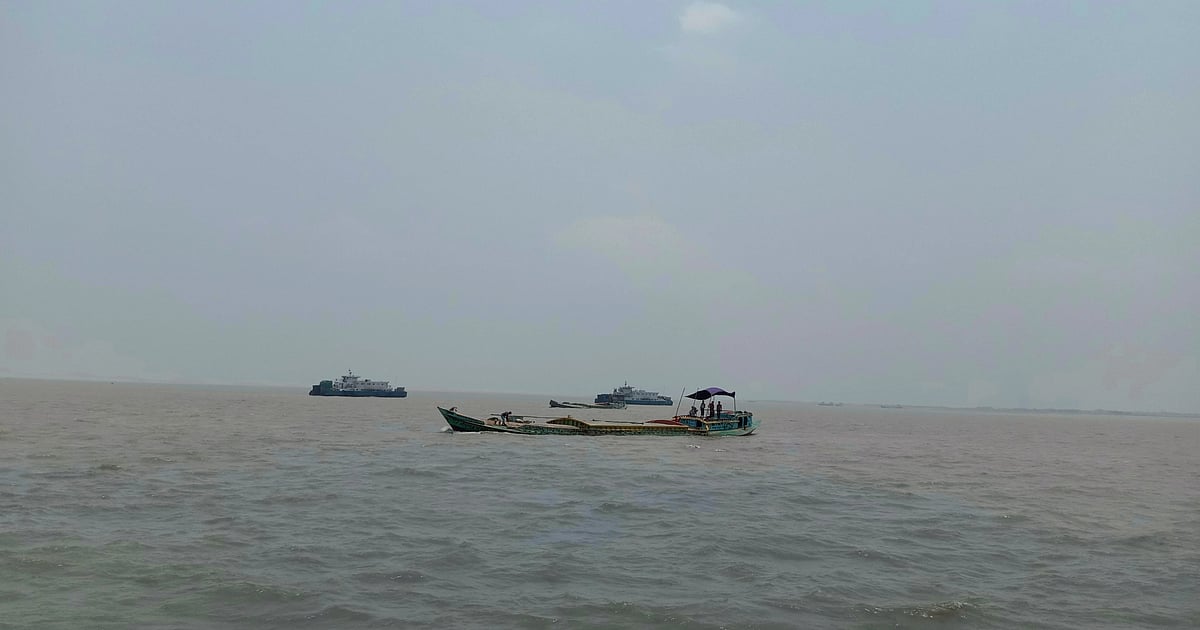
Padma River File photo

The incumbent government has finally taken the initiative to build the Padma Barrage. Nearly 25 years ago, the then Bangladesh Nationalist Party (BNP) government had initiated efforts to construct the barrage.

The Padma Barrage (First Phase) construction project may be placed for approval at the meeting of the Executive Committee of the National Economic Council (ECNEC) next Wednesday. The estimated cost of the project has been set at Tk 334.74 billion.

According to the project proposal documents, a 2.1-kilometre main dam will be constructed on the Padma River in Pangsha upazila of Rajbari. The initiative has been taken to address water shortages on nearly 37 per cent of the country’s land dependent on the Padma River.

By increasing water flow, five rivers in the country’s south western region will be revitalised, helping reduce salinity coming from the Sundarbans region. This is expected to help maintain biodiversity balance and increase agricultural and fish production.

A total of 16 projects, including the Padma Barrage construction project, are scheduled to be presented at Wednesday’s ECNEC meeting. It is learned that the initiative has been taken as part of fulfilling an electoral pledge.

Due to the Farakka Barrage, vast areas of our country have dried up because of water shortages. Temperatures have also increased. Certainly, the effects can be partially overcome through this barrage. We will be able to store water and supply it throughout the year.

Mahmudul Hossain Khan, Member (secretary), Agriculture, Water Resources and Rural Institutions Division, Planning Commission.

Asked why such a large project is being undertaken amid economic pressure, State Minister for Planning Zonayed Abdur Rahim Saki (Zonayed Saki) told Prothom Alo, “The government has an electoral commitment regarding this project. Discussions are ongoing now. There will be detailed discussions at the ECNEC meeting. Comments can be made after that.”

According to sources at the Planning Ministry, the project has mainly been prepared to provide some relief from the water crisis during the dry season caused by the Farakka Barrage. After decades of study and examination, the Padma Barrage project is now awaiting approval.

The final proposal for the project has been prepared under the Agriculture, Water Resources and Rural Institutions Division of the Planning Commission.

Md Mahmudul Hossain Khan, member (secretary) of the division, told Prothom Alo, “Due to the Farakka Barrage, vast areas of our country have dried up because of water shortages. Temperatures have also increased. Certainly, the effects can be partially overcome through this barrage. We will be able to store water and supply it throughout the year.”

Asked about the status of the project, Mahmudul Hossain Khan said, “We have completed our work and sent the project to ECNEC. Now the government will make the final decision.”

What the project includes

Under the project, a 2.1-kilometre main dam will be constructed in Pangsha upazila of Rajbari. It will include 78 spillways, 18 undersluices, and two fish passes. The barrage will be capable of storing 2.9 billion cubic metres of water. Three offtake infrastructures will also be built to distribute the stored water. In addition, a 113-megawatt hydropower plant will be established.

The stored water will be used to revive the flow of five rivers: the Hisna-Mathabhanga River, Gorai-Madhumati River, Chandana-Barashia River, Baral River and Ichamati River. Around 800 cusec (cubic metres per second) of water will be supplied to these rivers during the dry season.

Project documents say necessary irrigation water will be supplied to around 2.9 million hectares of cultivable agricultural land in the greater Kushtia, Faridpur, Jashore, Khulna, Barishal, Pabna and Rajshahi regions. It is expected to increase rice production by around 2.4 million tonnes and fish production by 234,000 tonnes.

Water shortages, salinity in the Sundarbans region and waterlogging due to siltation will worsen in the future. Therefore, freshwater supply must be increased. There is no alternative to this barrage.

Professor Mashfiqus Salehin, Institute of Water and Flood Management, BUET.

According to the project documents, if implemented, the project is expected to generate social and economic benefits worth around Tk 80 billion annually.

Why this project

People involved with the project said the construction of the Farakka Barrage in India’s West Bengal during the 1970s drastically reduced the flow of the Padma River in Bangladesh. As a result, six rivers connected to the Padma dried up. This severely affected agriculture, fisheries, navigation and biodiversity in the country’s southwestern region.

Meanwhile, the Padma River is the only source of fresh water in the greater Rajshahi, Pabna, Kushtia, Jashore, Khulna, Faridpur and Barishal districts. Therefore, development in these areas depends on proper water management. The barrage is planned to retain monsoon water and ensure controlled water supply during the dry season.

The project, proposed by the Ministry of Water Resources, will cost over Tk 334.74 in its first phase. Work is scheduled to continue from 2026 to 2033.

What experts say

Environmental and water resources expert Ainun Nishat, who was once involved with the project, told Prothom Alo, “This is not a new project. Discussions started in 1964. We selected the site in 1997. The Indian government had promised assistance in constructing the barrage. However, it was later stalled due to various political reasons.”

Although he said he is not aware of the project’s current status, he noted that there is no question about its benefits. However, the expert believes financing remains a major challenge.

The Institute of Water and Flood Management at Bangladesh University of Engineering and Technology (BUET) regularly conducts research on the country’s water management and flood conditions.

Professor Mashfiqus Salehin of the Institute told Prothom Alo, “Water shortages, salinity in the Sundarbans region and waterlogging due to siltation will worsen in the future. Therefore, freshwater supply must be increased. There is no alternative to this barrage.”

A similar project was discussed during the BNP government in 2002, while initial proposals for such an initiative date back to 1961 during the Pakistan era.

From 2009 to 2013, feasibility studies were conducted by experts from Bangladesh, Australia and Pakistan. Later, until 2016, the Water Development Board worked on designing the project.​
 

Crisis looms over Ganges treaty renewal
30-year deal expires in December

Mustafizur Rahman 11 May, 2026, 23:58

1778547689885.webp


Renewal of the Ganges Water Sharing Treaty between Bangladesh and India seems destined for a crisis as both the countries have opposing stances over how the water of the common river should be shared, with the 30-year deal expiring in December.

Indian foreign secretary Vikram Misri has recently said that water was always a priority for them among the bilateral issues as the two countries share at least 54 rivers and they have a water sharing treaty only for the Ganges.

Meanwhile, former Indian diplomat Pankaj Saran has said that the water sharing formula based on the historic flows of waters of 40 years from 1949 to 1988 might not work anymore for the renewed Ganges Water Sharing Treaty, 1996.

In an interaction with a media delegation from Bangladesh on May 5 in New Delhi, he said population had grown and the water flow had decreased, which he termed as the ‘new reality’ for the renewal of the deal.

‘Ganges water sharing formula (in the 1996 treaty) may not work anymore after 30 years. Things have changed a lot,’ said Pankaj, convener of NatStrat, a Delhi-based independent think tank for research on strategic and security issues.

Referring to the water sharing formula stipulated in the annexure of the water treaty signed between India and Bangladesh in 1996, Pankaj, a former Indian high commissioner to Bangladesh, suggested considering the water flows of the immediate past 40 years as both the countries were preparinag for negotiations over the renewal of the treaty.

Indian has long been withdrawing waters from common rivers unilaterally, affecting lives and livelihoods in lower riparian Bangladesh, according to experts and officials in Dhaka, who think that the new formula, if implemented, would further deprive Bangladesh of its rightful share of water as the water level at Farakka point has dropped over the years.

Former Joint Rivers Commission, Bangladesh member and water resources expert Ainun Nishat said that India was unilaterally withdrawing waters from the Ganges at its upstream, reducing the water flow at Farakka point.

‘The River Ganges does not begin at Farakka. It has a huge water flow at its upstream from where water is being withdrawn unilaterally, reducing flow along the border and affecting Bangladesh,’ he said.

About the Teesta development project implementation being discussed with China, retired diplomat Pankaj said that it was a choice of Bangladesh.

‘The Teesta is a common river. It’s a matter of concern to some extent for India,’ he observed, saying that solutions were known to all, but it needs political willingness’ as the signing of the Teesta water sharing treaty left pending for India’s decision since 2011.

In another interaction session with the Bangladesh media delegation, Indian foreign secretary Vikram Mistri on May 4 at his office in New Delhi said that they were ready to engage with the new government led by Bangladesh Nationalist Party chairman Tarique Rahman to discuss all the outstanding issues including water.

He hoped that the JRC, being a technical framework to deal with the issues of common rivers, would be able engage timely for the renewal of the Ganges water treaty, which he termed as a successful one.

Asked whether the issue of treaty renewal was raised at the technical level under the Indo-Bangladesh Joint Rivers Commission, water resources secretary AKM Shahabuddin on Monday said in Dhaka that he would not make any remark on the issue at this stage.

JRC, Bangladesh member Md Anwar Kadir also declined to comment on the issue.

Senior officials concerned at the water resources ministry and the JRC, Bangladesh, however, said everything would be discussed during the negotiation on the renewal of the Ganges water treaty.

The last ministerial meeting of the JRC concluded in New Delhi in August, 2022 after a gap of 12 years without any progress in signing a much-awaited Teesta water sharing deal and in the negotiations on six other trans-boundary rivers.

Both sides agreed to conduct a feasibility study for an optimum utilisation of the water received by Bangladesh under the provision of the Ganges Water Sharing Treaty.

Dhaka has already raised the issue of the renewal of Ganges Water Sharing Treaty that specifies water sharing during the dry season (January-May).​
 

Latest Posts

Back
Top Bottom