Bangladesh Defense
Saif
Senior Member
- Jan 24, 2024
- 21,435
- 9,743
- Nation

- Residence
- Axis Group


Renewing the Ganges Water Sharing Treaty: What should Bangladesh do?
To secure a fair Ganges Water Sharing Treaty, Bangladesh must prioritise ecological preservation over commercial water exploitation.
Renewing the Ganges Water Sharing Treaty: What should Bangladesh do?
S Nazrul Islam
The 30-year Ganges Sharing Treaty (GST), signed on 12 December 1996, is about to expire and needs to be renewed. Reaching an agreement on such a contentious issue, however, requires proper preparation. How well is Bangladesh doing in this regard?
The initiative has to come from Bangladesh because, in the absence of a treaty, India can use its upstream location to divert as much Ganges water as it wishes, subject to the 40,000-cusec capacity limit of the feeder canal. It is not in Bangladesh’s interest to be in that situation.
Bangladesh’s preparation should involve three tasks: (a) defining Bangladesh's position regarding the treaty; (b) taking the steps needed to ensure that its position is accepted; and (c) forming a competent team for the negotiations. It is not difficult to see that these tasks are interrelated.
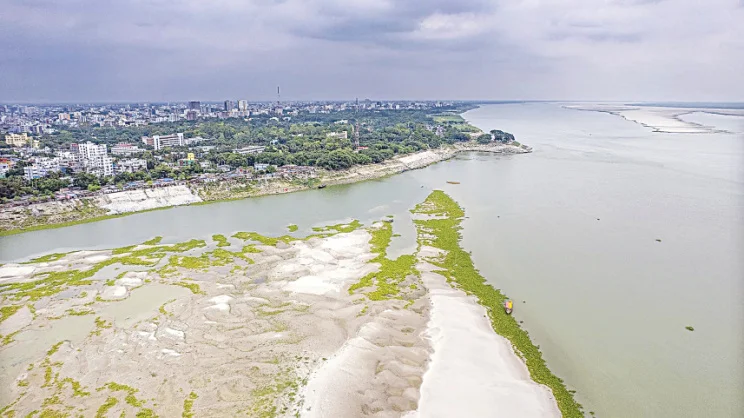
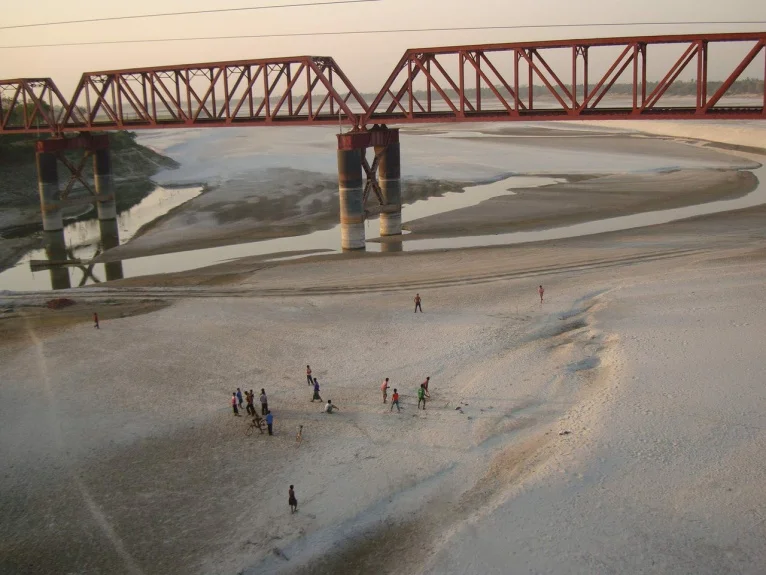
An aerial view shows a stretch of the Padma River where vast sandbars have emerged, signalling a serious water crisis largely blamed on the Farakka Barrage upstream. Photo: Rashed Shumon
Shifting from the commercial to the ecological approach
So far, river sharing negotiations between India and Bangladesh have been carried out on the basis of the "commercial approach" to rivers. Under this approach, rivers are viewed primarily as commercial assets, which are to be used up completely before any river water reaches the sea. The opposite is the "ecological approach", which emphasises rivers’ ecological functions while not neglecting their economic role. Among the ecological functions of rivers, the two most important are, first, serving as the vital link in the Earth's hydrological cycle and, second, fostering and sustaining unique ecosystems in their respective valleys.
It is clear that if Bangladesh engages in river sharing negotiations on the basis of the commercial approach, it is destined to lose because India will be able to put forward hundreds of commercial needs for river water, leaving nothing for Bangladesh. This was starkly demonstrated by Mamata Banerjee when she flatly declared that West Bengal needed all the Teesta water for irrigation and could not spare any for Bangladesh.
To counter India's commercial approach, Bangladesh may also try to follow this approach. In fact, that has been Bangladesh’s strategy so far. For instance, responding to India’s Farakka Barrage, it undertook the "Ganges-Kobadak (G-K) Project" in the 1950s to demonstrate that it, too, required Ganges water for irrigation. Similarly, facing India's construction of the Gajoldoba Barrage, Bangladesh built the Teesta Barrage at Dalia in the 1980s to demonstrate its own need for irrigation water.
However, this strategy has not succeeded. The G-K Project failed to halt India’s construction of the Farakka Barrage. Instead, Farakka itself prevented the G-K Project from going beyond the first unit of its first phase. The experience with the Teesta Barrage at Dalia has been even more dismal. The lack of steady flow devastated the entire Teesta river system downstream of Dalia, forcing Bangladesh to seek a billion-dollar Chinese grand project for the restoration of the Teesta.
To succeed in its negotiations with India, Bangladesh therefore needs to discard the commercial approach and embrace the ecological approach. This will help it in two ways. First, Bangladesh will be able to prioritise the necessity of preserving its riverine environment and ecosystems, including the Sundarbans, and it will be difficult for India to dismiss Bangladesh's arguments. Second, the ecological approach will help Bangladesh gain international support for its position because world opinion on rivers is increasingly shifting away from the commercial approach towards the ecological approach. (See the author’s book, Rivers and Sustainable Development, Oxford University Press, 2020, for details.)
Why Bangladesh should sign the 1997 UN Watercourses Convention
A prime example of this shift is the 1997 UN Convention on the Law of the Non-Navigational Uses of International Watercourses. This convention is beneficial for Bangladesh for two reasons. First, it emphasises the ecological functions of rivers. For instance, its Article 20 stipulates that "co-riparian states must, individually and, where appropriate, jointly, protect and preserve the ecosystems of international watercourses." Article 23 clarifies that the concept of a river ecosystem encompasses estuaries and coastal areas. Consequently, Bangladesh’s demand for an adequate flow of the Ganges will be grounded in the UN Convention.
Second, even regarding the economic (commercial) uses of rivers, the 1997 UN Convention imposes obligations that are favourable to Bangladesh. For instance, Article 7 stipulates that "a state utilising an international watercourse must ensure that no significant harm is caused to other riparian states. Should such harm occur, the state responsible must, in consultation with the affected state, take measures, including the provision of compensation, to redress the damage."
Furthermore, the Convention recognises "existing uses" of watercourses and specifies in Article 6 that, when assessing harm, "consideration must be given to whether the existing use of the watercourse by a riparian state has been impaired."
Clearly, viewed through the lens of the 1997 UN Convention, neither the Farakka nor the Gajoldoba barrage can be justified, because both have caused significant harm to Bangladesh’s ecology, agriculture, transportation, etc.
Hence, switching to the ecological approach and signing the 1997 UN Convention are two preliminary steps that Bangladesh needs to take to prepare itself for the negotiations. But what concrete position should Bangladesh adopt during the actual negotiations?
India’s homegrown movement against the Farakka Barrage
From the perspective of the ecological approach, the ideal demand from Bangladesh would be the removal of the Farakka Barrage and the restoration of the unimpeded flow of the Ganges. While this may seem like an impossible demand to many in Bangladesh, this is not the case for many in India itself. Public frustration with the Farakka Barrage has grown there over time because, first, it failed to fulfil the promise of preserving Kolkata's viability as a seaport. Second, Farakka caused upstream siltation, so that the river level at Farakka has increased by about 4.05 metres since 1974, despite some decrease in flow over the years. This has caused drainage congestion and severe floods in Bihar. Meanwhile, West Bengal has witnessed aggressive bank erosion, leaving tens of thousands of families destitute. Third, obstructed at Farakka, the Ganges is shifting channels and seems poised to adopt the neighbouring Pagla River as its main channel, bypassing Farakka entirely.
In view of these actual and potential dire consequences, a strong movement has emerged in India under the leadership of former Bihar Chief Minister Nitish Kumar, demanding the removal of the Farakka Barrage. In 2016, at the 11th meeting of India's Inter-State Council, chaired by Prime Minister Narendra Modi, Nitish Kumar declared that the Farakka Barrage had caused more harm than good and demanded its removal. At the "Abiram Ganges" conference held in Patna in February 2017, Rajendra Singh, the "Waterman of India", termed Farakka "sinister" and a "curse". The conference adopted an 11-point "Patna Declaration", with the primary demand being the restoration of the Ganges' natural flow through the removal of the Farakka Barrage and other dams. A follow-up conference held in Delhi in May 2017 adopted a similar declaration. (See the author’s book Water Development in Bangladesh – Past, Present and Future, Eastern Academic, 2022, for details.)
It is only natural that Bangladesh, the primary victim of the Farakka Barrage, should add its voice to India’s homegrown demand for the removal of Farakka. However, until this demand is fulfilled, Bangladesh has to ensure the renewal of the GST in a way that satisfies its minimum requirements.
Indo-Bangladesh Ganges sharing treaties so far
There have been three Indo-Bangladesh Ganges agreements. The first was the 1974 "Mujib-Indira Agreement", allowing India to withdraw 11,000 to 16,000 cusecs during the dry season (January-May), leaving approximately 40,500 to 44,500 cusecs for Bangladesh. Under the five-year agreement signed in 1977 during the Zia government, India agreed to limit its dry-season withdrawal to 20,000 cusecs, leaving approximately 35,000 cusecs for Bangladesh. It also included a "minimum guarantee clause (MGC)", ensuring a minimum flow of 27,600 cusecs for Bangladesh. Following the expiration of the 1977 agreement, there was no treaty for a long period. During these years, the dry-season flow of the Ganges entering Bangladesh depended largely on India's discretion.
Under the 1996 agreement, signed by the Sheikh Hasina government, India would withdraw 40,000 cusecs when the flow at Farakka exceeded 75,000 cusecs, leaving the rest for Bangladesh. When the flow at Farakka ranged between 70,000 and 75,000 cusecs, Bangladesh would receive 35,000 cusecs, with India receiving the rest. Finally, if the flow at Farakka fell below 70,000 cusecs, it would be shared equally between India and Bangladesh.
This agreement, however, did not contain any MGC. This was a matter of concern because the dry-season flow of the Ganges at Farakka has been steadily declining due to India's upstream diversion. Thus, the average dry-season flow of the Ganges under the Hardinge Bridge declined from 2,451 cumec during the pre-Farakka period (1934-74) to 1,295 cumec during the post-1996 Treaty years of 1997-2010. Consequently, without a guaranteed minimum flow, the volume of dry-season Ganges water entering Bangladesh often drops below the "minimum environmental flow" that is required to sustain the river and its ecosystem.
Necessity and feasibility of a 35,000-cusec minimum guarantee clause
It is therefore necessary that the renewed GST contain a guarantee of a minimum dry-season flow of 35,000 cusecs for Bangladesh. Ensuring this minimum should not be onerous for India because, as already noted, the navigability of Kolkata port does not depend on the Bhagirathi flow. As the legendary West Bengal Chief Engineer Kapil Bhattacharya pointed out about 60 years ago, the main reason for the siltation of Kolkata port was the dams that India had built on the Damodar and Rupnarayan Rivers without taking into consideration their effects on the sediments brought in by tidal flows. Bhattacharya was vilified for these "heretical" views and ultimately dismissed from his job by the authorities, who were intent on constructing the Farakka Barrage. However, subsequent experience vindicated his analysis and recommendations.
Nature shifted the main flow of the Ganges away from the Bhagirathi and towards Bangladesh many centuries ago. Attempting to reverse this shift using the Farakka Barrage runs counter to nature. This hubris has not proved its worth.
Thus, India has the option of increasing the flow of the Mayurakshi, Ajay, Damodar, Silai, Rupnarayan, Kangsabati (Kasai) and other tributaries that join the Bhagirathi-Hooghly River downstream of Farakka. By contrast, the Ganges flowing through Bangladesh has virtually no tributaries to boost its flow. Rather, it has numerous distributaries that rely on it for their water supply. In fact, the ecology and economy of Bangladesh's entire southwestern region depend on the Ganges. Nature shifted the main flow of the Ganges away from the Bhagirathi and towards Bangladesh many centuries ago. Attempting to reverse this shift using the Farakka Barrage runs counter to nature. This hubris has not proved its worth. It would therefore be better if India proactively agreed to the 35,000-cusec MGC. This decision may be beneficial for West Bengal too, because it would encourage the Indian central government to curb the ongoing, relentless pressure from its water lobby to construct structures for the withdrawal of water and thus allow more of the Ganges flow to reach Farakka, enabling more water to flow towards the Bhagirathi even after meeting the 35,000-cusec MGC for Bangladesh.
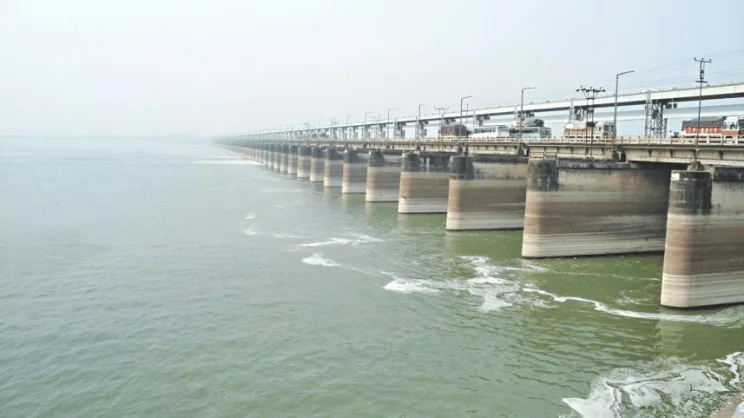
The Farakka Barrage on the Ganges in West Bengal, a key control point for upstream water diversion and central to the Ganges Water Sharing Treaty between India and Bangladesh. Photo: Star
India needs a broader perspective on river sharing
Despite India’s crucial support for Bangladesh’s War of Independence in 1971, public opinion in Bangladesh, to a large extent, quickly turned against India because of the Farakka Barrage. To this day, the Farakka Barrage and other diversionary barrages on shared rivers remain major obstacles to improving relations between Bangladesh and India. If these obstacles could be removed, cooperation between the two countries could blossom in many different directions. For example, Bangladesh could more willingly offer transit and transshipment facilities and opportunities for India’s seven northeastern states to use its seaports, thus aiding their accelerated development. Although the Sheikh Hasina government granted many of these privileges unilaterally, their long-term continuation is not guaranteed and could be affected by political changes in Bangladesh. India, therefore, has reason to consider river sharing issues within the broader context of its long-term relationship with Bangladesh.
Building ties with river activists in India
For Bangladesh's position to be accepted, it must garner support within India. Efforts to this end are required at both governmental and non-governmental levels. Organisations such as BAPA and BEN have been doing their best in this regard. They have held several conferences on water sharing issues, with significant participation by water experts and activists from India. A landmark event in this regard was the 2004 conference on the Indian Riverlinking Project (IRLP), in which about 50 participants, including leading river experts and activists from India, took part. The conference in 2013, titled "Water Resources of South Asia: From Conflict to Cooperation", was another such laudable event. Through these initiatives, a channel of communication has been established among river experts and activists from Bangladesh and India, and it can facilitate the dissemination of Bangladesh’s position and arguments regarding the GST. However, these efforts are not sufficient, and the Bangladesh government needs to do its part.
Ensuring support from the international community
Vigorous efforts are required in the international arena too. As noted above, signing the 1997 UN Convention should be the first step. Bangladesh can then explain its position to the countries that are signatories to the Convention. In particular, it may draw the attention of the international community to the necessity of an adequate dry-season Ganges flow in Bangladesh for the protection of the Sundarbans, a UNESCO-recognised World Natural Heritage Site. Several UNESCO delegations have previously noticed the degradation of the Sundarbans caused by the Farakka withdrawal and expressed concerns that a further decline in freshwater flow could seriously damage the health of the Sundarbans. Bangladesh can use UNESCO's observations to mobilise global public opinion in favour of its position.
India’s withdrawal of water during the dry season leaves the riverbed near Hardinge Bridge almost dry. Photo: Star
Currently, the world community remains largely unaware of India's unfair treatment of Bangladesh regarding shared rivers. Since the Sundarbans is also shared by Bangladesh and India, the necessity of protecting it can help unite the two countries instead of driving them apart.
Proposed Ganges Barrage will weaken Bangladesh’s position in the negotiations
The Bangladesh government's recent approval of the project to build a barrage on the Ganges inside Bangladesh, apparently aimed at countering the Farakka Barrage, is a self-defeating move. First, Bangladesh will lose the moral ground for any criticism of the Farakka Barrage. Second, it will undercut Bangladesh’s rationale for demanding a greater share of the dry-season flow because India will be able to point to the proposed barrage as Bangladesh’s own solution to the Ganges water scarcity problem, thus absolving itself of the responsibility of agreeing to an MGC. The sooner the Bangladesh government recognises this folly, the better it will be for the country.
Bangladesh requires a competent negotiating team
Finally, Bangladesh requires a competent team to successfully renegotiate the GST with India. Currently, the Bangladeshi part of the Joint Rivers Commission (JRC) is heavily reliant on bureaucrats who lack the technical knowledge necessary for the task. Merely including engineers, however, is not the solution, because they generally lack sufficient knowledge and understanding of the broader ecological functions that rivers perform. Hence, the Bangladesh JRC needs to be reconstituted to include experts who can help conduct the negotiations from the perspective of the ecological approach, which is the only correct approach for Bangladesh, as explained at the very beginning of this essay.
Dr S. Nazrul Islam is a Professor at the Asian Growth Research Institute and a former Head of Development Research at the United Nations.
S Nazrul Islam
The 30-year Ganges Sharing Treaty (GST), signed on 12 December 1996, is about to expire and needs to be renewed. Reaching an agreement on such a contentious issue, however, requires proper preparation. How well is Bangladesh doing in this regard?
The initiative has to come from Bangladesh because, in the absence of a treaty, India can use its upstream location to divert as much Ganges water as it wishes, subject to the 40,000-cusec capacity limit of the feeder canal. It is not in Bangladesh’s interest to be in that situation.
Bangladesh’s preparation should involve three tasks: (a) defining Bangladesh's position regarding the treaty; (b) taking the steps needed to ensure that its position is accepted; and (c) forming a competent team for the negotiations. It is not difficult to see that these tasks are interrelated.
An aerial view shows a stretch of the Padma River where vast sandbars have emerged, signalling a serious water crisis largely blamed on the Farakka Barrage upstream. Photo: Rashed Shumon
Shifting from the commercial to the ecological approach
So far, river sharing negotiations between India and Bangladesh have been carried out on the basis of the "commercial approach" to rivers. Under this approach, rivers are viewed primarily as commercial assets, which are to be used up completely before any river water reaches the sea. The opposite is the "ecological approach", which emphasises rivers’ ecological functions while not neglecting their economic role. Among the ecological functions of rivers, the two most important are, first, serving as the vital link in the Earth's hydrological cycle and, second, fostering and sustaining unique ecosystems in their respective valleys.
It is clear that if Bangladesh engages in river sharing negotiations on the basis of the commercial approach, it is destined to lose because India will be able to put forward hundreds of commercial needs for river water, leaving nothing for Bangladesh. This was starkly demonstrated by Mamata Banerjee when she flatly declared that West Bengal needed all the Teesta water for irrigation and could not spare any for Bangladesh.
To counter India's commercial approach, Bangladesh may also try to follow this approach. In fact, that has been Bangladesh’s strategy so far. For instance, responding to India’s Farakka Barrage, it undertook the "Ganges-Kobadak (G-K) Project" in the 1950s to demonstrate that it, too, required Ganges water for irrigation. Similarly, facing India's construction of the Gajoldoba Barrage, Bangladesh built the Teesta Barrage at Dalia in the 1980s to demonstrate its own need for irrigation water.
However, this strategy has not succeeded. The G-K Project failed to halt India’s construction of the Farakka Barrage. Instead, Farakka itself prevented the G-K Project from going beyond the first unit of its first phase. The experience with the Teesta Barrage at Dalia has been even more dismal. The lack of steady flow devastated the entire Teesta river system downstream of Dalia, forcing Bangladesh to seek a billion-dollar Chinese grand project for the restoration of the Teesta.
To succeed in its negotiations with India, Bangladesh therefore needs to discard the commercial approach and embrace the ecological approach. This will help it in two ways. First, Bangladesh will be able to prioritise the necessity of preserving its riverine environment and ecosystems, including the Sundarbans, and it will be difficult for India to dismiss Bangladesh's arguments. Second, the ecological approach will help Bangladesh gain international support for its position because world opinion on rivers is increasingly shifting away from the commercial approach towards the ecological approach. (See the author’s book, Rivers and Sustainable Development, Oxford University Press, 2020, for details.)
Why Bangladesh should sign the 1997 UN Watercourses Convention
A prime example of this shift is the 1997 UN Convention on the Law of the Non-Navigational Uses of International Watercourses. This convention is beneficial for Bangladesh for two reasons. First, it emphasises the ecological functions of rivers. For instance, its Article 20 stipulates that "co-riparian states must, individually and, where appropriate, jointly, protect and preserve the ecosystems of international watercourses." Article 23 clarifies that the concept of a river ecosystem encompasses estuaries and coastal areas. Consequently, Bangladesh’s demand for an adequate flow of the Ganges will be grounded in the UN Convention.
Second, even regarding the economic (commercial) uses of rivers, the 1997 UN Convention imposes obligations that are favourable to Bangladesh. For instance, Article 7 stipulates that "a state utilising an international watercourse must ensure that no significant harm is caused to other riparian states. Should such harm occur, the state responsible must, in consultation with the affected state, take measures, including the provision of compensation, to redress the damage."
Furthermore, the Convention recognises "existing uses" of watercourses and specifies in Article 6 that, when assessing harm, "consideration must be given to whether the existing use of the watercourse by a riparian state has been impaired."
Clearly, viewed through the lens of the 1997 UN Convention, neither the Farakka nor the Gajoldoba barrage can be justified, because both have caused significant harm to Bangladesh’s ecology, agriculture, transportation, etc.
Hence, switching to the ecological approach and signing the 1997 UN Convention are two preliminary steps that Bangladesh needs to take to prepare itself for the negotiations. But what concrete position should Bangladesh adopt during the actual negotiations?
India’s homegrown movement against the Farakka Barrage
From the perspective of the ecological approach, the ideal demand from Bangladesh would be the removal of the Farakka Barrage and the restoration of the unimpeded flow of the Ganges. While this may seem like an impossible demand to many in Bangladesh, this is not the case for many in India itself. Public frustration with the Farakka Barrage has grown there over time because, first, it failed to fulfil the promise of preserving Kolkata's viability as a seaport. Second, Farakka caused upstream siltation, so that the river level at Farakka has increased by about 4.05 metres since 1974, despite some decrease in flow over the years. This has caused drainage congestion and severe floods in Bihar. Meanwhile, West Bengal has witnessed aggressive bank erosion, leaving tens of thousands of families destitute. Third, obstructed at Farakka, the Ganges is shifting channels and seems poised to adopt the neighbouring Pagla River as its main channel, bypassing Farakka entirely.
In view of these actual and potential dire consequences, a strong movement has emerged in India under the leadership of former Bihar Chief Minister Nitish Kumar, demanding the removal of the Farakka Barrage. In 2016, at the 11th meeting of India's Inter-State Council, chaired by Prime Minister Narendra Modi, Nitish Kumar declared that the Farakka Barrage had caused more harm than good and demanded its removal. At the "Abiram Ganges" conference held in Patna in February 2017, Rajendra Singh, the "Waterman of India", termed Farakka "sinister" and a "curse". The conference adopted an 11-point "Patna Declaration", with the primary demand being the restoration of the Ganges' natural flow through the removal of the Farakka Barrage and other dams. A follow-up conference held in Delhi in May 2017 adopted a similar declaration. (See the author’s book Water Development in Bangladesh – Past, Present and Future, Eastern Academic, 2022, for details.)
It is only natural that Bangladesh, the primary victim of the Farakka Barrage, should add its voice to India’s homegrown demand for the removal of Farakka. However, until this demand is fulfilled, Bangladesh has to ensure the renewal of the GST in a way that satisfies its minimum requirements.
Indo-Bangladesh Ganges sharing treaties so far
There have been three Indo-Bangladesh Ganges agreements. The first was the 1974 "Mujib-Indira Agreement", allowing India to withdraw 11,000 to 16,000 cusecs during the dry season (January-May), leaving approximately 40,500 to 44,500 cusecs for Bangladesh. Under the five-year agreement signed in 1977 during the Zia government, India agreed to limit its dry-season withdrawal to 20,000 cusecs, leaving approximately 35,000 cusecs for Bangladesh. It also included a "minimum guarantee clause (MGC)", ensuring a minimum flow of 27,600 cusecs for Bangladesh. Following the expiration of the 1977 agreement, there was no treaty for a long period. During these years, the dry-season flow of the Ganges entering Bangladesh depended largely on India's discretion.
Under the 1996 agreement, signed by the Sheikh Hasina government, India would withdraw 40,000 cusecs when the flow at Farakka exceeded 75,000 cusecs, leaving the rest for Bangladesh. When the flow at Farakka ranged between 70,000 and 75,000 cusecs, Bangladesh would receive 35,000 cusecs, with India receiving the rest. Finally, if the flow at Farakka fell below 70,000 cusecs, it would be shared equally between India and Bangladesh.
This agreement, however, did not contain any MGC. This was a matter of concern because the dry-season flow of the Ganges at Farakka has been steadily declining due to India's upstream diversion. Thus, the average dry-season flow of the Ganges under the Hardinge Bridge declined from 2,451 cumec during the pre-Farakka period (1934-74) to 1,295 cumec during the post-1996 Treaty years of 1997-2010. Consequently, without a guaranteed minimum flow, the volume of dry-season Ganges water entering Bangladesh often drops below the "minimum environmental flow" that is required to sustain the river and its ecosystem.
Necessity and feasibility of a 35,000-cusec minimum guarantee clause
It is therefore necessary that the renewed GST contain a guarantee of a minimum dry-season flow of 35,000 cusecs for Bangladesh. Ensuring this minimum should not be onerous for India because, as already noted, the navigability of Kolkata port does not depend on the Bhagirathi flow. As the legendary West Bengal Chief Engineer Kapil Bhattacharya pointed out about 60 years ago, the main reason for the siltation of Kolkata port was the dams that India had built on the Damodar and Rupnarayan Rivers without taking into consideration their effects on the sediments brought in by tidal flows. Bhattacharya was vilified for these "heretical" views and ultimately dismissed from his job by the authorities, who were intent on constructing the Farakka Barrage. However, subsequent experience vindicated his analysis and recommendations.
Nature shifted the main flow of the Ganges away from the Bhagirathi and towards Bangladesh many centuries ago. Attempting to reverse this shift using the Farakka Barrage runs counter to nature. This hubris has not proved its worth.
Thus, India has the option of increasing the flow of the Mayurakshi, Ajay, Damodar, Silai, Rupnarayan, Kangsabati (Kasai) and other tributaries that join the Bhagirathi-Hooghly River downstream of Farakka. By contrast, the Ganges flowing through Bangladesh has virtually no tributaries to boost its flow. Rather, it has numerous distributaries that rely on it for their water supply. In fact, the ecology and economy of Bangladesh's entire southwestern region depend on the Ganges. Nature shifted the main flow of the Ganges away from the Bhagirathi and towards Bangladesh many centuries ago. Attempting to reverse this shift using the Farakka Barrage runs counter to nature. This hubris has not proved its worth. It would therefore be better if India proactively agreed to the 35,000-cusec MGC. This decision may be beneficial for West Bengal too, because it would encourage the Indian central government to curb the ongoing, relentless pressure from its water lobby to construct structures for the withdrawal of water and thus allow more of the Ganges flow to reach Farakka, enabling more water to flow towards the Bhagirathi even after meeting the 35,000-cusec MGC for Bangladesh.
The Farakka Barrage on the Ganges in West Bengal, a key control point for upstream water diversion and central to the Ganges Water Sharing Treaty between India and Bangladesh. Photo: Star
India needs a broader perspective on river sharing
Despite India’s crucial support for Bangladesh’s War of Independence in 1971, public opinion in Bangladesh, to a large extent, quickly turned against India because of the Farakka Barrage. To this day, the Farakka Barrage and other diversionary barrages on shared rivers remain major obstacles to improving relations between Bangladesh and India. If these obstacles could be removed, cooperation between the two countries could blossom in many different directions. For example, Bangladesh could more willingly offer transit and transshipment facilities and opportunities for India’s seven northeastern states to use its seaports, thus aiding their accelerated development. Although the Sheikh Hasina government granted many of these privileges unilaterally, their long-term continuation is not guaranteed and could be affected by political changes in Bangladesh. India, therefore, has reason to consider river sharing issues within the broader context of its long-term relationship with Bangladesh.
Building ties with river activists in India
For Bangladesh's position to be accepted, it must garner support within India. Efforts to this end are required at both governmental and non-governmental levels. Organisations such as BAPA and BEN have been doing their best in this regard. They have held several conferences on water sharing issues, with significant participation by water experts and activists from India. A landmark event in this regard was the 2004 conference on the Indian Riverlinking Project (IRLP), in which about 50 participants, including leading river experts and activists from India, took part. The conference in 2013, titled "Water Resources of South Asia: From Conflict to Cooperation", was another such laudable event. Through these initiatives, a channel of communication has been established among river experts and activists from Bangladesh and India, and it can facilitate the dissemination of Bangladesh’s position and arguments regarding the GST. However, these efforts are not sufficient, and the Bangladesh government needs to do its part.
Ensuring support from the international community
Vigorous efforts are required in the international arena too. As noted above, signing the 1997 UN Convention should be the first step. Bangladesh can then explain its position to the countries that are signatories to the Convention. In particular, it may draw the attention of the international community to the necessity of an adequate dry-season Ganges flow in Bangladesh for the protection of the Sundarbans, a UNESCO-recognised World Natural Heritage Site. Several UNESCO delegations have previously noticed the degradation of the Sundarbans caused by the Farakka withdrawal and expressed concerns that a further decline in freshwater flow could seriously damage the health of the Sundarbans. Bangladesh can use UNESCO's observations to mobilise global public opinion in favour of its position.
India’s withdrawal of water during the dry season leaves the riverbed near Hardinge Bridge almost dry. Photo: Star
Currently, the world community remains largely unaware of India's unfair treatment of Bangladesh regarding shared rivers. Since the Sundarbans is also shared by Bangladesh and India, the necessity of protecting it can help unite the two countries instead of driving them apart.
Proposed Ganges Barrage will weaken Bangladesh’s position in the negotiations
The Bangladesh government's recent approval of the project to build a barrage on the Ganges inside Bangladesh, apparently aimed at countering the Farakka Barrage, is a self-defeating move. First, Bangladesh will lose the moral ground for any criticism of the Farakka Barrage. Second, it will undercut Bangladesh’s rationale for demanding a greater share of the dry-season flow because India will be able to point to the proposed barrage as Bangladesh’s own solution to the Ganges water scarcity problem, thus absolving itself of the responsibility of agreeing to an MGC. The sooner the Bangladesh government recognises this folly, the better it will be for the country.
Bangladesh requires a competent negotiating team
Finally, Bangladesh requires a competent team to successfully renegotiate the GST with India. Currently, the Bangladeshi part of the Joint Rivers Commission (JRC) is heavily reliant on bureaucrats who lack the technical knowledge necessary for the task. Merely including engineers, however, is not the solution, because they generally lack sufficient knowledge and understanding of the broader ecological functions that rivers perform. Hence, the Bangladesh JRC needs to be reconstituted to include experts who can help conduct the negotiations from the perspective of the ecological approach, which is the only correct approach for Bangladesh, as explained at the very beginning of this essay.
Dr S. Nazrul Islam is a Professor at the Asian Growth Research Institute and a former Head of Development Research at the United Nations.