Bangladesh Defense
Saif
Senior Member
- Jan 24, 2024
- 20,267
- 9,549
- Nation

- Residence
- Axis Group

BD-India trade in travel services
December is usually a month of holiday-making for most people in Bangladesh. A large number of people wait throughout the year for the month when they can travel home and abroad with their families and friends. For most outbound tourists from Bangladesh, neighbouring India is the first destin
BD-India trade in travel services
Asjadul Kibria
Published :
Dec 27, 2025 23:50
Updated :
Dec 27, 2025 23:50

December is usually a month of holiday-making for most people in Bangladesh. A large number of people wait throughout the year for the month when they can travel home and abroad with their families and friends. For most outbound tourists from Bangladesh, neighbouring India is the first destination due to its geographical proximity. The improved connectivity, coupled with various travel facilitation measures over the last decade, has increased the number of Bangladeshi tourists in India. Besides leisure, a good number of Bangladeshis visit India for medical purposes. There are also travels for commerce and education, and the country becomes one of the top three source markets for India's Foreign Tourist Arrival (FTA). The other two top source markets are: the United States of America (USA) and the United Kingdom (UK).
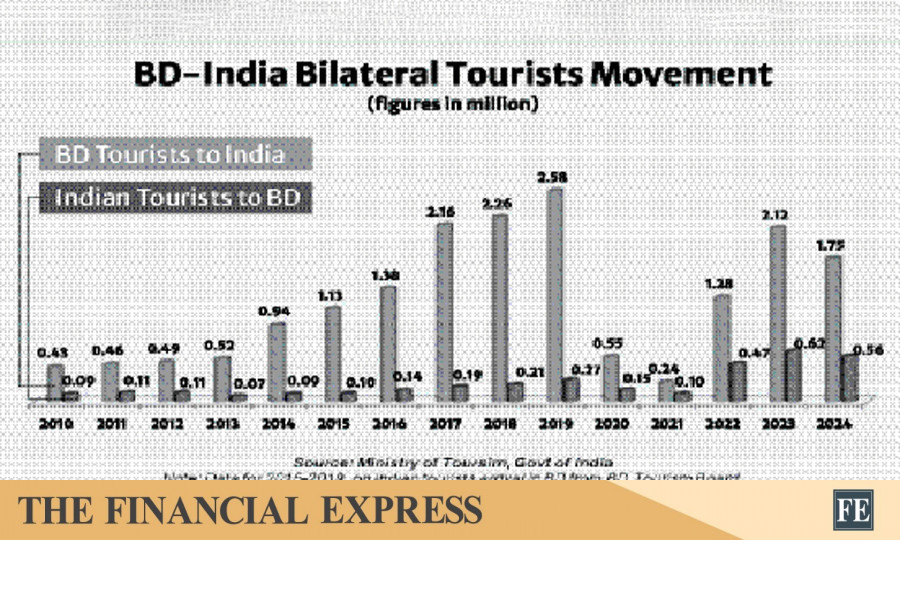
According to the Indian Ministry of Tourism, Bangladesh has ranked first or second in annual foreign tourist arrivals in India over the past 25 years. In 2001, approximately 0.43 million Bangladeshis visited India, with annual numbers remaining below 0.50 million on average until 2012, except in 2008. The figure rose to 0.92 million in 2014 and surpassed one million in 2015. In 2019, Bangladeshi tourist arrivals reached a record 2.58 million. The Covid-19 pandemic caused a sharp decline, with numbers dropping to 0.55 million in 2020 and 0.24 million in 2021. Arrivals rebounded to 1.20 million in 2022 and 2.12 million in 2023.
This growth was short-lived, as the number of Bangladeshi visitors to India fell to 1.75 million in 2024, primarily due to political changes. This decline slowed overall tourist growth in India. According to the India Tourism Data Compendium 2025, "Bangladesh, which emerged as India's leading source market post-2014 and peaked at 25.8 lakh arrivals in 2019, witnessed a sharp decline to 17.5 lakh in 2024-a drop by 8,27,562. Similarly, FTAs from China decreased from 3,39,442 in 2019 to 38,960 in 2024, a decline of 3,00,482. These instances of decline are likely influenced by factors such as policy shifts, geopolitical tensions, travel restrictions, and a shift in outbound tourism preferences."
Official statistics show that in the past year, 60 per cent of Bangladeshi tourists visited India in the first half, with the remaining 40 per cent traveling in the second half. Following a student-led uprising in July that led to Sheikh Hasina stepping down and seeking refuge in New Delhi, bilateral relations became strained. Rising anti-India sentiment prompted the Indian government to restrict visa issuance for Bangladeshis. Consequently, Bangladeshi tourist arrivals in India fell to 0.69 million in July-December 2024, down from 1.05 million in January-June. Overall, the total number of Bangladeshi tourists in India declined by 17.44 per cent last year, from 2.12 million in 2023 to 1.75 million.
This declining trend has continued into the current year, which ends next Wednesday. In the first quarter of 2025, Bangladeshi the number of Bangladeshi tourists dropped sharply, though official figures are pending. Estimates from the Quarterly Tourism Snapshot reports show a slight increase in the second and third quarters, with 0.09 million and 0.12 million visitors, respectively. However, the total number of visitors from Bangladesh is expected to decrease further in 2025 compared to 2024.
The sharp rise in travel to India from 2013 to 2019 was driven by several factors. The Hasina government, which was subservient to New Delhi, prioritised bilateral connectivity and introduced measures to ease cross-border movement. India relaxed its visa regime for Bangladeshis, recognizing the country's importance as a tourism market. The introduction of the friendship train between Dhaka and Kolkata in 2008, along with simplified travel procedures, attracted more visitors. Since 2017, point-to-point immigration and customs clearance has reduced waiting times. Two additional train services were later added. However, all three services have been suspended since July last year due to mass protests.
As 82 per cent of the India-bound visitors travel on road, infrastructure in a number of border ports have also been improved to facilitate the visitors. Bus services have also been increased to meet the growing demand from visitors. India Tourism Data Compendium 2025 said: "Travelling through air has also enhanced as reflected in number of flights growth. Land border travel remains significant-particularly for visitors from neighbouring countries such as Bangladesh, Bhutan, Nepal, and Sri Lanka."
In 2024, Bangladeshi tourists spent an average of two weeks in India. Approximately two-thirds visited for holidays and recreation, while about 27 per cent travelled for medical purposes. Economic growth and rise in per capita income over the years increased the number of travel services consumers in Bangladesh leading to rise in India-bound tourists.
Travel is one of the leading earning sources of India in terms of bilateral trade in commercial services. WTO statistics, compiled using the OECD Balanced Trade in Services (BaTIS), showed that in 2010, Indian export earnings in travel services with Bangladesh was $31 million which jumped to $177 million in 2023.
While Bangladesh sends a large number of visitors to India, Indian travel to Bangladesh is also significant. Last year, 0.55 million Indians visited Bangladesh, mainly for business and work, making it the 13th most popular destination for Indian nationals. About 1.80 per cent of Indian Nationals' Departures (IND) were to Bangladesh and more than two-thirds of all foreign tourist arrivals in Bangladesh are from India.
Bangladesh has yet to develop a comprehensive database on inbound and outbound visitors, making it difficult to obtain a clear picture of the trade in travel services with India as well as rest of the world.
Nevertheless, these statistics indicate that the dynamism in Bangladesh-India bilateral travel and tourism remains strong despite recent challenges. They also highlight the mutual reliance between the two neighbouring countries, although geopolitical tensions have begun to affect this relationship.
Asjadul Kibria
Published :
Dec 27, 2025 23:50
Updated :
Dec 27, 2025 23:50
December is usually a month of holiday-making for most people in Bangladesh. A large number of people wait throughout the year for the month when they can travel home and abroad with their families and friends. For most outbound tourists from Bangladesh, neighbouring India is the first destination due to its geographical proximity. The improved connectivity, coupled with various travel facilitation measures over the last decade, has increased the number of Bangladeshi tourists in India. Besides leisure, a good number of Bangladeshis visit India for medical purposes. There are also travels for commerce and education, and the country becomes one of the top three source markets for India's Foreign Tourist Arrival (FTA). The other two top source markets are: the United States of America (USA) and the United Kingdom (UK).
According to the Indian Ministry of Tourism, Bangladesh has ranked first or second in annual foreign tourist arrivals in India over the past 25 years. In 2001, approximately 0.43 million Bangladeshis visited India, with annual numbers remaining below 0.50 million on average until 2012, except in 2008. The figure rose to 0.92 million in 2014 and surpassed one million in 2015. In 2019, Bangladeshi tourist arrivals reached a record 2.58 million. The Covid-19 pandemic caused a sharp decline, with numbers dropping to 0.55 million in 2020 and 0.24 million in 2021. Arrivals rebounded to 1.20 million in 2022 and 2.12 million in 2023.
This growth was short-lived, as the number of Bangladeshi visitors to India fell to 1.75 million in 2024, primarily due to political changes. This decline slowed overall tourist growth in India. According to the India Tourism Data Compendium 2025, "Bangladesh, which emerged as India's leading source market post-2014 and peaked at 25.8 lakh arrivals in 2019, witnessed a sharp decline to 17.5 lakh in 2024-a drop by 8,27,562. Similarly, FTAs from China decreased from 3,39,442 in 2019 to 38,960 in 2024, a decline of 3,00,482. These instances of decline are likely influenced by factors such as policy shifts, geopolitical tensions, travel restrictions, and a shift in outbound tourism preferences."
Official statistics show that in the past year, 60 per cent of Bangladeshi tourists visited India in the first half, with the remaining 40 per cent traveling in the second half. Following a student-led uprising in July that led to Sheikh Hasina stepping down and seeking refuge in New Delhi, bilateral relations became strained. Rising anti-India sentiment prompted the Indian government to restrict visa issuance for Bangladeshis. Consequently, Bangladeshi tourist arrivals in India fell to 0.69 million in July-December 2024, down from 1.05 million in January-June. Overall, the total number of Bangladeshi tourists in India declined by 17.44 per cent last year, from 2.12 million in 2023 to 1.75 million.
This declining trend has continued into the current year, which ends next Wednesday. In the first quarter of 2025, Bangladeshi the number of Bangladeshi tourists dropped sharply, though official figures are pending. Estimates from the Quarterly Tourism Snapshot reports show a slight increase in the second and third quarters, with 0.09 million and 0.12 million visitors, respectively. However, the total number of visitors from Bangladesh is expected to decrease further in 2025 compared to 2024.
The sharp rise in travel to India from 2013 to 2019 was driven by several factors. The Hasina government, which was subservient to New Delhi, prioritised bilateral connectivity and introduced measures to ease cross-border movement. India relaxed its visa regime for Bangladeshis, recognizing the country's importance as a tourism market. The introduction of the friendship train between Dhaka and Kolkata in 2008, along with simplified travel procedures, attracted more visitors. Since 2017, point-to-point immigration and customs clearance has reduced waiting times. Two additional train services were later added. However, all three services have been suspended since July last year due to mass protests.
As 82 per cent of the India-bound visitors travel on road, infrastructure in a number of border ports have also been improved to facilitate the visitors. Bus services have also been increased to meet the growing demand from visitors. India Tourism Data Compendium 2025 said: "Travelling through air has also enhanced as reflected in number of flights growth. Land border travel remains significant-particularly for visitors from neighbouring countries such as Bangladesh, Bhutan, Nepal, and Sri Lanka."
In 2024, Bangladeshi tourists spent an average of two weeks in India. Approximately two-thirds visited for holidays and recreation, while about 27 per cent travelled for medical purposes. Economic growth and rise in per capita income over the years increased the number of travel services consumers in Bangladesh leading to rise in India-bound tourists.
Travel is one of the leading earning sources of India in terms of bilateral trade in commercial services. WTO statistics, compiled using the OECD Balanced Trade in Services (BaTIS), showed that in 2010, Indian export earnings in travel services with Bangladesh was $31 million which jumped to $177 million in 2023.
While Bangladesh sends a large number of visitors to India, Indian travel to Bangladesh is also significant. Last year, 0.55 million Indians visited Bangladesh, mainly for business and work, making it the 13th most popular destination for Indian nationals. About 1.80 per cent of Indian Nationals' Departures (IND) were to Bangladesh and more than two-thirds of all foreign tourist arrivals in Bangladesh are from India.
Bangladesh has yet to develop a comprehensive database on inbound and outbound visitors, making it difficult to obtain a clear picture of the trade in travel services with India as well as rest of the world.
Nevertheless, these statistics indicate that the dynamism in Bangladesh-India bilateral travel and tourism remains strong despite recent challenges. They also highlight the mutual reliance between the two neighbouring countries, although geopolitical tensions have begun to affect this relationship.