โ˜• Support Us โ˜•
[๐Ÿ‡ง๐Ÿ‡ฉ] - Monitoring the political activities of BNP | Page 37 | PKDefense

[๐Ÿ‡ง๐Ÿ‡ฉ] Monitoring the political activities of BNP

Reply (Scroll)
Press space to scroll through posts
G Bangladesh Defense
[๐Ÿ‡ง๐Ÿ‡ฉ] Monitoring the political activities of BNP
364
7K
More threads by Saif

Tarique thanks nation for warm welcome

UNB
Dec 27, 2025 23:53
Updated :
Dec 27, 2025 23:53

1766882032667.webp

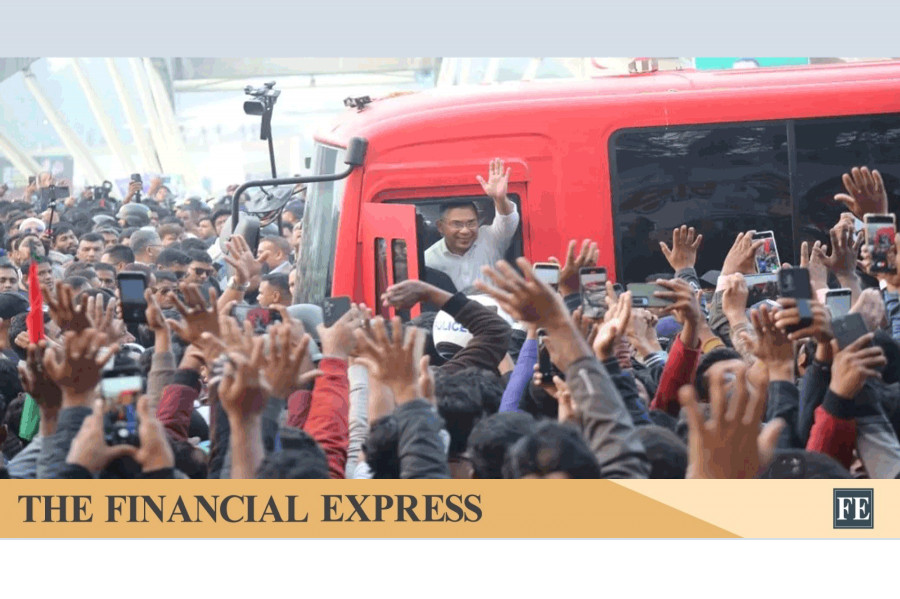
BNP Acting Chairman Tarique Rahman on Saturday expressed gratitude to the people of Bangladesh for their warm reception following his return to the country after 17 years abroad.

In a message posted on his verified Facebook page, he said, โ€œDear friends, sisters, and brothers across Bangladesh, last Thursday is a day I will carry in my heart forever, the day I returned to the soil of my homeland after 17 long years. The warmth of your welcome, the sea of faces along the roads of Dhaka, and the prayers of millions are moments, I will never forget. My deepest thanks to all.โ€

The BNP leader also said words cannot fully express the respect and love his family and he feels for this homecoming.

He thanked his supporters for standing by him and his family through all trials, saying their steadfast courage has been a source of strength for him.

Tarique also extended his gratitude to members of civil society, youths, professionals, farmers, workers, and citizens from all walks of life, saying they reminded him that the true strength of Bangladesh lies in its people when united.

He appreciated the media for covering his homecoming โ€œwith professionalism and careโ€ and thanked all those who ensured safety and calm during his arrival. โ€œYour service matters.โ€

The BNP leader also acknowledged leaders of other political parties who welcomed his homecoming.

โ€œI appreciate the thoughtful reflections that emphasised democracy, multiparty coexistence, and the enduring will of the people. I am grateful for the warm welcomes and for the hope expressed for a democratic, peaceful political culture, as well as the call to move beyond politics driven by vengeance. I take these words with humility and respect,โ€ he said.

He once again outlined his vision for the country, describing it as a plan โ€œfor all Bangladeshis and the countryโ€™s future. โ€œI spoke of a plan, not just a dream, for Bangladeshโ€™s future: a country where peace and dignity thrive, where every community feels secure and valued, and where every child can grow with hope.โ€

โ€œThis is a plan for all Bangladeshis. A united, inclusive Bangladesh. A Bangladesh that moves forward together. Thank you for welcoming me home. May Allah bless Bangladesh and all of you, now and always,โ€ Tarique concluded.​
 
Tarique signs nomination papers for Dhaka-17, Bogura-6 polls

UNB
Published :
Dec 28, 2025 20:41
Updated :
Dec 28, 2025 20:41

1766969559448.webp


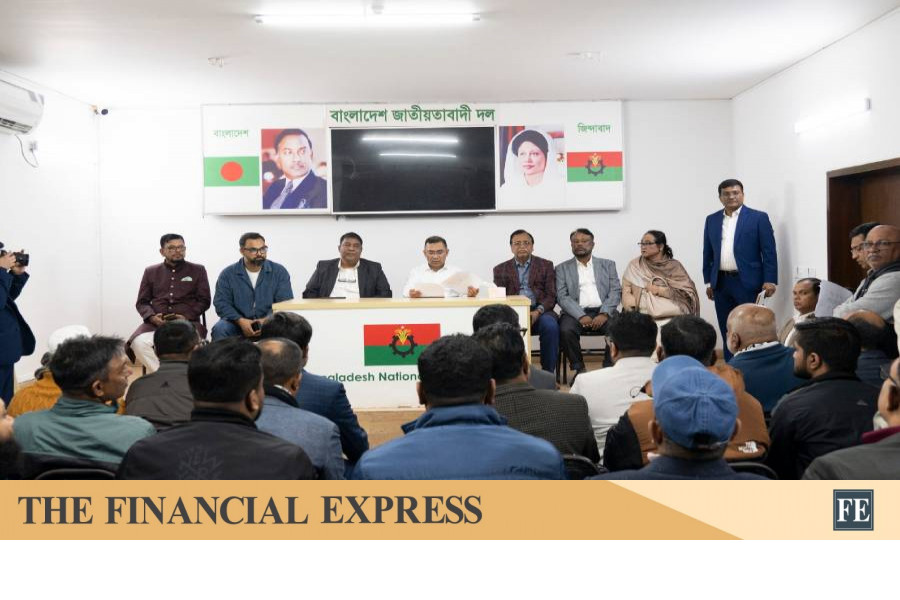
BNP Acting Chairman Tarique Rahman on Sunday signed his nomination papers to contest the 13th national parliamentary election from Dhaka-17 and Bogura-6 constituencies with the partyโ€™s electoral symbol, the Sheaf of Paddy.

Tarique signed the nomination papers in the evening at the BNP Chairpersonโ€™s Gulshan office in the presence of party coordinators of the two constituencies, said BNP media cell member Sayrul Kabir Khan.

For the Dhaka-17 constituency, BNP Chairpersonโ€™s Advisory Council member Abdus Salam has been appointed as the chief coordinator, while Advisory Council member Prof Dr Farhad Halim Donar will also play a key coordinating role in leading the election activities.

Party sources said Tariqueโ€™s nomination papers for both the Dhaka-17 and Bogura-6 constituencies will be submitted on Monday.

Earlier, BNP Standing Committee member Salahuddin Ahmed said Tarique will contest the upcoming parliamentary election from two seatsโ€”Bogura-6 and Dhaka-17โ€”as part of the partyโ€™s election strategy.

The 13th parliamentary election is scheduled to be held on February 12 next year.

Meanwhile, Tarique sat with BNP leaders and activists, including those from its associate bodies of the Dhaka-17 constituency, and exchanged views on organisational and election-related matters, Sayrul said.​
 
Tarique Rahmanโ€™s return, and the Kundera-esque weight of expectations

1766972369773.webp

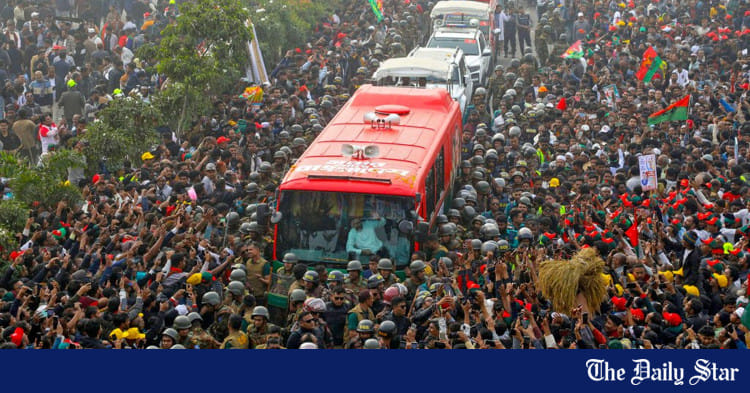
Bangladesh Nationalist Party (BNP) acting chairman Tarique Rahman waves from a vehicle after his arrival from London in Dhaka on December 25, 2025. FILE PHOTO: BNP MEDIA CELL

Tarique Rahman's return to Bangladesh after 17 years in exile has been greeted with a scale of emotion that is understandable. There were crowds, chants, tears, symbolism layered upon symbolism. In a country starved of political closure, it felt, to many, like a long-awaited homecoming. But in 2025, we are not a nation that can afford to confuse emotion with resolution. The country is in a stage where it can completely fall apart as well as heal, depending on the political trajectory. And this condition demands disciplineโ€”from leaders, such as Tarique Rahman, as much as from those who follow them.


When talking about Tarique Rahman's "homecoming," it becomes essential to clarify one point: he did not return to Bangladesh politically unformed or disconnected. From London, especially in recent years, he remained a persistent presence in the country's political conversation through statements, video addresses, party directives and policy documents. In a way, he shaped the BNP's oppositional posture and kept himself visible as its central figure. His critiques of democratic erosion, calls for accountability, and insistence on electoral legitimacy were not occasional, random interventions; they were part of a sustained narrative. His exile, therefore, was physical rather than political. What has changed now is not his relevance to the nation's politics, but his proximity to consequences.


From a distance, political language has a certain freedom. It can be sharp, even uncompromising. It can draw clear moral lines and name injustice without having to manage the fallout. On the ground, words can have different consequences. They address volatile public sentiments, weakened institutions, and a political culture where public trust has been worn thin over time. In Bangladesh today, very little is neutral. Silence is often interpreted. And rhetoric, even when well-intended, can move crowds in directions no one can quite control.


This is why Tarique Rahman's return should be assessed with a cautious optimism at best, not over-glorification. There is an understandable urge to see this as a historic turning point. But our recent history suggests that such moments, when overburdened with expectations, can just as easily unravel. When leaders are pushed into the spotlight as saviours rather than participants in a fragile political system, politics begins to resemble theatre. Brittle societies like ours can hardly endure that for very long.

Tarique Rahman's speech on the day of his return offered important clues as to how he understands the weight of this moment. His tone was reasonably mature and restrained. There was an emphasis on peace and unityโ€”elements the country is in dire need of right now. Violence was condemned. Elections were framed as the legitimate route to change. There were gestures towards inclusivity and a visible effort to lower the national temperature rather than raise it. In a country where political language has often normalised excess, this restraint was not insignificant and has not gone unnoticed.

The speech was also revealing in where it fell short of the expectations. It did not offer specificity. It did not articulate priorities; it did not chart out a roadmap. It invoked vision more than pathway. Unsurprisingly, it is a familiar feature of political homecomings everywhere, where leaders talk about vision rather than specifics. But in Bangladesh's present conditionโ€”where trust in politics and politicians is thin and patience thinner, thanks to its bitter political legacyโ€”the absence of detail matters. People are no longer just listening for reassurance. They are listening for structure, for understanding of how the future will be shaped.


Which again brings us to the question of expectations, the central tension of this moment.

Tarique Rahman returns not just with popularity, but with dockets, as back up. The BNP's 31-point outline on structural reforms is a serious attempt to respond to the institutional damage of recent years. It speaks to long-standing demands: restoring a non-partisan election framework, limiting executive overreach, reforming the judiciary, repealing repressive laws, and rebalancing the relationship between the state and the citizen. It signals an awareness that Bangladesh's crisis is perhaps not merely electoral, but constitutional.

Alongside this is the 19-point programmeโ€”the foundational vision articulated by Ziaur Rahman decades ago, and repeatedly invoked by his son. It is broader, more philosophical, concerned with sovereignty, self-reliance, social justice and national cohesion. Its strength lies in moral clarity rather than operational detail. It reminds supporters that BNP's claim to legitimacy has always rested on nation-building, not simply regime change.

Together, these frameworks suggest that Tarique Rahman is not returning empty-handed. There is ideological intent. There is an attemptโ€”at least on paperโ€”to move beyond grievance, rhetorical politics.

But we must understand that intent is not implementation.

Neither the 31 points nor the 19 points function as roadmaps. They tell us what should change, but not how that change will be shaped, financed, legislated, or politically negotiated where required, and who will be its owner and ultimately see it through. They talk about commissions, reforms, and principles, but stop short of outlining timelines or accountability mechanisms. This does not make them meaningless. It does, however, place a responsibility on their author and the BNP's leaderโ€”now returned to the countryโ€”to translate these well-articulated outlines into processes.

This is where expectations start to become uncomfortable.

And then there is also the expectation of restraint that goes beyond mere rhetorical condemnation of violence. In a political environment where mob violence is seemingly becoming substitute for institutional accountability, leadership requires repeated, unambiguous signalling that disorder is not a legitimate political instrument and will not be accepted as such. This is not about silencing protests; this is about refusing to legitimise disorder. Words must be chosen with an awareness of how quickly they can travel, and how easily they can be twisted to serve the purpose of vested quarters. As I said before, now Tarique Rahman does not enjoy the leverage of distance, now he has to shoulder the weight of his words in a Milan Kunderaโ€“esque style.

In addition, there is the inevitable and more prominent expectation of electoral anchoring from Tarique Rahman. Having long argued that elections are the only legitimate pathway to change, Tarique Rahman is now expected to bind his political project firmly to that processโ€”perilous and imperfect as it may be. This means discouraging disruption, resisting brinkmanship, and committing to outcomes that are not predetermined. In a country scarred by boycotts and flimsy mandates, it is a basic expectation.

However, and most critically, there is an expectation of temperature management. Bangladesh is not only polarised; it is at the boiling point. Years of repression, economic strain, and civic space shrinkage have resulted in a public mood that vacillates mostly between rage and outbursts. Leadership in such a context is not only about discouraging violence, but also creating space: for institutions to regain public trust, for politics to come to a steady pace, for disagreement to exist without becoming violent and for the people to heal.

This will perhaps be Tarique Rahman's most critical test of political acumen.

Tarique Rahman's return is therefore not a conclusion, but a test of his political maturity. He arrives with a powerful legacy, a solid, mobilised base to a country watching and hoping for stability, justice and a new era that will decide the nation's trajectory for the next leap to progress. Having said all these, he also arrives at a moment where miscalculation carries unforeseen risks.

Therefore, assessing Tarique Rahman's homecoming with cautious optimism is justified.

Bangladesh does not need another myth. It needs politics that can tolerate difference of opinion, navigate ambiguity, create unity and resist the urge to relent to chaos. Whether Tarique Rahman can meet all the expectations should be decided not by the scale of his welcome, but slowly, in how he handles power and formally holds it, when the time comes, regardless of the role he occupies in the next parliament.

The much-awaited return has happened. Expectations now carry weightโ€”and the country will witnesshow they are borne.-

Tasneem Tayeb is a columnist for The Daily Star.​
 
This will be vote against injustice: Rumeen Farhana after submitting nomination paper
Staff CorrespondentBrahmanbaria
Published: 29 Dec 2025, 21: 59

1767056486521.webp

Rumeen Farhana personally submitted her nomination paper to the Sarail upazila executive officer (UNO) and assistant returning officer Md Abubakkar Sarker on 29 December, 2025 Prothom Alo

Former lawmaker from reserved women seats and Bangladesh Nationalist Party (BNP) central international affairs secretary Rumeen Farhana has submitted her nomination paper for the Brahmanbaria-2 constituency as an independent candidate.

Rumeen Farhana personally submitted her nomination paper to the Sarail upazila executive officer (UNO) and assistant returning officer Md Abubakkar Sarker today, Monday afternoon.

Speaking to newspersons after submitting her nomination paper, Rumeen Farhana said, โ€œAllahโ€™s plans are beyond human understanding. Under Allahโ€™s plan, my father contested as an independent candidate in 1973 going against the tide of the Awami League. What a remarkable plan of Rabbul Alamin that now, in 2026, I am having to contest independently going against the tide of the sheaf of paddy. Allahโ€™s plans and the way they are carried out are beyond human comprehension.โ€

She later made a brief address to her supporters, saying, โ€œThe symbol you want is my symbol. Which symbol do you want?โ€ In response, her followers shouted, โ€œDuck, duck.โ€

The BNP leader mentioned Sarail and Ashuganj as two neglected upazilas saying, โ€œWhy is the condition of Sarail-Ashuganj still so dire even after 55 years of independence? Why did no MP bring about a change? Why did the people of Sarail-Ashuganj not receive what was rightfully theirs?โ€

Hinting at BNP, Rumeen Farhana said, โ€œThe time for change is coming. This vote will be against injustice; this vote will be against oppression; this vote will be in favour of the woman who has been on the ground for 17 years. This vote will be for the person who spoke up for you inside and outside parliament when you were shattered by lawsuits and attacks.โ€

Earlier, on Wednesday, Ali Hossain, former organisational secretary of the upazila Jubo Dal, collected the nomination papers on behalf of Rumeen Farhana from the UNO of Sarail.

1767056531259.webp

Rumin Farhana submits her nomination paper to assistant returning officer Md Abubakkar Sarker Monday afternoon. Prothom Alo

Today, at the time of submitting her nomination papers, she was accompanied by several hundred supporters, including former vice-president of upazila unit BNP, Hossain Mia, former general secretary of upazila unit Jatiyatabadi Chhatra Dal, Usman Khan, and president of upazila Jatiyatabadi Sramik Dal Ayub Hossain.

Mosharraf Hossain, office secretary of Shahbazpur union unit BNP, has signed Rumin Farhanaโ€™s nomination paper as the proposer, while Zunaid Khan, publicity secretary, has become her supporter.

Rumeen Farhana arrived at the upazila Sadar around 2:00 pm today. Hundreds of her supporters and party workers reached the upazila Sadar on motorcycles and other vehicles.

Known as a stronghold of the BNP, this constituency has been left to Jamiat Ulema-e-Islam Bangladesh as part of the negotiations between the BNP and its allied parties. Jamiat Ulema-e-Islam Bangladesh central committee vice-president Maulana Junaid Al Habib has been given nominated from this constituency.

The Brahmanbaria-2 constituency currently comprises Sarail and Ashuganj upazilas, along with Chandura and Budhanti unions of Bijoynagar upazila. Rumeen Farhanaโ€™s ancestral home is in Budhanti union, and she currently resides in Shahbazpur union of Sarail upazila. The constituency has a total of 499,448 voters.​
 
Tarique urges followers to help rebuild nation
Visits Naya Paltan office after 17 years

Staff Correspondent 29 December, 2025, 17:28

1767058025103.webp

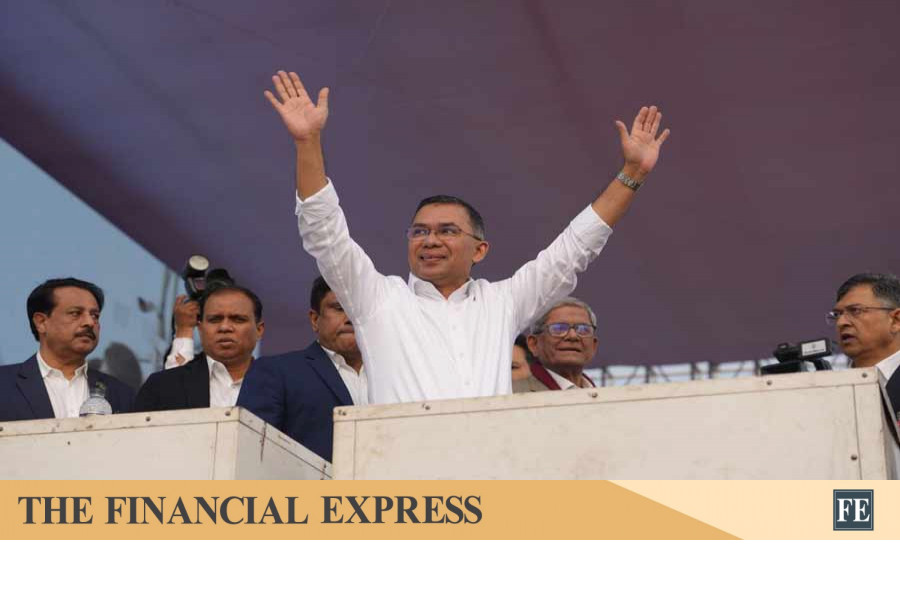
Acting BNP chairman Tarique Rahman waves while addresses the crowd in front of BNP central office at Nayapaltan in Dhaka on Monday. | New Age photo

Bangladesh Nationalist Party acting chairTarique Rahman urged the party leaders and activists to actively contribute to nation-building by carrying out their responsibilities from their respective positions.

โ€˜Let us all, from whatever position we are in, try to rebuild our country,โ€™ he said in a brief address at the BNPโ€™s Naya Paltan central office in the capital, where thousands of party leaders and activists gathered to welcome him.

This was Tariqueโ€™s first visit to the Naya Paltan BNP central office since his return to the country 17 years after exile in the United Kingdom.

He also said that if anyone saw a scrap of paper on a street one should remove it (to keep the street clean), stressing that through such small acts, people could come together to build the country step by step.

He also requested the supporters to leave the Naya Paltan road to help ease vehicular movement in the area,

During his address, he urged those present there to offer supplication for the recovery of his ailing mother BNP chair Khaleda Zia.

Amid tight security at and around the Naya Paltan office for his visit, Tarique arrived at the party office at 4:06pm and delivered a short speech from the second floor of the office building.

However, due to the huge crowd, security personnel had to struggle to bring Tariqueโ€™s vehicle close to the office. Thousands of party leaders and activists greeted him with loud applause, while Tarique waved back in acknowledgement.

Senior party leaders, including senior joint secretary general Ruhul Kabir Rizvi, along with officials and staff of the central office, formally received Tarique at the main entrance to the central office.

After entering the office building, Tarique went up to the second-floor balcony and waved to the supporters gathered there. He went to the party office after more than 17 years.

Addressing them, Tarique said, โ€˜There is no programme here today. If we keep the road blocked, general people will face inconveniences. Since there is no event here now, we should leave the place as quickly as possible.โ€™

Later, Tarique went to his designated chamber on the second floor. This room has been freshly built next to the BNP chairโ€™s room at the party office.

After returning to Dhaka on December 25 following one and a half decades of exile in the United Kingdom, Tarique has been passing busy days.

On the first day, after attending a reception and delivering a speech, he visited his mother Khaleda Zia at Evercare Hospital.

Later that night, Tarique and his family went to House No 196 at Gulshan 2 where he would live. After the assassination of his father, president Ziaur Rahman, the house was allotted to his mother by the then government.

A few months ago, the ownership documents of the house were handed over to BNP chair Khaleda Zia by public works ministry adviser Adilur Rahman Khan and Rajuk chair Riazul Islam Rizu.

Beside the House No 196 on Gulshan Avenue stands another residence named โ€˜Firoza,โ€™ where his mother Khaleda Zia lives.

A day after his return, Tarique on Friday paid homage at the grave of BNP founder Ziaur Rahman and later paid tribute at the National Martyrsโ€™ Memorial in Savar.

On Saturday morning, he visited the grave of Inquilab Mancha convener Sharif Osman bin Hadi. After offering prayers there, he also paid tribute at the grave of National Poet Kazi Nazrul Islam.

He then went to the Election Training Institute building at Agargaon, where he completed voter registration.

After that, he visited the Banani Graveyard to pay respects at the grave of his younger brother Arafat Rahman Koko. He also visited the graves of his father-in-law, former Navy chief Rear Admiral Mahbub Ali Khan, at the Banani Military Graveyard, and the graves of army officers who were killed in the Pilkhana massacre.

Earlier on Sunday, Tarique visited the BNP chairโ€™s Gulshan office for the first time and stayed there for nearly nine hours.​
 

Members Online

Latest Posts

Latest Posts