โ˜• Support Us โ˜•
[๐Ÿ‡ง๐Ÿ‡ฉ] - Save the Rivers/Forests/Hills-----Save the Environment | Page 51 | PKDefense

[๐Ÿ‡ง๐Ÿ‡ฉ] Save the Rivers/Forests/Hills-----Save the Environment

Reply (Scroll)
Press space to scroll through posts
G Bangladesh Defense
[๐Ÿ‡ง๐Ÿ‡ฉ] Save the Rivers/Forests/Hills-----Save the Environment
501
12K
More threads by Saif

No polythene bags at Dhaka trade fair, says commerce secretary

Published :
Dec 29, 2025 14:31
Updated :
Dec 29, 2025 14:32

1767055949004.webp

Single-use plastics, including polythene and plastic shopping bags, will be banned at the upcoming Dhaka International Trade Fair, according to Commerce Secretary Mahbubur Rahman.

Only plastic bottles for drinking water will be allowed at the event starting on January 1, he said on Monday.

Participating companies using polythene or plastic products for their own purposes will not be eligible for any awards, including best pavilion or best stall, he added.

The commerce secretaryโ€™s comment came at a media briefing held at the Bangladesh-China Friendship Exhibition Centre in Purbachal, the venue for the month-long fair, bdnews24.com reports.

Chief Adviser Muhammad Yunus will inaugurate the fair at 10:00 am on the opening day.

โ€œOne notable feature this year is that we have eliminated single-use plastics, including polythene, from the fair. At this yearโ€™s 30th International Trade Fair in Purbachal, no polythene bags will be allowed," said Mahbubur.

โ€œYou know people buy bottled water. We are still not able to supply water in glass bottles this year. From next year, we are considering installing (water) dispensers. But this time, since we cannot make that arrangement, plastic water bottles will be allowed. However, there will be a system to collect them. What is strictly prohibited is polythene bags.โ€

On stalls using such bags to carry their own goods, the secretary said: โ€œThose who bring polythene bags and use them to carry their own products will not be considered for any awards such as best pavilion or best stall this year.

โ€œEven if a stall or pavilion is otherwise the best, using plastic will make it ineligible for any award.โ€

At this yearโ€™s trade fair, a "Bangladesh Square" will display still photographs commemorating the Language Movement of 1952, the Liberation War of 1971, and the martyrs and injured activists from the July Uprising of 2024. Seminars will also be organised on promising sectors or product-based themes.

Authorities said that there would be dedicated electronics and furniture zones for the convenience of foreign entrepreneurs and companies. Seating corners have been arranged for senior citizens, while two childrenโ€™s parks will be set up for young visitors.

An open cultural centre will also promote products and marketing. Reserved stalls have been allocated for women entrepreneurs, entrepreneurs with disabilities, and those involved in cottage industries, handloom, textiles and handicrafts.

FEWER STALLS, LARGER AREA

This year, a total of 324 pavilions and stalls in different categories have been allocated to local and foreign entrepreneurs. Of these, 11 companies are from India, Turkey, Singapore, Indonesia, Hong Kong and Malaysia. Last year, 343 companies participated in the fair.

Explaining the reduction in the number of stalls, Mahbubur Rahman said: โ€œThis year our floor price was slightly higher than last year. It was only marginally higher, not much. However, bids have increased and bid values have gone up. From that perspective, revenue will increase for EPB.โ€​
 
Telecom giants leave a heavier carbon footprint in Bangladesh

Disclosures show Bangladesh delivers strong revenue for Grameenphone and Robi, alongside higher carbon emissions

1767057850662.webp


Global telecom giants are generating more carbon emissions in Bangladesh than in most of their developed markets, company disclosures show, a pattern environmental activists say exposes weaknesses in international climate agreements.

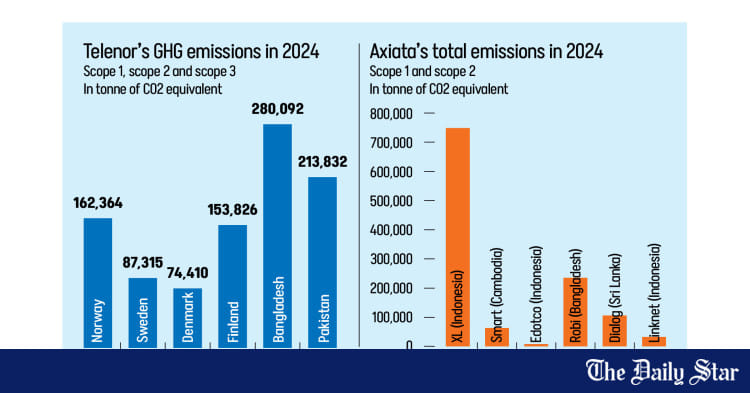
In 2024, Norwegian telecom group Telenor, the parent company of leading local operator Grameenphone, recorded its highest greenhouse gas emissions in Bangladesh among all its global operations, according to Telenor's annual report.

The same year, Robi Axiata, another leading telecom provider in Bangladesh, reported the second-highest emissions among the operating units of its Malaysian parent company, Axiata Group Berhad.

Both Telenor and Robi Axiata attribute their higher emissions in Bangladesh to a more carbon-intensive energy mix than in other countries where they operate

Environmental activists argue that the Paris Agreement placed stronger emissions-cutting expectations on developed nations, while developing countries were not subject to the same obligations.

"So many multinational companies are taking those opportunities," M Zakir Hossain Khan, chief executive of climate action think tank Change Initiative, told The Daily Star.

In 2024, Telenor Group's total greenhouse gas emissions in Bangladesh reached 280,000 tonnes, compared with 210,000 tonnes in Pakistan.

Emissions in Norway, where the company is headquartered, were 160,000 tonnes. Emissions in Finland were 150,000 tonnes. In Sweden and Denmark, it was less than 90,000 tonnes each last year, according to Telenor data.

Global Carbon Budget data show that Bangladesh's total carbon emissions were 1.08 billion tonnes in 2024, suggesting that Grameenphone alone accounted for roughly 0.26 percent of the national total. In the same year, Robi Axiata, the Bangladeshi arm of Axiata Group Berhad, contributed 19.7 percent of the group's total emissions.

Robi's scope 1 and 2 emissions, covering direct operations and purchased energy, amounted to 234,000 tonnes, while scope 3 emissions, including the supply chain, are expected to be considerably higher. A comparison of annual reports shows that Robi generated more carbon dioxide relative to turnover than Grameenphone.

It also shows that emissions by the multinationals in developed markets remain far lower than in countries such as Bangladesh and Pakistan.

Grameenphone reported that its scope 1 emissions, totalling 13,715 tonnes of carbon dioxide, came mainly from diesel used in backup generators. Scope 2 emissions from purchased grid electricity reached 169,570 tonnes.

Telenor has been operating in Bangladesh under the Grameenphone brand since 1996, holding 55.8 percent of shares. Bangladesh is also Telenor's second-largest revenue source, generating 14,995 million Norwegian krone in 2024, compared with 25,054 million krone in Norway.

In a written response, Grameenphone told The Daily Star that high emissions in Bangladesh are due to reliance on a carbon-intensive national grid and the widespread use of diesel generators to ensure uninterrupted service.

Grameenphone said that in Nordic countries, Telenor benefits from renewable electricity and well-established green power procurement mechanisms.

Bangladesh has recently approved a policy framework allowing private companies access to renewable energy through corporate power purchase agreements, but key guidelines and operational procedures are not yet fully in place, it said.

Meanwhile, Robi Axiata said its high greenhouse gas emissions reflect the country's energy and infrastructure challenges. Diesel generators are widely used to back up an unreliable grid, while network expansion into rural areas and rising data consumption increase energy demand.

The company said emissions are closely linked to its technical footprint, including the number of sites, coverage area, and hours of generator operation, which do not directly correlate with revenue. To reduce its carbon footprint, Robi said it is upgrading network equipment, optimising cooling systems, and implementing sleep-mode features.

Change Initiative chief executive Khan said multinationals focus on reducing carbon in developed countries while continuing to profit in developing nations without taking full responsibility for emissions.

He suggested the government introduce carbon taxes on companies and explore international carbon markets to mobilise funding for environmental projects.

Without such measures, per capita climate debt is rising sharply, from zero in 2009 to $80 today. "A rigorous focus is necessary," he said.​
 

Members Online

Latest Posts

Latest Posts