Bangladesh Defense
Saif
Senior Member
- Jan 24, 2024
- 21,704
- 9,794
- Nation

- Residence
- Axis Group


West Bengal election: Saffron Surge at two borders and Bangladesh’s unease
In this year’s West Bengal Assembly election, Chief Minister Mamata Banerjee found herself confronting almost the entire machinery of India’s central state, except the navy and air force. This was no ordinary election; it took on the character of a war. An unequal war. And in that asymmetry...
 en.prothomalo.com
West Bengal election: Saffron Surge at two borders and Bangladesh’s unease
Yet one question remains: why did sympathy for Mamata persist across the border, despite the cancellation of the Teesta water-sharing agreement? Perhaps it stems from opposition to communal politics, or shared concern for those who risk losing citizenship rights under voter verification measures such as SIR.
Altaf Parvez
Published: 05 May 2026, 08: 13
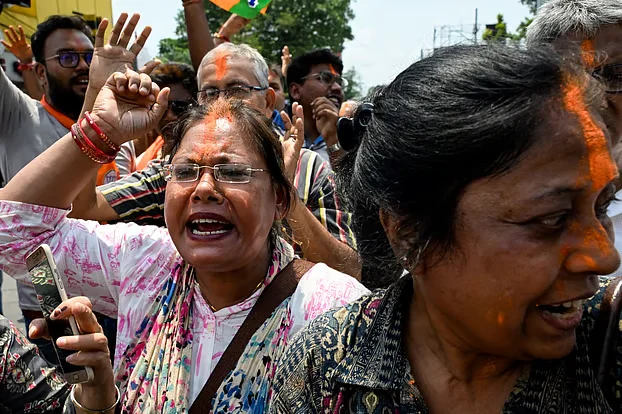
Bharatiya Janata Party (BJP) supporters celebrate near the residence of West Bengal chief minister and All India Trinamool Congress (TMC) party chairperson Mamata Banerjee, along a street near her residence in Kolkata on 4 May 2026 during vote counting for the West Bengal Legislative Assembly elections AFP
In this year’s West Bengal Assembly election, Chief Minister Mamata Banerjee found herself confronting almost the entire machinery of India’s central state, except the navy and air force. This was no ordinary election; it took on the character of a war. An unequal war. And in that asymmetry, Mamata and her party were left disoriented. With this election, it is evident that West Bengal’s politics has entered a new phase.
For the first time since India’s independence, the Bharatiya Janata Party (BJP) appears within reach of forming a government in the state. Exit polls from the night of 29 April, which had already projected a BJP surge, have not been proven wrong. A party that failed to win even a single seat in the 2011 Assembly election has now crossed the threshold of 150 seats within 15 years. For South Asia’s political landscape, the rise of the saffron camp makes 4 May a historic marker of the rightward shift.
Some observers suggest that Bengali identity has been politically marginalised in northern India. This raises a sharper question: why did “Bengal” not stand firmly behind its “daughter”? Was it due to the failures of the Trinamool Congress, or the BJP’s sophisticated electoral engineering? These debates are now unfolding. Meanwhile, the election results have also generated unease across the border in Bangladesh.
The underflow of emotion
No recent election in India has generated such intensity. Nor has any West Bengal election previously drawn such sustained attention in Bangladesh. The reason is clear: the central government of India turned the contest into a symbolic battle for prestige.
Prime Minister Narendra Modi visited the state four times in four months, campaigning extensively. His appearances ranged from eating street snacks like muri and chanachur to taking symbolic boat rides on the Ganges. The BJP deployed every possible tool of public outreach to appeal to Bengali voters, backed by vast financial resources. Together, these efforts created an unprecedented political storm. Statements from Amit Shah further deepened anxieties in Bangladesh. Despite the barbed-wire fence, an emotional undercurrent between the two sides became palpable.
Yet one question remains: why did sympathy for Mamata persist across the border, despite the cancellation of the Teesta water-sharing agreement? Perhaps it stems from opposition to communal politics, or shared concern for those who risk losing citizenship rights under voter verification measures such as SIR.
BJP’s warning to regional parties
At present, the BJP governs 21 of India’s 31 states and union territories, either alone or in coalition. In the 543-seat Lok Sabha, it holds 245 seats. Even a loss in West Bengal would not significantly dent its national dominance. Still, the RSS family had hoped to mark its centenary celebrations with a deeper foothold in Bengal—the ideological homeland of Shyama Prasad Mukherjee. That ambition appears to have been realised beyond expectations. The saffron century has reached a new apex in Bengal.
Mamata Banerjee’s defeat sends a clear warning to regional political forces across India. In Delhi, Arvind Kejriwal; in Uttar Pradesh, Mayawati; and in Andhra Pradesh, Chandrababu Naidu—all are now reminded of the asymmetry of electoral battles with the BJP.
At the same time, the election offers some hope for the Left. Though not in terms of seats, their vote share suggests partial recovery in traditional pockets. Alongside the Trinamool’s decline, the Left’s resurgence hints at the possibility of a third political force emerging in the future. However, fears of post-poll violence against Trinamool forces continue to trouble local society.
A vote for “change”
At the time of writing this article, the BJP appears well ahead of the majority threshold. In the previous Assembly election, the Trinamool Congress won 215 seats, while the BJP secured 77. This time, Trinamool’s tally has fallen sharply. The BJP’s campaign centred on the slogan of “paribartan”—change—and a significant portion of the electorate appears to have endorsed it.
After 15 years of continuous rule, Mamata Banerjee’s government has faced criticism for deficits in good governance, and lack of development alongside concerns over political violence and patronage networks. Yet the electoral shift also reflects the impact of voter list revision exercises known as SIR. The Trinamool Congress has repeatedly alleged that the Election Commission, through SIR, targeted Bengali-speaking voters at the BJP’s behest. The results suggest that this strategy was not without effect.
Millions were reportedly removed from voter rolls based on minor discrepancies. Constituencies where the Trinamool is strong were disproportionately affected. The BJP appears to have benefited significantly. The election raises troubling questions about whether electoral outcomes can be shaped in advance through administrative mechanisms. The evidence does not suggest a strong backlash from centrist voters; rather, it points to a broader acceptance—or mobilisation—of exclusionary narratives, including anti-Muslim sentiment.
Towards a divided West Bengal?
This election may well be historic for multiple reasons. Voters from different parts of the country travelled at personal expense to participate in what resembled a tidal wave of mobilisation. Yet this saffron surge also raises the possibility of West Bengal’s fragmentation.
One declared objective within sections of the BJP ecosystem has been the creation of a separate state comprising Darjeeling and Cooch Behar. This is a popular demand among the people of the northern districts as well. The BJP garnered huge votes from those areas. If such a political configuration were realised, West Bengal would shrink significantly, possibly limited to a smaller central-southern belt from Malda to East Medinipur. Economically and politically, such a state would be considerably weakened, especially if tea and tourism-rich northern regions were detached.
Thus, the choice between the BJP and Trinamool is not merely about electoral arithmetic or the loss of voting rights for millions. It signals a potential restructuring of West Bengal’s political and economic future. With Mamata Banerjee at odds with both the Leftists and the Indian National Congress, the anti-BJP vote has effectively fragmented into three distinct streams—an outcome whose wider political ramifications are likely to become increasingly evident in the near future.
Trinamool’s dashed hope to be a “All India Party”
Although the Trinamool Congress briefly held national-level party status for a few years before 2023, it failed to retain it. Under Indian electoral rules, a party must secure at least 6 per cent of votes in four states, along with certain seat thresholds, to qualify as a national party. While Trinamool meets Lok Sabha seat requirements (all from West Bengal though), its vote share outside West Bengal remains insufficient.
Why Bangladesh is concerned
It is now widely understood that Mamata Banerjee’s principal opponent was not only the BJP but also elements of the state apparatus. Several central institutions were deployed against Trinamool organisers under the pretext of corruption probes.
In this context, the BJP’s victory carries implications beyond India’s borders. If millions removed from voter lists under SIR are labelled “Bangladeshis” by political actors in Bengal and subsequently pushed across the border, what stance will Bangladesh adopt? The situation raises complex diplomatic and humanitarian questions.
At the same time, increasing marginalisation of minorities there is likely to strengthen identity-based politics on this side of the border. Assam presents a parallel trajectory, where exclusionary narratives around “illegal Bangladeshis” have gained electoral traction. The consolidation of such politics in border states will inevitably generate long-term pressure on Bangladesh.
By redrawing constituency boundaries—shrinking and expanding Muslim-majority electoral areas—the BJP-led alliance is set to secure at least 99 seats in the 126-member legislative assembly. As Assam Chief Minister Himanta Biswa Sarma’s rhetoric suggests, such political dynamics are likely to intensify in the coming period.
* Altaf Parvez is a researcher and political analyst.
Yet one question remains: why did sympathy for Mamata persist across the border, despite the cancellation of the Teesta water-sharing agreement? Perhaps it stems from opposition to communal politics, or shared concern for those who risk losing citizenship rights under voter verification measures such as SIR.
Altaf Parvez
Published: 05 May 2026, 08: 13
Bharatiya Janata Party (BJP) supporters celebrate near the residence of West Bengal chief minister and All India Trinamool Congress (TMC) party chairperson Mamata Banerjee, along a street near her residence in Kolkata on 4 May 2026 during vote counting for the West Bengal Legislative Assembly elections AFP
In this year’s West Bengal Assembly election, Chief Minister Mamata Banerjee found herself confronting almost the entire machinery of India’s central state, except the navy and air force. This was no ordinary election; it took on the character of a war. An unequal war. And in that asymmetry, Mamata and her party were left disoriented. With this election, it is evident that West Bengal’s politics has entered a new phase.
For the first time since India’s independence, the Bharatiya Janata Party (BJP) appears within reach of forming a government in the state. Exit polls from the night of 29 April, which had already projected a BJP surge, have not been proven wrong. A party that failed to win even a single seat in the 2011 Assembly election has now crossed the threshold of 150 seats within 15 years. For South Asia’s political landscape, the rise of the saffron camp makes 4 May a historic marker of the rightward shift.
Some observers suggest that Bengali identity has been politically marginalised in northern India. This raises a sharper question: why did “Bengal” not stand firmly behind its “daughter”? Was it due to the failures of the Trinamool Congress, or the BJP’s sophisticated electoral engineering? These debates are now unfolding. Meanwhile, the election results have also generated unease across the border in Bangladesh.
The underflow of emotion
No recent election in India has generated such intensity. Nor has any West Bengal election previously drawn such sustained attention in Bangladesh. The reason is clear: the central government of India turned the contest into a symbolic battle for prestige.
Prime Minister Narendra Modi visited the state four times in four months, campaigning extensively. His appearances ranged from eating street snacks like muri and chanachur to taking symbolic boat rides on the Ganges. The BJP deployed every possible tool of public outreach to appeal to Bengali voters, backed by vast financial resources. Together, these efforts created an unprecedented political storm. Statements from Amit Shah further deepened anxieties in Bangladesh. Despite the barbed-wire fence, an emotional undercurrent between the two sides became palpable.
Yet one question remains: why did sympathy for Mamata persist across the border, despite the cancellation of the Teesta water-sharing agreement? Perhaps it stems from opposition to communal politics, or shared concern for those who risk losing citizenship rights under voter verification measures such as SIR.
BJP’s warning to regional parties
At present, the BJP governs 21 of India’s 31 states and union territories, either alone or in coalition. In the 543-seat Lok Sabha, it holds 245 seats. Even a loss in West Bengal would not significantly dent its national dominance. Still, the RSS family had hoped to mark its centenary celebrations with a deeper foothold in Bengal—the ideological homeland of Shyama Prasad Mukherjee. That ambition appears to have been realised beyond expectations. The saffron century has reached a new apex in Bengal.
Mamata Banerjee’s defeat sends a clear warning to regional political forces across India. In Delhi, Arvind Kejriwal; in Uttar Pradesh, Mayawati; and in Andhra Pradesh, Chandrababu Naidu—all are now reminded of the asymmetry of electoral battles with the BJP.
At the same time, the election offers some hope for the Left. Though not in terms of seats, their vote share suggests partial recovery in traditional pockets. Alongside the Trinamool’s decline, the Left’s resurgence hints at the possibility of a third political force emerging in the future. However, fears of post-poll violence against Trinamool forces continue to trouble local society.
A vote for “change”
At the time of writing this article, the BJP appears well ahead of the majority threshold. In the previous Assembly election, the Trinamool Congress won 215 seats, while the BJP secured 77. This time, Trinamool’s tally has fallen sharply. The BJP’s campaign centred on the slogan of “paribartan”—change—and a significant portion of the electorate appears to have endorsed it.
After 15 years of continuous rule, Mamata Banerjee’s government has faced criticism for deficits in good governance, and lack of development alongside concerns over political violence and patronage networks. Yet the electoral shift also reflects the impact of voter list revision exercises known as SIR. The Trinamool Congress has repeatedly alleged that the Election Commission, through SIR, targeted Bengali-speaking voters at the BJP’s behest. The results suggest that this strategy was not without effect.
Millions were reportedly removed from voter rolls based on minor discrepancies. Constituencies where the Trinamool is strong were disproportionately affected. The BJP appears to have benefited significantly. The election raises troubling questions about whether electoral outcomes can be shaped in advance through administrative mechanisms. The evidence does not suggest a strong backlash from centrist voters; rather, it points to a broader acceptance—or mobilisation—of exclusionary narratives, including anti-Muslim sentiment.
Towards a divided West Bengal?
This election may well be historic for multiple reasons. Voters from different parts of the country travelled at personal expense to participate in what resembled a tidal wave of mobilisation. Yet this saffron surge also raises the possibility of West Bengal’s fragmentation.
One declared objective within sections of the BJP ecosystem has been the creation of a separate state comprising Darjeeling and Cooch Behar. This is a popular demand among the people of the northern districts as well. The BJP garnered huge votes from those areas. If such a political configuration were realised, West Bengal would shrink significantly, possibly limited to a smaller central-southern belt from Malda to East Medinipur. Economically and politically, such a state would be considerably weakened, especially if tea and tourism-rich northern regions were detached.
Thus, the choice between the BJP and Trinamool is not merely about electoral arithmetic or the loss of voting rights for millions. It signals a potential restructuring of West Bengal’s political and economic future. With Mamata Banerjee at odds with both the Leftists and the Indian National Congress, the anti-BJP vote has effectively fragmented into three distinct streams—an outcome whose wider political ramifications are likely to become increasingly evident in the near future.
Trinamool’s dashed hope to be a “All India Party”
Although the Trinamool Congress briefly held national-level party status for a few years before 2023, it failed to retain it. Under Indian electoral rules, a party must secure at least 6 per cent of votes in four states, along with certain seat thresholds, to qualify as a national party. While Trinamool meets Lok Sabha seat requirements (all from West Bengal though), its vote share outside West Bengal remains insufficient.
Why Bangladesh is concerned
It is now widely understood that Mamata Banerjee’s principal opponent was not only the BJP but also elements of the state apparatus. Several central institutions were deployed against Trinamool organisers under the pretext of corruption probes.
In this context, the BJP’s victory carries implications beyond India’s borders. If millions removed from voter lists under SIR are labelled “Bangladeshis” by political actors in Bengal and subsequently pushed across the border, what stance will Bangladesh adopt? The situation raises complex diplomatic and humanitarian questions.
At the same time, increasing marginalisation of minorities there is likely to strengthen identity-based politics on this side of the border. Assam presents a parallel trajectory, where exclusionary narratives around “illegal Bangladeshis” have gained electoral traction. The consolidation of such politics in border states will inevitably generate long-term pressure on Bangladesh.
By redrawing constituency boundaries—shrinking and expanding Muslim-majority electoral areas—the BJP-led alliance is set to secure at least 99 seats in the 126-member legislative assembly. As Assam Chief Minister Himanta Biswa Sarma’s rhetoric suggests, such political dynamics are likely to intensify in the coming period.
* Altaf Parvez is a researcher and political analyst.