[🇧🇩] Indo-Bangla Relation: India's Regional Ambition, Geopolitical Reality, and Strategic Options For Bangladesh

Quick Reply ✓ Posted!
[🇧🇩] Indo-Bangla Relation: India's Regional Ambition, Geopolitical Reality, and Strategic Options For Bangladesh
722
39K
More threads by Saif

G Bangladesh Defense

Bangladesh-India consular dialogue in Dhaka postponed

Diplomatic Correspondent

Dhaka
1794526175139.webp

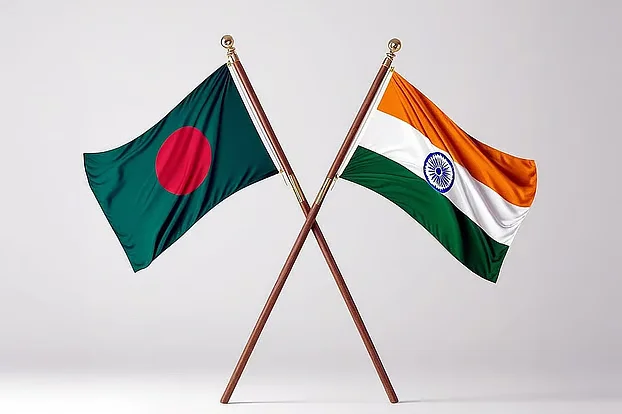
Flags of Bangladesh and India

The fifth consular dialogue between Bangladesh and India, scheduled to take place in Dhaka, has been postponed. A senior official of the Ministry of Foreign Affairs has confirmed the development.

The two-day dialogue was scheduled for 17 and 18 November in Dhaka.

Diplomatic sources in Dhaka and New Delhi told this correspondent that India requested a postponement through a diplomatic note last week, citing scheduling difficulties.

Several diplomatic sources in Dhaka, speaking on condition of anonymity, said the dialogue had been planned with the consent of both sides.

However, following the postponement, there is little likelihood of the meeting taking place this year.

Ahead of the consular dialogue, an inter-ministerial meeting was held at the Ministry of Foreign Affairs in Dhaka on 3 November.

At the meeting, officials suggested that the two countries discuss a range of bilateral issues, including preventing attempts at illegal push-ins, peaceful border management, visa operations, repatriation of citizens detained in the two countries, the release and repatriation of fishermen, and mutual legal assistance.

Since the dialogue process began in 2017, Bangladesh and India have held four rounds of consular talks. The fourth dialogue took place in New Delhi in May 2024.​
 

Indo-Bangla ties far bigger than Hasina issue: Shama


1794870906085.webp


Foreign Affairs State Minister Shama Obaid Islam has said Bangladesh-India relations are much broader than the issue of former prime minister Sheikh Hasina, stressing that the two neighbouring countries will address their differences through diplomacy.

“Bangladesh-India relations are a much bigger deal than Sheikh Hasina,” she said, adding that the bilateral relationship predated the 1971 Liberation War and could not be confined to a single issue.

The state minister made the remarks while responding to questions from journalists about Hasina’s possible extradition from India, the state of bilateral relations and reports of conditions allegedly put forward by New Delhi for her return.

On bringing Hasina back to face her sentence in Bangladesh, Shama said the Ministry of Foreign Affairs had written to India several times under the existing extradition treaty.

“The Ministry of Law is examining the legal technicalities, as is the Ministry of Home Affairs. We believe that, under the extradition treaty, like any other accused person, she will also be brought back to serve her sentence,” she said.

Hasina, who fled to India following the July-August 2024 mass uprising, was sentenced to death in a crimes against humanity case. Former home minister Asaduzzaman Khan Kamal was also convicted in the case.

Asked whether Bangladesh could issue Hasina a transit pass or facilitate her return if India was unwilling to extradite her, Shama questioned why New Delhi would not honour the bilateral extradition agreement.

She said the treaty could also be applied to other accused persons, including those allegedly involved in the killing of student leader Sharif Osman Hadi.

The state minister dismissed a BBC Bangla report suggesting that India had put forward two conditions for Hasina’s return: that she be allowed to travel under official protocol and that she be given an opportunity to appeal, with the crimes against humanity trial restarted.

“There is no basis for that report in the laws of Bangladesh. It does not come from any responsible part of the Indian government,” she said.

She added that Dhaka would respond to any formal communication from the Indian government, but would not attach importance to unofficial media reports. Shama also said there had been no communication from the Indian side regarding the reported conditions.

Responding to a question about a legal inquiry reportedly received by a Bangladesh mission from a law firm concerning Hasina’s passport, she said the government was examining the matter.

Citing the relevant laws of 1972 and 1973, she said Bangladeshi citizenship did not automatically guarantee the right to obtain a passport, particularly for a convicted criminal or someone facing serious criminal charges.

On the impact of Hasina’s activities in India on bilateral ties, Shama accused the former ruling Awami League of attempting to destabilise Bangladesh from abroad.

She alleged that the party was responsible for arson attacks and acts of violence in the past and continued to unleash violence in the country.

“When this terrorist group sits in another country, a country with which we have relations and a need to improve ties, and does this, it is certainly necessary for us as the government of Bangladesh to address it,” she said.

The state minister also clarified that the Bangladesh-India Foreign Secretary-level Consular Dialogue, scheduled for November 17-18, had not been cancelled but deferred.

She said both sides had agreed that the meeting should take place at a more convenient time, as it required the participation of officials at the secretary level from both countries.

Asked about possible high-level visits between Bangladesh and India, Shama said several VIP visits were expected and would be announced by the Ministry of Foreign Affairs in due course.​
 

Hasnat calls India ‘largest house of cross-border terrorists’


1794957478084.webp


National Citizen Party (NCP) Senior Joint Convener and lawmaker Hasnat Abdullah on Tuesday described India as the “largest house of cross-border terrorists”, accusing it of providing shelter and support to leaders and activists of the Awami League and Chhatra League, who were attempting to create instability in Bangladesh.

“India is the largest house of cross-border terrorists. Those who threaten Bangladesh's sovereignty and have killed people in this country are being provided shelter there,” he said, UNB reports.

Hasnat also urged the government to question India over its alleged role and seek a clear explanation about its position, saying the activities posed a direct challenge to the country's sovereignty.

He alleged that people involved in activities against Bangladesh were operating from Indian territory, carrying out violence in the country and returning to India, while New Delhi remained silent.

The NCP leader was addressing a discussion titled “One Year of the Verdict: Sheikh Hasina's Trial, Extradition and State Accountability”, arranged by the party’s July Mass Uprising Cell to mark the first anniversary of the death sentence against Sheikh Hasina for crimes against humanity during the July 2024 mass uprising.

He also accused India of applying double standards on cross-border security issues.

To explain his position, Hasnat presented a hypothetical example of Bangladesh providing shelter to an ULFA leader and allowing the individual to organise attacks and violent activities in India's Assam from Dhaka.

He questioned whether India would tolerate such activities if they were directed against its own territory, arguing that New Delhi was unwilling to accept a situation that it was allegedly allowing in Bangladesh's case.

The NCP leader further alleged that India had been providing training and shelter to people involved in cross-border violence over the past two and a half years.

He said Bangladesh respected international protocols and India's sovereignty but could not remain silent over activities that threatened its own sovereignty.

Hasnat called on the government to raise the issue with India and demand clarification over how it had allegedly become a “safe haven” for people involved in terrorism against Bangladesh.​
 

PKDefense Forums: Country-by-Country Military Discussions

Log In Register Forums
Latest
Back