Bangladesh Defense

Saif
Senior Member
- Joined
- Jan 24, 2024
- Messages
- 22,303
- Likes
- 9,875
- Nation

- Axis Group

KSA identifies asset quality, NPLs, capital inadequacy among risks
A push to woo Saudi investment to spur Sammilito Islami Bank takeoff has yet to deliver as none of the kingdom's banks and financial institutions has so far expressed interest to invest in the newborn lender for certain deficiencies. Officials have said the prospective investors listed asset
EFFORT TO WOO SAUDI INVESTMENT TO SPUR SAMMILITO ISLAMI BANK TAKEOFF
KSA identifies asset quality, NPLs, capital inadequacy among risks
A push to woo Saudi investment to spur Sammilito Islami Bank takeoff has yet to deliver as none of the kingdom's banks and financial institutions has so far expressed interest to invest in the newborn lender for certain deficiencies.
Officials have said the prospective investors listed asset quality, non-performing loans (NPLs), and capital inadequacy of the bank as risk factors.
After completing an initial assessment of the potential strategic investment opportunities in the five-in-one amalgamated Bangladeshi bank, the Ministry of Investment of Saudi Arabia shared the matter with the bank and financial institutions of the country.
However, recently the Saudi authority informed the government of Bangladesh that no formal investment proposal or commitment had been received from any specific investor so far.
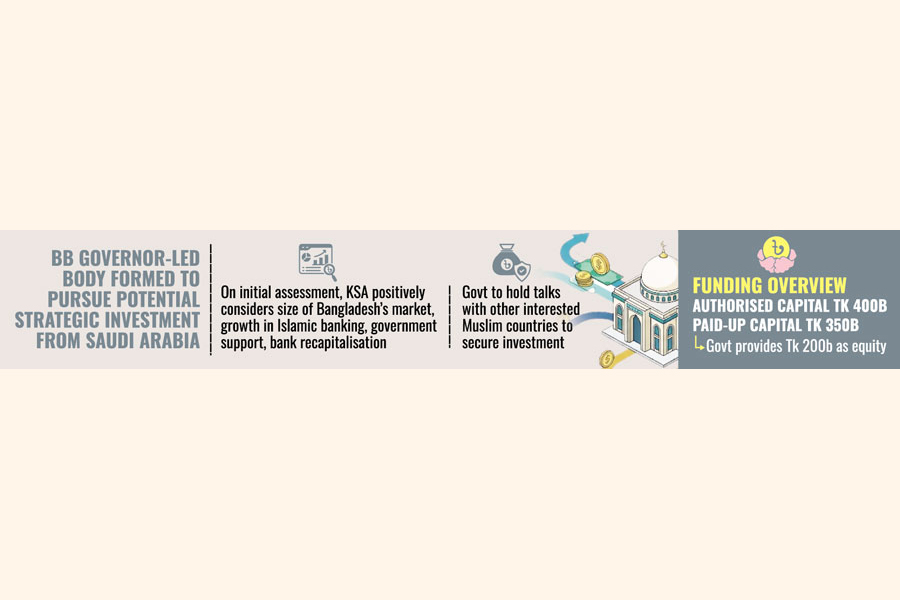
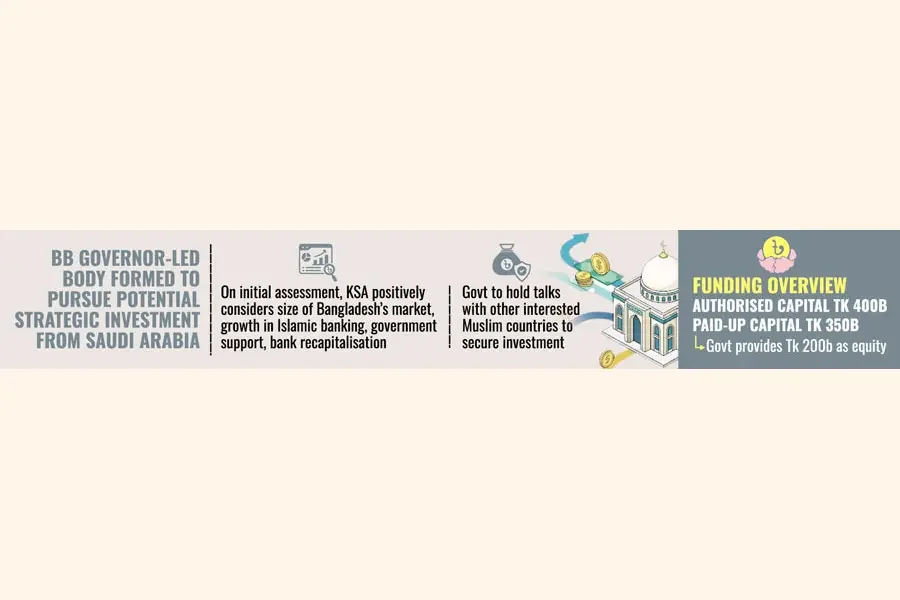
Amid the situation, the ministry of finance, which is eager to bring foreign investment in the Sammilito Islami Bank, formed a five-member committee, headed by the central bank's governor, to pursue potential strategic investment through establishing communication and conducting discussions with the officials of Ministry of Investment of Saudi Arabia and prospective investors.
The ministry of finance recently held a meeting in this regard with Prime Minister's Adviser for the Ministry of Finance and Planning Dr Rashed Al Mahmud Titumir in the chair.
The meeting was convened to determine the course of actions regarding the potential strategic investment by Saudi Arabia in the bank.
Sources said Financial Institutions Division Secretary Nazma Mobarek informed the meeting that Saudi Arabia had completed an initial assessment of the potential investment opportunities and positively considered the size of Bangladesh's market, the growth of the Islamic-banking sector, government support, and re-capitalisation of the bank.
Quoting a letter the government received from the Saudi authority, she told the meeting that "such an opportunity could strengthen investment and trade relations" between the two countries.
However, she said, the Saudi authorities had also identified certain risks relating to the quality of assets transferred from the merged banks, non-performing loans, provisioning, capital inadequacy, corporate governance, management, and the bank's actual financial valuation.
She suggested that undertaking coordinated initiatives among the relevant institutions are required for attracting potential foreign strategic investment.
Sources said the meeting discussed the necessity of establishing communication and conducting discussions with the Ministry of Investment of Saudi Arabia and prospective investors, reviewing the assets and liabilities of Sammilito Islami Bank, state of NPLs, provisions against NPLs, capital adequacy, and actual financial valuation of the bank.
Also, sources said, the meeting observed the requirement of determining the potential investment need, shareholding structure, investment terms and conditions, and safeguarding the interests of the government's invested capital.
The meeting further discussed the necessity of determining the investment structure, regulatory conditions, and required approvals for investing in the bank by foreign investors and taking subsequent actions and decisions in accordance with applicable laws and regulations.
Contacted Friday over the telephone, the FID Secretary, Nazma Mobarek, did not want to comment on the issue. Dr Rashed Al Mahmud Titumir did not respond to phone calls.
The Dr Yunus-led interim government formed the Sammilito Islami Bank in November last year by merging five private banks- First Security Islami Bank, Social Islami Bank, Global Islami Bank, Union Bank, and EXIM Bank.
These banks needed mergers as their nearly 77-percent credits turned NPLs amounting to some Tk 1.47 trillion, after being extensively looted by the then owners, led by Chittagong-based business conglomerate S Alam Group.
The new shariah-based bank's authorised capital was set at Tk 400 billion while the paid-up capital Tk 350 billion. Of the paid-up capital, the government has provided Tk 200 billion as equity.
The government is now looking for foreign investments to give the state-run Shariah-based bank a lifeline.
As part of this effort, the government has officially initiated discussions with Qatar and Saudi Arabia. Moreover, the government intends to hold talks with other interested Muslim countries to secure investment for the bank.
"We want to divest the bank's ownership," Rashed Al Mahmud Titumir said in August.
KSA identifies asset quality, NPLs, capital inadequacy among risks
A push to woo Saudi investment to spur Sammilito Islami Bank takeoff has yet to deliver as none of the kingdom's banks and financial institutions has so far expressed interest to invest in the newborn lender for certain deficiencies.
Officials have said the prospective investors listed asset quality, non-performing loans (NPLs), and capital inadequacy of the bank as risk factors.
After completing an initial assessment of the potential strategic investment opportunities in the five-in-one amalgamated Bangladeshi bank, the Ministry of Investment of Saudi Arabia shared the matter with the bank and financial institutions of the country.
However, recently the Saudi authority informed the government of Bangladesh that no formal investment proposal or commitment had been received from any specific investor so far.
Amid the situation, the ministry of finance, which is eager to bring foreign investment in the Sammilito Islami Bank, formed a five-member committee, headed by the central bank's governor, to pursue potential strategic investment through establishing communication and conducting discussions with the officials of Ministry of Investment of Saudi Arabia and prospective investors.
The ministry of finance recently held a meeting in this regard with Prime Minister's Adviser for the Ministry of Finance and Planning Dr Rashed Al Mahmud Titumir in the chair.
The meeting was convened to determine the course of actions regarding the potential strategic investment by Saudi Arabia in the bank.
Sources said Financial Institutions Division Secretary Nazma Mobarek informed the meeting that Saudi Arabia had completed an initial assessment of the potential investment opportunities and positively considered the size of Bangladesh's market, the growth of the Islamic-banking sector, government support, and re-capitalisation of the bank.
Quoting a letter the government received from the Saudi authority, she told the meeting that "such an opportunity could strengthen investment and trade relations" between the two countries.
However, she said, the Saudi authorities had also identified certain risks relating to the quality of assets transferred from the merged banks, non-performing loans, provisioning, capital inadequacy, corporate governance, management, and the bank's actual financial valuation.
She suggested that undertaking coordinated initiatives among the relevant institutions are required for attracting potential foreign strategic investment.
Sources said the meeting discussed the necessity of establishing communication and conducting discussions with the Ministry of Investment of Saudi Arabia and prospective investors, reviewing the assets and liabilities of Sammilito Islami Bank, state of NPLs, provisions against NPLs, capital adequacy, and actual financial valuation of the bank.
Also, sources said, the meeting observed the requirement of determining the potential investment need, shareholding structure, investment terms and conditions, and safeguarding the interests of the government's invested capital.
The meeting further discussed the necessity of determining the investment structure, regulatory conditions, and required approvals for investing in the bank by foreign investors and taking subsequent actions and decisions in accordance with applicable laws and regulations.
Contacted Friday over the telephone, the FID Secretary, Nazma Mobarek, did not want to comment on the issue. Dr Rashed Al Mahmud Titumir did not respond to phone calls.
The Dr Yunus-led interim government formed the Sammilito Islami Bank in November last year by merging five private banks- First Security Islami Bank, Social Islami Bank, Global Islami Bank, Union Bank, and EXIM Bank.
These banks needed mergers as their nearly 77-percent credits turned NPLs amounting to some Tk 1.47 trillion, after being extensively looted by the then owners, led by Chittagong-based business conglomerate S Alam Group.
The new shariah-based bank's authorised capital was set at Tk 400 billion while the paid-up capital Tk 350 billion. Of the paid-up capital, the government has provided Tk 200 billion as equity.
The government is now looking for foreign investments to give the state-run Shariah-based bank a lifeline.
As part of this effort, the government has officially initiated discussions with Qatar and Saudi Arabia. Moreover, the government intends to hold talks with other interested Muslim countries to secure investment for the bank.
"We want to divest the bank's ownership," Rashed Al Mahmud Titumir said in August.