Why the Rohingya crisis needs a new political imagination
Benjamin Etzold and Anas Ansar
This year marks the 75th anniversary of the 1951 UN Refugee Convention. Bangladesh is also approaching a sobering milestone: nearly a decade since more than 740,000 Rohingya fled Myanmar's military atrocities in August 2017, joining earlier waves of displacement. Together, these anniversaries invite an uncomfortable question. Has the international refugee protection regime become too comfortable with managing displacement rather than resolving it? Have we already reached the limits of policies centred on containment and repatriation?
To say the least, Bangladesh deserves recognition for providing sanctuary to nearly 1.2 million Rohingya refugees despite not being a party to the Refugee Convention and despite facing significant economic, environmental and security pressures of its own. What began as an emergency humanitarian response has evolved into one of the world's largest and longest-running refugee operations. The crisis is growing increasingly complex with each passing day. Yet the continued encampment of such a large population in one of South Asia's most fragile borderlands is no longer a temporary solution. It has become part of the crisis itself.
The humanitarian response remains indispensable, but it is becoming increasingly difficult to sustain. The 2025 Joint Response Plan sought US$935 million to support refugees and host communities, yet by the end of the year, less than half of that amount had been funded. As humanitarian budgets shrink worldwide amid geopolitical competition, donor fatigue and rising domestic priorities, the assumption that the camps can be be maintained indefinitely is becoming increasingly unrealistic.
The problem is not simply one of policing. It reflects the limitations of governing a population of more than one million people through a humanitarian model designed for short-term emergencies. As displacement becomes protracted, institutions built for crisis management struggle to address the social, economic and security dynamics of what has effectively become a large urban settlement.
More fundamentally, humanitarian assistance alone cannot provide what refugees need most: protection, dignity and a future.
The camps in Cox's Bazar were designed as temporary places of safety. Increasingly, however, they have become places of insecurity. Academic and policy research has documented thousands of serious security incidents, including killings, kidnappings, extortion and widespread gender-based violence. The recent landslide and the deaths of nine Rohingya reveal the multiple dimensions of the crisis. Armed criminal networks continue to operate within the camps, while reports of the forced recruitment and trafficking of Rohingya men and boys into the conflict across the border have increased since fighting intensified in Myanmar's Rakhine State in 2024. These realities expose a painful contradiction: spaces established to protect refugees have themselves become deeply insecure.
The problem is not simply one of policing. It reflects the limitations of governing a population of more than one million people through a humanitarian model designed for short-term emergencies. As displacement becomes protracted, institutions built for crisis management struggle to address the social, economic and security dynamics of what has effectively become a large urban settlement. The politics of temporality has started to haunt Bangladesh itself.
Landslides expose deadly risks for Rohingya refugees in Bangladesh. Photo: Ak Mohammed Sadek
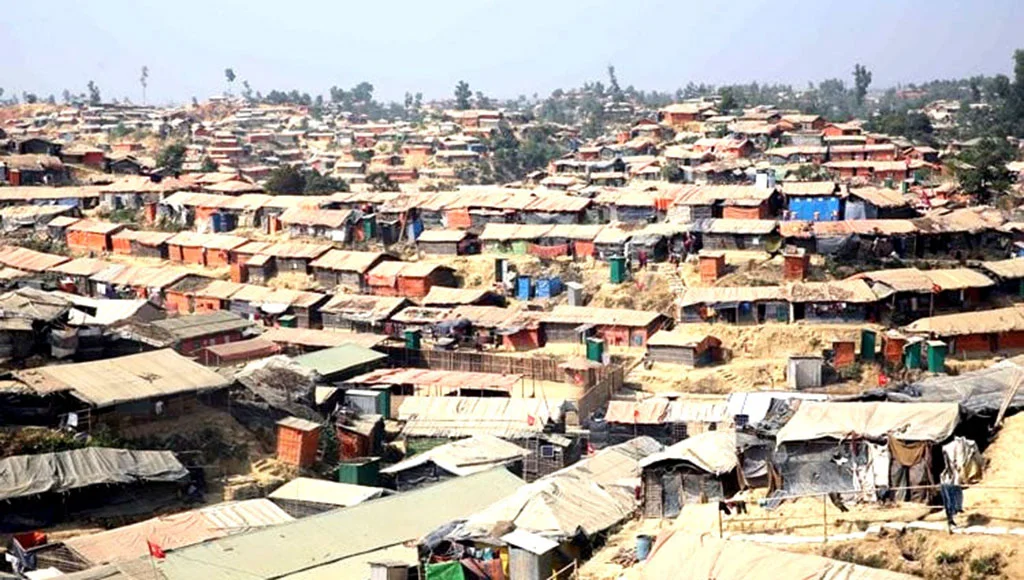
After the first mass exodus of Rohingya to Bangladesh in 1978, refugees erected makeshift shelters in Cox's Bazar district. In 1992, the first official refugee camps were built. Following the mass displacement in August 2017, these camps were rapidly expanded and new camp sites were opened. Successively, roads, schools, health facilities, markets and extensive service networks have transformed them into complex urban spaces closely intertwined with the economy of Cox's Bazar. Many Rohingya have long contributed informally to agriculture, fisheries, construction and local services despite legal restrictions on movement and employment. Humanitarian agencies are also major employers and service providers, and the 'refugee economy' has thus become a structurally important and beneficial element of the regional economy. The truth is that, over the course of almost 50 years, temporary Rohingya camps have turned into permanent settlements that will continue to exist in the future.
Acknowledging this reality does not mean abandoning the principle of voluntary, safe and dignified repatriation. Bangladesh has consistently maintained, and rightly so, that the sustainable solution lies in creating conditions inside Myanmar that allow the Rohingya to return with guaranteed citizenship, security and rights. That position should remain unchanged, even though it is highly unlikely that all Rohingya refugees will eventually return.
Maintaining repatriation as the ultimate objective should thus not prevent policymakers from recognising that indefinite encampment carries growing humanitarian, economic and security costs. A policy framework built entirely around temporariness is increasingly disconnected from realities on the ground. Issues such as cross-border violence, the growing influence of armed groups, onward migration through maritime routes, and social and political fractures within the Rohingya community have become more pronounced, underscoring the need to revisit the existing policy framework. Policies that promote greater freedom of movement, enhanced self-reliance, access to decent work outside the camps, expanded social space, and improved security should be developed and implemented, while also mitigating local conflicts, ensuring social cohesion and balancing the needs of host communities. In addition, infrastructural development and planning for the camps-turned-into-cities within existing local settlements must proceed.
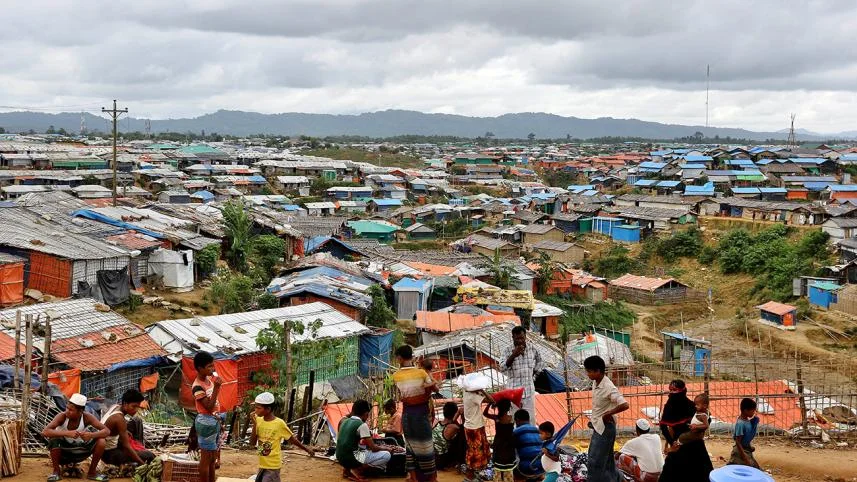
Rohingya camps in Cox’s Bazar. Photo: Anisur Rahman
Nonetheless, Bangladesh also faces a difficult diplomatic dilemma. The return of the Rohingya ultimately depends on developments inside Myanmar, yet Myanmar today remains divided by civil war, with authority fragmented between the military government, ethnic armed organisations and local administrations. Dhaka understandably hesitates to engage too closely with the military authorities, whose actions drove the mass displacement and whose legitimacy remains internationally contested. Strategic ambiguity in diplomatic disengagement also limits Bangladesh's ability to influence the conditions necessary for eventual repatriation.
Navigating this dilemma requires pragmatic diplomacy rather than political endorsement. Bangladesh will likely need to engage multiple actors, including the military authorities where necessary, ethnic stakeholders in Rakhine, ASEAN members, China, India and the United Nations, to keep open every possible pathway towards safe returns. In such circumstances, diplomacy should be judged not by symbolism but by whether it advances the interests of displaced Rohingya and regional stability.
The broader regional context underscores the need for a diplomatic reset. Prime Minister Tarique Rahman's recent engagement with China may provide an opportunity to reinvigorate these efforts, as Beijing remains Myanmar's most influential partner and maintains channels with both the military authorities and actors in Rakhine. Bangladesh should encourage China to use its unique leverage in pursuit of these objectives. With SAARC effectively dormant and the Bay of Bengal becoming increasingly central to regional geopolitics, Bangladesh has sought stronger engagement with ASEAN. Although full membership remains uncertain, closer institutional cooperation could provide additional diplomatic platforms for addressing the Rohingya crisis as a regional rather than solely bilateral challenge.
The next commemoration of the Rohingya mass exodus should not become another anniversary marked only by appeals for humanitarian funding. It should be a moment to rethink the political framework underpinning the response. Humanitarian assistance remains essential, but humanitarianism cannot substitute for political strategy. A forward-looking strategy must consider the de facto transformation of what were once temporary camps into permanent settlements, the Rohingyas' ongoing need for protection and support, and their right to a future, as well as the complex security challenges in the Bangladesh-Myanmar borderland.
Dr Benjamin Etzold is Senior Researcher at bicc – Bonn International Centre for Conflict Studies, Germany, and has conducted multiple studies on protracted displacement situations in Bangladesh and other countries.
Dr Anas Ansar is Assistant Professor in the Department of Political Science and Sociology at North South University and Senior Researcher at the Arnold Bergstraesser Institute, University of Freiburg, Germany.
 Bangladesh Defense