| Global Defense, OSINT & Geopolitics Wire

[🇧🇩] Insurgencies in Myanmar. Implications for Bangladesh

[🇧🇩] Insurgencies in Myanmar. Implications for Bangladesh
493
25K
More threads by Saif

G Bangladesh Defense

Myanmar rights situation plummets to new low amid Rohingya abuses, illicit economies: UN

1787699407298.webp


The human rights situation in Myanmar, particularly that of minority communities, has deteriorated to a new low amid worsening abuses against the Rohingya and the devastating impact of illicit economies, including illegal rare-earth mining, according to a new UN Human Rights report.

“This report depicts a picture of suffering, misery, and cruelty on multiple levels and across the country that is heartbreaking,” said UN High Commissioner for Human Rights Volker Türk.

He called on all states, companies and investors to undertake serious soul-searching over their actions — or inaction — and ask whether their activities are fair and just for the people of Myanmar. “Can the societal and environmental harm of their activities even be reversed? Their own reputations and their credibility are on the line.”

The report details how unrelenting violence and a conflict economy work hand-in-hand to expose civilian populations to untold misery. It covers the period between 1 June 2025 and 31 May 2026.

“The military’s persistent quest for control and legitimacy has only deepened the suffering and the multiple life-threatening protection and humanitarian concerns civilians face,” the report states.

“Military tactics aimed at imposing fear and control, facilitated by the use of new technologies to expand surveillance, permeate every aspect of life,” it says.

Highlighting acts of military violence against the civilian population, the report notes the persistent use of airstrikes, arson attacks, displacement and denial of assistance. It also details the commission – by both the Myanmar military and the “Arakan Army” – of widespread and systematic violations and abuses against the Rohingya, nine years since the terrible violence of 2017 that forced hundreds of thousands of Rohingya to flee.

“Across northern Rakhine, the Arakan Army has perpetrated arbitrary arrests, torture, sexual and gender-based violence, instances of enforced disappearance, forced labour and recruitment, unlawful confiscation of land and residential property, and the destruction of villages, religious and cultural sites, caused renewed Rohingya displacement,” it says.

Children are systematically used for labour, with witnesses describing workers as young as six years old clearing jungle, constructing buildings and doing menial work for Rakhine families, the report says, adding that in one case, a child was forced to clear bones and skulls of victims of a massacre.

Interviewees reported the arrest and detention of Rohingya attempting to escape forced recruitment, with cases of Rohingya girls resorting to early marriage in the hope that married girls were less likely to be forcibly recruited.

“Once detained, individuals reported being routinely subjected to ill-treatment with former detainees describing beatings with bamboo, rubber pipes, and belts; being burned with matches and cigarettes; being hung upside down with their bodies spun until they passed out; chilli being applied to genitals; and removal of fingernails,” the report reads.

The absence of the rule of law across Myanmar has acted as an enabler for illicit economies in the country, helping to finance the conflict, worsen the crisis, and has impacts on the wider region, the report finds.

Human rights crises continue to multiply from rising illegal mining, drug production, human trafficking, and scam centres.

Economic collapse and conflict-induced displacement have also generated a labour market that is easy for economic actors and criminal organisations to exploit, the report states, finding that civilians are lured into a system marred by endless human rights violations and abuses.

Unregulated exploitation of natural resources has destroyed the environment, livelihoods, and traditional community-based systems in a growing number of areas in the country, particularly minority areas.

Illicit economies and rare earth mining in Kachin and Shan have strengthened the expansion of transnational criminal networks, irresponsible business practices, and serious instances of transboundary environmental contamination, the report finds.

Satellite images confirmed that Kachin remained the primary mining area, with 302 new sites since 2021 – a 149 percent increase. In Shan, sites increased from 12 pre-coup to 85 post-coup.

Despite limited availability of official records, findings indicated a peak in trade flows in 2023 amounting to US$ 1.4 billion, the report finds.

Financial investigations have highlighted a complex web of relationships among multiple actors and entities that fostered illicit gains with impunity, it adds.

Massive volumes of hazardous chemical leaching agents and toxic mining runoff flow directly into local waterways, resulting in severe chemical and transboundary pollution.

“Environmental contamination impacted maternal and reproductive health, with local documentation efforts confirming sharp surges in miscarriages, severe bleeding during pregnancy, childbirth, or after delivery, and pregnancy complications attributed to heavy metal and chemical exposure,” says the report.

Lack of economic opportunities, displacement and forced conscription have also triggered an influx of women into the mining sector. “This aggravated risks of sexual violence and harassment by supervisors, guards, and militia members who operated with absolute impunity,” it says.

The report also highlights the absence of occupational health and safety standards. “Without knowledge and equipment, interlocutors stated that workers developed symptoms like acute respiratory distress, severe headaches, chemical burns, and gastrointestinal illnesses,” it says. “Prolonged exposure caused the accumulation of toxic agents, leading to chronic pulmonary, kidney, and liver diseases.”

Toxic wastewater from leaching pools discharged directly into downstream agricultural land also made the soil barren or significantly affected yield and quality, reducing farmers’ incomes, it adds.​
 

Failure of repatriation affects Rohingyas, and increases pressure on Bangladesh

Raheed Ejaz


1787700065419.webp

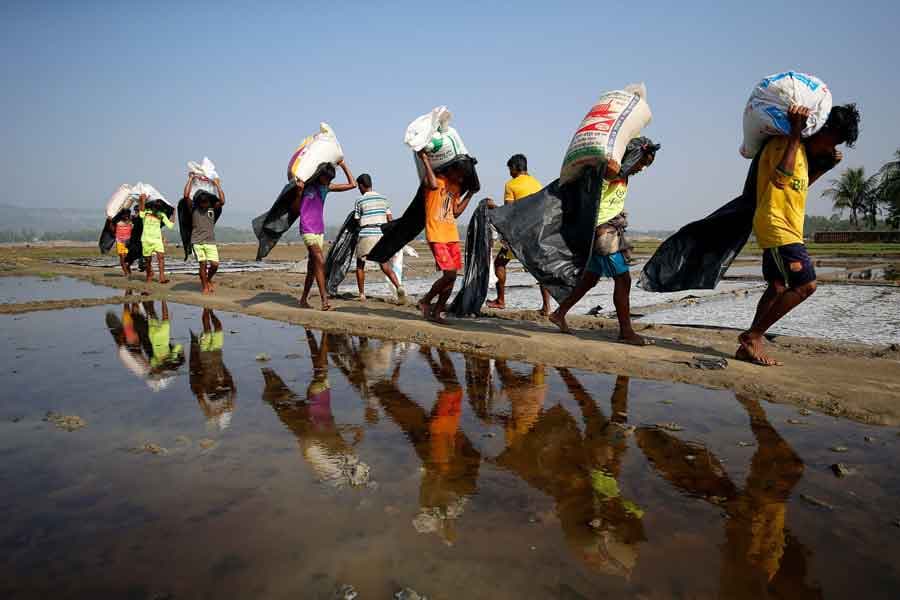
Kutupalong Rohingya Camp File photo

Myanmar recently said that more than 300,000 Rohingyas living in Bangladesh are former residents of Rakhine. At the same time, Naypyidaw has once again denied their identity as “Rohingya” and brought the term “Bengali” to the fore. Myanmar’s contradictory messages therefore raise the question: has the country’s position on taking back the Rohingyas actually changed, or is it seeking to further complicate the crisis?

Myanmar’s Ministry of Foreign Affairs said on 17 August that, of the list of 828,824 people submitted by Bangladesh, information on 426,545 had been verified. Of them, 308,797 were identified as former residents of Rakhine. But Naypyidaw did not provide any timeline for repatriation. Instead, it said repatriation would not begin until the security situation improved.

Meanwhile, the “Bengali” controversy has resurfaced. Referring to the Rohingyas by this name is a long-standing position of Myanmar. But as discussions on repatriation resume, questions are now being raised about the political significance of bringing that position to the forefront. On the one hand, Rohingyas are being identified as former residents of Rakhine; on the other, their own ethnic identity is being denied.

The question, therefore, is not simply how many people Myanmar is prepared to take back. If Myanmar remains unyielding over the identity and rights of those it says it is willing to receive, how realistic can that repatriation actually be?

Repatriation announced, but no one has returned

In the weeks following 25 August nine years ago, more than 700,000 Rohingyas fled to Bangladesh. At the time, the equation surrounding repatriation was not nearly as complicated as it is today. The entirety of Rakhine was under the control of Myanmar’s military. International pressure was mounting following the Myanmar military’s horrific atrocities against the Rohingyas in Rakhine.

In that situation, and largely under pressure from China, Bangladesh signed a repatriation agreement with Myanmar barely three months after the influx of Rohingyas began. It was hoped that, through an understanding with the Myanmar government, the Rohingyas could eventually be returned.

That reality no longer exists in Myanmar in 2026. Civil war spread across the country following the military coup in 2021. The military has lost control of various areas. The balance of power has also shifted in Rakhine. The Arakan Army is now one of the state’s principal military and political forces. Amid these changes, Myanmar is once again putting forward figures for repatriation.

Rakhine now under Arakan Army

The biggest change in the old framework for Rohingya repatriation has occurred in the balance of power in Rakhine. In late 2023, the Arakan Army launched a major offensive in Rakhine. It subsequently took control of one military base and key area after another. By late 2024, there were also reports that Maungdaw, along the Bangladesh border, had come under the Arakan Army’s control. As a result, the Myanmar military’s control weakened across large parts of the state, including northern Rakhine.

Although Naypyidaw retains control of some important areas, such as Sittwe, the overall reality in Rakhine has changed. This is where the biggest question over repatriation arises.

The Myanmar government says it wants to take back the Rohingyas. But in many of the areas where they are most likely to return, Naypyidaw does not have effective control. So who will ensure their security after repatriation? Who will administer those areas? Who will guarantee their freedom of movement? And who will make the final decisions on citizenship and political rights? Nine years ago, the answers to these questions were relatively clear. They are not anymore.

New risks for the Rohingyas

The rise of the Arakan Army in Rakhine has created a new reality for the Rohingyas. But it has not brought any guarantee of security. The Arakan Army has been accused of persecuting Rohingyas, restricting their movement, forcibly displacing them and subjecting them to forced recruitment. Similar allegations of forced recruitment have also been made against Myanmar’s military. As a result, there is no easy choice for the Rohingyas. On the one hand, Naypyidaw maintains its longstanding position on their ethnic identity and citizenship.

On the other, the Rohingyas’ relationship with the Arakan Army, which controls large parts of Rakhine, is also complicated. In this situation, repatriation is not simply a matter of crossing the border and returning home. The central questions are who will protect them after they return and what rights they will have.

Bangladesh faces a new reality

The changes in Rakhine are also significant for Bangladesh’s diplomacy. Until now, Dhaka has primarily discussed repatriation with the Myanmar government. But as the power structure in Rakhine has changed, questions have arisen over how much this policy reflects the reality on the ground. In June, Foreign Affairs Adviser Khalilur Rahman told Parliament that Bangladesh was working to establish effective dialogue between the Myanmar authorities and the Arakan Army to create a stable environment in Rakhine.

This signals a significant shift. It does not mean recognising the Arakan Army. Rather, the reality is that it is difficult to completely ignore the side that exercises effective control over large parts of Rakhine when trying to create conditions for repatriation. This reality has already become apparent in some incidents along the border. Bangladesh has communicated with the Arakan Army to secure the release of Bangladeshi fishermen it had detained. In other words, the realities on the ground have already created a degree of contact.

The question is how strategically Bangladesh can make use of this reality. On the one hand, it will have to continue repatriation talks with Naypyidaw. On the other, it will also need to maintain necessary communication with the forces exercising effective control in Rakhine. At the same time, international pressure must be sustained so that the questions of Rohingya citizenship and rights do not fall outside the scope of repatriation discussions. Finding a path toward a solution through dialogue at multiple levels, while safeguarding the country’s interests, will be a major challenge for Bangladesh.

Bangladesh and Myanmar decided in November 2018 to repatriate the first group of Rohingyas. Not a single Rohingya was returned in the first phase. After the two countries failed to make progress, China became involved in efforts to repatriate the Rohingyas. The second attempt, mediated by China in 2019, also failed. The Rohingyas refused to return because conditions in Rakhine were not conducive to their return, including the lack of guarantees of citizenship and security.

At a time when Bangladesh is trying to verify lists and negotiate with Myanmar over repatriation, Myanmar is saying that there is no ethnic group called “Rohingya.”

Myanmar’s strategy on the numbers

Myanmar’s sudden announcement that more than 300,000 Rohingyas had been verified, may have piqued the curiosity of many, but this is not the first time the country has publicised such figures. In April 2025, on the sidelines of the sixth BIMSTEC summit in Bangkok, Myanmar’s Deputy Prime Minister and Foreign Minister Than Swe met Khalilur Rahman, then the High Representative to the Chief Adviser of Bangladesh’s interim government. At that meeting, Myanmar initially confirmed that 180,000 Rohingyas had been verified and deemed eligible for repatriation.

The Bangladesh government’s attitude toward such an announcement from Myanmar at the time was essentially to wait for the military junta to put forward a figure. But Myanmar did not say when it would take back those it had deemed eligible for repatriation.

It again said that repatriation would begin once the security situation improved. There was no specific timeline for the return of the Rohingyas. Each time, the process has reached a certain point and then stalled: verification has taken place, but repatriation has not. The picture this time is no different. Here, the distinction between “verification” and “repatriation” is important. Identifying someone as a former resident of Rakhine does not mean that conditions have been created for their safe, voluntary and dignified return.

Old “Bengali” narrative, new questions

Calling the Rohingyas “Bengali” is nothing new for Myanmar. The country does not recognise the Rohingyas among its 135 officially recognised ethnic groups. It has also continued to deny them citizenship rights. But the question now is why this old narrative is being brought to the fore again. At a time when Bangladesh is trying to verify lists and negotiate with Myanmar over repatriation, Myanmar is saying that there is no ethnic group called “Rohingya.” Bangladesh has protested this position. Rohingyas in exile believe it is simply a continuation of Myanmar’s longstanding stance. The refusal to recognise Rohingya citizenship and identity makes it clear, they argue, that the country lacks genuine goodwill toward repatriation.

At the same time, there is another aspect to Myanmar’s recent actions. Its identification of 308,797 people as former residents of Rakhine at least shows that it is not formally denying the issue in its entirety. It is therefore more reasonable to view the “Bengali” narrative not as an entirely new policy, but as a repetition of the old politics of identity. The real question is how much this identity politics is affecting the practical process of repatriation.

* Raheed Ejaz is Special Correspondent, Prothom Alo​
 

Talks with Myanmar, diplomatic efforts continue, says Foreign Secretary

Staff Correspondent
Cox’s Bazar
Published: 25 Aug 2026, 17: 27

1787700463381.webp

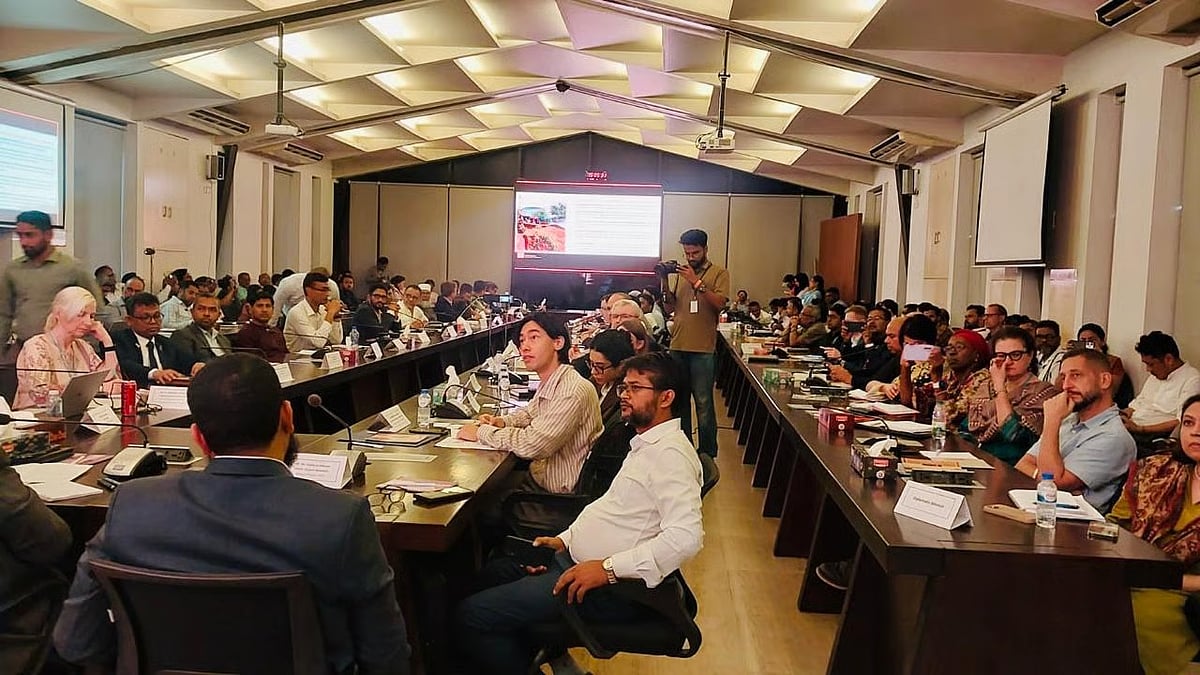
Representatives of various local and international organisations attend a high-level roundtable discussion on the Rohingya crisis in Cox’s Bazar on 24 August 2026. Prothom Alo

Foreign Secretary Asad Alam Siam has said Bangladesh is continuing talks with Myanmar and diplomatic efforts to resolve the Rohingya refugee crisis. Bangladesh wants to create conditions that will allow the Rohingyas to return to their homeland with safety and dignity.

He said this at a high-level roundtable held in Cox’s Bazar town on Monday. The two-day event, held at the office of the Refugee Relief and Repatriation Commissioner (RRRC), was organised by the Government of Bangladesh and the Norwegian Refugee Council (NRC). The event was organised to mark nine years since Rohingyas fled to Bangladesh to escape the genocide in Myanmar’s Rakhine State.

The first day of the two-day roundtable, titled ‘The Rohingya Exodus: Challenges and the Future of this Protracted Crisis’, was held on Monday. Foreign Secretary Asad Alam Siam was the chief guest at the opening session. Refugee Relief and Repatriation Commissioner Mohammad Mizanur Rahman chaired the session.

Representatives and experts from various local and international organisations working with Rohingya refugees attended the meeting. They called for safe and dignified repatriation of the Rohingyas, as well as greater access to education, skills development and livelihood opportunities. They also stressed the need for long-term support and coordinated initiatives to reduce the pressure on local communities caused by hosting the Rohingyas.

1787700499330.webp

Representatives of various local and international organisations attend a high-level roundtable discussion on the Rohingya crisis in Cox’s Bazar on 24 August 2026. Prothom Alo

Norwegian Refugee Council (NRC) Bangladesh Country Director Dipankar Datta said the nature of the Rohingyas’ needs has also changed as the crisis enters its tenth year. He said that alongside emergency assistance, the Rohingyas need access to education, skills development and livelihood opportunities, as well as multi-year funding.

NRC expert Ezatullah Raji highlighted challenges related to housing, land and property in the refugee camps. Referring to his remarks, Igor Ciobanu, principal coordinator of the Rohingya Coordination Platform (RCP), said the Rohingyas are now facing new and complex challenges arising from prolonged displacement.

Ellie Moody, head of the humanitarian assistance department at the Foreign, Commonwealth and Development Office (FCDO), said the waiting period should be used to prepare the Rohingyas for their future through education and skills development until conditions conducive to repatriation are created. The needs of local communities must also be taken into consideration, she added.

Alexander Falk Bilde, deputy head of mission at the Norwegian Embassy, said that as long as the Rohingyas remain displaced, it is essential to provide them with relevant education and livelihood opportunities while ensuring basic services for local communities.

Marcel Colom, head of the UN refugee agency UNHCR’s Cox’s Bazar sub-office, said an environment must be created so that Rohingyas can make their own decisions about repatriation based on adequate information. At the same time, efforts must be made to strengthen the capacity and resilience of local communities that have been hosting refugees for years.

1787700536303.webp

Foreign Secretary Asad Alam Siam inaugurates a two-day photo exhibition at the RRRC office premises in Cox’s Bazar on 24 August 2026. Prothom Alo

Professor Sazzad Siddiqui, chairman of the Department of Peace and Conflict Studies at Dhaka University, said that instead of simply waiting for a political solution, education and income-generating opportunities must be ensured for the current generation.

At the meeting, The Daily Waada editor and former press secretary to the interim government Shafiqul Alam called for greater involvement of Muslim-majority countries in resolving the Rohingya crisis. He said a generation of Rohingyas must not be lost.

Speakers at the meeting included The Daily Star Head of Crime Jamil Khan, local NGO Pulse Executive Director Abu Morshed Chowdhury, Humanity & Inclusion (HI) Bangladesh Country Manager Sibghatullah Ahmed, NRC Bangladesh Head of Programme Mainul Islam, and United Council of Rohingya President, panel member and Rohingya community leader Md Shuaif.

After the meeting, Foreign Secretary Asad Alam Siam inaugurated a two-day photo exhibition at the RRRC office premises in the evening. The exhibition features more than a hundred photographs, including hand-drawn pictures by Rohingya boys and girls, handwritten letters describing the genocide in Rakhine, and photographs depicting the horrors of the days of the genocide.​
 

Rohingyas seek safe, dignified return

They observe ‘Genocide Day’ on 9th anniv of their exodus to Bangladesh

Tarekur Rahman . Cox’s Bazar 25 August, 2026, 10:47

1787701848948.webp

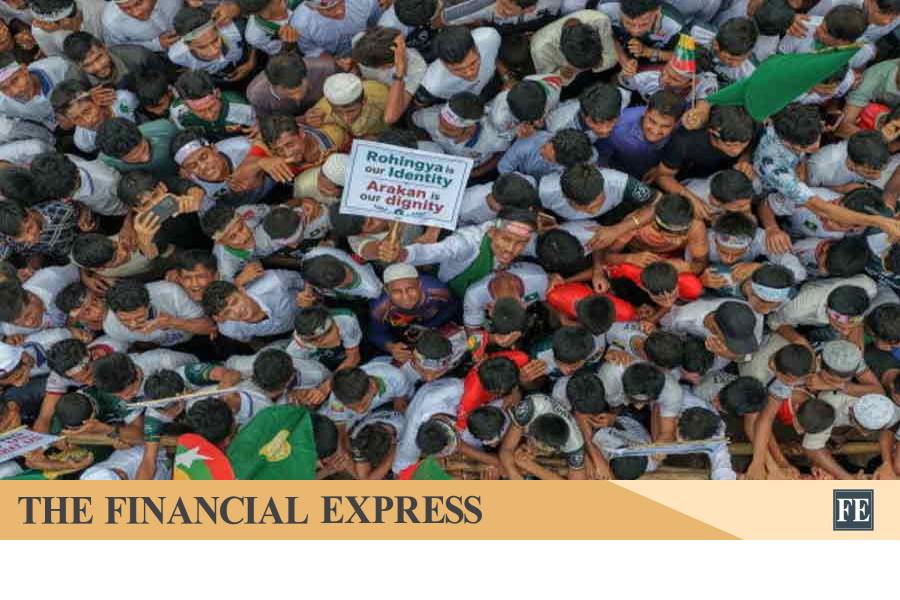
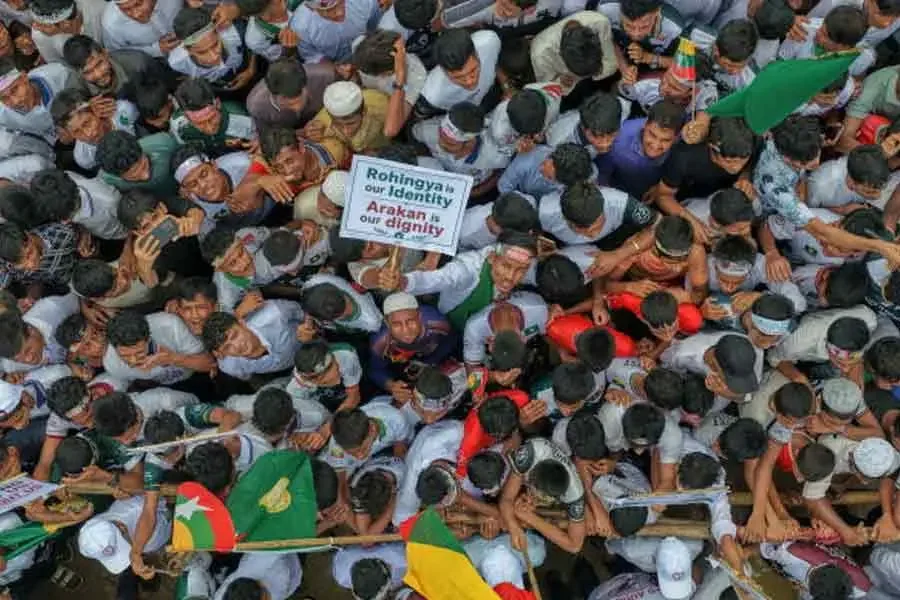
Tens of thousands of Rohingyas gather to take part in a protest, marking the ninth-year anniversary of their exodus, on Kutupalong refugee camp playground at Ukhia in Cox’s Bazar on Tuesday. | New Age photo

Rohingyas observed ‘Genocide Day’ at refugee camps in Cox’s Bazar on Tuesday, demanding a safe and dignified return to Myanmar.

According to the United Nations, about 12 lakh Rohingyas currently live in Bangladesh.

Despite several major international efforts to resolve the crisis over the past nine years, none has materialised due to a lack of consensus among the parties involved.

On Tuesday, more than one lakh Rohingya men and women from 33 camps at Ukhiya and Teknaf gathered at a rally to mark nine years since they fled to Bangladesh amid a military persecution.

On August 25, 2017, hundreds of thousands of Rohingyas fled to Bangladesh amid the military crackdown in Myanmar’s Rakhine State.

A large refugee settlement was subsequently established at Ukhiya and Teknaf in Cox’s Bazar.

The rally was organised at the football field of Kutupalong Camp-4 Extension at Ukhiya on Tuesday morning.

At the rally, the Rohingyas demanded safe and dignified repatriation to their homeland of Arakan and called for a coordinated initiative by the international community.

The rally ended with a prayer for the opportunity to return to their homeland.

Rohingyas attending the rally said they wanted to return to Myanmar as soon as possible if their security, rights and dignity were ensured.

Salim Ullah of Kutupalong Camp-4 said, ‘We did not want to leave our own country. We took shelter in Bangladesh to save our lives. If our security and rights are ensured, we want to return to our homeland.’

Hazera Khatun said, ‘It is not enough just to send us back. We must be assured that we will not face persecution again after returning to Myanmar. We do not want to become displaced again.’

Majed Abdullah, a resident of Camp-3, said in tears, ‘My father was killed in Myanmar in 2017. We were tortured and forced to leave. We have not found peace even after coming to Bangladesh. Terrorist groups have repeatedly attacked me. We do not want to stay here. We want to be repatriated safely to Myanmar after our demands are accepted.’

Sahara Bibi, a resident of Camp-1, said, ‘There has been no solution to our repatriation even after nine years. We want to return to our homeland soon. We call on the United Nations to take necessary steps for our safe repatriation.’

A section of the Rohingyas at the rally also chanted slogans demanding the release of Arakan Rohingya Salvation Army chief Ataullah Abu Ammar Jununi.

Syed Ullah, head of the United Council of Rohingya, said a new generation had grown up in the camps over the past nine years, but their future remained uncertain.

‘The security, citizenship rights and dignity of Rohingyas must be ensured before they return to Arakan,’ he said.

Nurul Amin, a leader of Balukhali Camp-9, said, ‘Myanmar claims that we are Bengalis, which is not true. We are Rohingyas. Bangladesh has given us shelter.’

Rohingya leaders from different camps said the Rohingya crisis was not merely an issue between Bangladesh and Myanmar.

They said influential countries and the international community must work together to create conditions for safe and dignified repatriation.

Additional security measures were taken at the Rohingya camps ahead of the rally.

Members of law enforcement agencies were deployed at and around the rally venue.​
 

UN agencies hold 88pc of Rohingya response funds, local NGOs get just 2.5pc

LNGOs get zero funding from the US

1787784902492.webp


Nearly 88 percent of the funding under the 2026 Joint Response Plan (JRP) for the Rohingya humanitarian response is held by UN agencies.

Lcal NGOs (LNGOs), however, receive only 2.5 per cent of the funding allocated for the refugee camps, according to a latest research revealed on Tuesday.

The findings were presented at a press conference titled “Where Is the Funding for the Rohingya Response Going?”, organised by the Cox’s Bazar CSO-NGO Forum (CCNF) and COAST Foundation, held at the Cox’s Bazar Press Club, said a release.

Md Shahinur Islam of COAST Foundation presented the research findings, saying US$ 710.5 million is required to assist 1.56 million people under the 2026 JRP.

Of the funding, 87.96 percent is held by UN agencies, 7.78 percent by international NGOs and 4.26 percent by national NGOs, while LNGOs have no funding as appealing partners in the JRP, according to the presentation.

Within funding allocated for the Rohingya camps, 63.6 per cent goes to international NGOs, 33.9 per cent to national NGOs and only 2.5 per cent to LNGOs, it said.

The presentation also showed that of $ 150 million in funding from the United States, 92 percent went to UN agencies and 8 percent to international NGOs.

Speakers said funding is being channelled through UN agencies and international NGOs, whose operational costs are also significantly high.

Anjuman Ara Begum of Rokeya Foundation called for meaningful engagement of LNGOs in humanitarian response efforts and demanded that at least 25 percent of humanitarian funding be provided directly to LNGOs.

Helal Uddin, executive director of local NGO 'Agrajatra', said local organisations have no access or only very limited access under the current JRP and Pooled Fund mechanism.

He demanded that local organisations be included as appealing partners in the JRP so they can directly access the funds.

Nurul Islam Helali, president of Journalist Association Cox’s Bazar, said funding to LNGOs is not charity but the right of local organisations.

Robiul Alam, president of the Ukhiya Rights Implementation Committee, focused on environmental protection, surface water preservation and restoration of agricultural land.

He said waste from the camps is damaging local farmland and called for a permanent solution to the problem.

Nasir Uddin said there has been no progress in repatriation and that frustration and uncertainty among the host community continue to grow.

1787784926092.webp


CCNF Member Secretary Zahangir Alam said peaceful coexistence is not possible without a sustainable solution to the crisis.

Momtaz Uddin Bahari, general secretary of the Cox’s Bazar Press Club, stressed the need for an effective and sustainable solution to the Rohingya crisis.

The Rohingya crisis has entered its 10th year since the influx began in 2017, with nearly 1.2 million Rohingya refugees currently sheltered in Cox’s Bazar, according to the organisers.​