Home Watch Videos Wars Movies Login

[🇧🇩] Insurgencies in Myanmar. Implications for Bangladesh

[🇧🇩] Insurgencies in Myanmar. Implications for Bangladesh
450
19K
More threads by Saif

G Bangladesh Defense

Rohingyas seek safe, dignified return

They observe ‘Genocide Day’ on 9th anniv of their exodus to Bangladesh

Tarekur Rahman . Cox’s Bazar 25 August, 2026, 10:47
1787701848948.webp

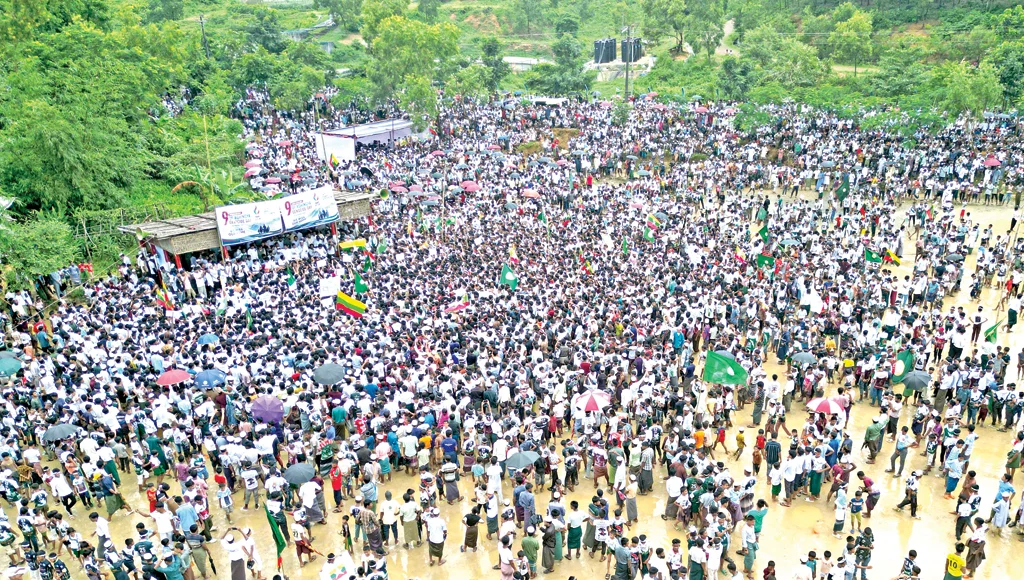
Tens of thousands of Rohingyas gather to take part in a protest, marking the ninth-year anniversary of their exodus, on Kutupalong refugee camp playground at Ukhia in Cox’s Bazar on Tuesday. | New Age photo

Rohingyas observed ‘Genocide Day’ at refugee camps in Cox’s Bazar on Tuesday, demanding a safe and dignified return to Myanmar.

According to the United Nations, about 12 lakh Rohingyas currently live in Bangladesh.

Despite several major international efforts to resolve the crisis over the past nine years, none has materialised due to a lack of consensus among the parties involved.

On Tuesday, more than one lakh Rohingya men and women from 33 camps at Ukhiya and Teknaf gathered at a rally to mark nine years since they fled to Bangladesh amid a military persecution.

On August 25, 2017, hundreds of thousands of Rohingyas fled to Bangladesh amid the military crackdown in Myanmar’s Rakhine State.

A large refugee settlement was subsequently established at Ukhiya and Teknaf in Cox’s Bazar.

The rally was organised at the football field of Kutupalong Camp-4 Extension at Ukhiya on Tuesday morning.

At the rally, the Rohingyas demanded safe and dignified repatriation to their homeland of Arakan and called for a coordinated initiative by the international community.

The rally ended with a prayer for the opportunity to return to their homeland.

Rohingyas attending the rally said they wanted to return to Myanmar as soon as possible if their security, rights and dignity were ensured.

Salim Ullah of Kutupalong Camp-4 said, ‘We did not want to leave our own country. We took shelter in Bangladesh to save our lives. If our security and rights are ensured, we want to return to our homeland.’

Hazera Khatun said, ‘It is not enough just to send us back. We must be assured that we will not face persecution again after returning to Myanmar. We do not want to become displaced again.’

Majed Abdullah, a resident of Camp-3, said in tears, ‘My father was killed in Myanmar in 2017. We were tortured and forced to leave. We have not found peace even after coming to Bangladesh. Terrorist groups have repeatedly attacked me. We do not want to stay here. We want to be repatriated safely to Myanmar after our demands are accepted.’

Sahara Bibi, a resident of Camp-1, said, ‘There has been no solution to our repatriation even after nine years. We want to return to our homeland soon. We call on the United Nations to take necessary steps for our safe repatriation.’

A section of the Rohingyas at the rally also chanted slogans demanding the release of Arakan Rohingya Salvation Army chief Ataullah Abu Ammar Jununi.

Syed Ullah, head of the United Council of Rohingya, said a new generation had grown up in the camps over the past nine years, but their future remained uncertain.

‘The security, citizenship rights and dignity of Rohingyas must be ensured before they return to Arakan,’ he said.

Nurul Amin, a leader of Balukhali Camp-9, said, ‘Myanmar claims that we are Bengalis, which is not true. We are Rohingyas. Bangladesh has given us shelter.’

Rohingya leaders from different camps said the Rohingya crisis was not merely an issue between Bangladesh and Myanmar.

They said influential countries and the international community must work together to create conditions for safe and dignified repatriation.

Additional security measures were taken at the Rohingya camps ahead of the rally.

Members of law enforcement agencies were deployed at and around the rally venue.​
 
Analyze

Analyze Post

Add your ideas here:
Highlight Cite Respond

UN agencies hold 88pc of Rohingya response funds, local NGOs get just 2.5pc

LNGOs get zero funding from the US

1787784902492.webp


Nearly 88 percent of the funding under the 2026 Joint Response Plan (JRP) for the Rohingya humanitarian response is held by UN agencies.

Lcal NGOs (LNGOs), however, receive only 2.5 per cent of the funding allocated for the refugee camps, according to a latest research revealed on Tuesday.

The findings were presented at a press conference titled “Where Is the Funding for the Rohingya Response Going?”, organised by the Cox’s Bazar CSO-NGO Forum (CCNF) and COAST Foundation, held at the Cox’s Bazar Press Club, said a release.

Md Shahinur Islam of COAST Foundation presented the research findings, saying US$ 710.5 million is required to assist 1.56 million people under the 2026 JRP.

Of the funding, 87.96 percent is held by UN agencies, 7.78 percent by international NGOs and 4.26 percent by national NGOs, while LNGOs have no funding as appealing partners in the JRP, according to the presentation.

Within funding allocated for the Rohingya camps, 63.6 per cent goes to international NGOs, 33.9 per cent to national NGOs and only 2.5 per cent to LNGOs, it said.

The presentation also showed that of $ 150 million in funding from the United States, 92 percent went to UN agencies and 8 percent to international NGOs.

Speakers said funding is being channelled through UN agencies and international NGOs, whose operational costs are also significantly high.

Anjuman Ara Begum of Rokeya Foundation called for meaningful engagement of LNGOs in humanitarian response efforts and demanded that at least 25 percent of humanitarian funding be provided directly to LNGOs.

Helal Uddin, executive director of local NGO 'Agrajatra', said local organisations have no access or only very limited access under the current JRP and Pooled Fund mechanism.

He demanded that local organisations be included as appealing partners in the JRP so they can directly access the funds.

Nurul Islam Helali, president of Journalist Association Cox’s Bazar, said funding to LNGOs is not charity but the right of local organisations.

Robiul Alam, president of the Ukhiya Rights Implementation Committee, focused on environmental protection, surface water preservation and restoration of agricultural land.

He said waste from the camps is damaging local farmland and called for a permanent solution to the problem.

Nasir Uddin said there has been no progress in repatriation and that frustration and uncertainty among the host community continue to grow.

1787784926092.webp


CCNF Member Secretary Zahangir Alam said peaceful coexistence is not possible without a sustainable solution to the crisis.

Momtaz Uddin Bahari, general secretary of the Cox’s Bazar Press Club, stressed the need for an effective and sustainable solution to the Rohingya crisis.

The Rohingya crisis has entered its 10th year since the influx began in 2017, with nearly 1.2 million Rohingya refugees currently sheltered in Cox’s Bazar, according to the organisers.​
 
Analyze

Analyze Post

Add your ideas here:
Highlight Cite Respond

International response to Myanmar’s crimes

1787787457785.webp

This photo taken in September 9 shows Rohingya refugees standing behind barbed wires at Kutupalong refugee camp. | Agence France-Presse/Munir uz Zaman

WHEN more than 700,000 Rohingya fled to Bangladesh in the last quarter of 2017, the world witnessed a humanitarian crisis of an unprecedented scale in Southeast Asia. The UN human rights chief described it as ‘a textbook example of ethnic cleansing.’ The UN secretary general called the situation ‘catastrophic.’ The French president described it as ‘a genocide.’ The US vice-president called Myanmar’s actions ‘terrible savagery.’ Yet, a decade later, Rohingyas, the stateless, forgotten and embittered race of the mankind, languish in camps in Bangladesh. The international response has been a study in failure and Bangladesh’s performance, despite bearing the heaviest burden, has been marked by strategic miscalculations.

Great power game

CHINA and Russia have been the most consequential obstacles to international action. They both called Myanmar’s atrocity crimes ‘internal affairs.’ They opposed resolutions against Myanmar in the UN Security Council in 2017. When Britain and France drafted a resolution calling on Myanmar to ‘immediately cease military operations’ and allow refugees to return, China strongly opposed it. A UNSC diplomat said that the Chinese were not on board and wanted them ‘to say nothing and do nothing on this issue.’

In November 2018, Britain drafted another resolution with a timeline for refugee return and a warning that the Security Council could consider further steps, including sanctions. Both Russia and China rebuffed it. The Russian UN ambassador called the draft resolution ‘inappropriate, untimely and useless.’ China boycotted all discussions and defined Myanmar’s genocidal crimes as ‘a legitimate counter-insurgency operation.’

Both Chinese and Russian policies towards Myanmar are motivated by strategic and economic interests. Russia has military trade interests. It is the largest source of Myanmar air force inventory. Four months after the genocidal crimes, Myanmar placed a purchase order for six Su-30SME military aircraft at $210 million, along with Orlan-10E UAV and Pantsir S-1 missile systems. After the 2021 coup, Russia secured the sale of undisclosed quantities of Ka-27/28 anti-submarine helicopters and precision-guided munitions.

China has classified geostrategic, economic and military trade interests in Myanmar. Military regimes have received China’s consistent protection. China has its ‘second coast’ in Myanmar, providing a quick access to the Indian Ocean through the Bay of Bengal, reducing dependence on the Malacca Strait.

India’s calculated silence

INDIA, a geopolitical actor in the region, remained silent. Its support was limited to only a plane load of rice for the refugees. In resonance with the Myanmar regime, India announced plans in September 2017 to deport Rohingya refugees living in Indian states. On October 4, 2018, India handed over seven Rohingya men to Myanmar authorities at the border town of Moreh in Manipur state after ‘reconfirming their willingness to be repatriated, a move Human Rights Watch called ‘forced return.’ On April 8, 2021, the Indian Supreme Court cleared the deportation of 176 more Rohingyas.

India has geostrategic interests in Myanmar and competes with China. Driven by its act-east policy, counter-insurgency concerns in its northeast and competition with China, India views the Myanmar government as a critical partner. It has provided military aid for the Tatmadaw. It avoided supporting Bangladesh’s call for the repatriation of the Rohingyas to keep Nay Pyi Taw in confidence.

ASEAN paralysis

THE Association of Southeast Asian Nations, caught by its ‘principles of non-interference’ dilemma, failed to respond to the crisis perpetrated by one of its member states. During the 31st Summit held in November 10–14, 2017, the regional bloc did not respond because of the leadership failure to grasp the gravity of the situation. The Philippines president, chair of the summit, was a maverick on the refugee crisis. He said on January 6, 2018 that ‘genocide was taking place in Myanmar’ then apologised to Aung San Suu Kyi for his ‘genocide remark.’

ASEAN’s ‘five-point consensus’ on Myanmar, agreed on after the 2021 coup, has been openly ignored by the junta. The inability to take collective, decisive action has exposed ASEAN’s organisational pitfall.

ICJ: silver line

THE republic of the Gambia, with support from the Organisation of Islamic Cooperation, filed a lawsuit against Myanmar in the International Court of Justice in November 2019. On January 23, 2020, the court ordered provisional measures that ‘Myanmar must take all measures within its power to prevent the commission of genocide against Rohingya.’

On July 22, 2022, the ICJ rejected Myanmar’s objections on the court’s jurisdiction and ruled to proceed with the Rohingya genocide trial. Public hearings on the merit of the case were held in January 12–29, 2026. Eleven states intervened in the case. During the hearings, the ICJ heard allegations that military officials had incited violence through hate speech, calling the ethnic minority in derogatory terms who should be made ‘extinct.’ Myanmar rejected the allegations, telling the court that the Gambia’s case rests on ‘unsubstantiated allegations.’

However, the final judgement could take years and the most important question remains: ‘If the Gambia gets a favourable verdict, what will be the international community’s response to implementing the judgment?’

Bangladesh’s pitfalls

WHILE bearing the immense economic and environment burden resulting form the catastrophe, Bangladesh’s handling of the crisis has been marked by several strategic missteps. Initially, Dhaka’s primary focus was on emergency management and relying heavily on the goodwill of powers like China to mediate with Myanmar. This approach failed to account for the fundamentally transactional nature of the mediators’ interests.

A critical error was Dhaka’s early reluctance to internationalise the issue robustly, fearing it would antagonise Myanmar and China and complicate repatriation talks. This allowed the narrative to be framed as a bilateral or trilateral issue, precisely as China desired, insulating the Myanmar junta from the full weight of multilateral pressure.

Two subsequent actions severely damaged repatriation prospects. First, Bangladesh’s relocation of refugees to the Bhasan Char island was strategically misinterpreted by the junta as evidence that Bangladesh was preparing for long-term integration of the Rohingyas into its own population. Second, the Arakan Army’s successful takeover of Rakhine State altered the reality on the ground. The junta with which Bangladesh negotiated is no longer the sovereign authority in Rakhine.

Bangladesh failed to analyse military junta’s intention after the Kofi Annan Commission’s report and also failed to understand the purpose of Myanmar’s military buildup in northern Rakhine in June–July 2017. While the army was bringing in extra forces, the Arakan Army and the Tatmadaw were holding an unofficial ceasefire. Warring parties normally do not move personnel or war material while a truce is in force. Extra forces were brought in to conduct a planned Clearance Operation to evict the Rohingyas.

Another blunder was not creating leadership within the Rohingya community. They needed a leader to keep them organised for resettling in their homes in Myanmar.

Unfolding humanitarian catastrophe

TODAY, more than 1.2 million Rohingya refugees live across 33 congested camps in the world’s largest refugee settlement in Cox’s Bazar and Bhasan Char. New arrivals continue in bits and pieces as conflict, insecurity and violence escalate in Rakhine. The Office of UN High Commissioner for Refugees recorded 150,000 new arrivals in 2025.

The 2025–2026 joint response plan requires $934.5 million to reach 1.2 million people, but it has only received 35 per cent of the funding. Life in the camps remains bleak and overcrowded and fragile settlements face constant threats from extreme weather, disease, and insecurity. More than 235,000 Rohingya children remain without access to formal education. An MSF survey found that 84 per cent of the Rohingya refugees do not feel safe returning to Myanmar.

The tenth year of the exodus finds the Rohingyas no closer to justice or return. The world watched in 2017. A decade later, the world continues to watch and do far too little.

To be continued.

Mohammad Abdur Razzak (safera690@yahoo.com), a retired commodore of the Bangladesh navy, is a geopolitical analyst.​
 
Analyze

Analyze Post

Add your ideas here:
Highlight Cite Respond

Latest Posts

Back
 
G
O
 
H
O
M
E