


 Bangladesh Defense
Saif
Senior Member
- Joined
- Jan 24, 2024
- Messages
- 21,327
- Likes
- 9,697
- Nation

- Residence
- Axis Group


Rohingyas need the world’s support
PM’s proposed roadmap can guide the international community
Rohingyas need the world’s support
PM’s proposed roadmap can guide the international community
VISUAL: STAR
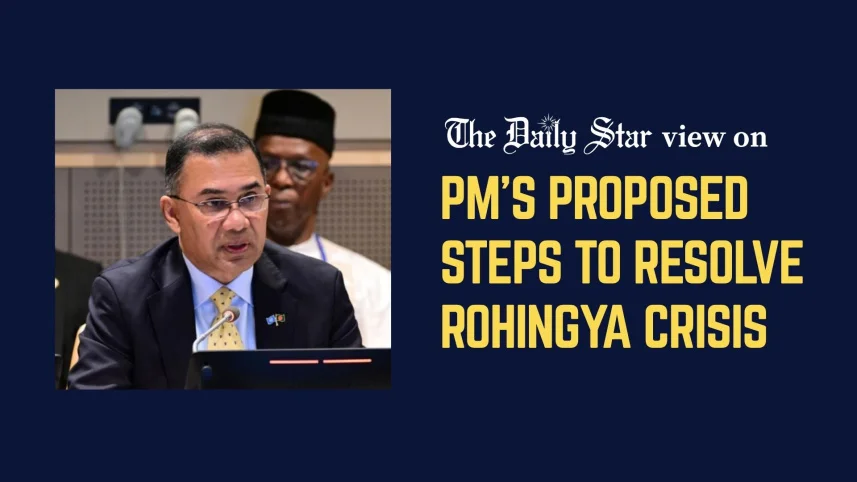
We welcome Prime Minister Tarique Rahman’s proposal of five distinct measures to resolve the Rohingya crisis at a high-level side event of the United Nations General Assembly at the UN Headquarters in New York on September 23. Last month marked the ninth year of the 2017 mass exodus of Rohingya people to Bangladesh, when some 7,00,000 refugees fled targeted military violence in Rakhine State. Currently, more than 1.2 million refugees reside in camps across Cox’s Bazar and Bhasan Char. Their prolonged displacement is felt more keenly as the years have gone by without sufficient cooperation from Myanmar to facilitate the Rohingyas’ dignified and sustainable repatriation. As such, the PM’s proposed steps should be considered and implemented by the international community.
The proposals include establishing a clear and credible roadmap for the early, safe, voluntary, dignified, and sustainable repatriation of the Rohingya to Myanmar; ending violence against civilians in Myanmar (including the Rohingya) and guaranteeing their fundamental rights and security; ensuring adequate and predictable humanitarian support for refugees and host communities in Bangladesh; strengthening justice and accountability; and stepping up regional and international cooperation to combat the narco-economy, human trafficking, digital scams, illegal arms, and other transboundary crimes.
Disappointingly little progress has been made over the years in ensuring voluntary and safe Rohingya repatriation. Meanwhile, the ethnic community’s situation in Myanmar has worsened, as they are caught up between the ruling military forces and the Arakan Army, being subjected to extrajudicial executions, torture, forced labour and recruitment, and large-scale arson. This has made the possibility of safe Rohingya refugee repatriation seem even dimmer. Additionally, “competing conflicts” elsewhere in the world and a historic decline in development aid since 2025 have worsened the Rohingya crisis, an emergency now being viewed as a case of prolonged displacement. The US alone drove three-quarters of the recent aid decline, with its official development assistance falling by 56.9 percent compared to 2024. In 2025, donors met only 46 percent of the $934.5 million appeal for aid under the 2025-26 Joint Response Plan. As a result, in 2026, the appeal was reduced to $710.5 million to cover only the minimum required to sustain lifesaving assistance.
Meanwhile, Bangladesh continues to accommodate a growing refugee population. But the suffering of the Rohingya has only worsened since 2017. Children born nine years ago are unfamiliar with their homeland and are being raised in uncertainty, with little access to the most basic necessities. Most young people remain excluded from education and skills training, and their future is shadowed by increasing uncertainty.
We therefore urge the international community to stand by the Rohingya population and support Bangladesh in pushing for their dignified repatriation and appropriate rehabilitation. No one can make up for the years Rohingya refugees have lost to forced displacement. But the world must realise that the crisis is still there, and worsening each day, and that the multifaceted plight of the Rohingya is no less urgent than any other ongoing humanitarian crisis.
PM’s proposed roadmap can guide the international community
VISUAL: STAR
We welcome Prime Minister Tarique Rahman’s proposal of five distinct measures to resolve the Rohingya crisis at a high-level side event of the United Nations General Assembly at the UN Headquarters in New York on September 23. Last month marked the ninth year of the 2017 mass exodus of Rohingya people to Bangladesh, when some 7,00,000 refugees fled targeted military violence in Rakhine State. Currently, more than 1.2 million refugees reside in camps across Cox’s Bazar and Bhasan Char. Their prolonged displacement is felt more keenly as the years have gone by without sufficient cooperation from Myanmar to facilitate the Rohingyas’ dignified and sustainable repatriation. As such, the PM’s proposed steps should be considered and implemented by the international community.
The proposals include establishing a clear and credible roadmap for the early, safe, voluntary, dignified, and sustainable repatriation of the Rohingya to Myanmar; ending violence against civilians in Myanmar (including the Rohingya) and guaranteeing their fundamental rights and security; ensuring adequate and predictable humanitarian support for refugees and host communities in Bangladesh; strengthening justice and accountability; and stepping up regional and international cooperation to combat the narco-economy, human trafficking, digital scams, illegal arms, and other transboundary crimes.
Disappointingly little progress has been made over the years in ensuring voluntary and safe Rohingya repatriation. Meanwhile, the ethnic community’s situation in Myanmar has worsened, as they are caught up between the ruling military forces and the Arakan Army, being subjected to extrajudicial executions, torture, forced labour and recruitment, and large-scale arson. This has made the possibility of safe Rohingya refugee repatriation seem even dimmer. Additionally, “competing conflicts” elsewhere in the world and a historic decline in development aid since 2025 have worsened the Rohingya crisis, an emergency now being viewed as a case of prolonged displacement. The US alone drove three-quarters of the recent aid decline, with its official development assistance falling by 56.9 percent compared to 2024. In 2025, donors met only 46 percent of the $934.5 million appeal for aid under the 2025-26 Joint Response Plan. As a result, in 2026, the appeal was reduced to $710.5 million to cover only the minimum required to sustain lifesaving assistance.
Meanwhile, Bangladesh continues to accommodate a growing refugee population. But the suffering of the Rohingya has only worsened since 2017. Children born nine years ago are unfamiliar with their homeland and are being raised in uncertainty, with little access to the most basic necessities. Most young people remain excluded from education and skills training, and their future is shadowed by increasing uncertainty.
We therefore urge the international community to stand by the Rohingya population and support Bangladesh in pushing for their dignified repatriation and appropriate rehabilitation. No one can make up for the years Rohingya refugees have lost to forced displacement. But the world must realise that the crisis is still there, and worsening each day, and that the multifaceted plight of the Rohingya is no less urgent than any other ongoing humanitarian crisis.

