Can Tarique Rahman’s plan break the Rohingya repatriation deadlock?
Jannatul Naym Pieal
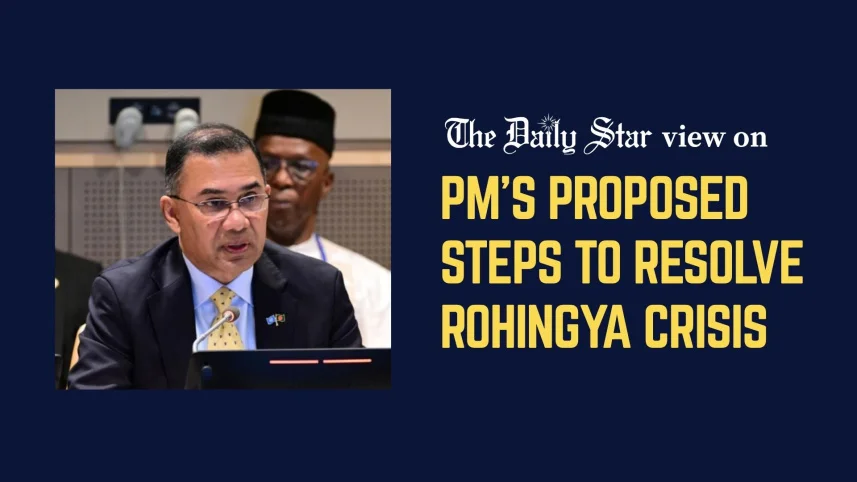
Prime Minister Tarique Rahman presented a five-point plan to address the Rohingya crisis at the United Nations on September 23, calling for a credible roadmap for voluntary repatriation, an end to violence in Rakhine State, predictable humanitarian funding, stronger accountability and regional cooperation against trafficking, illegal arms and scam networks.
Speaking at a side event co-hosted by Bangladesh and The Gambia, he said humanitarian generosity could not become an excuse for political inaction, as Bangladesh hosts more than 1.2 million Rohingya refugees, nine years after the mass displacement of 2017.
The same day, TIME published an interview with Myanmar's Min Aung Hlaing, who seized power in the 2021 coup and subsequently assumed presidency,
He said an existing repatriation agreement depended on Bangladesh and its allies rolling back international legal cases against Myanmar, warning that otherwise "it becomes an impossible situation for us to resolve".
He also sought sanctions relief from Washington and again denied that the military had committed atrocities against the Rohingya, whom he described as the “Bengalis in Rakhine State”, in 2017.
Myanmar's military government rejected the interview within hours of publication, calling it "unethical", blacklisting the TIME journalist who conducted it and banning the magazine — a reaction that sits awkwardly alongside Min Aung Hlaing's own appeal for closer engagement with the West.
Nevertheless, his remarks underscore a fundamental challenge to Tarique Rahman’s proposal: while Bangladesh is seeking progress on several fronts, Myanmar’s military leadership appears to be tying Rohingya repatriation to concessions on other issues.
1. A credible roadmap for repatriation
The prime minister's first proposal is not new.
Bangladesh and Myanmar reached repatriation agreements following earlier refugee influxes, including those of 1978 and 1991–92.
Although many refugees returned, the agreements failed to resolve the discrimination, denial of citizenship and insecurity that had driven them out.
Myanmar's 1982 Citizenship Law left most Rohingya without citizenship, while restrictions on movement and basic rights continued. Allegations of coercion also affected the 1990s repatriation process.
Rohingya refugee camps in Cox’s Bazar. Photo: Anisur Rahman
The latest verification exercise has produced some administrative progress.
In August, Myanmar's Foreign Ministry said it had verified 308,797 of the 828,824 names submitted by Bangladesh, while leaving 113,507 unverified and flagging 4,241 individuals as suspected of terrorist activity.
But verification is not acceptance for immediate return. Myanmar has said repatriation will begin only when security conditions in Rakhine improve.
Min Aung Hlaing's TIME interview adds another condition: the rollback of international legal cases.
This is a significant obstacle because Bangladesh already has a history of agreements that produced paperwork but few meaningful returns. The November 2017 arrangement, for example, did not lead to substantial repatriation in 2018 or 2019.
Another roadmap will have limited value unless Myanmar commits to a timetable, legal protections and independently monitored returns. The number of verified names cannot substitute for evidence that refugees can actually go home safely.
2. An end to violence and security guarantees
The second proposal faces a more immediate problem: Myanmar's military does not control most of Rakhine State.
The Arakan Army, operating under the United League of Arakan, has captured large parts of the state during its offensive against the military.
The military has retained Sittwe and a limited number of strategic positions, while fighting has continued around the state capital.
This means Min Aung Hlaing cannot guarantee security throughout Rakhine simply by signing an agreement with Bangladesh.
A Rohingya family returning to an area controlled by the Arakan Army would depend on the authority exercising control there, not on assurances from Naypyidaw. The military cannot guarantee access to homes, farmland or villages it no longer administers.
The Arakan Army, however, cannot grant Myanmar citizenship or change national laws. That authority remains with the central government.
Any workable arrangement would therefore need the participation of both Naypyidaw and the Arakan Army, with clear responsibilities for security, movement and protection against abuses.
It would also require independent monitoring and a mechanism to respond if conditions deteriorate.
Tarique Rahman's proposal recognises the need to end violence, but the diplomatic challenge is now much broader than persuading Myanmar's government to accept returnees.
Bangladesh must establish whether the authorities controlling Rohingya destinations will protect them, while ensuring that the central government provides the legal status necessary for a lasting return.
A Rohingya family returning to an area controlled by the Arakan Army would depend on the authority exercising control there, not on assurances from Naypyidaw. The military cannot guarantee access to homes, farmland or villages it no longer administers. The Arakan Army, however, cannot grant Myanmar citizenship or change national laws. That authority remains with the central government. Any workable arrangement would therefore need the participation of both Naypyidaw and the Arakan Army, with clear responsibilities for security, movement and protection against abuses.
3. Predictable humanitarian funding
Rahman called for predictable funding as contributions to the UN’s humanitarian appeal continue to decline.
The 2026 Joint Response Plan sought $710.5 million for 1.6 million people, including Rohingya refugees and host communities in Cox's Bazar, compared with more than $934 million the previous year.
The shortfall threatens food assistance, healthcare, education and other essential services.
But Min Aung Hlaing's TIME interview offered little indication that humanitarian funding for the Rohingya response is a priority for his government. His emphasis was instead on sanctions relief, renewed Western engagement and cooperation against transnational crime — issues that may attract Washington's attention but do not address the immediate funding gap confronting the refugee response in Bangladesh.
The two governments are therefore approaching the crisis from different directions. Bangladesh needs international assistance to sustain the refugee response while pursuing conditions for eventual repatriation. Myanmar's military-backed government, meanwhile, is seeking greater diplomatic and economic engagement while the conditions preventing large-scale Rohingya returns remain unresolved.
There is also a broader risk: that continued humanitarian assistance becomes a substitute for political action.
The international community cannot withdraw essential support while the crisis continues, but financing refugee camps indefinitely is not a durable solution. Bangladesh needs both sustained humanitarian assistance and a credible political process capable of ending the prolonged displacement.
4. Justice and accountability
The fourth proposal reveals one of the sharpest differences between Tarique Rahman's position and Min Aung Hlaing's.
The prime minister thanked The Gambia for pursuing its case against Myanmar at the International Court of Justice (ICJ). Min Aung Hlaing, meanwhile, has linked progress on repatriation to the easing of international legal pressure.
The ICJ concluded hearings on the merits of The Gambia's case on January 29 this year and has begun its deliberations. The Court has said that its decision will be delivered at a public sitting, with the date to be announced in due course.
The case concerns Myanmar's obligations under the Genocide Convention and allegations that its treatment of the Rohingya violated the convention. Myanmar disputes the allegations.
Separately, the prosecutor of the International Criminal Court has applied for an arrest warrant for Min Aung Hlaing over alleged crimes against humanity of deportation and persecution of the Rohingya. An application for a warrant is not the same as an issued arrest warrant, nor does it amount to a finding of guilt.
Prime Minister Tarique Rahman speaks at a high-level side event, “The Rohingya Crisis: A Renewed Call for a Durable Solution to Protracted Displacement, with Justice and Accountability,” at the UN Headquarters in New York on September 23, 2026. Photo: PMO
An Argentine court has separately issued arrest warrants for Min Aung Hlaing and other Myanmar officials under the principle of universal jurisdiction in a case involving allegations of genocide and crimes against humanity.
The proceedings also involve different forms of responsibility. The ICJ case concerns Myanmar's responsibility as a state under the Genocide Convention, while proceedings before the ICC concern the potential criminal responsibility of individuals.
Crucially, these processes are not diplomatic instruments that Bangladesh can simply trade away. The Gambia brought the ICJ case, while the ICC operates under its own legal framework. Bangladesh cannot unilaterally terminate either proceeding.
Nor would the removal of international legal pressure by itself establish the conditions necessary for safe return. Conflict continues in Myanmar, the central authorities do not exercise effective control over all of Rakhine State, and fundamental questions surrounding citizenship, security and rights remain unresolved.
Bangladesh can pursue negotiations over repatriation while continuing to support international accountability processes. Any eventual return arrangement should therefore be assessed according to the protections, legal status, security and freedom available to returnees.
5. Regional cooperation against trafficking and scam networks
The fifth proposal offers perhaps the clearest area of overlapping interests. Bangladesh wants stronger regional cooperation against human trafficking, illegal arms flows and online scam networks that have expanded amid Myanmar's conflict.
Min Aung Hlaing has likewise presented cooperation against transnational crime as an area in which his government could work with Western countries, including the United States.
But cooperation in this area should be distinguished from progress on the Rohingya question itself. Action against scam networks would not, by itself, resolve questions of citizenship, accountability, security or the rights of returning refugees.
Myanmar's broader effort to improve relations with Washington provides important context. Its Ministry of Information has hired veteran US political operative Roger Stone, through the Washington-based DCI Group, for a reported $50,000 a month to work on rebuilding relations with the United States.
The arrangement illustrates the military-backed government's wider effort to reopen channels with Washington at a time when Min Aung Hlaing has publicly expressed interest in sanctions relief and renewed Western engagement.
Malaysia's approach introduces another dimension.
Prime Minister Anwar Ibrahim announced this month that he would invite Min Aung Hlaing to Malaysia as part of efforts to negotiate the return of refugees from Myanmar. Myanmar has reportedly agreed to receive 5,000 people in stages, with Malaysia preparing an initial group for voluntary return.
That initiative will provide an important test. If returns proceed, the central question will not simply be how many people cross the border, but whether they return voluntarily and whether their security, legal status and basic rights can be independently verified after arrival.
For Bangladesh, developments in Malaysia therefore deserve close attention. A visible repatriation programme elsewhere in the region could increase pressure for renewed returns from Bangladesh even if the underlying political and legal conditions in Rakhine remain unsettled.
China and India add another layer.
Both possess considerable influence in Myanmar, but their strategic interests do not necessarily coincide with Bangladesh's priorities. China has major interests in political stability, infrastructure and access to the Bay of Bengal, while India's interests include the Sittwe port and connectivity between its northeastern states and the Bay of Bengal.
Both therefore have reasons to favour greater stability in Rakhine. But an interest in stability does not automatically translate into pressure for Rohingya citizenship, accountability or political rights.
For Bangladesh, the diplomatic challenge is to translate regional powers' interest in stability into concrete support for conditions necessary for sustainable return — including security, humanitarian access, freedom of movement and protection against renewed displacement.
Bangladesh needs to distinguish process from outcome. Verification of a list of refugees does not demonstrate that they can return safely. Cooperation against scam networks does not resolve citizenship. A new memorandum or bilateral agreement does not by itself guarantee protection after return. And diplomatic engagement with Myanmar's government does not necessarily translate into authority over all the territory to which refugees would return.
Bangladesh needs to measure progress differently
The five proposals address many of the central dimensions of the crisis. But Min Aung Hlaing's interview also demonstrates why diplomatic activity should not automatically be treated as progress towards resolving the Rohingya question.
Myanmar's military-backed government is seeking sanctions relief and greater international engagement while fundamental obstacles to repatriation remain. At the same time, political and territorial realities inside Rakhine have changed dramatically, complicating any bilateral agreement reached solely between Dhaka and Naypyidaw.
Bangladesh therefore needs to distinguish process from outcome.
Verification of a list of refugees does not demonstrate that they can return safely. Cooperation against scam networks does not resolve citizenship. A new memorandum or bilateral agreement does not by itself guarantee protection after return. And diplomatic engagement with Myanmar's government does not necessarily translate into authority over all the territory to which refugees would return.
A workable framework will consequently have to address the authorities exercising effective control in relevant parts of Rakhine, while securing independent monitoring, legal protections, humanitarian access and sustained international support. International accountability processes should remain separate from negotiations over repatriation.
Nine years after the mass exodus of 2017, the central question is no longer simply whether Myanmar is prepared to receive Rohingya refugees.
It is whether those refugees can return with sufficient rights, security and freedom to rebuild their lives — without facing persecution or another cycle of displacement.
Jannatul Naym Pieal is a Dhaka-based writer, researcher and journalist.


 Bangladesh Defense