[🇧🇩] Israel and Hamas war in Gaza-----Can Bangladesh be a peace broker?

[🇧🇩] Israel and Hamas war in Gaza-----Can Bangladesh be a peace broker?
1K
45K
More threads by Saif

G Bangladesh Defense

Israeli strikes kill 12 in Gaza
Agence France-Presse . Gaza City 22 July, 2026, 00:08

1784679054416.webp

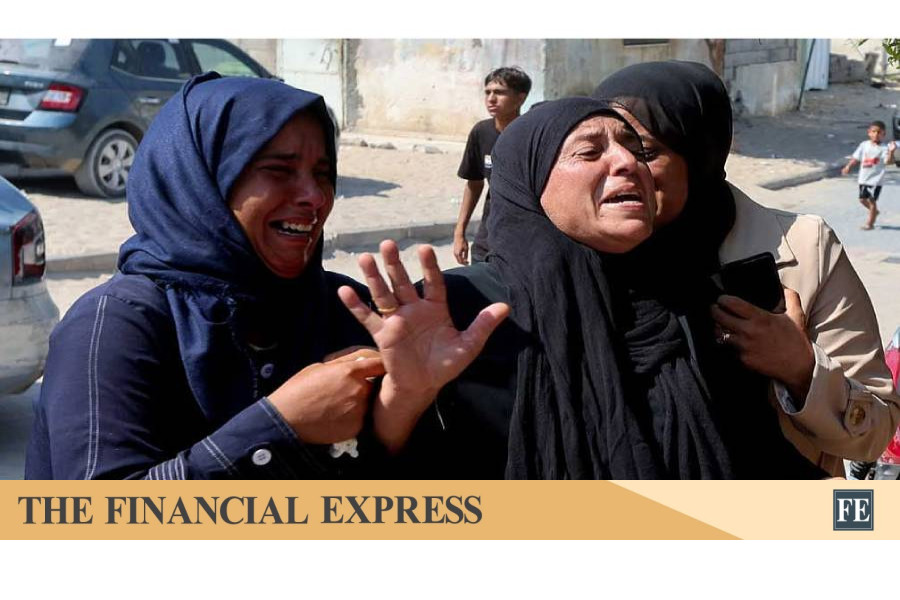
Mourners weep next to the body of one of the Palestinian who died after an Israeli airstrike targeted a residential apartment in the Sabra neighbourhood of Gaza City on Tuesday. | AFP photo

Gaza’s civil defence agency and witnesses said Israeli strikes killed 12 people, including a family of six, in the Palestinian territory on Tuesday.

A fragile ceasefire remains in place between Israel and Palestinian militant group Hamas, but it has not halted the violence in the Gaza Strip, and efforts to secure a lasting agreement to end the war have stalled.

One airstrike hit a house belonging to the Al-Masri family in central Gaza City in the north, according to the territory’s civil defence agency, which operates as a rescue service under Hamas.

Witnesses said six members of the family were killed, including four children. Gaza’s Al-Shifa hospital said it had received the bodies and the wounded.

An Israeli military source said that a strike had targeted ‘a Hamas terrorist’ in the area, without elaborating.

At the site, AFP journalists observed extensive damage to the charred multi-storey house, whose roof had almost completely collapsed.

Relatives gathered at the hospital. Some wept as the body of a girl was placed in a white plastic bag and laid alongside the other bodies wrapped in thick blankets.

The ‘attack took us by surprise’, said Ahmed al-Masri, who identified himself to AFP as a survivor of the strike.

‘I could hear the children crying out for help, yet I was unable to save them,’ he added.

‘My brother’s entire family was wiped from the civil registry: him, his wife and their four children.’

He said he had helped his children escape through a window, while flames devoured the building.

Another witness, Youssef al-Masri, said the strike took place around 2:00am.

‘While we were asleep, we heard the sound of a massive explosion and found that the house had been shelled, destroyed and engulfed in flames,’ he said.

The civil defence agency said six other people were killed on Tuesday in another Israeli strike in Gaza, where violence has persisted despite the ceasefire.

The United Nations said on Tuesday that Israeli attacks had killed at least 57 Palestinians from July 13 to 20.

‘The Israeli military has intensified its attacks in Gaza in recent days,’ UN rights office spokesman Thameen Al-Kheetan told reporters in Geneva.

‘Nowhere is safe for Palestinians in Gaza.’

The Israeli army has in recent days announced a series of strikes in the territory targeting Hamas and Islamic Jihad members who it said were involved in the October 7, 2023 attack on Israel that set off the war, or the holding of hostages after.

At least 1,168 Palestinians have been killed since the truce took effect last October, according to Gaza’s health ministry, which operates under Hamas authority and whose figures are considered reliable by the United Nations.

The Israeli military says it has lost five soldiers in Gaza over the same period, as well as one civilian contractor.

Restrictions imposed on media outlets and limited access in Gaza prevent AFP from independently verifying tolls or freely covering the violence there.​
 

Israeli strikes kill 4 in Gaza
Agence France-Presse . Gaza City, Palestinian Territories 30 July, 2026, 23:28

1785454815049.webp

A Palestinian boy walks his bicycle through the rubble of a destroyed building after it was targeted by Israeli strikes the previous night following warnings to evacuate in Deir al-Balah, central Gaza Strip on Wednesday. | AFP photo

Gaza’s civil defence agency and two hospitals said Israeli attacks on Thursday killed four people across the Palestinian territory, including two children.

A ceasefire remains in place between Israel and Palestinian militant group Hamas, but it has not halted the violence in Gaza, and efforts to secure a lasting agreement to end the war have stalled.

Civil Defence spokesman Mahmoud Basal said that ‘four martyrs, including two children, and a number of wounded were transported following Israeli airstrikes’ across the Gaza Strip.

One Palestinian was killed and 10 others were wounded in an airstrike near a camp for displaced people next to Gaza City’s Yarmouk Stadium, according to the civil defence agency.

In a separate incident, Nasser Hospital, in Gaza’s southern city of Khan Yunis, said that its emergency service had received two people including an eight-year-old girl, as well as three wounded.

The casualties came after ‘an Israeli helicopter strike targeted the tent of the Balawi family west of Khan Younis,’ the hospital said.

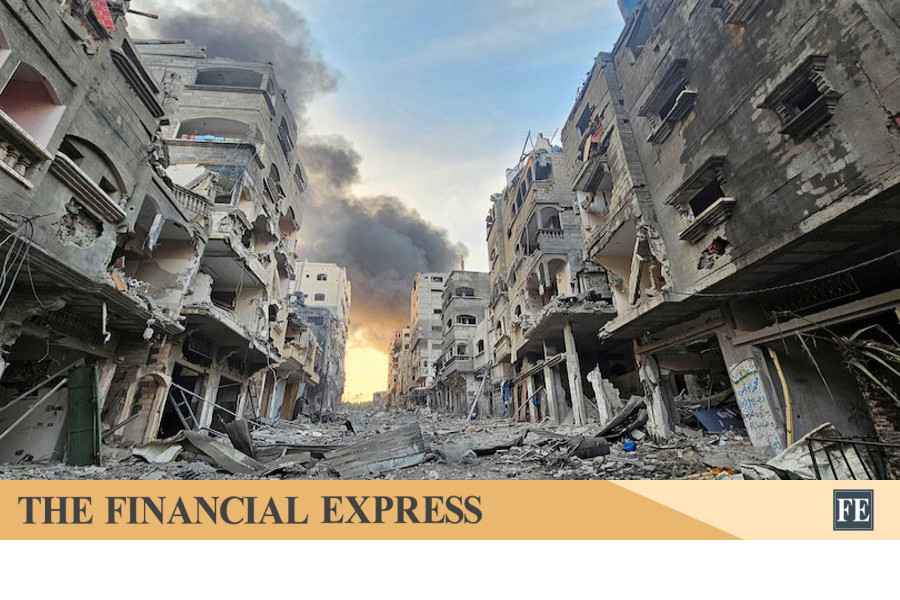
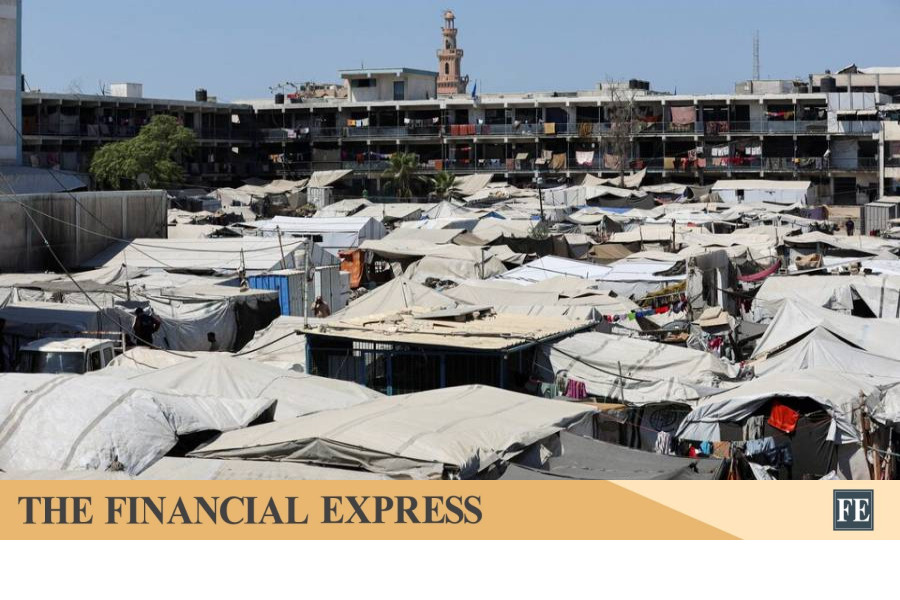
Tens of thousands of people in Gaza still live in tents, after nearly three years of Israeli airstrikes destroyed much of the Palestinian territory’s standing structures.

The emergency department at Al-Aqsa hospital in central Gaza reported ‘the arrival of a child martyr and a number of wounded’ after an airstrike hit an apartment near the municipality building in the nearby Bureij refugee camp.

Israel’s military did not confirm any individual attack, but said that ‘the IDF struck several Hamas terror infrastructure overnight’ Thursday.

The air strikes come as a Hamas delegation holds talks in Cairo with Egyptian, Qatari, and Turkish mediators aimed at consolidating the ceasefire agreement between Israel and the Palestinian militant group, according to two sources familiar with the talks who spoke to AFP.

Since the fragile truce came into effect last October, Israel has continued carrying out near-daily air and artillery strikes across the territory, more than 60 per cent of which it controls.

Since the ceasefire agreement was announced, at least 1,214 Palestinians have been killed in Gaza, according to the territory’s health ministry, whose figures the United Nations considers reliable.

The Israeli military says it has lost five soldiers in Gaza over the same period, as well as one civilian contractor.

Restrictions imposed on media outlets and limited access in Gaza prevent AFP from independently verifying tolls or freely covering the violence there.​
 

Hamas agrees to deal for disarmament, Israel's withdrawal from Gaza

AFP
Gaza City, Palestine
Published: 31 Jul 2026, 10: 33

1785541923686.webp

Hamas fighters carrying weapons in Gaza, Palestine. File Photo: AFP

Hamas said Friday it agreed to a deal to end the war with Israel that included provisions addressing its weapons and the gradual withdrawal of Israeli forces from the Gaza Strip.

The group's disarmament has been one of the key sticking points in the advancement of a ceasefire deal that has been in place in Gaza since October.

US President Donald Trump announced late Thursday an agreement for the "complete disarmament" of Hamas, calling it a critical step toward a new Palestinian government in Gaza.

Hamas officials told AFP a committee established by Trump's Board of Peace to govern Gaza would oversee the process of storing the Islamist movement's weapons.

The group said it expected mediators and the Board of Peace to ensure Israel complied with the deal's terms, which included Israel's withdrawal from Gaza.

Ghazi Hamad, a member of the group's negotiating team, said the movement was making "concessions for the sake of our people in the Gaza Strip, to save them from killing and displacement".

"Israel will not intervene in the issue of disarmament. The National Committee is the body that will undertake this task," he said, referring to the National Committee for Administration of Gaza (NCAG).

There was no immediate statement from Israel.

Despite the October ceasefire, violence has continued in Gaza, with Israeli strikes killing at least four people, including two children, on Thursday, according to health officials.

Ghazi Hamad, a member of the group's negotiating team, said the movement was making "concessions for the sake of our people in the Gaza Strip, to save them from killing and displacement".

Focus now on implementation
The Board of Peace confirmed in a post on X that Hamas had "agreed to a detailed Roadmap for implementing the next phases of the Gaza ceasefire".

"Our focus now turns to implementation," the organisation wrote, adding the NCAG will "soon begin a phased transition toward full authority".

Trump, in an earlier social media post, said that once Hamas's disarmament is complete, "Israeli forces will withdraw, and the International Stabilization Force will work with a new Palestinian police force to take responsibility for Gaza being safe for its residents and its neighbors".

Nickolay Mladenov, the Board of Peace's high representative for Gaza, said Friday the deal "took months of very difficult negotiations".

"What happens next matters even more. Implementation and verification have to be real," Mladenov wrote on X.

"Withdrawal must move in lockstep with decommissioning," he added.

Egypt's state-linked Al-Qahera News said early Friday that Cairo is set to host a meeting "soon" of the Gaza truce mediators, which also include the United States, Qatar and Turkey, focused on the second phase of the Gaza ceasefire plan.

1785542009657.webp

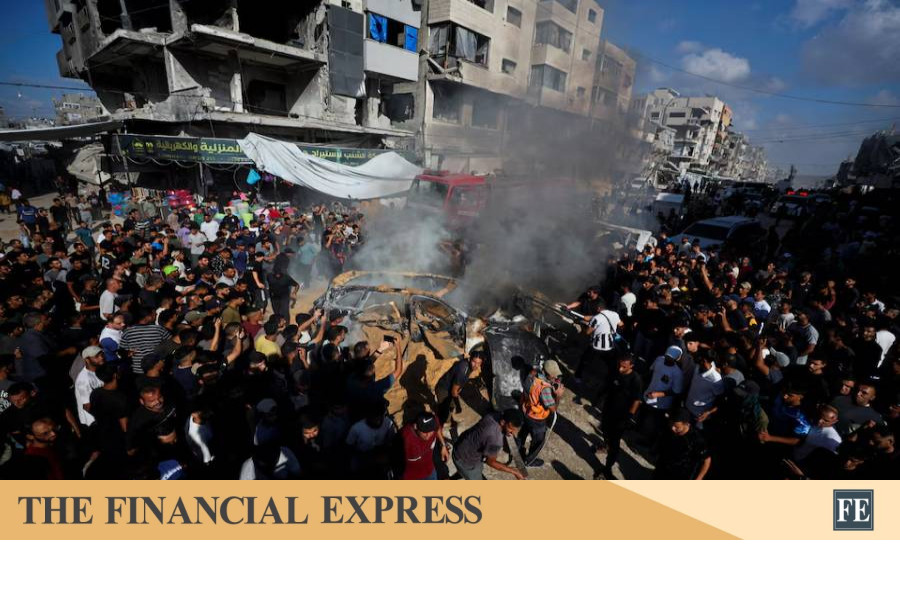
Palestinians flee in search of safety amid smoke and flames following an Israeli strike on Al-Muttaqin Mosque in Gaza City on 28 July 2026. AFP

'No exceptions'
Earlier, a diplomatic source told AFP: "We continue to advance the implementation roadmap that offers a balanced and pragmatic path forward, with all weapons decommissioned and a phased transition of responsibilities taking place to hand over full authority to the technocratic government."

The source, who spoke on condition of anonymity as he was not authorized to speak publicly on the matter, said there would be "no exceptions for certain weapons or certain people. One authority, one law, one weapon".

"Israel will not intervene in the issue of disarmament. The National Committee is the body that will undertake this task," Ghazi Hamad said, referring to the National Committee for Administration of Gaza (NCAG).

The roadmap, the source said, would create "a process for the elimination of all tunnels, depots of weapons and any weapons production facilities".

The source said a verification mechanism would ensure compliance by each side.

A Hamas source familiar with the talks told AFP earlier that the movement was "awaiting the Israeli response to the amendments we recently submitted to the mediators".

The source said the amendments concerned two articles in the roadmap presented by the Board of Peace.

Regarding the article concerning weapons, the Hamas source said that "some points were removed, and alternatives were proposed".

Before the deal's announcement, an Israeli political source told AFP that the proposed agreement did not "satisfactorily" address Israeli demands.

"Israel demands the complete disarmament of Hamas, including the removal of weapons from Gaza and full demilitarization of the Strip as a precondition for any process," the source said.

The source also said that "the issue of Gaza did not come up at all" in the meeting between Israeli Prime Minister Netanyahu and Trump in Washington this week.​
 

Israeli strikes kill 13 in Gaza
Agence France-Presse . Gaza City, Palestinian Territories 02 August, 2026, 09:20

1785715197037.webp

Palestinians make their way through destroyed buildings in Khan Yunis in the southern Gaza Strip on July 31. | AFP photo.

Israeli strikes on Gaza hit multiple residential buildings and killed at least 13 people, authorities said Sunday, despite Hamas saying it agreed to the latest stage of a deal to end the war.

Hamas said Friday it had agreed to a plan championed by US president Donald Trump that includes provisions for handing over its weapons and the gradual withdrawal of Israeli forces from the Gaza Strip.

Israel has yet to officially comment on the agreement, but a political source has said ‘that there will be no withdrawal whatsoever’ without Hamas’s ‘genuine disarmament’.

Gaza’s civil defence rescue service, which operates under Hamas authority, on Sunday said eight people were killed in strikes around midnight that hit multiple residential buildings, and five others were killed later in the day.

In one overnight attack near the central Gaza Strip, a man and his wife were killed and several others were wounded when an Israeli military helicopter struck an apartment, a civil defence spokesman said.

An elderly man and a child were killed in another attack on an apartment west of Gaza City, and three people, including a child, were killed in a strike on a residential building northwest of Khan Younis in the southern Gaza Strip.

‘One person was killed and four others injured in an Israeli drone strike targeting a group of civilians near a camp for displaced people in Jabalia refugee camp, northern Gaza Strip,’ he said.

A couple and their child were killed in a strike on an apartment west of Gaza City at dawn, the spokesman said, adding that the woman was pregnant.

Two others were killed in an Israeli drone strike on their vehicle in Deir al-Balah in the central Gaza Strip, he said, with the Al-Aqsa Martyrs’ Hospitals saying they were brothers.

Authorities reported on Saturday that eight people had been killed in strikes that damaged a hospital’s medical supplies and targeted a rooftop. The Israeli army said two of the strikes targeted members of the Army of Islam and Islamic Jihad militant groups.

Meanwhile, authorities in Gaza said Saturday that they had recovered the remains of another 112 people in rubble, part of daunting operations after more than two years of Israeli strikes.

Gaza’s civil defence agency said it found the remains or body parts following 136 hours of digging, largely with bare hands, in Sabra, a neighbourhood in the south of Gaza City.

The remains included those of 40 children, 38 women and seven people who had had physical disabilities, according to the agency, which serves as a rescue service under Hamas.

The International Committee of the Red Cross said it supported the operation, which took place over nearly two weeks.

‘For more than two and a half years, thousands of families in Gaza have lived in pain and uncertainty, waiting for the chance to recover the remains of their loved ones, mourn them and lay them to rest with dignity,’ said Amani Al-Naouq, ICRC spokesperson in Gaza.

‘The search for missing persons and the recovery of human remains is a critically important humanitarian issue,’ she said.

Colonel Mohammed Abu Dan, who is in charge of the site for the civil defence agency, said that the team has not yet found 157 other bodies believed to be under the rubble there.

He described the search as arduous, with teams sifting by hand through destroyed concrete and twisted metal.

Thousands of people’s remains are still unaccounted for in Gaza, many of them believed to have been buried under rubble from intense Israeli air strikes.

Restrictions imposed on media outlets and limited access in Gaza prevent AFP from independently verifying tolls or freely covering the violence.

The Hamas-run health ministry has confirmed the deaths of more than 73,300 people in the war, in figures that are considered reliable by the United Nations.

The war broke out when Hamas militants attacked southern Israel on October 7, 2023, killing 1,221 people and dragging 251 hostages into Gaza in the deadliest attack on the Israeli population since the creation of the state in 1948.​
 

Is there any hope for Gaza?
6 August 2026, 00:03 AM

Mahir Ali

Only an unreasonably optimistic worldview could persuade anyone to view last week’s announcements about the Gaza Strip as a ‘breakthrough’. Hamas might have agreed to put away its weapons, but that’s contingent on Israel’s withdrawal from the occupied territory. Its armed forces control more than 70 per cent of the Strip, and says it won’t budge until Hamas ‘completely’ disarms. At best, this is a recipe merely for prolonging the status quo that followed last year’s so-called ceasefire, which has been violated more or less daily by the Israel Defence Forces, with nary an objection from Donald Trump’s ridiculous Board of Peace (BoP). One can just about imagine a scenario in which the graduated disarmament of not just Hamas but also Israeli-sponsored factions in the territory is accompanied by a reciprocal IDF pullout.

But anyone cognisant of realities would find it hard to imagine any meaningful concessions from the Israeli state ahead of the October elections — even afterwards, regardless of whether Benjamin Netanyahu retains the prime ministerial post he has held far too frequently. There has lately been exaggerated commentary about the US president’s capacity to restrain Netanyahu’s worst impulses. This variety of nonsense is belied by recent history. All of the White House incumbent’s predecessors this century resisted Netanyahu’s unrelenting efforts to spark a military confrontation with Iran. It took a stupendous ignoramus to plunge in with haste and to regret it at leisure — amid his various other pastimes, from golf to architectural glitter.

The negotiations he recently cited as an explanation for not launching his threatened fire and fury against his latest adversary appear to be taking place only between Iran and Oman. Whether they lead to the reopening of the Strait of Hormuz will depend on extraneous factors over which only the US has control. The minimum requirement would be for the American blockade to be lifted, but it would hardly be unreasonable for Iran to also demand the cessation of attacks on its infrastructure. As in the case of Gaza, it’s natural to hope for the best without losing sight of contrary likelihoods.

Devoid of diplomatic skills, weak on geopolitical knowhow, and ignoring the recent precedents in Iraq and Afghanistan, the Trump administration this year embroiled the US in yet another war without an exit strategy. ‘Peace with honour’ used to be the motto in the Vietnam era, but the eventual defeat was accompanied only by ignominy. Perhaps the only consolation that can be drawn more than 50 years later is that the periodic bouts of invariably misguided military aggression can be interpreted as the fatuous fireworks of a fading empire.

1786059673782.webp

Palestinians inspect the site of an Israeli strike on a residential apartment, according to medics, in Gaza City, August 2, 2026. Photo: REUTERS

The death throes might linger for a while, though, and there might be worse to come. Public opinion across much of the world, including in the West, no longer holds the US or its auxiliaries in much esteem. But ruling elites are a different matter. Notwithstanding Trump’s contempt, the EU by and large remains beholden to the Western emperor. So do many of the regimes in West and South Asia. One of them, for instance, has credited the BoP’s “significant achievement” to Trump’s “courageous leadership”, adding as an afterthought the hope that it would result in ‘realisation of the right to self-determination of the people of Palestine’.

The phrase ‘self-determination’ sounds almost archaic in the Palestinian context, particularly amid an unending genocide in Gaza and ‘ethnic cleansing’ in the West Bank. The pogroms are a daily affair, and they are only stepped up in the face of any resistance. The Palestinian Authority has long served as a kind of Vichy regime for the Zionist occupation, and rarely goes beyond the occasional platitude in response to everyday atrocities. Any resistance prompts the illegal settlers to step up their malignance. When BBC’s Lucy Williamson recently interrogated a settler called Yehuda Shimon on why one Jewish death (in an unusual instance of rebellion) should be avenged by taking hundreds or thousands of Palestinian lives (as he advocated), Shimon responded: “No, millions. One Jewish life, it’s 10 million… .”

We are witnessing the aftermath of that kind of attitude in Gaza. Even beyond public opinion among the states most complicit in Israel’s genocide, though, there are occasional indications of the turning tide. A German appeals court this week acquitted a woman convicted for Instagram posts that compared Israeli actions to Nazi conduct. Since Nazi ideology was being denigrated rather than promoted, the court ruled, the comments fell under the category of protected speech. It would be a welcome change if British courts took a cue from that, given their inclination to not just convict pro-Palestinian activists as terrorists, but to condemn their advocates as well.

This article was first published under the title “Back to war" in Dawn, an ANN partner of The Daily Star, on July 15, 2026.

Mahir Ali is a columnist at Dawn.​
 

Israel rejects Trump’s 15-point plan for Gaza: PM Netanyahu
Reuters
Jerusalem

1786318294557.webp

US President Donald Trump and US Vice President JD Vance meet Israeli Prime Minister Benjamin Netanyahu at the White House in Washington, US, on 4 February 2025

US President Donald Trump and US Vice President JD Vance meet Israeli Prime Minister Benjamin Netanyahu at the White House in Washington, US, on 4 February 2025REUTERS
Israel has rejected US President Donald Trump’s Board of Peace 15-point plan for Gaza, and will not withdraw until Hamas fully disarms, Prime Minister Benjamin Netanyahu said on Sunday.

Trump announced last month that there had been a breakthrough in his plan to end the war, which both Israel and Hamas agreed to last year and which started with the ceasefire.

Israel has continued to carry out strikes on Gaza since agreeing to the ceasefire last October.

Trump said that Hamas, which ruled Gaza for nearly two decades before carrying out the 7 October 2023, attack on Israel that triggered the Gaza war, had agreed to lay down its weapons.​
 

Israel demolishes home of slain Palestinian
Agence France-Presse . Tell, Palestinian Territories 11 August, 2026, 23:18

1786492984007.webp

Child relatives of Palestinian Farouk Ramadan, who was involved and killed in clashes with Israeli settlers on July 24, killing two, react after his home in the upper story was subject to a controlled-demolition in the Palestinian village of Tell in the occupied West Bank on Tuesday. | AFP photo.

Israeli forces on Tuesday demolished the home of a Palestinian who died in July in the most lethal clash in months in the occupied West Bank, residents and the army said.

The clash broke out on July 24 when a group of Israeli settlers approached the town of Tell, leaving dead one settler, one soldier and four Palestinians including Farouq Ramadan, whose home was demolished.

‘At around 8:15am (0515 GMT), the Israeli army blew up the apartment where the martyr Farouq Ramadan lived with his wife and five daughters,’ Tell mayor Walid Zaidan said.

Zaidan said that about 30 Israeli military vehicles and engineering teams entered the village Monday evening, evacuating residents of 30 houses surrounding Ramadan’s home before the demolition.

AFP journalists saw army engineers set up explosives and detonate the second-floor apartment where Ramadan had lived, after troops amassed from Monday evening.

The army in a statement said troops ‘demolished the house where the terrorist who carried out the shooting’ had lived.

‘We will continue to take proactive and offensive action to thwart terrorism throughout Judea and Samaria and to bring to justice terrorists who sought to harm the citizens of the State of Israel,’ it said, using a biblical name for the West Bank.

Israeli army radio said the two-week timeline to demolish the house was an ‘unprecedented record time’.

Israel routinely demolishes family homes of Palestinians it accuses of being involved in attacks, seeing the policy as a deterrent, but critics say it amounts to collective punishment that leaves innocent family members homeless. Palestinians say the villagers in Tell came under attack from settlers.

On July 24, footage showed Ramadan seizing an Israeli’s weapon during a clash with settlers, leading an emergency response team from a nearby settlement to rush to the scene with ensuing gunfire.

A military probe last week said that the soldier was killed by Palestinian fire, but could not conclusively determine whether the settler was killed by Palestinian or friendly fire.

Ramadan was killed in the exchange of gunfire, but it was unclear who by.

Israel has occupied the West Bank since 1967, but in recent years the number of settlements in the Palestinian territory — which are illegal under international law — has soared.

Excluding east Jerusalem, more than 5,00,000 Israelis live in settlements in the West Bank, home to around three million Palestinians.

According to an AFP tally based on data from the Palestinian health ministry, Israeli soldiers or settlers have killed at least 1,097 Palestinians, including both militants and civilians, since the start of the Gaza war.

Israeli figures over the same period show that at least 48 Israelis, including civilians and security personnel, have been killed in the West Bank in Palestinian attacks or during Israeli military operations.​
 

Israeli strikes in Gaza kill two people, first fatalities in more than a week, medics say

1786661944426.webp

Mourners attend the funeral of a Palestinian man Huthaifa Kawari, who was killed in an Israeli strike, according to medics, at Nasser Hospital in Khan Younis, in the southern Gaza Strip, Aug 13, 2026. REUTERS/Ramadan Abed

An Israeli airstrike killed two Palestinians, including a senior police official, in the Gaza Strip on Thursday, in the first reported fatalities in more than a week as the Israeli military scaled back its targeted attacks in the enclave under US pressure.

Palestinian medics said the first strike targeted two people riding on a motorbike, in a western area of Khan Younis in the southern Gaza Strip. The other person was wounded, they added.

The Israeli military said in a statement that the Khan Younis airstrike targeted a Hamas commander planning an attack on its troops.

Later on Thursday, an Israeli drone launched three missiles against a vehicle driving in western Gaza City, killing the head of the Gaza City police force, and critically wounding two other people medics and witnesses said.

The Hamas-led interior ministry also confirmed in a statement the "assassination" by Israel of police colonel Jamal Abu Kmail.

The Israeli military did not immediately comment.

Israel had stepped up attacks on members of the Hamas-led police force since an October ceasefire began, killing dozens of them, according to security and health officials.

Trump Gaza Plan

US President Donald Trump announced last month that there had been a breakthrough in his plan to end the war, to which both Israel and Hamas agreed, with Israeli forces withdrawing as Hamas disarms and an International Stabilization Force working with a new Palestinian police force to secure the enclave.

On Sunday, Israeli Prime Minister Benjamin Netanyahu restated his rejection of Trump's latest Gaza plan in televised remarks to his right-wing government, even as Israel's military had effectively halted attacks in the territory under pressure from ‌the US president.

Hamas said it agreed to the plan to avoid a resumption of war, but it added that the implementation of ⁠the deal would depend on Israel first meeting its own commitments, including withdrawal and halting attacks.

On Wednesday, the Israeli military said in a statement that a man was hit in an aerial strike in order to remove a threat to Israeli military troops. Gaza medics said one person was critically wounded in the attack in Beit Lahiya town, in the north of the enclave.

Israeli fire has killed more than 1,250 Palestinians in Gaza, most of them civilians, since a US-backed ceasefire halted two years of full-scale war in October.

It is unclear how many of those killed might be members of the paramilitary group since Hamas does not usually disclose information about dead fighters.

Four Israeli soldiers were killed by paramilitary members in Gaza over the same period, according to an Israeli tally.​
 

Israeli strikes in Gaza kill 2

Agence France-Presse . Gaza City, Palestinian Territories 13 August, 2026, 22:33

1786665417200.webp

Israeli settlers run as being chased by an Israeli military vehicle around Palestinian houses in the village of Qusra, south of Nablus, in the occupied West Bank, on August 13, 2026. | AFP photo.

Israeli strikes in Gaza killed two people including a senior police officer on Thursday, health officials said, the second straight day of bombardment after a lull due to a US peace push.

The Israeli military said it struck a Hamas commander in the Khan Yunis area who it said had been planning attacks against troops, in the second such targeting in as many days.

‘The terrorist was struck in an aerial strike in order to remove the threat to IDF troops,’ the military said, adding that ‘steps were taken to mitigate harm to civilians.’

Gaza’s civil defence agency, which operates as a rescue service under Hamas, said an airstrike west of Khan Yunis killed one person, with the city’s Nasser Hospital confirming the arrival of a body following the attack.

In a separate incident in Gaza City, the civil defence said one person was killed and several others injured in an Israeli strike on a vehicle in the Sheikh Ajlin neighbourhood.

Al-Shifa Hospital said it had received the body of Gaza City’s police governor Jamal Abu Kamil.

Gaza’s interior ministry confirmed Abu Kamil ‘was assassinated in an Israeli airstrike targeting his vehicle on Al-Rashid Street, southwest of Gaza City’.

When contacted by AFP, the Israeli military said it was checking the reports.

Israel on Wednesday carried out its first airstrike in Gaza since August 3.

The hiatus in airstrikes came after US president Donald Trump’s announcement of a ‘major milestone’ in his plan to end the war.

Hamas had announced that it would disarm by giving its weapons to a nascent Palestinian governing committee.

Trump’s ‘Board of Peace’, in charge of implementing the ceasefire deal, had initially announced that Israel in turn would start a phased withdrawal from much of the Gaza Strip.

But prime minister Benjamin Netanyahu on Sunday publicly rejected the deal and vowed no Israeli pullout, even after the Board of Peace reassured him that Israel would not have to withdraw until complete Hamas disarmament.

Israeli operations in Gaza have killed 1,260 Palestinians since the ceasefire, according to the territory’s health ministry, which operates under Hamas authority and whose figures are considered reliable by the United Nations.

The Israeli army has reported five deaths in its ranks during the same period.​
 

Israel blocks activists from reaching besieged Palestinian families
New Age Desk 14 August, 2026, 23:11

1786753553225.webp

Activists hold flags next to Israeli soldiers as they accompany Palestinian landowners to their property, which is at risk of being confiscated by Israeli settlers, in Beit Sahur, south of Bethlehem, in the occupied West Bank on Friday. | AFP photo

Israeli forces have prevented Israeli and foreign activists from reaching Palestinian families whose homes have been surrounded by settlers for nearly a week in the occupied West Bank town of Qusra, south of Nablus, reports Al Jazeera.

The activists were trying to deliver food and water to three homes in the Ras al-Ain area on Friday, according to the Palestinian news agency Wafa.

Al Jazeera’s Laith Jaar, reporting from Qusra, said that Israeli forces brought in reinforcements and stopped members of the Israeli group Peace Now from reaching the families after declaring the area a closed military zone.

Qusra mayor Abdel Azim Wadi told Wafa that Israeli forces had also forced Italian activists who managed to reach the homes earlier in the week to leave.

ads
Settlers began surrounding the homes earlier this week, blocking roads with stones, erecting a tent nearby, and preventing residents from entering or leaving freely.

Water and electricity supplies to the homes have also been cut. About 15 Palestinians, including two children, are living in the three homes and have struggled to obtain basic supplies, according to the United Nations.

The UN said they were ‘trapped inside their homes in a state of terror, unable to attend to their basic needs and without access to water or electricity’.

Israeli forces entered the area a day earlier and ordered the families to temporarily leave their homes. The residents refused to leave the area and instead gathered in one of the three houses, fearing their homes could be taken over if abandoned.

Jaar reported that settlers again attempted on Friday to erect a tent and establish an outpost near the homes before Israeli forces removed it.

Qusra has emerged as a flashpoint for settler violence in the northern occupied West Bank, with the UN saying earlier this year that it had recorded more settler attacks there than in any other occupied West Bank community.

The developments come as Israeli defence minister Israel Katz has ordered preparations for transferring responsibility for enforcing civilian law involving settlers in the occupied West Bank from the military to the Israeli police.

Political scientist Ibrahim Rabaia told Al Jazeera that the proposed move appeared to be driven by political considerations and questioned how broadly it could be implemented.

He said the military remains responsible for the occupied West Bank under the existing system, while coordination between the army and police already takes place.

Rabaia argued that transferring responsibilities would be unlikely to result in police preventing settlers from attacking Palestinian homes.

‘The police are controlled by national security minister Itamar Ben-Gvir, who arms these settlers and supports them in the West Bank,’ he said.

Rabaia, an academic in political science and former managing editor of the journal Palestinian Affairs, said settlement expansion had reached an advanced stage, with infrastructure, funding and planning being put in place to create what he described as ‘a reality that cannot be reversed,’ including new areas capable of accommodating larger numbers of settlers in the future.​
 

Israel’s Gaza war expenditure hits $136 billion, Haaretz reports


1786922823050.webp

A view shows houses and buildings destroyed in Israeli strikes, in Jabalia in the northern Gaza Strip, October 11, 2023.
Source: REUTERS/Anas al-Shareef/Files

Israel’s genocidal war on Gaza, which began on October 7, 2023, has become the longest and most expensive war in Israel’s history, with costs reaching about 420 billion shekels ($136bn) and national debt rising by roughly 400 billion shekels, Haaretz newspaper reports.

The report said Israel entered its ground offensive in Gaza in late October 2023, expecting at least three months of fighting, despite ammunition stockpiles having been prepared for shorter wars.​

A former Israeli military officer told Haaretz that stocks of some types of ammunition were insufficient even for a short war, while actual consumption in some categories reached twice the levels originally planned.
 

Hamas says committed to Gaza deal
Agence France-Presse . Gaza City, Palestinian Territories 18 August, 2026, 23:16

1787098158224.webp

A boy walks carrying a table on his back past salvage workers scrapping the rubble of a building that was destroyed during Israel’s war against Hamas in Gaza, to use the recycled remains in the future, in Gaza City on Sunday. | AFP photo

Hamas said on Tuesday it remained committed to the US-backed Gaza peace deal after White House envoy Jared Kushner spoke to Israel about steps towards the group’s disarmament.

‘Hamas is committed to this agreed-upon process. It is clear that, so far, the Israeli side has not given the mediators clear approval of the roadmap,’ Hamas spokesman Hazem Qassem said.

‘There are timelines and procedural steps that need to be worked out in detail, but there must first be Israeli approval of the roadmap,’ he said.

Kushner, president Donald Trump’s son-in-law, held a rare meeting with Hamas on Sunday in Egypt before meeting the following day in Jerusalem with Israeli prime minister Benjamin Netanyahu, who has publicly rejected the latest phase of the deal.

Kushner, in a Fox News interview after the talks, said that Hamas’s disarmament could begin in about 30 days and that reconstruction of Gaza would not begin until that happens.

Kushner also said that the United States is ‘not going to restrict Israel’s right to defend itself if there are any imminent threats’ in Gaza.

Netanyahu has demanded that Hamas fully disarm. In his talks with Kushner, the two sides agreed that a US general would oversee the surrender of weapons, according to an Israeli official.

Trump’s ‘Board of Peace’ implementing the deal has also told Netanyahu that Israel does not need to start withdrawing from Gaza until full disarmament, walking back an earlier call for Israel to start a phased pullout.

Israel has kept up airstrikes in Gaza despite the peace push.

The Israeli military said Tuesday that a strike two days earlier had killed a commander of the Islamic Jihad group who was responsible for abducting an Israeli during the October 7, 2023 attack that triggered the war.

Israeli operations have killed at least 1,265 Palestinians since a ceasefire came into effect on October 10, according to figures from Gaza’s health ministry, which operates under Hamas authority and whose figures are considered reliable by the United Nations.

The Israeli army has reported five deaths in its ranks from Gaza operations over the same period.​
 

Is Trump’s Gaza peace plan falling apart?

Maleeha Lodhi

The Israeli prime minister’s public rejection of the US-backed Gaza roadmap came as little surprise. Last month, the Board of Peace (BoP) announced a 15-point plan to implement the next phases of President Donald Trump’s peace initiative. Brokered by the US, agreement on the plan was announced by Trump on July 30. He called this a “major milestone”. The 15-point document’s aim was to move the peace process forward by reaffirming and fleshing out specific commitments for implementation by the parties to the conflict.

The second of the 15 points required Israel to abide by all “remaining obligations” under the Sharm el-Sheikh Memorandum especially an end to its military operations. It called on Hamas and other Palestinian factions to cease their military actions under the peace plan. The 15 points also detailed the framework for Gaza’s governance including the National Committee for the Administration of Gaza’s (NCAG) responsibilities for running the Strip. Composed of Palestinian technocrats, the transitional body was established by the BoP in January. But it was prevented by Israel from entering Gaza. It has since remained stuck in Cairo. The 15-point framework makes it clear that in the specified timetable NCAG must enter the Strip and start to assume day-to-day governance.

The roadmap involves reciprocal steps. It mandates a link between decommissioning of armed militias including Hamas and “an Israeli withdrawal, in phases, from areas under its control in Gaza”. Point 13 commits Israeliforces “to complete their phased withdrawal from Gaza Strip according to an agreed upon timetable”. The plan provides for the inventorying and storage of Hamas’s heavy weapons under NCAG’s supervision. Hamas would disarm in exchange for a gradual Israeli military withdrawal and establishment of governance by the technocratic Palestinian committee.

Rejecting the plan, Benjamin Netanyahu declared his country’s troops will not withdraw until Hamas is “genuinely disarmed”. The Israeli leader’s wholesale rejection of the 15-point plan threatens to derail the peace process altogether. It makes the ceasefire’s fate uncertain and pushes it to the brink of collapse.

Rejecting the plan, Benjamin Netanyahu declared his country’s troops will not withdraw until Hamas is “genuinely disarmed”. The Israeli leader’s wholesale rejection of the 15-point plan threatens to derail the peace process altogether. It makes the ceasefire’s fate uncertain and pushes it to the brink of collapse. For its part, Hamas agreed to the plan, with the BOP announcing on July 31 that the resistance group had consented to disarm. Hamas said it would surrender its weapons in stages. After Israel’s rejection of the plan, Hamas reiterated its commitment to it while urging the BoP and mediators to prevent ceasefire violations.

Several Western analysts attribute Netanyahu’s opposition to the plan to electoral politics with general elections due in two months. The Oct 27 poll poses a major challenge for Israel’s longest-serving prime minister, whose declining public support places his political future in jeopardy. But elections alone do not explain Netanyahu’s rejection. Israel was never really committed to the Trump plan, despite signing on to the Sharm el-Sheikh agreement. Netanyahu has since done everything to block its implementation.

Several of Israel’s actions testify to that. It has conducted almost daily military strikes on Gaza defying the ceasefire brokered by the US last October. Over 1,000 Palestinians have been killed since the ceasefire came into effect. Israel also intensified its bombings of Gaza after announcement of the 15-point plan. It has seized control of over 70 per cent of the Strip and deepened its occupation. Israeli defence officials vowed their forces would indefinitely remain in so-called “security zones” in Gaza, with no timetable for withdrawal. Netanyahu also did not allow the 13-member Palestinian NCAG to enter Gaza.

Israel has carried out deadly military raids into the West Bank, along with its de facto annexation and engaged in ethnic cleansing of the Bedouin and herding communities. A senior UN official warned the West Bank was at “breaking point”. But Washington had nothing to say on these actions. Only a single incident of Israeli settler violence prompted a rare rebuke from the US envoy. Israel’s military assaults on Lebanon and occupation of its southern areas also showed Tel Aviv’s aggressive designs and lack of interest in a truce.

1787181921555.webp

Benjamin Netanyahu has rejected Donald Trump's 15-point plan for Gaza. Photo: Reuters

So far, there is silence from Washington over Netanyahu’s rejection of the Gaza plan. Trump claimed he would give his reaction on social media. He never did. The US may be distracted by its conflict with Iran. But that doesn’t explain why it hasn’t said anything about Israel’s abandonment of the Gaza plan. Trump administration officials privately tell journalists they are willing to give “leeway” to Netanyahu to navigate the looming elections. Jared Kushner, Trump’s son-in-law and envoy, is however set to visit Israel next week accompanied by Nickolay Mladenov, BoP’s high representative, for talks on the Gaza plan.

Following Netanyahu’s Washington visit in July, the BoP contradicted its own 15-point plan by announcingIsrael will only be obligated to withdraw after “complete” disarmament. But after Netanyahu’s rejection, a Board member told a Middle Eastern media outlet that the peace process will still be based on the original plan for “phased, reciprocal commitments”.

From the very inception of Trump’s Gaza plan, the US never committed to an even-handed approach. Instead, it adopted a pronounced pro-Israel stance. It did nothing to stop Israel from violating the ceasefire and cease the killings of Palestinians in Gaza. It turned a blind eye to Israeli expansion of areas under its control. Washington frequently demanded Hamas should disarm but said nothing about the reciprocal obligation for Israel to withdraw from the enclave.

Future prospects for peace in Gaza hinge on how much pressure, if any, the US is prepared to mount on Israel to compel it to drop its opposition to the Trump plan. If it is unable or unwilling to do this, and the tail wags the dog, then it won’t just be Israel that will sabotage the plan. The US will end up defeating its own peace initiative.

Vice President J.D. Vance occasionally criticised Israel for its stance. But this did not change the heavy influence of the Israeli lobby on the Trump administration’s Middle East decisions. This continues to be the case despite Israel’s plummeting standing among the majority of Americans. A new book Israel’s Lobby describes it as the most powerful foreign policy lobby that has for decades held America in its grip.

Future prospects for peace in Gaza hinge on how much pressure, if any, the US is prepared to mount on Israel to compel it to drop its opposition to the Trump plan. If it is unable or unwilling to do this, and the tail wags the dog, then it won’t just be Israel that will sabotage the plan. The US will end up defeating its own peace initiative.

This article was first published under the title “Gaza plan at risk, again" in Dawn, an ANN partner of The Daily Star, on August 17, 2026.​
 

Israeli strike kills nine in Gaza
Agence France-Presse . Gaza City 19 August, 2026, 22:38

1787182968614.webp

Women mourn during the funeral of Palestinians killed in an Israeli army strike on Gaza City’s port the previous day, in Gaza City on Wednesday. | AFP photo

Gaza health officials said an Israeli strike on the municipal police headquarters in Gaza City killed nine people on Wednesday, with the Israeli military saying it targeted a Hamas commander in that strike and another further south.

Attacks in the Palestinian territory have continued in recent days, despite a renewed push by the United States to advance a long-term Gaza peace plan.

Gaza City’s Al-Shifa Hospital reported the arrival of nine bodies, including a woman and a girl, and at least 20 wounded following the strike in Gaza City.

The territory’s civil defence agency, which operates as a rescue service under Hamas, confirmed the toll.

The Israeli military said the strike on the police headquarters targeted a Hamas commander who it said had planned to carry out attacks against troops in the territory.

‘Prior to the strike, steps were taken to mitigate harm to civilians, including the use of precise munitions and aerial surveillance,’ it added.

It said it had also struck a commander in Hamas’s military wing in the Nuseirat area in the central Gaza Strip.

Hamas spokesman Hazem Qassem condemned what he called Israel’s ‘complete disregard for all calls for a ceasefire’.

He said US president Donald Trump’s Board of Peace, which is tasked with implementing the ceasefire plan agreed last October, ‘bears responsibility for this escalation due to its failure to fulfil its obligations by pressuring the occupation’ to abide by its commitments.

Trump’s envoy Jared Kushner had said on Monday that progress towards disarming Hamas and moving forward with the Gaza peace plan could begin within a month following a meeting with Israeli prime minister Benjamin Netanyahu.

The sit-down came two weeks after Hamas endorsed the latest stage of Trump’s Gaza plan.

Netanyahu, however, has refused to support the roadmap, vowing not to withdraw troops until the Palestinian Islamist movement is ‘genuinely disarmed’.

Gaza health officials said Tuesday that an Israeli airstrike killed six people in the port of Gaza City, with the Israeli army saying it had targeted several Hamas commanders.​
 

Israeli airstrikes in Gaza kill two people, including a 4-year-old boy, medics say


1787526358242.webp

Palestinian Civil Defence firefighters work to extinguish a fire after an Israeli strike, carried out after the Israeli military warned residents to evacuate the area, Al-Zawayda, in the central Gaza Strip, August 23, 2026. REUTERS/Mahmoud Issa

Two Israeli airstrikes in the Gaza Strip on Sunday killed at least two people, including a 4-year-old boy, and wounded seven ‌others, Palestinian health officials said.

One of the strikes hit a building in Zawayda town in the centre of the enclave and followed a warning by the Israeli army for the owners of the property to leave the area, residents said.

Medics said flying debris and shrapnel that spread for dozens of metres around had wounded at least six people, including the 4-year-old, Mohammad Abdel-Salam Taha, who was later pronounced dead at hospital.

“There is no ceasefire, there is nothing,” said Abu Ahmed, a displaced Palestinian ⁠who was sheltering close to the building, which the airstrike reduced to a pile of mangled steel and concrete.

“We want solutions, we want to live in peace,” he said.

The second airstrike took place in the nearby Nuseirat refugee camp, the health officials said.

Israel’s military said it was looking into both strikes.

ISRAEL TARGETS HAMAS DESPITE CEASEFIRE

An October 2025 U.S.-backed ceasefire halted major fighting in the shattered territory, but it failed to end strikes by the Israeli military, which it said aimed to thwart attacks by Hamas and other Gaza militants.

The military said in a statement late on Saturday that it had struck and killed a senior Hamas militant, Sharif Al-Hasnat, in the city of Deir Al-Balah. It said he was leading efforts to restore Hamas’ “underground infrastructure”.

Hamas accuses Israel of violating the ceasefire and undermining efforts ‌to implement ⁠a broader plan by U.S. President Donald Trump to end the Gaza conflict, which also includes Israeli withdrawals and Hamas disarmament.

More than 1,280 Palestinians have been killed in Gaza since the ceasefire took effect last October, according to Gazan health officials, while the Israeli military says four Israeli soldiers have been killed.

WEST BANK VIOLENCE

In the Israeli-occupied West Bank, an Israeli man was stabbed and wounded by a suspect believed to be a Palestinian man, ⁠police and the Israeli military said.

Security camera footage distributed by the military showed a man waiting by a vehicle next to a main highway near Jericho before stabbing the Israeli man when he approached his parked car.

The suspect fled on foot and Israeli soldiers were searching for him, the ⁠military said.

Elsewhere in the West Bank, health officials said Israeli forces had shot and killed a 14-year-old boy, Islam Ajjouri, during a raid into Askar refugee camp near Nablus.

The Israeli military said it was looking into the incident.

The West Bank, home to 3 million ⁠Palestinians and some 500,000 settlers, has seen a rise in settler violence and seizures of land and resources.

U.N. bodies and most countries view the settlements as illegal under international law regarding military occupations. Israel disputes this and it cites biblical and historical ties to the land.​
 

Israel moves to evict UN training centre for Palestinians
Agence France-Presse . Kafr ‘Aqab, Palestinian Territories 25 August, 2026, 23:46

1787701994452.webp

Israeli forces detain a Palestinian man during a raid on the UNRWA Vocational Training Centre, located between the Kafr Aqab neighbourhood and the Qalandia refugee camp, south of the West Bank city of Ramallah, on Tuesday. | AFP photo

Israeli police raided a vocational training centre run by the UN agency for Palestinian refugees in an east Jerusalem suburb on Tuesday, in a move a far-right minister said aimed to ‘remove’ the body from the site.

The move follows repeated warnings by UNRWA that Israeli authorities were threatening its Qalandia training centre, located between the east Jerusalem neighbourhood of Kafr Aqab and Qalandia refugee camp.

The centre was established in 1952 and offers vocational training to around 340 Palestinians from the occupied West Bank every year, according to UNRWA.

‘Making history! This morning we are starting work to remove UNRWA from Kafr Aqab,’ national security minister Itamar Ben Gvir posted on his Telegram.

‘Large forces of the Israel police are operating together with the relevant bodies to implement the law and remove UNRWA from the site,’ he added in a statement.

‘An organisation whose employees were involved in terrorism and which time and again served as a cover for Hamas has no right to exist for even one more second, and it has no place in Jerusalem and in the State of Israel,’ he said.

Israel has repeatedly accused UNRWA of providing cover for Hamas militants, claiming that some of its employees took part in the group’s October 7, 2023 attack on Israel, which sparked the war in Gaza.

A series of investigations, including one led by France’s former foreign minister Catherine Colonna, found some ‘neutrality-related issues’ at UNRWA but stressed Israel had not provided conclusive evidence for its headline allegation.

An AFP journalist at the scene on Tuesday said Israeli forces had closed the main road near the entrance to the Qalandia Training Centre, while forces inside the institute were moving from one building to another.

The journalist reported seeing a convoy of three civilian vehicles leaving the institute, escorted by the military.

The Jerusalem Governorate, the Palestinian local authority for the region encompassing Qalandia camp, said Israeli forces had raised the Israeli flag in the courtyard of the training centre.

Mohammad Saeed Aslan, from the Popular Committee for Services in Qalandia camp, accused Israel of wanting ‘to take control of UNRWA’s institutions in general’.

Israel occupied and annexed east Jerusalem in 1967, in a move not recognised by much of the international community.

Israeli settlers in the West Bank attacked AFP journalists reporting on tension with Palestinians, in violence that left at least five people injured, the reporters and medics said.

A three-person team from the international news agency had travelled to the village of Jannatah near Bethlehem to report on Israeli activists who conduct solidarity visits with Palestinians facing harassment by Israeli settlers, who recently blocked a road in the area.

Israel’s foreign ministry on Tuesday announced that the Jerusalem municipality had begun ‘renovation work’ on a ‘new educational and community complex in Jerusalem’s Kafr Aqab neighbourhood, for the benefit of thousands of its Arab residents’.

‘Despite holding no property rights to the plot, UNRWA has walled off the land for decades,’ it said in a statement, adding that ‘while UNRWA is playing politics, the Jerusalem Municipality is improving daily life for all its residents, Jews and Arabs alike’.

The raid on the Qalandia training centre comes a day after representatives from more than 25 diplomatic missions and international organisations visited the site.​
 

Why Gaza peace deals keep falling apart

Adam Farquhar

Donald Trump’s Board of Peace published a 15-point roadmap for Gaza in late July in which Hamas would hand its weapons to a committee of Palestinian technocrats, certified by an international verification body, and Israel would withdraw from the strip in phases. After Israel officially rejected the plan on August 9, US envoy Jared Kushner flew to the Egyptian coast to meet Hamas representatives.

From there, he travelled to Jerusalem where it was proposed the weapons would instead be handed over under the supervision of an American general. This change to the disarmament process is a clear illustration of what has gone wrong with each agreement reached over Gaza since January 2025: none have established, in advance, who certifies compliance.

The University of Edinburgh’s Peace Agreement Database and Dataset recorded four agreements related to the Gaza ceasefire process in 2025. They include a ceasefire agreement in January, a run of ceasefire and related agreements in October and a UN resolution in November.

These agreements addressed things such as the exchange of hostages and prisoners, and created a transitional authority for the Gaza Strip. But they did not build the machinery that decides what counts as a breach, who adjudicates in case of disputes and how the process resumes once a breach has been found.

Series of deals
The January 2025 deal contained the most detailed provisions of the four agreements. Its published text named the number of hostages and prisoners for exchange, the corridors through which Israeli troops would leave Gaza and the sequence in which displaced families could return home. What it did not do is say what holding the parties to it would involve.

The guarantors – the US, Egypt and Qatar – were asked only to work towards continued negotiation. A follow-up mechanism was announced by Qatar’s prime minister, Sheikh Mohammed bin Abdulrahman bin Jassim al-Thani, alongside the deal rather than written into it. Guarantors were given the ability to log issues, but not enforce the agreement.

This gap showed when the first phase of the deal ended on March 1 with the second phase in limbo and, on March 18, Israel resumed its bombing campaign.


1787786952118.webp

US President Donald Trump speaks at the inaugural Board of Peace meeting at the US Institute of Peace in Washington, DC, US, 19 February 2026. Photo: REUTERS


The two October 2025 agreements sought to get the process back on track under renegotiated terms. The October 10 agreement looked to address the lack of an enforcement mechanism in the January deal.

A centre run from Israel by US Central Command, the arm of the American military responsible for the Middle East, was created to coordinate aid and monitor the ceasefire. But little changed after two months. Aid workers and UN staff complained of continued aid restrictions and a lack of discussion over who would govern and secure Gaza.

The so-called Trump Declaration for Enduring Peace and Prosperity was signed on October 13 by the leaders of the US, Egypt, Qatar and Turkey. This agreement committed signatories to a broad set of principles around religious tolerance, human rights, security and dialogue across the region.

Neither Israel nor Hamas signed it. That is not unusual as guarantors often sign what warring parties will not. But four governments cannot promise tolerance and human rights on behalf of two parties that did not sign, and nothing in the text says what they will do to make them.

The UN’s November resolution was the most institutionally significant agreement. It officially endorsed Trump’s Gaza peace plan, called the Comprehensive Plan to End the Gaza Conflict, and established the Board of Peace as the head of a new transitional body overseeing political transition in Gaza.

It said nothing about who sits on the body, including women, who appear in the agreement only in relation to prisoners and hostages.

The resolution did, however, build the machinery for the economic reconstruction of Gaza. It also included a provision around the “self-determination and statehood” of the Palestinian people. But the resolution carries the same defect as the ceasefires.

Under the UN resolution, statehood becomes possible once reform of the Palestinian Authority, which was created in 1994 as an interim administration for Gaza and the West Bank, is “faithfully carried out” and redevelopment in Gaza “has advanced”. Nobody was appointed to judge when either has happened.


1787786986332.webp

Palestinians inspect the site of an Israeli strike on a house at al-Shati (Beach) refugee camp in Gaza City, 24 August 2026. Photo: REUTERS


This brings us back to the 15-point roadmap, which was an attempt to address some of the lack of detail in previous agreements. The plan contains an international verification committee that would certify that both parties have completed each phase before the next one begins.

However, the phased withdrawal of Israeli troops the roadmap had promised has now been reversed. On August 17, the Board of Peace assured the Israeli prime minister, Benjamin Netanyahu, that Israeli forces would not move out of Gaza until disarmament of Hamas was complete. Verification of this disarmament has also shifted from a multilateral committee to an American general.

Any workable version of this agreement needs an arbiter both sides can live with, agreed before the steps begin, with a stated procedure for breaches. It needs the regional guarantors who made these deals possible in the first place to be inside that mechanism.

And beyond this, there needs to be a governing arrangement that Palestinians in Gaza have some say in and that provides them with a political horizon to aim for and some means of addressing the trauma of war. Without this, even if the disarmament row is settled, the same absence will produce the same deadlock.

This article was first published under the title “Why Gaza peace deals keep unravelling" in The Conversation on August 20, 2026.

Adam Farquhar is a Research Associate in the School of Law at the University of Edinburgh.​
 

Fresh Israeli strikes kill five in Gaza
Agence France-Presse . Gaza City, Palestinian Territories 28 August, 2026, 22:21

1788048050408.webp

Volunteers from the ‘Guardians of Heritage’ team collect books while carrying out conservation work as part of an initiative to protect the historical features of the damaged Abu Salim mosque that was recently hit by an Israeli strike in Deir el-Balah, central Gaza Strip on Thursday. | AFP photo

Israeli strikes killed five people in Gaza on Friday, authorities in the Palestinian territory said, in the latest day of attacks despite international appeals to move ahead on a peace plan.

The civil defence agency, which serves as a rescue service under Hamas, said that the bodies of three people were recovered in pieces after Israeli strikes in the town of Al-Qarara, east of Khan Yunis.

Nasser Hospital in Khan Yunis named the three people and said they all belonged to the same family, with two aged 42 and one aged 28.

An Israeli military spokesperson, contacted by AFP, said that the military was looking into it.

Gaza authorities later reported two additional deaths, including in a drone attack near Gaza City.

The latest deaths came the same day that Israel carried out a rare airstrike in the occupied West Bank, with prime minister Benjamin Netanyahu saying it killed militants planning attacks from the Palestinian territory.

Israel has kept striking the Gaza Strip and its forces have made further inroads despite a US-brokered ceasefire announced in October, with Israel insisting it must eliminate threats from Hamas, which led the unprecedented October 7, 2023 attack against Israel.

Nickolay Mladenov, the high representative for Gaza under the ‘Board of Peace’ established by president Donald Trump to implement the deal, said Thursday that deadly Israeli strikes made it hard for the people of Gaza to feel the ceasefire, which he said was still holding.

‘Every use of force that does not answer an immediate threat, and every incident that the deconfliction mechanism was not asked to resolve, costs this process something very hard to buy back,’ he told the UN Security Council.

He said Hamas also has not fulfilled its commitments including on disarmament, although the group promised late last month to do so.

Israel has warned that it will retaliate for the flying of kites in Gaza after a number crossed into Israel, leading some parents to stop their children from kite-flying.

In previous years, kites and balloons laden with explosives have been flown from Gaza. The latest did not contain explosives although at least one reportedly had a political message written on it.

Defence minister Israel Katz said Thursday that the deadline had passed to stop kite-flying, warning, according to Israeli media: ‘Any launch constitutes an act of terrorism in itself, and we will treat it as such.’​
 

Forcible displacement of Palestinians raise concerns of ethnic cleansing
Staff Correspondent 04 September, 2026, 17:57

1788652960023.webp


A UN report said Israel forcibly displaced the entire Palestinian populations of three refugee camps in the occupied West Bank and continues to prevent their return, raising concerns of forcible transfer and ‘ethnic cleansing.’

The UN Human Rights Office report published on Friday said Israeli forces displaced residents of the Jenin, Nur Shams and Tulkarm refugee camps during Operation Iron Wall in January and February 2025.

‘The forcible emptying of refugee camps, destruction of civilian infrastructure, and denial of humanitarian access suggest a deliberate strategy to effect the mass forcible transfer of large parts of the population of the northern West Bank,’ the report says.

Israeli forces killed civilians, destroyed homes and infrastructure, cut water and electricity, and restricted humanitarian access during the operation, according to the report.

More than 33,000 Palestinians were displaced from the three camps, with 33,362 still unable to return as of July, according to the UN agency for Palestinian refugees, UNRWA.

The report said the ‘large-scale, long-term and systematic displacement’ raises serious concerns of the crime against humanity of forcible transfer.

It said actions that rendered the camps uninhabitable ‘appear to amount to collective punishment and raise concerns of ethnic cleansing.’

According to the report, Israeli forces killed 102 Palestinians, including 21 children, during the period covered.

The fatalities accounted for 46% of all Palestinians killed by Israeli forces in the occupied West Bank during that period, it said.

By October 2025, 52% of structures in Jenin camp, 48% in Nur Shams and 36% in Tulkarm had been destroyed or damaged, according to the report.

Displaced Palestinians also told the UN office that Israeli officers said there would be ‘no more refugee camps’ and that they should ‘all go to Jordan.’

On Feb. 23, 2025, Israel’s defense minister ordered the Israeli army to remain in the three camps and said Palestinians displaced from them would not be allowed to return.

Despite a previous truce and hostage exchanges brokered in late 2025, intermittent Israeli military strikes continue across Gaza, and far-right Israeli officials continue pushing proposals focused on the removal or displacement of Palestinians from the territory.

Clashes, military raids, and settler violence persist in the West Bank, alongside renewed international controversy regarding Israeli settlement expansions.​
 

Are we not forgetting the genocide of the Palestinians?

The joint statement of 12 Western countries is most timely

Mahfuz Anam

1789193878600.webp

Mass funeral for members of the Irahem, Malaka, Qanbour, Balawi and Dahdouh families, who were killed in an Israeli strike in 2023 and whose remains were recovered from beneath the rubble, in Gaza City, September 6, 2026. PHOTO: REUTERS

What the Nazis did to the Jews, Israel is now doing to the Palestinians. It has turned Gaza and the West Bank into de facto concentration camps. Instead of gas chambers, it bombs helpless Palestinians as a near-daily routine. What an irony. The Nazis and their collaborators murdered millions of Jews across Europe, and the world was sympathetic to their plight and wanted justice, which, unfortunately, has come at the cost of the Palestinians.

Israel’s relentless bombing has reduced Gaza to piles of rubble, and those who have survived the devastation have nowhere to live except in tents, without food and the minimum facilities for a livelihood. Their hospitals have been bombed, their sources of electricity decimated. They have even been deprived of water and, for weeks if not months, have been forced to drink seawater. Nearly 80,000 Palestinians have already been killed, including over 20,000 children. Subject to an arrest warrant issued by the International Criminal Court, Israeli Prime Minister Benjamin Netanyahu, along with his diabolical team, has thus committed the most inhuman and barbaric crime under the pretext of eliminating Hamas. For those still alive, each day is a survival without any hope for the future. The Israelis are trying to starve Gazans into extinction. This is genocide unfolding right before the eyes of the world, and it is not condemning it enough.

The tragedy of the moment is that world attention currently stands diverted because of the US-Israeli war on Iran. It has already been revealed that it was an Israeli ploy that dragged the US into this war. The resulting disarray in global supply chains, rising energy costs, and other troubles have served to largely shift focus away from the Palestine situation. Although many had hoped that the war would end quickly, its prolongation has kept global attention diverted, allowing Israel to use the opportunity to continue its killings and territorial expansion in Palestine.

Meanwhile, Israeli attacks on southern Lebanon have killed more than 4,300 people since March 2. About 12,400 have been wounded, while hundreds of thousands have been displaced. Moreover, there have been 179 attacks on Lebanese ambulance crews, killing 135 healthcare workers.

In Gaza, more than 1,300 Palestinians have been killed since the US-brokered ceasefire last October. Even though much of Gaza has been razed to the ground, the bombing continues. For Israel, killing Palestinians seems to have become a sort of an “entertainment” item, for which justification can always be engineered. The new cause for concern is the attacks by Israeli settlers in the West Bank, with 76 Palestinians reportedly killed as of August 10 in 2026. Many have been displaced due to settler violence, demolitions, and evictions.

Whatever Israel is doing, the secret plan is to realise the idea of “Greater Israel”. It is a political, religious and nationalist vision that the present ultra-right-wing government wants to implement. They want a territory far larger than present-day Israel. The so-called biblical version—as interpreted by the orthodox Jews—of the concept of Greater Israel extends from the Nile to the Euphrates. Another version refers to territory stretching from the Mediterranean Sea to the Jordan River. A more practical version, advocated by many Zionists, involves the permanent control of the West Bank and Gaza, while Israel has already taken over East Jerusalem and the Golan Heights.

The outcome of the Six-Day War of 1967, in which Israel’s victory was something nobody had imagined, made Israeli leaders more confident. They concluded that their ambition of implementing the Greater Israel plan was possible. When Menachem Begin and his Likud party assumed power in 1977—10 years after the war—the idea of Greater Israel, the ideology of Likud and the Israeli right, started to be implemented more rapidly. Over the years, the idea grew and more and more Zionists took it up as their plan. And if the plan was to be realised, the Israeli military had to grow. This triggered its expansion and the creation of right-wing militias in various parts of Israel. The US, knowingly or unknowingly, became an integral part of the plan.

So the aim became clear—expand Jewish settlements in the West Bank and make them as permanent as possible so that it becomes difficult, in fact impossible, to remove them if the situation were to change due to international pressure.

After the 1967 war, Israel started the settlement process. By 1972, there were 14 settlements, and within four years, this became 20, with 3,200 settlers. The argument grew stronger that Judea and Samaria were not only strategically useful but also religiously ordained to be part of Greater Israel. Following Begin’s coming to power, the number of settlers rose from 3,200 to 17,400, and the number of settlements increased substantially. By 1983, there were 22,800 settlers and 76 recognised settlements. According to an estimate, the number of settlers in the West Bank now exceeds 5,00,000 in 2026. In the initial phase, from 1967-1977, the settlements were largely justified from a security perspective; from 1977 to 1992, it became more ideological; and from 1993 to 2009, settlement expansion became far more intensive. Finally, from 2009 to 2026, what happened was de facto annexation.

The only serious attempt at a peaceful solution during this time was the Oslo Accords. It began secretly in 1992 and progressed into direct negotiations between Israel and the PLO. In 1993, the Oslo Accords were formally signed between Yitzhak Rabin and Yasser Arafat in the presence of US President Bill Clinton. This was followed by the Gaza-Jericho Agreement in 1994, which implemented the first major agreement on Palestinian self-rule. In 1995, the second Oslo Agreement was signed, dividing the West Bank into Areas A, B and C. The idea was to expand Palestinian self-rule, but it ended up with greater Israeli control of the territory. Today, the West Bank, with its intensive infrastructure, military outposts, roads, municipal jurisdictions and economic integration, can be said to have practically become integrated with Israel.

In the face of the above, the recent joint statement by the foreign ministers of Canada, Denmark, Finland, France, Iceland, Ireland, Norway, Poland, Portugal, Spain, Sweden and the UK comes as a very timely collective action towards the two-state solution, which remains the only way forward for permanent peace in the Middle East. The joint statement categorically said that Israel’s actions in the West Bank “are undermining the possibility of a two-state solution. The situation is rapidly deteriorating amid unprecedented levels of settler violence and settlement expansion.” It called for an immediate stop to the expansion of settlements and civilian administrative powers. The countries also declared that they are determined to take action in pursuit of a just and lasting peace. The statement reads: “We are unequivocally committed to the two-state solution, in accordance with relevant UN Security Council resolutions, that enables Israel and a sovereign, democratic and viable Palestinian state to live side by side in peace, security…”

Netanyahu and his far-right cabinet have never hidden their aim to eliminate the Palestinians and have thoroughly opposed the two-state solution. So, for these Western countries to strongly support its revival is a very important development. Israel has not faced such a unified Western stance before. A year earlier, Saudi Arabia and France moved for wider recognition of a Palestinian state, which resulted in more countries doing so. The latest initiative should lead to greater international support for the two-state solution. All Arab countries should endorse it fully, and so should the international community.

This should be done not only for the Palestinians but also for the future of a law-abiding international order that will create a better world for us all. Otherwise, we will become a civilisation devoid of values, ethics, justice and, most importantly, peace.

Mahfuz Anam is the editor and publisher of The Daily Star.​
 

UN urges access for int’l investigators to Gaza after bodies found
Agence France-Presse . Geneva, Switzerland 16 September, 2026, 00:00

1789536132416.webp

A flag flutters in wind at the main entrance of the building which houses the United Nations Offices in Geneva. | AFP file photo.

The United Nations called Tuesday for international investigators to be granted to access to all of Gaza ‘to assist with evidence-gathering’ as hundreds of bodies are pulled from the rubble.

The ongoing recovery of extensive human remains in Gaza, mostly of women and children, nearly three years after Israel heavily bombed their homes, highlights the possibility that war crimes have been committed, the UN warned.

‘The remains of what appears to be entire families are now being unearthed at locations that were pulverised by Israeli attacks,’ UN rights chief Volker Turk pointed out in a statement.

‘I worry the remains recovered so far may only be the tip of the iceberg,’ he said, pointing to how ‘much of Gaza has been flattened by Israeli bombing or demolition and clearing by heavy machinery and explosives’.


‘Today, many areas in Gaza where the Israeli military is deployed continue to be levelled by bulldozers with no respect for the dead under the rubble,’ he lamented.

The rights office said it was critical that evidence of violations, including at destroyed sites, calling for ‘international investigators to be allowed into all parts of Gaza to assist with evidence-gathering’.

It pointed out that the Palestinian Civil Defence had reported that more than 630 bodies and other human remains had been recovered from beneath destroyed buildings across Gaza since last November.

‘It estimates the total number of missing under the rubble at over 8,000,’ it said.

Turk insisted that ‘every feasible effort must be taken to document and identify these victims, preserve forensic information and biological samples, record their burial locations and inform their families’.

‘The discovery of extensive remains under the rubble in Gaza City resurfaces (the) concerns of war crimes and other atrocity crimes,’ he warned.

Israel’s full-scale war on Gaza — which began after a Hamas attack inside Israel on October 7, 2023 — reduced much of the Palestinian territory to rubble.

The relentless Israeli bombardment and ground offensive has killed more than 73,000 Palestinians, including more than 1,350 since a ceasefire agreed last October, according to Gaza’s health ministry, which is under Hamas authority.

Israel’s military shot and killed a Palestinian man during a raid in the occupied West Bank on Tuesday, Palestinian health officials said, while the army said it fired at someone who tried to seize a soldier’s weapon.

The Palestinian health ministry announced the death of 54-year-old Ziad Mohammad Jaber by ‘Israeli army gunfire in Umm al-Sharayet, in the city of Al-Bireh’, near Ramallah in the central West Bank.​
 

Israeli strikes kill three people in Gaza, medics say


1789963325246.webp


Palestinians attempt to extinguish a fire following an Israeli airstrike that hit a vehicle in Gaza City, September 19, 2026. REUTERS/Stringer

Israeli airstrikes killed at least three Palestinians in the Gaza Strip on Saturday, health officials said.

One strike near Jabalia refugee camp ‌in northern Gaza killed Basir Al-Bursh, the son of Munir Al-Bursh, the territory’s health ministry director-general, medics and family members said.

The Israeli military said it had struck several militants on Saturday, including Basir Al-Bursh, without giving further information. Hamas, the Palestinian militant group that runs Gaza, did not immediately comment.

Munir Al-Bursh lost a daughter in an Israeli airstrike in December 2023, according ⁠to family members and medics. He was wounded in that attack.

In video obtained by Reuters, Al-Bursh was seen carrying his son’s body, wrapped in a blanket, with other mourners as it was rushed to hospital by ambulance.

“I was with him in the tent, and he said, Dad, they will target us, you and me together, I said that is fine, we will go to heaven together,” said Al-Bursh in the video.

“He went outside the tent and they struck him and he was martyred, may God have mercy on him,” added Al-Bursh.

At Al Shifa Hospital, Al-Bursh could barely stand ‌as mourners ⁠arrived to pay their respects.

Elsewhere, a strike killed a man in Shejaia, east of Gaza City, while another hit a vehicle in the Sheikh Radwan district of Gaza City, killing one person, the civil defence service and medics said, taking Saturday’s death toll to at least three.

The Israeli military said the Sheikh Radwan strike ⁠targeted a Hamas militant. The blast reduced the vehicle to a mangled wreck.

Palestinian authorities say more than 73,000 people have been killed in Israel’s assault on Gaza, launched after Hamas-led fighters killed about 1,200 people in southern ⁠Israel in October 2023.

A US-brokered ceasefire agreed last year calls for the eventual reconstruction of the territory, but little progress has been made as negotiators have failed to agree terms for Hamas to ⁠disarm and Israel to withdraw its troops.

More than 1,300 Palestinians, mostly civilians, have been killed in Gaza since the ceasefire took effect, according to the territory’s health officials, while the Israeli military says four Israeli soldiers have been killed.​
 

Trump peace board pitches $2.45 billion Gaza plan, implementation uncertain

Reuters
Published: 24 Sep 2026, 14: 02

1790317924751.webp

Young Palestinians amid the rubble of buildings destroyed during the war, at Jabalia refugee camp in the northern Gaza Strip. 5 August, 2026. REUTERS

President Donald Trump's Board of Peace unveiled a $2.45 billion plan on Wednesday to begin rebuilding Gaza, but officials acknowledged it faces an uncertain future as Israel and Hamas remain at odds over terms of a US-backed ceasefire.

The proposal, laid out by board officials at an event during the UN General Assembly in New York, consists of 66 programs that would rehabilitate Gaza's infrastructure and economy, destroyed by two years of full-scale Israeli military assault.

It was the latest plan aimed at advancing Trump's Gaza ceasefire, which was announced nearly a year ago but has failed to halt Israeli attacks on Gaza, including one on Wednesday that killed four people including a Hamas official.


US Secretary of State Marco Rubio told reporters in New York: "Obviously this is a longterm project. It's not something that can happen in six months. But at least gives people a hope. Here’s the future that awaits you if everyone does their part."

Jared Kushner, Trump's son-in-law, who devised the Gaza plan while backing Israel's right to "finish the job" in Gaza if Hamas does not disarm, acknowledged the proposal faced "different delays on different things, for whatever reason."

"We're just refining, sharpening the axe, getting ready for when we get to the time to cut the tree," Kushner said. "And hopefully, that will be very, very soon."

Israel, Hamas dispute troop withdrawal, disagreement
Nearly a year after a ceasefire ended major fighting in Gaza, reconstruction has yet to begin with negotiators failing to agree conditions for Hamas to lay down its weapons and Israel to withdraw its troops.

Most buildings have been destroyed and more than 2 million residents are confined to around a third of the ‌enclave's territory, ⁠mostly in tents or crowded rooms in damaged buildings among the ruins.

The Board of Peace plan announced on Wednesday estimates physical damage in Gaza at $35.2 billion and says full recovery and reconstruction will require about $71.4 billion over the next decade.

Its plan calls for repairing border crossings, restoring electricity and water infrastructure, deploying 25,000 portable solar power kits and permanently filling tunnels beneath sites needed for priority reconstruction projects.

Nickolay Mladenov, the board's lead Gaza envoy, said that he and other officials do not want Gaza to go back to the way it was before the war.

"We want to give people a new chance, and we want to make sure that both the Palestinians in Gaza and Israeli communities living across the border have a chance to put behind them this fear of violence that has driven their lives for so many years," Mladenov said.​
 

Bangladesh reaffirms support for independent, sovereign State of Palestine


1790380865875.webp


State Minister for Foreign Affairs Shama Obaed Islam has reiterated Bangladesh’s call for an independent, sovereign and viable State of Palestine on pre-1967 borders, with East Jerusalem as its capital, and for Palestine’s full membership in the United Nations.

Shama Obaed attended the High-Level Ministerial Meeting of the Global Alliance for the Implementation of the Two State Solution, held at the UN Headquarters in New York on the sidelines of the 81st session of the UN General Assembly on September 24.

State Minister Shama Obaed called for accelerated implementation of UNSCR 2803 arrangements with clear accountability and Palestinian ownership, protection of UNRWA’s mandate and sustained funding, prevention of forced displacement and demographic change in Gaza and an end to settlement expansion.

The meeting was attended by Ministers and senior representatives from Member States and international organizations, who discussed concrete steps to advance the implementation of the two state solution.​
 

Gaza suffers world’s worst ever economic crisis: UN
Agence France-Presse . Geneva 26 September, 2026, 00:10

1790383940906.webp

A Palestinian family inspects the remains of their home and livestock pen after they were demolished along with more than 20 other structures that Israeli authorities said had been built without permits, in the Palestinian village of Jinba, south of Yatta in the Israeli-occupied West Bank, on Wednesday. | AFP photo

Gaza is suffering the world’s worst economic crisis ever recorded, with nine in 10 businesses destroyed and hundreds of thousands of people unemployed, a top UN development agency warned on Thursday.

Israel’s military offensive sparked by Hamas militants’ attack in October 2023 devastated the territory of two million people before a patchy ceasefire was announced in October 2025.

‘The collapse of the economy of Gaza is the world’s most severe economic crisis on record,’ said Pedro Manuel Moreno, acting secretary-general of the UN Conference on Trade and Development.

‘It has wiped out decades of development and generated an acute economic crisis for its people,’ he told reporters in Geneva as the organisation released a new report.

It said 92 per cent of Gaza’s ‘economic establishments have been damaged or destroyed’.

The territory’s daily per capita GDP is $0.58 a day, the report said. Prices are 274 per cent higher than in 2022.

Israel’s military offensive killed more than 73,000 people, according to the territory’s health ministry under Hamas authority, whose figures are regarded as reliable by the United Nations.

It displaced virtually the entire population and damaged or destroyed most of its buildings.

Before October 2023, ‘two out of three Gazans were poor. Today, everyone in Gaza is multidimensionally poor,’ said Mutasim Elagraa, UNCTAD’s coordinator for assistance to the Palestinians.

Industrial activity and agricultural production have fallen by 94 per cent, with only 1.5 per cent of arable land accessible, forcing ‘total dependence on humanitarian food aid’, Elagraa said.

According to the report, the conflict has destroyed hundreds of thousands of jobs, leaving more than 90 per cent of Gaza’s working-age population unemployed.

The report also detailed an economic and financial crisis in the occupied West Bank, citing ‘reduced access to land and natural resources linked to (Israeli) settlement expansion’.

The Palestinian government has borrowed heavily from local banks, drawn on the Palestinian pension fund and owes money to private contractors, Elagraa said.

The Palestinian territories risk a ‘banking collapse’, he warned. The ‘political and social and humanitarian consequences will be immense’.​
 

Israeli strike kills five in Gaza City
Agence Frqance-Presse . Gaza City, Palestinian Territories 01 October, 2026, 00:00

1790813693950.webp

Palestinians inspect the damage following an Israeli airstrike that targeted a minibus and killed five people in Gaza City’s Tel al-Hawa neighbourhood on Wednesday, according to Gaza’s civil defence agency and a hospital. | AFP photo.

Gaza’s civil defence agency and a hospital said an Israeli airstrike targeting a minibus killed five people on Wednesday in a neighbourhood southwest of the city.

Mahmoud Bassal, the spokesperson for the civil defence which operates as a rescue force under Hamas authority, said there were ‘five martyrs and 20 wounded, including a number of children and women... as a result of an Israeli airstrike that targeted a passenger bus in Tel al-Hawa’.

Bassal said the bus was carrying civilians between Gaza City and the central and southern parts of the Palestinian territory.

He said it was hit ‘by two missiles fired by Israeli drones, which led to the destruction of its front and completely burned it’.

AFP has contacted the Israeli military for a response.

Gaza City’s Al-Shifa hospital confirmed that five bodies and several wounded people had arrived at the medical facility ‘following an Israeli airstrike that targeted a vehicle near the destroyed cabinet headquarters in the Tel al-Hawa neighbourhood’.

The Gaza war was sparked by Hamas’s unprecedented 2023 attack against Israel, which resulted in the deaths of 1,221 people, according to an AFP tally based on official Israeli figures.

The massive Israeli offensive in response has left most of Gaza in ruins and killed more than 74,000 people, according to Gaza’s health ministry, which is under Hamas authority and whose figures are considered reliable by the United Nations.

Israeli forces have killed more than 1,400 people since a ceasefire was announced last October, according to Gaza’s health ministry.

The Israeli military has identified five deaths in its ranks over the same period, as well as the death of one civilian contractor.​
 

Israeli strike kills 5 in Gaza
Agence France-Presse 04 October, 2026, 01:24

Gaza’s civil defence agency and a hospital said on Saturday that an overnight Israeli airstrike on an apartment in Gaza City killed five Palestinians, including four women.

Israeli media reported that the military was targeting Ali al-Amoudi, a senior Hamas official. The army has yet to comment on the incident.

Gaza City’s Al-Shifa hospital told AFP it had ‘received at dawn five martyrs and a number of injured... following the Israeli airstrike on an apartment’ in the Rimal neighbourhood.

It said the dead were two women and their daughters, as well as a young man.

Mahmoud Bassal, the spokesperson for the civil defence which operates as a rescue force under Hamas authority, told AFP that his team took ‘five bodies and several wounded’ to the hospital after the strike.

He said two missiles directly hit the apartment, causing a fire to break out and damaging the building.

Meanwhile, the World Health Organization on Friday said getting humanitarian aid through Israel into Gaza is layered with ‘delay after delay’ as it decried ‘chronic shortages’ of mdical supplies.

Reinhilde Van de Weerdt, the WHO’s representative in the Palestinian territories, said the health situation in the Gaza Strip ‘remains utterly dire’, with none of its hospitals fully functional.

‘Not enough humanitarian aid is entering Gaza, and definitely not enough to allow for a meaningful expansion and restoration of health services,’ she told reporters in Geneva, speaking from Jerusalem.

She said Israel’s approval system for medical and other humanitarian supplies was proving a major bottleneck.

‘It is laborious, time-consuming, with no guaranteed results,’ she said.

Based on the WHO’s latest analysis, large volumes of medical supplies wait for clearance for a median of 74 days, said Van de Weerdt, adding that if it is not, ‘than we start that lengthy, cumbersome process all over again’.

She added that the approval system kept changing, with new regulations introduced.

Van de Weerdt said standard health kits used worldwide had the lowest approval rate, while X-ray machines, sterilisation equipment and spare parts for CT scans and other essential machinery ‘get rejected regularly’.

‘In just the last six months alone, one shipment of prosthetics and assistive devices was rejected four separate times,’ she said.

However, medicines move ‘relatively well’, with almost 87 per cent approved and one per cent rejected, she added.

‘It’s not one single blockage. It’s a system, layered with delay after delay... and on the other side of every one of these delays is a patient who is waiting,’ she said.

‘We need the unimpeded and predicable entry of humanitarian and health supplies into Gaza, at scale.

‘We hope that Israel will at least release the pressure on medical supplies.’

Van de Weerdt called for more crossings into the territory to be opened, and for ‘clear, published guidance’ on processes and requirements.

She added that success should not be measured in terms of numbers of trucks crossing the border, insisting that it says ‘almost nothing about whether people’s actual health needs are being met’.

‘A truck full of non-priority supplies, or the right supplies arriving too late, doesn’t save lives.’​
 

Palestine is more than a humanitarian cause
Isaac Namoura 07 October, 2026, 00:00


1791332929374.webp

Isaac Namoura in his hometown in the West Bank in 2020. | Author’s courtesy


A TICKING bomb and a matter of time. These words summarise what’s currently going on now in Palestine. But you, the person who’s reading this, might ask how, and I will answer.

Let’s start by talking about the Gaza Strip. Currently more than 50 per cent of the land has already been taken by the Israeli occupation. And the people and their resistance are boiled down into thinking about how to survive every day on its own. Water to drink and to wash yourself, sanitation and sanitary products, access to medical care and critical care.

Nevertheless, people are very aware of the current political situation of the world, especially with American foreign politics about the genocide and the recent Trump plans, and they’re aware that this is a sugar-coated way of saying, ‘We are going to take your land and turn it into anything we want, and you have no right to complain. If you don’t like it, leave.’

Most of the news that comes out from the Gaza Strip right now is completely shadowed, and no one is seeing anything coming out from there except for the people who are searching for it.


The West Bank has been divided into small cantonments that people somehow scrape by and somehow move around through numerous checkpoints, which has increased in number by twofold. Some people can’t reach their workplaces, and others can’t visit their family members and loved ones, all while everyday there’s new legislation to make more illegal settlements; the most recent has been a settlement they’re building one kilometre away from my own house.

The incidence of settler violence has increased at least threefold from three years ago. Full of unhinged audacity, they come armed with way more weapons than before, and they destroy everything. They attack houses, burn them down while people are inside, steal and kill cattle, and cut down and burn trees. Basically, whatever helps people to exist other than the fact that they shoot people on sight if they show any form of resistance, or if they see them in a secluded area, it depends on how much ‘fun’ they want to have — sadistic blood thirst at its best.

As for finances, there are two types of workers in the West Bank, the majority (60-65 per cent) of which are workers inside the Israeli-occupied land, and for the past three years their work has been cut off, and they haven’t made any form of financial progression since then, and the other half, which are government and private sector workers inside the West Bank, have been receiving half and most of the time less than that of their salaries, with some who haven’t even got any salary for the past few months, all while the price of basic groceries and oil has increased heavily. Not even factoring the problem of availability, this is already a dire situation.

And how can we forget about the nearly 12,000 Palestinian hostages in Israeli jails, who were taken without any trial, who have been tortured, starved, and even raped, including women and children, and every household has a beloved one that’s rotting in their injustice, waiting for the day they see the light of freedom.

So as I said in the beginning, a ticking bomb is the West Bank, and a matter of time is the Gaza Strip.

As a Palestinian in Bangladesh, I have witnessed the kindest, warmest treatment by people, be they friends, teachers and colleagues, or even street vendors. Once they hear where I am from, they never waste a chance to show kindness. People here made Bangladesh a second home for me. In all honesty, I don’t know how I will be able to say goodbye to all of this once I leave after I am done with my internship.

There are definitely certain things that changed my perspective on life: how much the concept of comfort is relative and how much we can get easily used to a new life, and how my life back at home is a form of suffering. For example, I have water 24/7, and I use as much as I want. Back at home, we used to stay days and weeks without water because it used to be cut off, or when the electricity didn’t go away randomly for days or even weeks. Like back at home, I realised I can travel between two cities without needing to be worried about the army threatening or shooting me, that I can travel wherever I want. In Palestine, the sea is only 40 kilometres away from me, yet if I never came to Bangladesh, I probably would have never been able to visit a beach in my life. I can walk around at night without being worried about a settler shooting me or running over me with his car, and most importantly, for me, is how open and free Bangladesh can be for me to express my genuine opinion on politics or anything else I wish to talk about.

Witnessing all of this while being in Bangladesh has been an experience of mixed feelings. On one hand, I feel proud to represent my cause and even more proud of my Bangladeshi friends for being on the right side of history, but on the other, I wish I was there with my family. Being devastated is an understatement. I have seen my Palestinian friends here lose family members and how they lived through it while being away from home. No matter how much in touch with my family I am, every time we speak about the current situation, it hits me that it’s way worse than I even thought.

What we want from the world is simple: we recognise that our struggle has been familiar to most people around the world, but now we are waiting for action, don’t stop boycotting, sharing, talking, rallying, lobbying, and always remember, this is not just a humanitarian cause, we are people who are fighting for freedom and self-determination, against the coalition of evil and vile.

Isaac Namoura is a Palestinian medical student who has been living in Bangladesh since 2020 and is currently an intern physician at Shaheed Suhrawardy Medical College Hospital.​
 

Israel strikes kill three in Gaza
Agence France-Presse . Gaza City 08 October, 2026, 00:00

1791418219267.webp

Displaced Palestinians receive hot meals distributed by a charity kitchen in the Nuseirat camp for Palestinian refugees, central Gaza Strip on Wednesday. | AFP photo.

Israel carried out new strikes in Gaza on Wednesday as it marked the third anniversary of the October 7 attacks by Hamas, with Palestinian officials reporting three people dead.

Loud bangs across the border in Gaza were audible from the site of the Nova music festival just as family members gathered at dawn to mourn the more than 300 revellers killed three years earlier.

In Gaza City, Al-Shifa hospital reported two people killed in an Israeli strike overnight.

Gaza’s civil defence identified one of the dead as Mohamed Tamous and said he was a volunteer for the agency, which serves as an emergency rescue service under Hamas.

In the southern city of Khan Yunis, Nasser Hospital said that a 60-year-old man, Hisham Ibrahim Abu Mustafa, was killed in an Israeli strike and that others were injured.

AFP has asked the Israeli military for comment.

On the third anniversary of the first day of the war in Gaza, living conditions remain dire in the coastal Palestinian territory, despite a US-brokered ceasefire that came into effect in October 2025. ‘After three years of siege, killing and destruction, Israel has turned the Gaza Strip into an uninhabitable place,’ said Gaza City resident Mahmoud Abu Hasira.

Hundreds of thousands of displaced people still live in tent cities and makeshift shelters that sprawl on beaches or next to piles of rubble from bombed-out residential buildings.

‘We once had homes, but now we have lost our loved ones, whose bodies still lie beneath the rubble,’ said Bassam Nasser, a resident of Beit Hanoun, a now largely destroyed city in Gaza’s north, who was displaced in the early days of the war.

Israel says it controls about 60 per cent of Gaza, on the territory’s outer perimeter including Beit Hanoun, while most of the Palestinian population lives in the remaining Hamas-controlled areas.

Though Israel eased its restrictions on aid trucks entering Gaza after the ceasefire, Ahmed Nasser, another resident of Gaza City, said that life remained desperately hard.

‘The war and the famine have left us hungry, fearful and displaced, living in tents and struggling with soaring prices,’ he said.

Israel’s military offensive has displaced nearly the entire population of Gaza and killed more than 74,200 people, according to Gaza’s health ministry, which is under Hamas authority and whose figures are considered reliable by the United Nations.

Since the ceasefire was declared last October, Israeli forces have killed more than 1,460 people in Gaza, according to the ministry.​
 

Almost all Gaza residents need shelter as El Niño threatens flooding, UN agency says


1791590154076.webp

Tents for displaced Palestinians inside a school-turned-shelter in Khan Younis, in the southern Gaza Strip, September 10, 2026. REUTERS/Ramadan Abed/Files

Almost all of Gaza’s population need tents or help with shelter ahead of winter, with the El Niño weather phenomenon expected to bring heavier rainfall, while supplies remain scarce due to Israeli ‌restrictions, the UN migration agency said on Friday.

The El Niño — which could be the strongest ever, according to the UN weather agency — could further weaken unsafe buildings, and cause flooding amid the enclave’s heavily damaged drainage systems, the IOM said.

Almost 2 million people inside the enclave, largely devastated by the war launched ⁠by Israel in response to Hamas’ assault in October 2023, require assistance, but only about 17% of the needs for winter shelter supplies have been met by humanitarian actors, IOM Director General Amy Pope said.

“Families who have already endured repeated displacement and devastating loss must be able to face the winter in safety and dignity,” Pope said, adding that constraints by Israeli authorities are making it hard for agencies to scale up their responses.

Some 8,600 emergency shelter kits, comprising wood, a tarpaulin and some basic materials, ‌have ⁠not been allowed by Israeli authorities to enter Gaza, as they have been determined as dual use, the IOM said.

COGAT, the Israeli military arm that oversees aid flows into Gaza, did not immediately respond to Reuters request for comment. Israel cites security concerns for its curbs on ⁠Gaza.

IOM said they had been able to bring in some tarpaulin and tents, but that it was not enough at the current scale needed in Gaza.

More than half of all tents ⁠and makeshift shelters in the enclave need replacing as they are in poor condition, the IOM said, warning that there are few alternatives with war-damaged buildings posing ⁠safety risks.

More than 3,600 structures were identified in August as dangerous and at risk of collapse, while around 1.8 million people are living in displacement sites - most in flood-risk areas, the IOM said.​
 

Gaza and the elusive path to peace: Can the Middle East finally break the cycle of war?

Farzana Afroz & Tania Khatun


1791935384399.webp

Palestinians flee the area after Israeli bombardment in central Gaza City on 18 March, 2024, amid the ongoing battles between Israel and the militant group Hamas. The staggering suffering, death and destruction of six months of war since Hamas's 7 October attack has widened the gulf between Israelis and Palestinians, leaving both feeling that the prospect of peace is ever more elusive. AFP

The Gaza crisis is no longer merely a local confrontation between Israel and Hamas; it has become one of the most consequential tests of the international order, humanitarian law and the credibility of global diplomacy. What began as another chapter in the protracted Israeli-Palestinian conflict has evolved into a devastating humanitarian catastrophe and a formidable diplomatic challenge.

Behind the immediate violence lies a century of contested history, displacement, occupation, competing national aspirations and repeated failures of negotiation. The central question now is not simply how to stop the fighting, but whether the current diplomatic momentum can transform a fragile ceasefire into a durable political settlement.

The roots of the conflict stretch back to the early twentieth century, but the establishment of Israel in 1948 and the Palestinian Nakba created the foundations of the modern dispute. The 1967 war further complicated the situation when Israel occupied the West Bank, East Jerusalem and Gaza.

Although Israel withdrew its permanent military presence and settlements from Gaza in 2005, its control over borders, airspace and access continued to shape the territory's political and economic reality. Hamas's electoral victory in 2006 and its subsequent takeover of Gaza in 2007 deepened the Palestinian political schism between Hamas and Fatah, leaving the Palestinian leadership divided between Gaza and the West Bank.

The Oslo Accords of the 1990s once generated cautious optimism. Israel and the Palestine Liberation Organisation recognised each other, and the Palestinian Authority was established as an interim governing structure. Yet Oslo postponed the most contentious questions—Jerusalem, refugees, borders, settlements and sovereignty—rather than resolving them.

Consequently, what was intended as a transitional framework gradually became a symbol of an unfinished peace process. The expansion of Israeli settlements and the absence of a sovereign Palestinian state subsequently weakened confidence in the two-state paradigm.

The Gaza crisis reached an unprecedented level after Hamas's 7 October 2023 attack on Israel, in which approximately 1,200 people were killed and around 250 were taken hostage. Israel responded with an extensive military campaign across Gaza, producing enormous civilian casualties, mass displacement and infrastructural devastation. The consequences have extended far beyond the battlefield: Gaza's healthcare system has been severely degraded, schools and homes have been destroyed, food insecurity has intensified and access to water, sanitation and humanitarian assistance has become increasingly precarious.

This humanitarian catastrophe has simultaneously exposed the limitations of the existing peace architecture. Previous ceasefires, including those mediated by Egypt and Qatar, have generally been temporary and transactional, focusing on hostage releases, prisoner exchanges or humanitarian access rather than addressing the structural causes of conflict.

Egypt and Qatar have nevertheless remained indispensable interlocutors because they possess channels of communication with both Israel and Palestinian actors. The United States, meanwhile, remains the most influential external actor because of its strategic relationship with Israel and its capacity to exert diplomatic and economic leverage.
Is there a peace deal now?

As of 17 August 2026, there is an important diplomatic development, but it would be misleading to describe the situation as a fully implemented and permanent peace agreement.

The most significant initiative is US President Donald Trump's broader 20-point Gaza peace plan, which seeks a permanent cessation of hostilities, Hamas's disarmament, phased Israeli withdrawal, a new Palestinian technocratic administration, international security arrangements and large-scale reconstruction. In January 2026, the United States announced the formation of the National Committee for the Administration of Gaza, intended to oversee governance, public services and reconstruction as part of Phase Two of the plan.

The future of Gaza will depend on whether diplomacy can move beyond temporary ceasefires towards an enforceable political settlement. The first priority must be the consolidation of a durable ceasefire accompanied by unhindered humanitarian access.

The White House

A major breakthrough emerged in late July 2026 when Hamas agreed in principle to a framework involving disarmament, transfer of civilian authority to a Palestinian technocratic government and a phased Israeli withdrawal. The arrangement was presented as a major step towards implementing Trump's 20-point framework.

However, the agreement has not yet translated into a comprehensive, stable peace settlement. The principal obstacle is sequencing. Hamas has accepted a phased process, while Israeli Prime Minister Benjamin Netanyahu has insisted that Israel will not withdraw from Gaza until Hamas is completely disarmed. Israel subsequently rejected the newer US-backed 15-point roadmap, while Hamas has continued to support the broader framework subject to reciprocal Israeli commitments.

Therefore, the present situation should be characterised as a fragile and contested peace process rather than a final peace deal. Indeed, diplomatic efforts remain active. On 17 August, US envoy Jared Kushner met Netanyahu after meeting Hamas's political leadership in Cairo, seeking to revive negotiations and overcome the deadlock over disarmament and Israeli withdrawal.

What comes next?

The future of Gaza will depend on whether diplomacy can move beyond temporary ceasefires towards an enforceable political settlement. The first priority must be the consolidation of a durable ceasefire accompanied by unhindered humanitarian access. Without food, medicine, shelter, clean water and reconstruction, peace will remain little more than a diplomatic abstraction.

Second, Gaza requires a credible post-war governance mechanism. A Palestinian technocratic administration could potentially provide an interim alternative to both direct Israeli military rule and continued Hamas governance. Yet such an arrangement will require Palestinian legitimacy, Arab backing and international guarantees.

Third, disarmament must be accompanied by reciprocal security guarantees. Demanding unilateral concessions from one side while leaving the other''s security concerns unaddressed, is unlikely to produce sustainable peace. A monitored, phased process involving an international stabilisation force could offer a possible mechanism for preventing renewed violence.

Most importantly, however, Gaza cannot be detached from the broader Israeli-Palestinian question. Reconstruction without political rights may restore buildings but not peace. A sustainable settlement ultimately requires addressing Palestinian self-determination, Israeli security, borders, Jerusalem, settlements and the refugee question. The two-state solution, despite its severe political and territorial obstacles, remains the most widely supported international framework for resolving these fundamental disputes.

The international community also has a decisive responsibility. The United States must use its considerable leverage more consistently; the European union should overcome its internal divisions; Arab states must continue mediation and reconstruction efforts; and the United Nations should strengthen mechanisms for humanitarian protection and international monitoring. China and other emerging powers could also contribute to a more genuinely multilateral diplomatic architecture.

Ultimately, the Gaza crisis has exposed the limitations of a diplomacy that repeatedly treats symptoms while postponing causes.

A ceasefire can silence weapons, facilitate hostage releases and open humanitarian corridors, but it cannot by itself resolve the political architecture that has sustained decades of confrontation. If the present diplomatic momentum is to become meaningful, it must evolve from a transactional arrangement into a structured peace process one capable of linking security, governance, reconstruction, political legitimacy and Palestinian self-determination within a coherent framework.

The real measure of success, therefore, will not be whether the guns fall silent for several weeks or whether another agreement is signed. It will be whether the parties can transform temporary restraint into durable coexistence, whether Israeli security can be reconciled with Palestinian political rights whether reconstruction can be converted into economic and institutional recovery and whether international guarantees can replace the recurring logic of retaliation with a credible system of accountability.

Gaza does not simply need another pause between wars. It needs a political architecture capable of making the next war unnecessary. After decades in which diplomacy has repeatedly approached the threshold of peace only to retreat into another cycle of violence, the current opening represents not a guarantee of peace, but a rare opportunity to redefine what peace itself must mean not merely the absence of war, but the presence of security, dignity, political rights, accountable governance and a viable future for both Palestinians and Israelis.

* Farzana Afroz is Associate Professor, Department of International Relations, Jahangirnagar University

* Tania Khatun is a student of Department of International Relations, Jahangirnagar University​
 

Israeli strikes kill four in Gaza
Agence France-Presse . Gaza City


1792108841445.webp

An injured Palestinian woman is carried away from the site of an Israeli drone strike that reportedly killed one Palestinian in Jabalia in the northern Gaza Strip on Thursday. | AFP photo.


Palestinian officials said Israeli strikes killed four people in Gaza on Wednesday, days after the anniversary of the declaration of a US-mediated ceasefire.

Two young men died when Israeli forces struck a vehicle near Khan Yunis in the southern Gaza Strip, civil defence spokesman Mahmoud Bassal and Nasser Hospital said.

Two other people, including a woman, were killed when an Israeli aircraft struck an apartment building in Gaza City, according to Bassal and Al-Shifa hospital.

The Israeli military did not immediately give details on the strikes. Earlier Wednesday, it said it had killed more than 100 ‘terrorists’ over the past four months in an operation in the north of the Gaza Strip.

The military said it also destroyed around eight kilometres of tunnels used by militants.

Israeli prime minister Benjamin Netanyahu, who faces a tight reelection battle this month, has vowed no let-up in targeting Hamas despite the ceasefire that went into effect on October 10, 2025, leading Hamas to free its remaining living hostages.

Hamas stormed into Israel on October 7, 2023, the deadliest day ever for the country. The attack resulted in the deaths of 1,221 people, according to an AFP tally from official Israeli figures, with militants also dragging 251 hostages into Gaza, 44 of them already dead.

Israel’s massive offensive in Gaza has since killed more than 74,300 people, according to the territory’s health ministry, which operates under Hamas and whose figures are generally considered reliable by the United Nations.

Meanwhile, Israeli opposition politician Gadi Eisenkot, prime minister Benjamin Netanyahu’s main rival in upcoming elections, vowed Thursday to end Hamas rule in Gaza if he wins office following the October 27 vote.

“Today I give a public commitment: from the moment I enter the Prime Minister’s Office, within 18 months Hamas will no longer rule the Gaza Strip,” the leader of the centre-right Yashar party said at a press conference near the war-ravaged Palestinian territory.

He said he would achieve this either by implementing US President Donald Trump’s ceasefire plan, which provides for the gradual disarmament of Hamas and a transfer of power, or through “creative operations” by Israel’s military aimed at destroying the Palestinian movement’s military wing.​
 

Strike on Gaza university kills 3

Agence France-Presse . Gaza City

1792975125960.webp


An Israeli strike on a university in Gaza City killed three people on Sunday, staff and a local hospital said, while the civil defence agency reported four others killed elsewhere in the territory.

Reached for comment, the Israeli military said it was looking into the reports.

Al Shifa hospital said it received three bodies and treated eight people who were wounded in the Gaza City drone strike, with two sources at the Islamic University saying those killed were administrative staff and the injured were students.

Gaza’s education ministry said in a statement that the students had been present for classes.

It went on to condemn the strike and said ‘the global silence regarding attacks on students and universities serves as encouragement for the continuation of these crimes’.

‘This strike occurs at a time when the higher education sector is facing total annihilation, with 95 percent of the buildings belonging to academic institutions having been damaged as a result of the war,’ it continued.

‘This heinous assault is part of a continuous series of attacks on education; over the past six days, 10 students and educators have been killed by the occupation’s fire.’

A truce has been in effect in Gaza for over a year, but has failed to completely halt the violence there.

Gaza civil defence spokesman Mahmoud Bassal said four other people were killed on Sunday, two in an airstrike in the southern city of Khan Yunis, one in central Deir al Balah and one in the north of the Strip.​
 

Netanyahu or Eisenkot: Why Israel's election may change little for Palestinians

The two rivals have contrasting backgrounds and competing visions of leadership, but their positions on Palestinian rights raise questions about whether a change of government would bring a change in policy.

Tanim Ahmed


1793146377128.webp

A combination picture shows Israeli Prime Minister Benjamin Netanyahu as he attends a memorial service held for Ran Gvili, an off-duty police officer who was killed fighting militants that had infiltrated Israel during the deadly October 7, 2023, attack by Hamas, and the last hostage recovered from Gaza, in Meitar, Israel, January 28, 2026, and Israeli opposition leader and former military chief, Gadi Eisenkot, as he launches an election campaign for Yashar, his new political party, at an event near Hod Hasharon, Israel, June 30, 2026. Photo: REUTERS/Amir Cohen

Although the two frontrunners in the Israeli elections could not be more different, neither would mean much of a difference for Palestine.

Incumbent Benjamin Netanyahu, despite his privileged upbringing in a well-to-do Jerusalem neighbourhood, has for long passed himself as the champion of the working man. Netanyahu’s American English and engaging oratory have contributed to his charm.

Netanyahu’s top challenger, Gadi Eisenkot, who served as his army chief and then in his war cabinet, grew up in the working-class township of Eilat that people of modest background actually identify with. Eisenkot joined the Golani Brigade, which could be said to be the heart of Israel’s infantry with deep roots in the land. He rose through its ranks to head the military. He is not sophisticated. Nor is he a great speaker. But he is a down to earth man who every working man can relate to.

Netanyahu is an Ashkenazi jew, meaning he is of European descent. Eisenkot is a Mizrahi -- those who are of Middle Eastern or oriental descent -- with parents from Morocco. Israel has never had a Mizrahi PM.

Netanyahu’s sons have made very little contribution to the ongoing genocide in Gaza, that Israelis appear to perceive as an existential war. In fact one of his sons has been hanging out in Miami for three years with state security at his disposal and is known for trolling political opponents of his father.

Eisenkot had driven his son to the reservists’ assembly point on October 7 when Hamas attacked Israel. A medic in the army, Eisenkot’s son died in December 2023 when he stepped on an IED. Eisenkot lost two nephews in this war too.

Both Netanyahu and Eisenkot have criticised each other for being too "soft" on Palestinians. Netanyahu, who has overseen the killing of 74,000 people in Gaza since October 2023, is "soft" on Palestine, says Eisenkot, who is credited with the "Dahiya Doctrine", which calls for disproportionate force and destruction of civilian infrastructure. The term is derived from the densely populated eponymous Beirut suburb which was a stronghold of Hezbollah. It suffered extensive bombardment in 2006.

Eisenkot has criticised Netanyahu for not caring about Israeli hostages and pulverising Gaza only to keep his far-right coalition intact. While Netanyahu continues to exempt the ultra-orthodox Jews from reserve duty and provides them government benefits, Eisenkot is of the view that everyone should share the burden of serving in the army. Although exemption for the orthodox Jews had been suspended in 2024, Netanyahu continues to overlook it, and in all likelihood, will continue to do so should he win.

Eisenkot’s alliance -- Israel has never had any single party carry the election -- is projected to take up to 54 seats in the 120-seat Knesset. Netanyahu’s coalition is projected to get about 50. It appears that Arab support could turn out to be the deciding factor. Arab parties have indicated that they might be ready to lend their support for an opposition alliance to remove Netanyahu from office.

But full results take time to come out and forming government is almost invariably a complicated affair often leading to inconclusive elections, necessitating further rounds of elections.

Since Israel’s electoral system is based on proportional representation, turn out really matters and this time there has been a record. Haaretz is reporting that Netanyahu has been railing against the Arabs for trying to "steal" the election by turning out in droves. The threshold for a party to get into the Knesset is 3.25% of the popular vote. Any party securing that percentage gets four seats.

About 15 million people live in areas under Israeli control. Just over 7 million Jewish Israelis and 1.7 million Palestinian citizens of Israel who live within what is called the green line (Israel’s pre-1967 borders) have voting rights.

Over 500,000 Israeli settlers who live in the occupied West Bank have voting rights. But the 3.1 million Palestinians do not. Similarly in occupied East Jerusalem, more than 230,000 Israelis have voting rights but about 350,000 Palestinians living there cannot.

Exit polls, due in about a few hours, may provide the first indications over who will preside over the next Israeli government but it will take a few days still for that to pan out.​
 

From Gaza to Ramallah, Palestinians see little hope in Israeli vote


1793319147742.webp
 

Heavy rain floods tents housing Gaza displaced people, aid shortages hamper response


1794095396500.webp

A displaced Palestinian man stands in a partially flooded tent camp during a rainy day in Gaza City, November 7, 2026. REUTERS/Dawoud Abu Alkas TPX IMAGES OF THE DAY

Heavy rains have flooded tens of thousands of tents housing displaced Palestinians crammed into encampments across the Gaza Strip, washing away shelters and soaking blankets and mattresses, local authorities said on Saturday.

The ‌Hamas-run Gaza government media office said at least 70,000 tents had been flooded in the past 12 hours, affecting tens of thousands of displaced people and causing injuries although no fatalities had been reported.

The territory's civil defence service said it had received 1,500 distress calls from displaced residents. Three abandoned houses collapsed without causing injuries, it added.

At a tent encampment in Gaza City, some people tried to repair their tents, while others used sand to reinforce them and prevent water from entering. Some were busy getting their children out ⁠of flooded tents.

Olfat Magdoub, a Gaza resident, tried in vain to sweep water away from her tent.

"This is the first day of rain, and of course we are already flooded. What will happen if it rains again the next day? This is only the first day and we're already overwhelmed," said the woman.

"Two weeks ago when it rained, I swear to God, I spent four days sleeping on blankets spread on the floor because the rainwater had flooded the bedding. Same now, the mattresses are wet so we sleep on the ground.”

Municipal and civil defence officials said they were unable to cope with the storm because of fuel shortages and damage to equipment.

They said Israel had destroyed hundreds of vehicles, including bulldozers and others used to pump water, during its war against Hamas, which had displaced most of the territory's more than 2 million ‌residents and ⁠left much of Gaza in ruins. Most of the population now lives in tent camps.

Hamas blamed Israel for not allowing shelters and construction materials into Gaza.

COGAT, the Israeli military agency that coordinates aid, did not immediately comment on the accusations by Hamas. It said in a statement on Friday that it had stepped up efforts to improve sanitary conditions across Gaza before the heavy rain, which had been expected, in coordination with international organisations.

LITTLE PROGRESS ON RECONSTRUCTION

The agency said ⁠four additional vacuum trucks entered Gaza this week through the International Committee of the Red Cross (ICRC), joining eight others brought in over the past month to support sewage pumping, weekly waste removal and repairs to water and sewage infrastructure.

A US-brokered ceasefire last year called for the eventual reconstruction of Gaza, but little progress ⁠has been made. Negotiators have failed to agree on terms for Hamas to disarm or for Israel to withdraw its troops, which control about two-thirds of the territory and from which residents have been ordered to leave.

"We have no resources, no tarpaulins, no tents and no one is ⁠checking on us," said displaced Gaza resident Rafiq Ghattas, standing barefoot in the middle of a large pool of rainwater.

Palestinian authorities say more than 74,000 people have been killed in Gaza since Israel began its assault on the territory after Hamas-led fighters killed about 1,200 people in southern Israel on attacks on October 7, 2023.​
 

UNICEF says Israel blocks Gaza basin repairs, warns of flood risk


1794356255790.webp

A picture taken Aug 4, 2026 shows Palestinians attending the funeral of 112 members of the Hassayna and Abu Sharia clan, who were killed in an Israeli strike in 2023 and whose remains were recovered from beneath the rubble, according to Gaza’s Civil Defense, in Gaza City, Aug 4, 2026. REUTERS/Dawoud Abu Alkas

The UN children’s agency said Israel had rejected the import of equipment needed to repair a water basin in Gaza, warning that the facility could overflow and endanger nearby residents through flooding and disease.

Local authorities say Israel destroyed water infrastructure and vehicles used to pump water during its military campaign in Gaza, which displaced most of the territory’s more than 2 million residents and left much of the enclave in ruins. Most of the population now lives in tent camps.

One damaged facility is the Sheikh Radwan stormwater basin in Gaza City, which is contaminated with sewage and at risk of overflowing after heavy rainfall, according to UNICEF’s James Elder.

He told reporters the agency had been working with Israeli authorities and US President Donald Trump’s Board of Peace for a year on a $3 million plan to repair it. But COGAT, the Israeli military agency overseeing humanitarian affairs in Gaza, rejected the project in the past few days.

“Toxic sewage could flow into the streets and tents of Gaza City, forcing children and families from their makeshift homes once more, and grossly increasing the threat of disease. So we’re a bit baffled,” he told a press briefing in Geneva.

“Let’s do the rehabilitation before this becomes another entirely preventable killer of girls and boys in Gaza,” he said.

COGAT did not immediately respond to a request for comment.

Elder said the agency had cited security grounds, in an apparent reference to strict Israeli rules regulating the entry of items that could be used for either civilian or military purposes by Hamas.

This week, heavy rain has already flooded tens of thousands of tents housing displaced Palestinians in encampments across the Gaza Strip.

Four people, including three small children, were killed when a sand embankment collapsed on their tents, highlighting the risks ahead of the rainy winter season.

A US-brokered ceasefire last year called for the eventual reconstruction of Gaza, but little progress has been made as negotiators have failed to agree on terms for Hamas to disarm or for Israel to withdraw its troops.

World Health Organization spokesperson Christian Lindmeier said at the same briefing that flooding, poor sanitation and insufficient health and water services posed significant risks of communicable diseases in Gaza.

Nearly one million displaced people across Gaza now face medium or high flood risk, he said.​
 
Back
Top