[🇮🇱] Israel News/Views

[🇮🇱] Israel News/Views
12
215
More threads by Saif

G  Israeli Defense

Israel to give verdict on Netanyahu in pivotal election

AFP
Jerusalem


1793145666220.webp

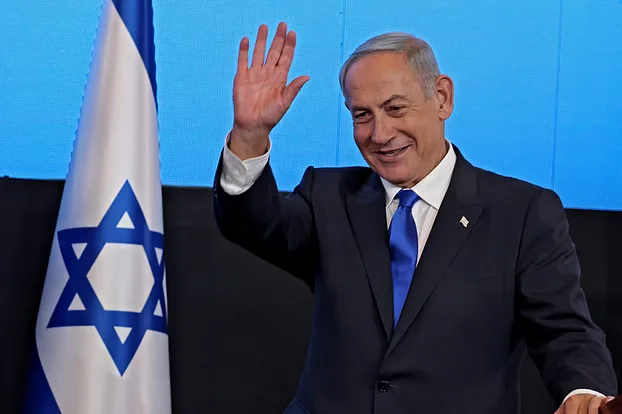
In this file photo taken on 1 November, 2022 Israel’s ex-premier and leader of the Likud party Benjamin Netanyahu addresses supporters at campaign headquarters in Jerusalem early after the end of voting for national elections AFP

A deeply divided Israel heads to the polls on Tuesday for the first time since Hamas’s 7 October, 2023 attack, with voters delivering their verdict on veteran Prime Minister Benjamin Netanyahu and the country’s rightward drift.

Israelis are casting their ballots in the shadow of three years of multi-front regional wars triggered by 7 October, with the trauma still fresh and questions over accountability and security central to the campaign.

The close-fought vote comes as Israel looks increasingly isolated on the world stage, driven by a devastating military campaign in Gaza, soaring settlement construction and violence in the occupied West Bank, and a move towards hard-right religious nationalism.

The last polls to be published showed Netanyahu, Israel’s longest-serving prime minister, running neck and neck with his main centrist rival Gadi Eisenkot, a political novice and former military chief whose mild manner is seen as the antithesis of the incumbent.

Some 7.3 million people are eligible to vote, with more than half a million young people due to cast their ballot for the first time. Surveys show they overwhelmingly identify as centre-right or right-wing.

Tens of thousands of Israelis are estimated to have flown in from abroad to vote in an election seen as crucial to deciding the future character of their country.

“I think this is one of the most important election days in the history of the state of Israel,” Uriel Brandler, a 58-year-old real estate agent, told AFP in Jerusalem the day before the vote.

“The country definitely needs a change for the better in every aspect.”

Netanyahu, 77, has served as Israel’s prime minister on and off for more than 19 years.

The wily political operator focused heavily on his security credentials during his campaign, playing on his relationship with US President Donald Trump and insisting he is the only one who can keep Israelis safe.

In the years since 7 October, Netanyahu led multiple wars that have seen Israeli forces reduce Gaza to rubble, occupy southern Lebanon and for the first time pummel arch-foe Iran with US help.

At home, Israelis have faced bombardment from Iran, Hamas, Lebanese militant group Hezbollah, and Yemen’s Houthi rebels.

‘Not afraid to take action’

Zipporah Bennett, an 85-year-old retiree, said she was voting for Netanyahu “because he has had the experience of navigating the country through a lot of difficult seasons”.

“He has the full support of the American government,” she said, “and I believe he’s a man who’s not afraid to take action.”

Netanyahu returned to power in December 2022, bringing into his coalition far-right ultra-nationalists who have since seen their political clout skyrocket.

The opposition has scorned the premier for his backing of ultra-Orthodox parties fighting to keep exemptions for religious Jewish students from drafting into the military, which faces personnel shortages.

But one of the biggest criticisms levelled at Netanyahu is his failure to take responsibility for the 7 October attack, the deadliest day in the country’s history.

Eisenkot, 66, has pledged to establish an independent state commission of inquiry into the security failures that led to the attack, something Netanyahu’s government has resisted.

Seeking to unseat the premier is an informal bloc of parties led by Eisenkot’s Yashar and spanning from the right to the centre-left.

Eisenkot has vowed to prevent the creation of a Palestinian state and expressed support for Israeli settlements, but has promised to crack down on violent settlers.

Neither Eisenkot nor Netanyahu have publicly said they would partner with the predominantly Arab lists, which represent some 21 percent of Israel’s population and who could become kingmakers if the results are as close as expected.

Most polling stations will close at 10:00 pm (2000 GMT).

Final results could take days to trickle in and it is highly unlikely that any single party will come close to the 61 seats needed for a majority in the 120-member parliament.

Cobbling together any coalition could take weeks or months, with possible new elections on the horizon if negotiations fail.​
 

Israeli exit polls show deadlock in apparent setback for Netanyahu

Two exit polls give Eisenkot edge, third has blocs tied


1793146183726.webp

Israel's Prime Minister Benjamin Netanyahu and his wife Sara prepare to vote at a polling station in Jerusalem on October 27, 2026, on the day of Israel's legislative election. Photo: YONATAN SINDEL/Pool via REUTERS

Israel's wartime election was deadlocked on Tuesday, exit polls showed, with two major television networks giving Gadi Eisenkot's opposition bloc a narrow lead over Prime Minister Benjamin Netanyahu's camp and a third showing them tied, leaving neither side with a clear path to power.

If the projections hold, the result would mark a major setback for Netanyahu's coalition, which entered the election with 68 seats, though the deadlock could allow Israel's longest-serving prime minister to remain in power as caretaker during coalition negotiations.

Turnout was 77.7%, Israel's Central Elections Committee said, the highest in more than two decades and around 7 percentage points higher than in 2022.

Two of Israel's three major television networks gave Eisenkot's bloc a narrow edge over Netanyahu's Likud-led camp in updated exit polls, while Channel 13 put the two blocs level at 51 seats each.

None of the projections gave either camp the 61 seats needed for a majority in the 120-seat Knesset. Far-right religious parties led by Itamar Ben-Gvir and Bezalel Smotrich were projected to take a combined 13 seats within Netanyahu's bloc.

Arab parties outside the two main blocs could hold the balance of power. But Eisenkot, leader of the Yashar party and a former military chief, has all but ruled out forming a government with them, complicating his path to power even in projections where his bloc finishes ahead.

Final results could take days, and Israel's fragmented political system leaves smaller parties potential kingmakers. No single party has ever won 61 seats outright in the 120-seat Knesset, making coalitions the norm.

It was the first election since the Hamas-led attacks of October 7, 2023, and the ensuing wars in Gaza, Lebanon and Iran.

Yohanan Plesner, president of the Israel Democracy Institute, called the exit polls a major defeat for Netanyahu's coalition, which was projected far below its 68 seats in the outgoing Knesset, while cautioning that Eisenkot had not emerged as a clear winner and much could change as votes were counted.

NETANYAHU SETBACK, NO CLEAR WINNER

Opposition leader Yair Lapid said in a statement: “Don’t let anyone confuse you: the Netanyahu bloc has suffered a crushing defeat. This is a total collapse and the public has told them to go home.”

Eisenkot, 66, who lost a son and two nephews in the Gaza war, emerged as Netanyahu's strongest challenger, stressing his security credentials while positioning himself as a centrist domestically.

He entered politics only four years ago and joined Netanyahu's war cabinet after the 2023 Hamas attack, but quit eight months later, criticising the prime minister's leadership.

Eisenkot offers a break with Netanyahu's leadership and far-right allies, but not with the hardline approach to security that has become more entrenched since the 2023 Hamas attack. He opposes Palestinian statehood and says Hamas' military wing must be destroyed or dismantled.

Eisenkot says Israel's response — a war that has killed more than 74,000 Palestinians, according to Gaza health authorities — was a failure because Hamas remains in charge.

"Dear Democrats, a decision was made," Yair Golan, leader of the Democrats party and a Netanyahu rival, said at a party rally after polls closed. "The nation has given us a sacred duty: to translate the trust they have placed in us into action, to fortify democracy, to save Israel and to provide true defense for the state."

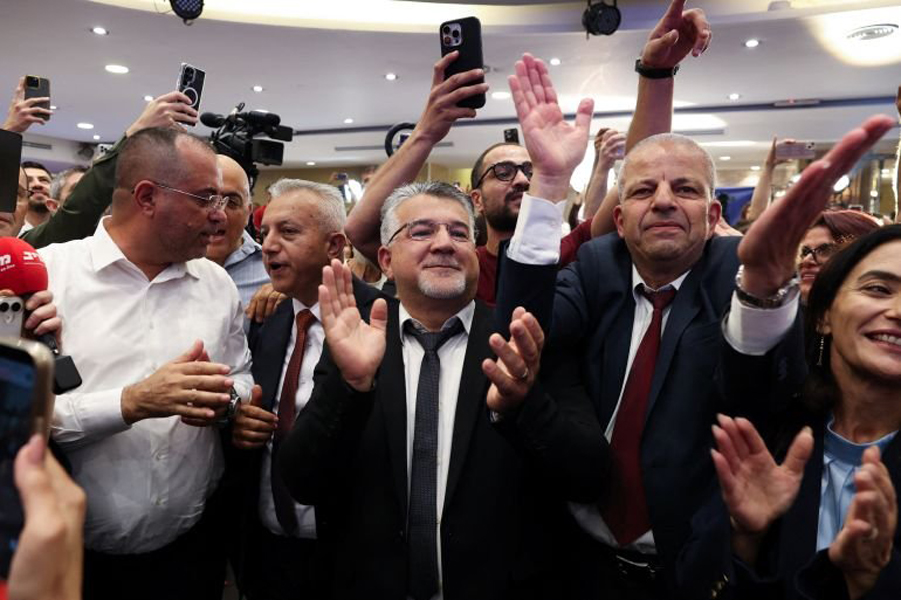
The headquarters of the Joint List, an alliance of several Arab parties, burst into whistles and applause when exit polls were released, on a historic night for turnout among Palestinian citizens of Israel.

“We refuse the occupation and racism, and we will remain here,” said Faten Gattas, a candidate in the Joint List, in a speech at the alliance’s headquarters in Nazareth. Candidates hoped that high Arab voter participation would allow them to play a decisive role in preventing Netanyahu’s coalition – the most far-right in Israel's history – from returning to power.

A WARTIME VERDICT

Voters grappled with the trauma of Israel's deadliest day, when Hamas killed 1,200 people and took 251 hostages, and the wars in Gaza and with Lebanon's Hezbollah and Iran that followed.

While Netanyahu was criticised for the country's biggest security failure, he argued that he had made Israel and the world safer by assassinating top leaders of Hamas, Hezbollah and Iran.

The policies of Netanyahu's right-wing coalition have been divisive at home and deepened Israel's international isolation, but he has portrayed himself as the leader with the mettle to face down Israel's foes.

Netanyahu, 77, has served as prime minister for nearly 19 of the past 30 years and has repeatedly survived political crises. His opponents have managed to wrest the premiership from him only once since 2009, after four inconclusive elections in two years. Eighteen months later, he was back.

He entered the election facing longstanding corruption charges, which he denies, and criticism over intelligence failures that allowed Hamas-led militants to carry out their attack.

Netanyahu campaigned on an endorsement from US President Donald Trump, his ally in the war against Iran.​
 

Arab parties on track to win record seats in Israel election, polls show


1793232660787.webp


Israel’s Arab parties are projected to win 19 seats in the Israeli parliament, exit polls indicate, after voting among Palestinian citizens of Israel surged to their highest levels in decades.

Exit polling data from Tuesday’s vote suggested that the leading Arab-led parties, the Joint List and Ra’am, could hold a record combined 19 seats in the 120-member Knesset.

With more than one-third of votes counted, the Joint List was winning over 9 per cent of votes. The opposition bloc led by former Israeli military chief of staff Gadi Eisenkot’s Yashar party was trailing the coalition led by Prime Minister Benjamin Netanyahu’s Likud party, though the votes were preliminary.

Polls estimated voter turnout among Palestinian citizens of Israel at around 80 per cent, historic numbers that break 1999 records, Israel’s Channel 12 reported on Tuesday.

The leader of Ra’am, or the United Arab List, Mansour Abbas, said he hopes the final election results will allow the anti-Netanyahu bloc, including his party, to win the 61 seats required to form a government.

“With the numbers we have now, there is no government,” Abbas told Israel’s Channel 12 before preliminary votes began trickling in.

Abbas, whose Ra’am party currently holds five seats in the Knesset and joined the coalition that governed Israel from 2021 to 2022, added that both main blocs reached out to his party before and after the election.​
 

Netanyahu and rival each claim mandate after tight Israel election

AFP

1793233328579.webp

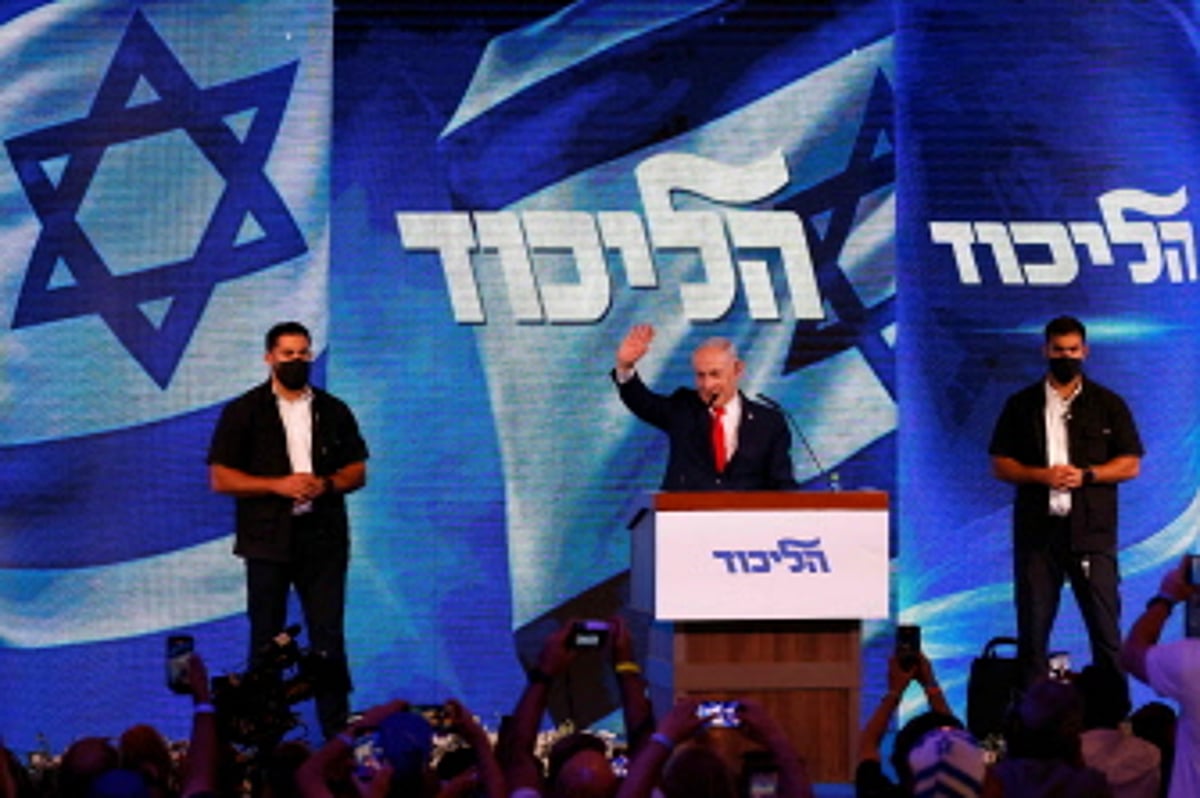
Israel's Prime Minister Benjamin Netanyahu waves to his supporters at the election night rally after the first exit polls were announced, in Jerusalem on early 28 October 2026, during Israel's legislative elections. Netanyahu vowed early on the following day to form a new government after a close election, saying no leader should rule through the backing of Israeli Arabs, whose parties posted strong gains. AFP

Israeli Prime Minister Benjamin Netanyahu and rival Gadi Eisenkot each vowed on Wednesday (28 October) to form a government after both came up short in the first election since the 7 October, 2023 attack.

Voters turned out Tuesday in the highest numbers in decades to give their verdict on the divisive rule of Netanyahu, Israel's longest-serving prime minister who has pushed the country sharply to the right and unleashed a wave of wars in response to the Hamas attack.

Exit polls showed Eisenkot, a former military chief and political novice, and his opposition bloc neck and neck with Netanyahu's hard-right camp and both well away from the threshold for a majority in parliament.

The strongest gains came from Arab Israeli parties whose voters turned out in soaring numbers against Netanyahu, who has relentlessly warned that the minority would dilute the Jewish nationalist direction in which he has taken Israel.


1793233362527.webp

Yashar party leader Gadi Eisenkot (C) arrives to address his supporters at the election night rally after the first exit polls were announced, in Tel Aviv on early 28 October 2026, during Israel's legislative elections. AFP

Netanyahu, greeting cheering supporters at a Jerusalem convention centre after 3:00 am (0100 GMT), called for a "strong government of the right" and said that the "Jewish and Zionist majority must unite".

The 77-year-old prime minister was unusually brief and did not directly claim victory.

Instead, he listed leaders Israel has killed under his orders and again hinted that he was ready for a third bombing campaign against Iran alongside US President Donald Trump, his close ally.

"Israel has a unique opportunity with our partner President Trump to forever eliminate the existential threat of Iran," Netanyahu said.

Eisenkot, speaking to his own supporters in Tel Aviv, issued a veiled warning to Netanyahu, who observers say could use a war to push for a unity government.

"Netanyahu, don't you dare use Israel's security for your political needs," Eisenkot said.

Addressing Israel's security establishment, Eisenkot said that they served the state and not Netanyahu, calling him "a caretaker prime minister, without a mandate or the people's trust".

1793233402151.webp

Supporters of Likud party leader and Israel's Prime Minister Benjamin Netanyahu celebrate at the International Convention Centre in Jerusalem early on 28 October 2026. AFP

'Public has voted for change'

Eisenkot shares many of Netanyahu's views on security and has backed the Gaza offensive following 7 October that has reduced the territory to rubble.

But Eisenkot has vowed to create a more inclusive atmosphere inside Israel and to rein in extremist settlers in the West Bank who have attacked Palestinians with virtual impunity.

After turnout of nearly 78 per cent, the highest since 1999, Eisenkot said it would be a mistake to hold a second election and vowed to work "swiftly" to form a government.

"The public has voted for change," Eisenkot said. "A worthy leader would accept the people's vote of no confidence and announce his retirement from political life today."

The three mainstream Israeli television networks in exit polls gave the two blocs each around 51 seats -- well below the 61 needed to govern -- after initially giving an edge to the opposition.

Israeli Arab lists were projected to win 17 to 18 seats, a sharp gain, with some Israeli Arab communities reporting near-universal turnout driven by outrage to often derogatory rhetoric against them by Netanyahu's far-right allies.

Key Israeli Arab leader Mansour Abbas said he believed the right had "suffered a major loss" and was open to working with Eisenkot.

But Eisenkot said during the campaign he would not govern with Israeli Arab lawmakers -- and Netanyahu again suggested that a government relying on Arab votes would lack legitimacy.

Arab lawmakers could give Eisenkot support in parliamentary votes to maintain a minority government without joining a coalition. If not, Israel could head to new elections.

Itamar Ben Gvir, a far-right firebrand who according to exit polls did not gain as much as many expected, warned Netanyahu against another option -- a unity government with Eisenkot.

"It would be a terrible mistake," said Ben Gvir, who champions the expulsion of Palestinians and would likely be excluded from any unity government.

Hebrew University of Jerusalem political scientist Gideon Rahat said Ben Gvir had succeeded in mobilising votes -- of Israeli Arabs.

But he said: "Even if Netanyahu lost, that doesn't mean Eisenkot won."

1793233466780.webp

Israel's Prime Minister Benjamin Netanyahu addresses his supporters at the election night rally after the first exit polls were announced, in Jerusalem on early 28 October 2026, during Israel's legislative elections AFP

Divisive

The election came as Israel looks increasingly isolated on the world stage, driven by the war in Iran and the military campaign in Gaza, soaring settlement construction and violence in the occupied West Bank.

Netanyahu himself faces an arrest warrant from the International Criminal Court over Gaza as well as domestic corruption charges that could land him in prison if he loses power.

Eisenkot is a political novice whose mild manner is the antithesis of the smooth-talking incumbent.

The son of working-class Moroccan Jewish immigrants, Eisenkot would be the first prime minister of Middle Eastern or North African descent.

Before voting, the 66-year-old Eisenkot paid his respects privately at the grave of his son Gal, whose death fighting in Gaza has drawn empathy from many Israelis.

Tens of thousands of Israelis are estimated to have flown in from abroad for an election seen as crucial for their country.

Eilana Zisblit, 55, told AFP she had travelled back from Canada, where she has lived for almost 30 years, to vote for a centre-right party in Eisenkot's bloc.

"The country is going in a really, really bad direction. Both for Jews and Arabs living in the country, and for Jews living abroad," she said.

The time to act is "now, or the country really won't survive anymore".​
 

Arab parties could play kingmaking role in forming new Israel govt

President urges against new vote despite inconclusive result

Agence France-Presse . Jerusalem

Israel’s president voiced hope Wednesday for avoiding a second election after a hard-fought vote produced no clear winner, leaving Prime Minister Benjamin Netanyahu and the opposition scrambling for options and making Israeli Arab parties possible kingmakers.

With more than 85 per cent of ballots counted, Netanyahu’s right-wing bloc was slightly ahead but still short of a majority in Tuesday’s election, the first since the October 7, 2023 attack that led Israel to wage war in Gaza and across the region.

Both Netanyahu, Israel’s longest-serving prime minister who is allied with far-right and ultra-Orthodox Jewish parties, and Gadi Eisenkot, a former military chief leading a broad opposition bloc, said they would seek to form the next government.

But neither looks set to reach the 61-seat threshold, with Netanyahu’s bloc projected to win 53 of the 120 seats in parliament and Eisenkot’s opposition set for 48.

The final results could still change, but one place of clear gains was among Israeli Arab lists, which were set to jump to 19 seats.

‘We must do everything we can, certainly after yesterday, to avoid another round of elections,’ said President Isaac Herzog, who is tasked with determining which candidate to tap to form a government, and who urged parties to keep ‘an open mind’.

Yousef Jabareen, head of the leftist Arab-majority Joint List, said the Israeli public had voted for new leadership and ‘anyone who wants to offer a substantive and genuine alternative to Netanyahu’s blood-soaked government will have to talk to us’.

‘It’s either the continuation of racism, the continuation of exclusion and the continuation of supremacy, or a genuine Jewish-Arab partnership,’ he said.

Voters from the Arab community, descendants of Palestinians who stayed after Israel’s creation and make up around 20 per cent of the population, have been enraged by the Netanyahu government’s ultra-nationalist Jewish vision for the country and the Palestinian territories.

Eisenkot has resisted allying with Arab parties.

Netanyahu during the campaign relentlessly attacked the opposition by saying it would put Arabs in power, running on the slogan: ‘Either the Right or Palestine.’

Yair Golan, the head of Israel’s main left-wing party and a member of Eisenkot’s camp, became its first to call for an alliance with the Arab lists.

‘We must no longer accept Netanyahu’s racist division between Jewish votes and Arab votes,’ Golan said in a social media post.

But Eisenkot’s camp also includes right-wingers who share many of Netanyahu’s hawkish views and have adamantly rejected working with Arab lawmakers.

Arab lawmakers could also give Eisenkot support in parliamentary votes on an ad hoc basis, enabling him to maintain a minority government without joining a coalition, although few observers believe such an arrangement would survive for long.

A lack of a clear majority for either camp could mean weeks spent trying to cobble together coalitions, with new elections a possibility if negotiations fail.

‘Maybe everybody lost in these elections but the Arab parties. And for the Arab parties, it’s unclear that they can make use of their huge success,’ Hebrew University of Jerusalem political scientist Gideon Rahat said.

A stalemate could in the immediate term benefit Netanyahu, who would remain caretaker prime minister until a new government is formed.

Both Netanyahu and Eisenkot appeared to indicate another factor was on the horizon — a Israeli attack alongside the United States on Iran.

Netanyahu ordered bombing campaigns against Iran both last year and earlier this year, reluctantly stopping only after President Donald Trump reached a now-moribund ceasefire.

In the days leading up to the election, Netanyahu repeatedly called for the overthrow of Iran’s government. News reports, which Netanyahu denied, said military top brass pushed back on his plans for pre-election action.

Trump has said that the United States is no longer negotiating with Iran but will not attack until after next Tuesday’s US midterm elections.

Speaking at a rally, Netanyahu said that Israel had a ‘unique opportunity’ with Trump to ‘forever eliminate the existential threat of Iran’.

Eisenkot in a post-election appearance warned Israel’s security chiefs that they must serve the national interest and not the political needs of Netanyahu, whom he called a caretaker premier ‘without a mandate’.

‘Netanyahu, don’t you dare use Israel’s security for your political needs,’ Eisenkot said.

All eyes will be on Herzog, who has reportedly supported a unity government, which could take on more urgency if Netanyahu attacks Iran, although Eisenkot has publicly ruled out serving with him.

Netanyahu, who has served as prime minister on and off for more than 19 years, has divided Israeli society.

Facing criminal charges over corruption that he denies, he has sought to revamp the judiciary.

He has also allied with far-right champions of extremist settlers who attack Palestinians in the West Bank with virtual impunity.

Netanyahu is also wanted by the International Criminal Court over Israel’s devastating war in Gaza, where residents expressed uncertainty Wednesday as to what the vote might mean for them.

‘Our fear is that these elections might result in the emergence of an even worse leader and those who are more violent and bloodthirsty,’ displaced Gazan Huda al-Houli said.​
 
Back
Top